Tag: censorship

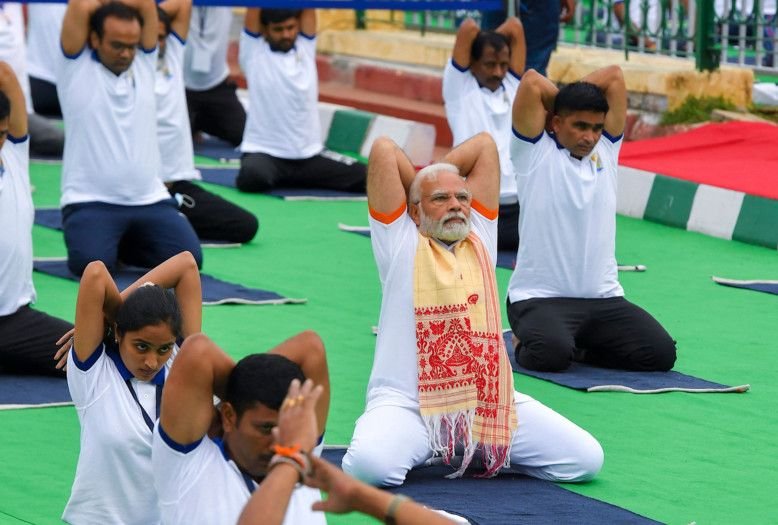
  • Modi to celebrate International Yoga Day on UN’s Lawn during U.S. visit

    Modi to celebrate International Yoga Day on UN’s Lawn during U.S. visit

    In celebration of the ninth annual observance of International Day of Yoga, Indian prime minister Narendra Modi will be leading a yoga session on the north lawn of the UN headquarters in New York on Wednesday morning.

    Modi, a practicing Hindu, often presents himself as devoutly religious. Considering yoga has its origins in ancient Hindu religious practices, the exercise seems a fitting ode to both his faith and culture.

    But there are other, more important concerns surrounding his crucial visit to Washington.

    Congresswoman boycotts speech

    Earlier today, United States’ Congresswoman Ilhan Omar published a tweet ahead of Indian prime minister Narendra Modi’s speech to Congress. She stated she will not be attending the address, holding a briefing with human rights groups instead to discuss ‘Modi’s record of repression and violence.’ 

    She accused his government of repression of religious minorities, emboldening Hindu nationalist groups, and targeting journalists/human rights advocates ‘with impunity’.

    At the beginning of June, top lawmakers in the U.S. had invited Modi to address Congress on the 22nd of June, during his visit to Washington, DC. Addressing Congress is a rare opportunity that is granted only to the country’s closest allies.

    Biden asked to raise concerns

    A letter was sent to U.S. President Joe Biden on the eve of Modi’s visit to Washington, asking him to raise concerns around democratic norms and human rights in India with its prime minister. 

    A total of 75 American Senators and Representatives have signed the letter. The U.S. lawmakers that drafted it said they were concerned about religious intolerance, press freedoms, internet access and the targeting of civil society groups. 

    They cited “a series of independent, credible reports” reflecting “troubling signs” in India, as reported by Reuters

    “We do not endorse any particular Indian leader or political party — that is the decision of the people of India — but we do stand in support of the important principles that should be a core part of American foreign policy,” said the letter.

    A strategic ceremony

    According to BBC, the discussions between the two states not only have potential to infuse new energy into India-U.S. relations, but also have an impact on the global order.

    As China’s influence continues to grow in the Indo-Pacific, the U.S. needs India’s influence more than ever, viewing it as a counterbalance to China’s. While India is reluctant to claim this tag, China is one of the main catalysts driving India-U.S. relations.

    Human rights advocates worry that geopolitics might overshadow humanitarian issues. U.S. rights groups have planned protests against Modi’s state visit to Washington, citing India’s deteriorating human rights record, as reported by Reuters.

  • Video: Former Twitter CEO says Modi Govt threatened to shut down platform in India

    Video: Former Twitter CEO says Modi Govt threatened to shut down platform in India

    Twitter’s co-founder and former boss Jack Dorsey in an interview with YouTube channel Breaking Points talked about censorship requests he received from the Indian government led by Prime Minister Narendra Modi.

    Jack said that Twitter received “many requests” from the Indian government to block accounts covering farmers’ protests. The former CEO of Twitter further said that the platform also received multiple requests to block those accounts that were critical of the government.
    He has also said that the Indian government threatened to shut down Twitter in the country.

    “India is a country that had many requests of us around the farmers protest, around particular journalists that were critical of the government, and it manifested in ways such as ‘we will shut Twitter down in India,’ which is a very large market for us; ‘we will raid the homes of your employees,’ which they did; ‘we will shut down your offices, if you don’t follow suit,’ and this is India, a democratic country,’” Dorsey said.

    Dorsey said that Turkey also has similar requests like India. He noted that Twitter, which frequently engaged in legal battles with the government and prevailed, was also threatened with closure by the Turkish government.

  • Delhi University to remove chapter about Alama Iqbal from political science textbooks

    A chapter about Allama Iqbal in a book recommended for Political Science syllabus has been removed by Delhi University, after a discussion at the Academic Council meeting.

    According to Indian news organization ANI, the Vice Chancellor, Yogesh Singh, said that those who laid the foundation to break India should not be taught to students:

    “Iqbal wrote songs supporting the ‘Muslim League’ and the ‘Pakistan Movement’. Iqbal was the first to raise the idea of the partition of India and the establishment of Pakistan and said that instead of teaching about such people, we should study our national heroes.”

    The right-wing student movement Akhil Bharatiya Vidyarthi Parishad has welcomed the motion, saying Iqbal was a ‘fanatic theological scholar’ who was responsible for the partition of India.

    “Delhi University academic council decided to scrap fanatic theological scholar Mohd Iqbal from DU’s political science syllabus. It was previously included in BA’s sixth-semester paper titled ‘Modern Indian political thought. Mohammad Iqbal is called the ‘philosophical father of Pakistan’. He was the key player in establishing Jinnah as a leader in Muslim League. Mohammad Iqbal is as responsible for India’s partition as Mohammad Ali Jinnah is.”

  • Bella Hadid wants your support finding the right organisations to help flood victims in Pakistan

    Bella Hadid wants your support finding the right organisations to help flood victims in Pakistan

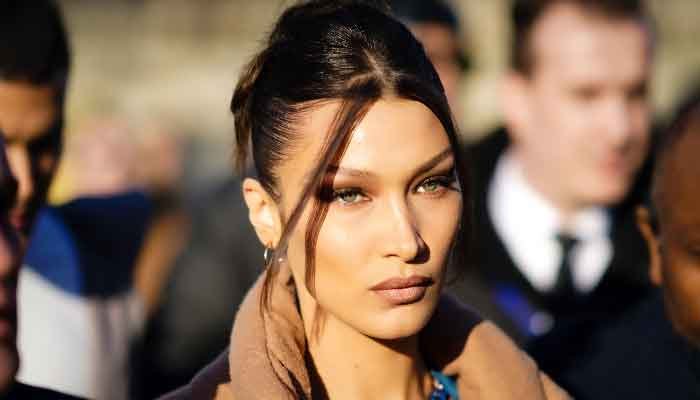
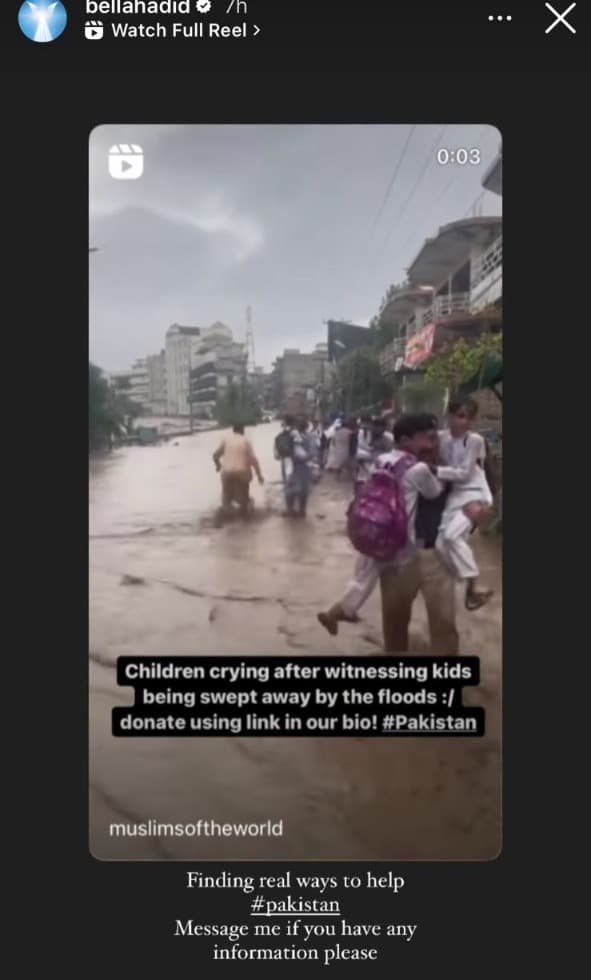
    Supermodel Bella Hadid has requested her followers to guide her on ways to help the flood victims in Pakistan.

    Sharing a video on her Instagram stories, she wrote , “Finding real ways to help Pakistan.” 

    Floods triggered by incessant rains have killed more than 1000 people including 300 hundred children.

    The catastrophic flooding has rendered millions of people homeless during the last few days.

    Earlier this year, Bella claimed she was “shadow banned” by Instagram for posting about Palestine after Israeli authorities attacked worshippers at al-Aqsa Mosque on Friday.

    “If you really would like to silence me , just like the journalists, or really anyone trying to educate about Palestine, @instagram, I will continue to come forward with peace , showing factual information about how the IDF, Israeli government, and Settlers attack innocent Palestinians for no reason , except for simply being Palestinian. This is all a breach of human rights, and if you continue to sensor us, is the biggest form of bias and Unjust censorship.”

    “But I will not continue to sit here and have my peoples name be slandered as if they are constantly doing something wrong to deserve this kind of abuse. Absolutely UNPROVOKED abuse. In their home , and on their land, that they have lived in for hundreds of years. Especially now, during the holy month of Ramadan. This is unprovoked,” added Bella.

    Bella is an ardent advocate of women’s rights as well. In February, she had called out India for the discrimination faced by Muslim women for wearing hijab.

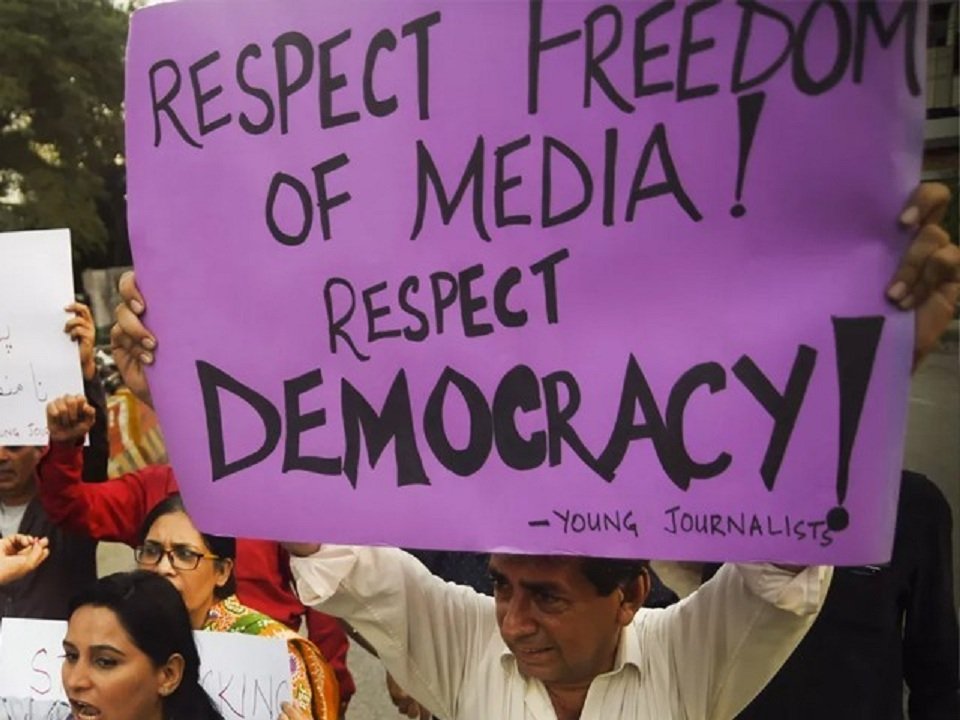
  • Politicians, civil society unite with journalists, support protest against media authority bill

    Politicians, civil society unite with journalists, support protest against media authority bill

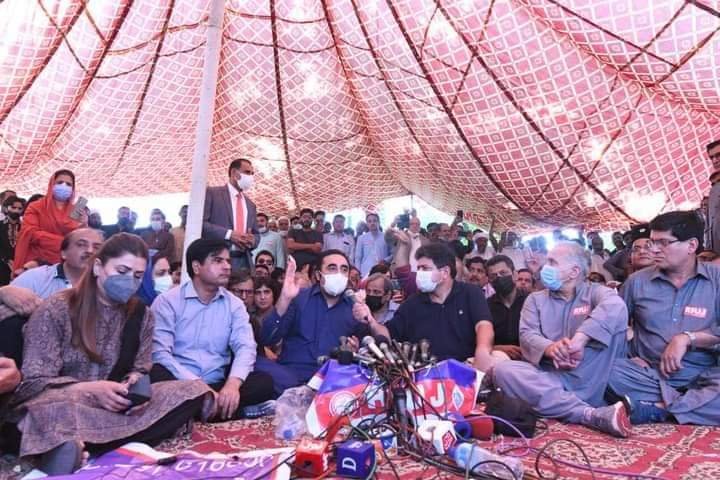
    As journalists continue with sit-in outside of the Parliament House, against the government’s proposed Pakistan Media Development Authority (PMDA), prominent leaders from political parties, student unions, and members of the civil society also joined in to show solidarity.

    The protest began on Sunday and is said to continue until President Dr Arif Alvi’s address to the joint session of parliament on Monday.

    Former Prime Minister Shahid Khaqan Abbasi, Pakistan Muslim League-Nawaz (PML-N) Information Sec­retary Marriyum Aurangzeb, and MNA Mohsin Dawar, among others, visited the protest site on Sunday night to extend their support.

    Pakistan Muslim League-Nawaz (PML-N) president, Shehbaz Sharif speaking on the media authority bill termed it as “black law” and expressed solidarity with journalists. He said the media had fought a war for its freedom and no one could snatch it. 

    https://twitter.com/pmln_org/status/1437373043542736902

    “The government doesn’t have the guts to pass it and we won’t allow it,” added Shehbaz warning the government against passing the “black law” or bear the consequences.

    He tweeted in solidarity with the protestors and said, “PTI government is demolishing every institution that represents democracy. We support journalists in their struggle against PMDA.”

    Pakistan People’s Party (PPP) Chairman Bilawal Bhutto Zardari Monday slammed the Pakistan Media Regulatory Authority (PMDA), saying that the proposed bill is an “attack on the freedom of media and judiciary.”

    The PPP chairman vowed his party will not let the government get away with snatching livelihoods from the masses. He showed solidarity with journalists who have been attacked, saying that the PPP “will not be satisfied till they [journalists] are not satisfied.”

    “Even if they manage to have this black law passed, journalists will [struggle to] have it abolished,” he added.

    Bilawal warned the government that if it tried to have the PMDA law passed via force, the PPP will challenge it in the courts. The PPP chairman said he feared the government will try to pass the bill during a joint sitting of the Parliament.

    Bilawal said his party will attend the joint sitting of the Parliament with a two-point agenda; to advocate for the rights of 20,000 government employees who were sacked and to campaign for freedom of speech.

    PPP leaders, Senator Sherry Rehman and Raza Rabbani, visited the protest camp and addressed the protesters.

    “We have repealed all the ordinance regarding media censorship, whether it was Ayub Khan or Zia-Ul-Haq. This is why the government won’t bring this on the Parliament floor because we will repeal the PMDA bill and they are scared”

    Marriyum Aurangzeb, along with PML-N leader Ahsan Iqbal, also visited the protest site on Monday.

    Addressing the protesters, Iqbal criticised the Pakistan Tehreek-e-Insaf (PTI) government for “attacking and attempting to muzzle” the media.

    Referring to the PMDA bill, he called it a “conspiracy” and said if the bill was passed, “democracy will die in this country”.

  • ‘The gun is already placed on their head’: Hamid Mir on being  banned by Geo

    ‘The gun is already placed on their head’: Hamid Mir on being banned by Geo

    In an interview with Stephen Sackur on BBC HARDtalk, senior journalist Hamid Mir talked about why he was banned on Geo News, press freedom, censorship under Prime Minister Imran Khan, attacks on journalists, and how he is worried for his own safety in Pakistan.

    Disappointment on being off-air

    Stephen Sackur questioned Hamid Mir as to how disappointed he was with his employers [Geo News] and the Jang group who did not stand by him. Sackur also questioned how Mir felt that he had lost his voice and platform as a journalist because he was suspended from his channel.

    Mir said he was certainly disappointed but did understand the circumstances under which the decision was taken place.

    “Mir Shakil ur Rehman was arrested last year and he remained in the detention of the National Accountability Bureau (NAB) for more than seven months for a three-decade-old case, which was not a very big case. And I think that he was arrested, he was detained, just because of the freedom he was trying to give us. He got bail from the Supreme Court but his name was placed on the Exit Control List. He cannot leave Pakistan. He is already being held at gunpoint. So, my employers, the gun is already at their head. So when they were asked to ban Hamid Mir, they banned me. So I can understand their problem,” replied Mir.

    Imran Khan is a helpless Prime Minister

    The BBC host asked Mir that in the past he had a friendly relationship with PM Imran Khan so did he ever think that PM Imran personally wanted to see him taken off-air.

    Hamid replied, “It’s a very difficult question for me to respond [to], but I will try to very honestly. Imran Khan stood by me in 2007 when I was banned by General Pervez Musharraf, and yes at that time he was the biggest supporter of media freedom in Pakistan. Yes, I provided him a lot of space on my TV shows because he was in the Opposition, and you can say that I was friendly with him when he was in the Opposition. But when he became PM, I started raising questions. I even met him personally, and I asked him that your government should provide more space to the media because you are the biggest beneficiary of media freedom.”

    “One of my interviews with the former president, Asif Ali Zardari, was banned on my show, on my TV channel and some other Opposition leaders were also banned on different TV channels. So we started criticising Imran Khan and so I think he was not happy with my criticism.

    “The second part of your question is very important. I think that Imran Khan is not directly responsible for imposing a ban on me. And I don’t think he wants me to be off-air. But like past prime ministers, he is not a very powerful prime minister and I think he is helpless and he can’t help me,” said Mir.

    Concerned about my personal security

    Sackur questioned Mir if he feared the toxic environment in Pakistan and how concerned was he about his personal safety in the country after two assassination attempts on him. Mir answered, “Yes, I am very concerned about my personal security for a long time. I asked my family to leave Pakistan and my family left, my daughter and wife have already left. I was also approached by some people who suggested I leave Pakistan. But I decided not to leave.”

    Ready to face imprisonment

    The HARDtalk host asked Hamid Mir if he was ready to face imprisonment for the accusations against him, to which Mir responded, ” Yes, and I am ready to face life imprisonment because if they will be able to convict me at least the whole world will come to know what is going on in Pakistan. The whole world is already aware of what is going on in Pakistan because I am a living example of censorship in Pakistan. Everybody knows what happened to Hamid Mir and why he is banned and everybody knows the names of the people which I have not mentioned, everybody knows who was responsible for imposing a ban on me.”

    “The common Pakistanis are very wise, they are very clever. They know each and everything about what’s going on. But you see, there is no rule of law in Pakistan. And we only want justice, we want that the rule of law should be established in Pakistan. And if a journalist is asking questions, don’t try to silence his voice,” added Mir.

    State of media freedom in Pakistan

    Stephen Sackur questioned Mir whether there was a climate of fear in Pakistan when it comes to journalists or journalism.

    “Yes, definitely, there is a climate of fear in Pakistan. A lot of young journalists, they are very disappointed and look at the state of media freedom in Pakistan. When Mr Imran Khan became prime minister in 2018 Pakistan was ranked at 139 on the World Press Freedom Index. Today, in 2021, when I am talking to you, it is 145. So Pakistan lost six points in the last three years,” said Mir.

    He further added, “According to the International Federation of Journalists, Pakistan is one of the five most dangerous countries for journalists in the whole world. This is not good for Pakistan, for its reputation and credibility in the international community. And yes, there is a climate of fear in Pakistan because Pakistani journalists think journalism is becoming very difficult in this country and this government of Imran Khan [is] now planning some more anti-media laws which is not acceptable to us.”

    Rule of law only solution in Pakistan

    Commenting on the grave danger to democracy in Pakistan, Hamid Mir said, “I think that the rule of law is the solution to all of our problems. That’s why we want a general democracy in Pakistan because the founder of Pakistan, Muhammad Ali Jinnah was a democrat and I am a follower of his.”

    “And all those people who are trying to snatch media freedom from us are enemies of Pakistan and are enemies of Muhammad Ali Jinnah,” said Mir.

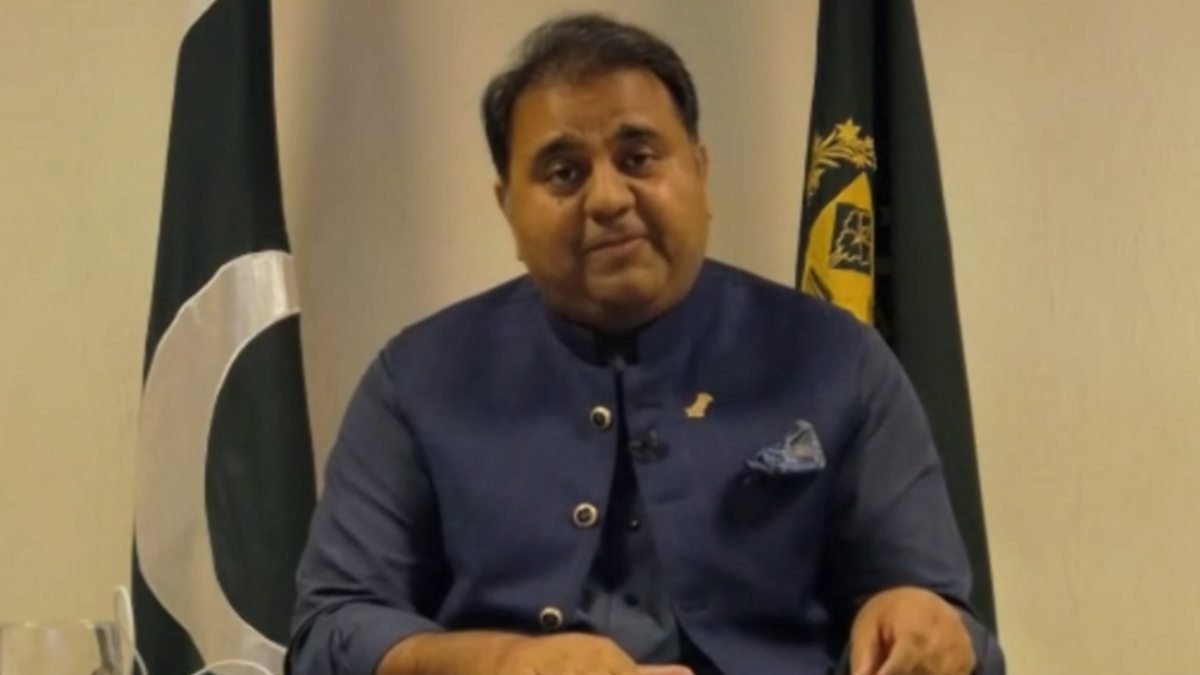
  • ‘No one can dare undermine me,’ Fawad Chaudhry burns BBC HARDTalk

    ‘No one can dare undermine me,’ Fawad Chaudhry burns BBC HARDTalk

    Federal Minister for Information and Broadcasting Fawad Chaudhry talked on the protection of journalists, the involvement of the establishment within the state, the economy of Pakistan, missing persons, popularity of Prime Minister Imran Khan, Covid stituation and many other issues in an interview given to BBC host Stephen John Sackur on BBC HARDtalk.

    Journalists Protection

    The host opened the interview by asking what is the government and Fawad Chaudhry being the Information Minister doing to protect the journalists of the country. Sackur mentioned the recent attack on journalist Asad Ali Toor, who was severely beaten up by unidentified assailants in his apartment. Sackur further mentioned how a senior journalist and former Chairman of Pakistan Electronic Media Authority (Pemra), Absar Alam, was shot in Islamabad. To which Fawad Chaudhry replied, “Individual incidents do happen. The situation is not only dangerous for journalists but it has been for all the citizens of Pakistan. We have faced the worst terrorism. When we were fighting our war against terrorism, we lost a lot of field journalists and many civilians.”

    “Benazir Bhutto too got killed due to terrorism. We have been dealing with tough times,” replied Fawad.

    Stephen Sackur asked what the state was doing about the involvement of state agencies in such incidents.

    “It’s a bit fashionable for the western media to accuse ISI (Inter-Services Intelligence)
    when such incidents happen. When you name any organisation or Pakistani intelligence agency, you are bound to produce evidence of their involvement as well,” replied the minister. “The two specific incidents which you have mentioned, the investigation is still under process, I still don’t know under what pretext have you concluded that the state must be involved in any of this.”

    Direct State Interference

    BBC host asked Chaudhry about freedom of speech in Pakistan. He said that media censorship has increased during Imran Khan’s tenure. Chaudhry replied, “We have about 112 private channels, 43 international channels, with this kind of mass media we have, how do you expect the state to intimidate the media? How can the state be accused of intimidating the media?”

    Censorship

    “I am the Information Minister of the world’s fifth-largest state. I am the Information Minister of one of the world’s seven nuclear states of the world. No one can dare to undermine me. I am here with full authority and I decide in Pakistan what will and what is happening,” answered Fawad when told by Sackur that Chaudhry has no real power or control.

    PTI government’s comparison with previous government’s

    The host compared the working of the Pakistan Tehreek-e-Insaf (PTI) with previous governments.

    “This may be a perception of some Indian-influenced think tanks, not ours. This is not the perception of the people in general. Imran Khan is the most popular prime minister,” said Fawad.

    “As said, don’t undermine the elected government of Pakistan. Imran Khan has received nearly 200 million votes. This is not a joke. He is the prime minister of a nuclear state. He takes the decisions, the cabinet takes the decisions,” added Fawad.

    Relation with establishment

    Fawad Chaudhry said that we have a very good relationship with the ‘so-called establishment’ “as you term it so often. They are part and parcel of our system. We have huge respect for them, but the decision-making rests with the prime minister and the cabinet.”

    Missing Persons

    The BBC host asked about missing persons the security establishments, and the deep state?

    “ISI and army respect human rights just as any other civilian government will do. They are the most civilised army of the world, they are the most responsible army of the world. People in Pakistan respect them for their role,” said Fawad.

    “Least number of missing persons were reported in Imran Khan’s government. We are the only government that has just passed a law against disappearance. We are the only ones who have made illegal confinement a criminal offense. And now the bill has been passed and will go to the parliament,” added Fawad

    Imran Khan’s pledge to deliver

    The show host said that PM Khan’s promises have not been delivered to the people of Pakistan.

    “Unfortunately, I do not agree with your conclusion. Right now Pakistan’s growth rate is 3.94 per cent, which is one of the highest in the whole world despite all the Covid crises,” said Fawad.

    Fawad added, “People who have voted for Prime Minister Imran Khan and PTI are still ardent fans. In the next elections, PM Imran Khan will be elected again.”

    Covid situation

    Sackur asked why only one per cent of Pakistan’s population has been vaccinated.

    “As far as Covid is concerned Pakistan is a great success story. The partial lockdown story that Prime Minister Imran Khan implemented in Pakistan was a great success story,” replied Chaudhry.

  • Pakistan’s official Oscar entry ‘Zindagi Tamasha’ fails to qualify

    Pakistan’s official entry in the International Feature Film Award category at the 93rd Academy Awards Zindagi Tamasha is out of the Oscars race. The film is not part of the list of 15 international feature films announced Tuesday that “will move on to the official phase one voting, which will take place on March 5-9.”

    According to a report published in Variety Magazine, “Fifteen films will advance to the next round of voting in the International Feature Film category. Films from 93 countries were eligible in the category, the most in Oscars history. Academy members from all branches were invited to participate in the preliminary round of voting and must have met a minimum viewing requirement to be eligible to vote in the category.”

    “In the nominations round, Academy members from all branches are invited to opt in to participate and must view all 15 shortlisted films to vote,” stated the report.

    The nominates for the Oscars will be announced on March 15 while the award ceremony will be held on April 25.

    Read more – ‘Emily in Paris’ writer surprised with Golden Globe nomination

    The Pakistani Academy Selection Committee had selected Sarmad Khoosat’s Zindagi Tamasha as Pakistan’s official entry to the Oscars in November 2020.

    Directed and co-produced by Khoosat and written by Nirmal Bano, Zindagi Tamasha features Arif Hassan, Eman Suleman, Samiya Mumtaz and Ali Kureshi in the lead roles. The film is centred around a naat khwan Rahat Khawaja (played by Hassan) and his family who are outcast from the society when a video of Khawaja enjoying a song is leaked.

    The official synopsis states: “The film is an intimate portrait of a family as well as a scorching political commentary on little gods on this earth who police our private passions.”

    Meanwhile, Zindagi Tamasha has not yet hit cinemas in Pakistan. It was initially scheduled to hit screens on January 25, 2020, but immense backlash from religious circles forced the federal and provincial government to halt its release. However, in July 2020, the Senate HR committee cleared the film and allowed it to be screened post-COVID-19.

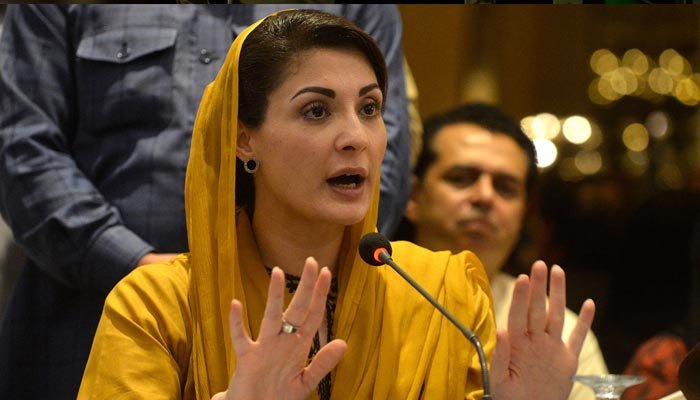
  • Maryam urges media houses to ‘unite against govt pressure’

    Maryam urges media houses to ‘unite against govt pressure’

    Amid increasing censorship in the country, Pakistan Muslim League-Nawaz (PML-N) Vice President Maryam Nawaz has urged media houses to resist the government pressure, saying the media should stand united if it doesn’t want to become a tool for anyone.

    Addressing a social media workers convention in Lahore, the PML-N VP said no one would be able to cower the media into submission if the media houses stood united against repression.

    She said the government has pitched news channels and anchorpersons against each other, adding that those who had “courage to speak were asked to sack anchors if they didn’t want to get shut down”.

    It may be mentioned here that after the current government came to power, several journalists were sacked from their jobs. The journalists she is referring to could include Matiullah Jan, Nusrat Javed, Murtaza Solangi and Talat Hussain. But not all of the journalists were fired, Talat, for example, parted ways with Geo after mutual agreement.

    In a reference to the incarceration of Geo head Mir Shakilur Rehman, she said the heads of those channels who refused to capitulate were put into the NAB cell. She said media was even not free to run the name of a retired officer on TV, as it only broadcasts scripts approved by the authorities.

    “I understand that these channels are doing it under compulsion, but asked for how long they will endure this,” Maryam said, adding that “Geo News is nowadays against us [PML-N], but I know it is facing pressure”.

    According to the PML-N leader, journalists like Matiullah and Ali Imran were being abducted but the ‘fake’ prime minister had no idea about it when asked on TV.

    “If you don’t know who attacked Maryam’s room in Karachi and who kidnapped Captain (r) Safdar and Sindh IG then why people shouldn’t call you ‘Khaw Makhaw’,” she said alluding to the Karachi incident after the PDM rally in the port city.

    She asked the media for how long it would endure this attitude. Maryam said if the same situation continued then one day the journalists will be whisked away from their houses and then they will have to say that they went to the northern areas for ‘recreation’.

  • PTI issues list of ‘good’ and ‘bad’ journalists, deletes tweet after backlash

    PTI issues list of ‘good’ and ‘bad’ journalists, deletes tweet after backlash

    In another attack on press freedom, an official Twitter handle of Pakistan Tehreek-e-Insaf (PTI) Lahore issued a list of ‘bad’ journalists on social media, calling them “anchors/mediamen building narratives for the corrupt”.

    “Let take these name loud and clear,” read the tweet with hashtag ‘HardTalkNotCapitalTalk’.

    A little context of the tweet: the said hashtag started trending on social media site after an interview of Pakistan Muslim League-Nawaz leader Ishaq Dar, wherein he was grilled by Stephen Sackur in his characteristically inquisitorial style.

    The trolls subsequently took to Twitter to celebrate the humiliation meted out to Dar and launched attacks on Pakistani mediapersons, especially Hamid Mir who hosts Capital Talk on Geo, for ostensibly being ‘too lenient to the corrupt’ Sharifs and other opposition politicians.

    So, who are these ‘bad journalist’ accused by the ruling party of promoting ‘corrupt narratives’? According to the list, Hamid Mir, Asma Shirazi, Naseem Zahra, Najam Sethi, Talat Hussain, Mansoor Ali Khan, Gharidah Farooqi, Javed Ch, and Saleem Safi are the ‘bad journalists’.

    Most of the mentioned journalists are critical of government policies and other transgressions.

    ‘GOOD JOURNALISTS’

    But the PTI Lahore account also shared a list of journalists who they thought were “fighting the war of truth and justice” i.e. “good journalists”.

    These journalists are Imran Khan, Maleeha Hashmey, Sabir Shakir, Kashif Abbasi, Ghulam Hussain, Sami Ibrahim, Shifa Yousafzai, Mooed Pirzada, Abdul Qadir, and Waqar Malik.

    The official handle asked its followers to “appreciate brave and bold journalists fighting the war of truth and justice” instead of the ‘bad’ journalists who promote corruption.

    The journalists and media organisations took exception to the tweets by the official handle of the PTI’s Lahore chapter. The Coalition For Women In Journalism condemned the “vicious attacks of PTI trolls against these brave women journalists”.

    The list was also condemned by Mansoor Ali Khan, who said such lists put journalists in the harm’s way. Whereas Amber Rahim Shamsi commented on the list of “good journalists”, saying: “When those in power become comfortable with a journalist, it’s because the journalist isn’t asking uncomfortable questions.”

    Subsequently, a member of PTI social media issued “apologies”, saying it was done by a “regional account”.

    According to Human Rights Watch, “In Pakistan, arbitrary arrest, detention, and baseless criminal prosecutions are used as instruments of press censorship” among other things.

    In Aug this year, women journalists released a joint statement on attacks on women in media in Pakistan, which said that vicious attacks through social media were being directed at women journalists and commentators in Pakistan, making it incredibly difficult for them to carry out their professional duties.

    In the following month, daughter of late poet Fahmida Riaz, in protest against the alleged abduction and torture of journalists and writers by the state, declined the presidential award that the government had announced for her late mother.