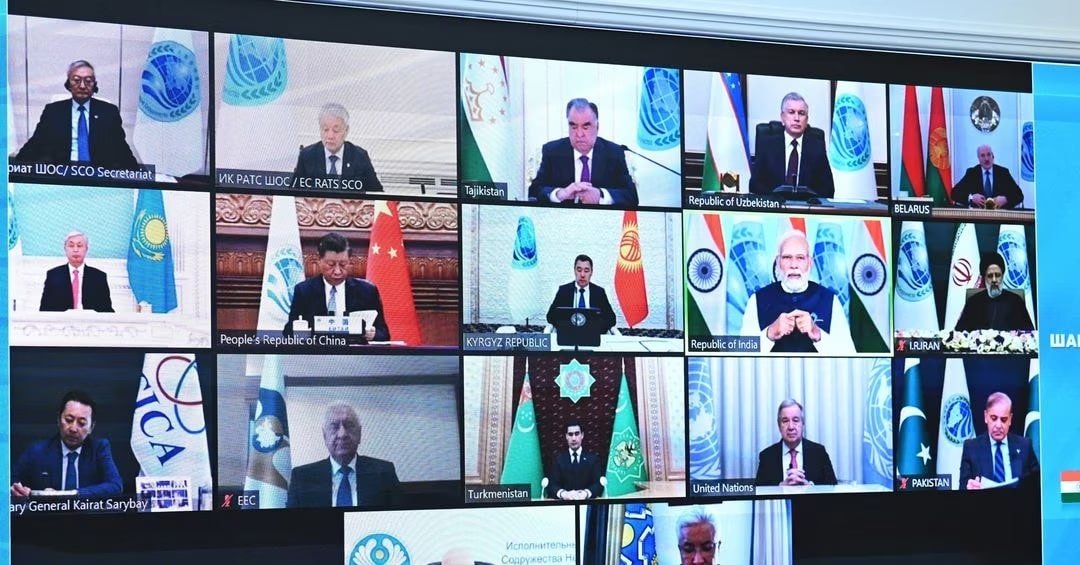
This year, the Shanghai Cooperation Organisation’s (SCO) summit was hosted by India, where Indian Prime Minister Narendra Modi launched thinly veiled accusations against Pakistan, saying “some countries” are “terror havens“.
Pakistan’s Prime Minister Shehbaz Sharif was in attendance, along with other SCO member countries leaders, such as Xi Jingping and Vladimir Putin.
The SCO is a Eurasian political, economic and security organisation, which unites China, Russia, India, Kazakhstan, Kyrgyzstan, Pakistan, Tajikistan, Uzbekistan, and, as of yesterday, Iran. It’s currently the world’s largest regional bloc in terms of geographic scope and population.
Addressing the online summit, Dawn reports Modi to have said, “Some countries use cross-border terrorism as an instrument of their policies, provide shelter to terrorists. SCO should not hesitate to criticise such nations. There should be no place for double standards on such serious matters.”
India claims that a part of the China–Pakistan Economic Corridor passage passes through a ‘disputed’ region. Modi told leaders that “terrorism has become a major threat to regional and global peace. Dealing with this challenge requires decisive action. Regardless of its form or manifestation, we must unite in our fight against terrorism.”
Pakistan PM Shehbaz Sharif responded in turn, saying that the SCO stands for observance of the UN principles of sovereignty, territorial integrity and people’s right to self-determination, considered a reference to the Kashmir dispute.
“UNSC resolutions offer us a workable framework for the resolution of longstanding disputes in the region,” Dawn reported Shehbaz to have said. “These must be addressed immediately and settled amicably before it is too late.”
Kashmir has been a contentious point between the two countries since partition, but especially since India abolished Articles 370 and 35A in 2019. These articles were decades-old and provided a measure of autonomy to the disputed Muslim-majority region.
In the earlier SCO summit in May, Pakistan’s Foreign Minister Bilawal Bhutto criticised India’s decision to scrap the special status of the disputed region of Kashmir, saying New Delhi’s unilateral move in 2019 had undermined the possibility of holding talks between the neighbours.
India has also accused Pakistan’s military of backing Kashmiri rebels, a claim Islamabad has denied.