Tag: China

  • Italy gave China protective equipment to help with coronavirus, then China made them buy it back: report

    Italy gave China protective equipment to help with coronavirus, then China made them buy it back: report

    At the peak of the COVID-19 outbreak in China, Italy had donated personal protection equipment (PPE) to Beijing and now when Rome is in dire need of the same, China is making them buy it back, a report in The Spectator has claimed.

    According to reports, after the new coronavirus made its way to Italy, decimating the country’s significant elderly population, China told the world it would donate PPE to help Italy stop its spread.

    Reports later indicated that China had actually sold, not donated, the PPE to Italy. A senior Trump administration official told The Spectator that it was much worse than that as “Beijing forced Italy to buy back the supply that it gave to China during the initial outbreak”.

    “Before the virus hit Europe, Italy sent tons of PPE to China to help China protect its own population,” the administration official explained.

    “China then has sent Italian PPE back to Italy — some of it, not even all of it… and charged them for it,” he added.

    Unfortunately, China’s diplomacy in the wake of the pandemic outbreak has been slippery.

    Much of the supplies and testing kits that China sold to other countries have turned out to be defective.

    Spain had to return 50,000 quick-testing kits to China after discovering that they were faulty.

    In some cases, instead of apologising or fixing the issue, China has blamed others for the defective equipment. It reportedly told the Netherlands to “double-check the instructions” on its masks, after the country had complained that half of the masks did not meet safety standards.

    “China has a special responsibility to help because they are the ones who began the spread of the coronavirus and did not give the information required to the rest of the world to plan accordingly,” the official said, adding that China’s “disinformation campaign” of lying to the world about the seriousness of its COVID-19 outbreak further delayed the response by other countries.

  • Coronavirus: Info Ministry shares fake news about Chinese help, then deletes tweet

    Coronavirus: Info Ministry shares fake news about Chinese help, then deletes tweet

    In a rather embarrassing development for the government, the Information Ministry has shared fake claims regarding Chinese help for Pakistan amid the outbreak of the new coronavirus — COVID-19 — and later deleted its tweet.

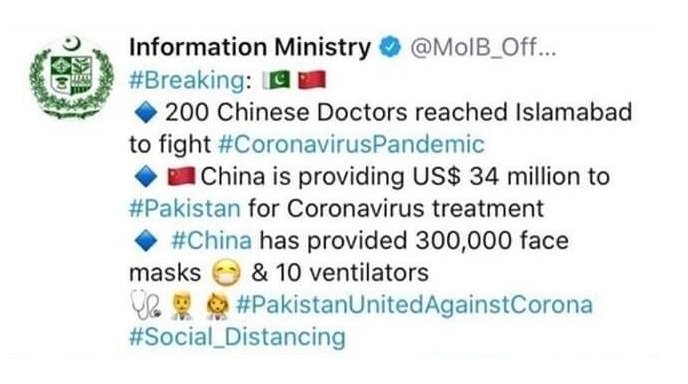
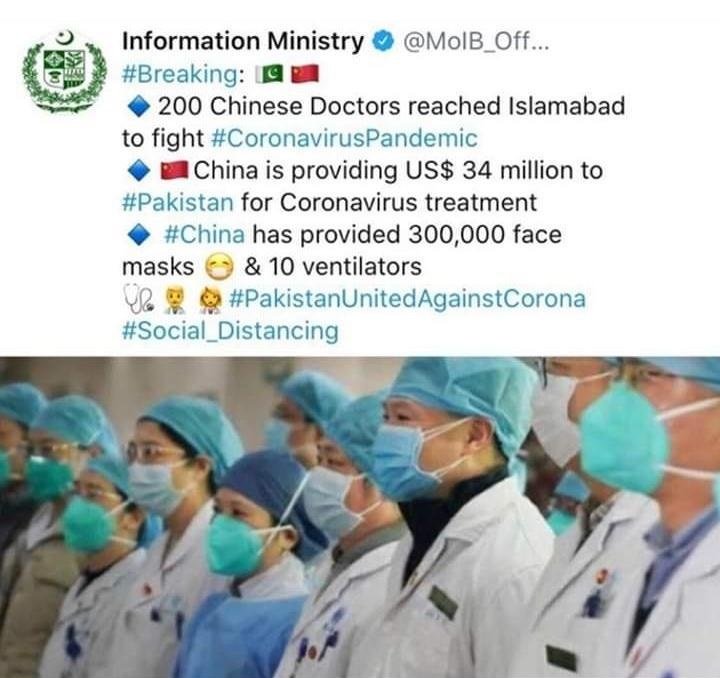
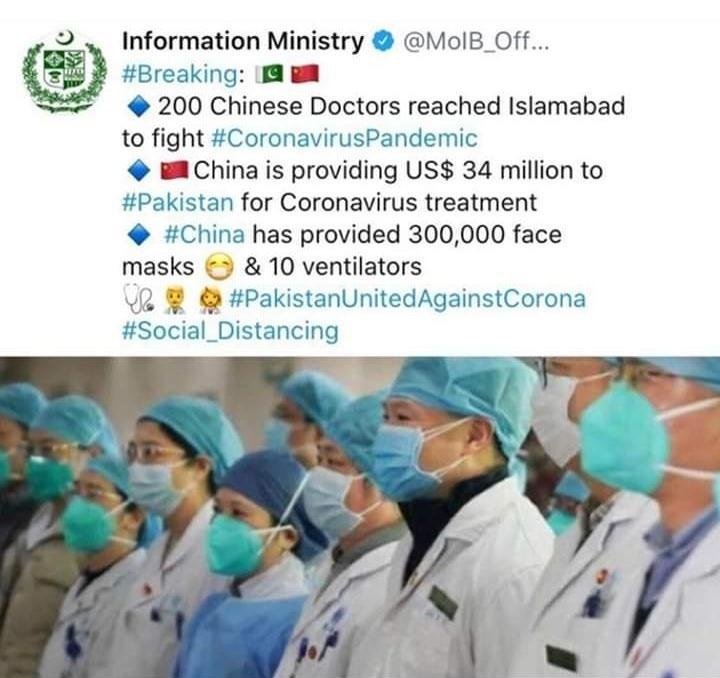
    As per the details, the Information Ministry, which is responsible to release government information to the public and international communities, on Sunday in a now-deleted tweet claimed that 200 Chinese doctors had reached Islamabad to help the country fight the coronavirus pandemic.

    It also said that China was providing Pakistan with $34 million for treatment of the infected.

    The same was tweeted by Radio Pakistan as well.

    Since the the national public broadcaster for radio also deleted its tweet, an archived version of it can be viewed here.

    Speaking to The Current, an official, on the condition of anonymity, confirmed not only that the two claims were fake, but also that the tweets had been deleted after it was pointed out.

    They, however, said that China had given Pakistan $4 million in aid and the claim pertaining to the provision of 300,000 medical face masks besides 10 ventilators was also true.

    This was confirmed by Economic Affairs Minister Hammad Azhar as well.

    Taking to Twitter, he wrote:

    “They have also undertaken to arrange for much greater number of ventilators,” the minister added.

  • ‘China manipulated number of COVID-19 infections for president’s visit’

    ‘China manipulated number of COVID-19 infections for president’s visit’

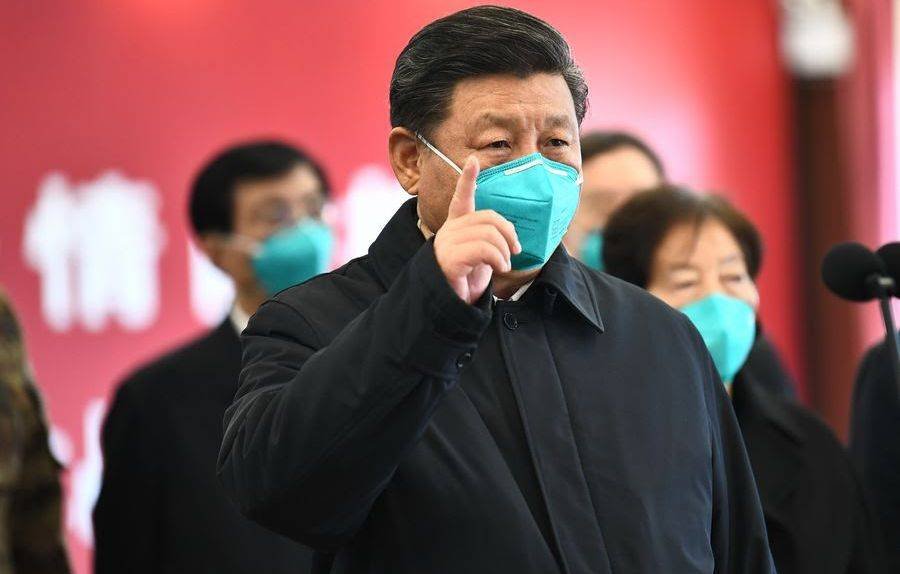
    The number of novel coronavirus patients in Wuhan, the epicenter of China’s virus outbreak, was manipulated in time for President Xi Jinping’s visit last week, a local doctor was quoted as saying by Tokyo-based Kyodo News.

    According to the Japanese media outlet, a number of symptomatic patients were abruptly released from quarantine early while a portion of testing was suspended.

    China’s health authorities had last Thursday reported no new cases of coronavirus in Wuhan, marking the first time for the city to have no instances of local transmission since the viral epidemic began late last year.

    But the doctor, who works at a quarantine facility, said the government tally “cannot be trusted.”

    The number of patients currently undergoing treatment is deliberately being reduced in an effort to show the Xi government’s success in combatting the epidemic, he said.

    The doctor, whose responsibilities include determining whether a patient is discharged from a hospital, expressed strong concerns that if the truth remains hidden from the public, another outbreak could occur.

    Guidelines from the National Health Commission stipulate that patients must test negative for the virus twice and be cleared for pneumonia via a computerised tomography — imaging through X-rays or ultrasound — scan before being discharged.

    But according to the doctor, from around the time of Xi’s visit, even though his patients still exhibited signs of pneumonia, the patients were released from quarantine at the discretion of a “specialist” from the epidemic prevention and control authority.

    From then on, the criteria for discharging patients became loose, and “a mass release of infected patients began,” he said.

    Also, patient interviews with those exhibiting symptoms such as fever were simplified, and blood tests to detect antibodies produced during infection were discontinued. As a result, “suspected patients were released back into society,” he said.

    Xi, on March 10, made his first visit to the central Chinese city of Wuhan since the outbreak began, emphasizing the government’s achievements in its epidemic prevention and control efforts.

    According to the National Health Commission, nearly 58,000 people have been discharged from hospitals in Hubei Province, where Wuhan is the capital. Beginning in mid-March, the number of new infections in Wuhan has stayed below a dozen patients a day.

  • VIDEO: President wants a ‘volunteer force’ to fight coronavirus in Pakistan

    VIDEO: President wants a ‘volunteer force’ to fight coronavirus in Pakistan

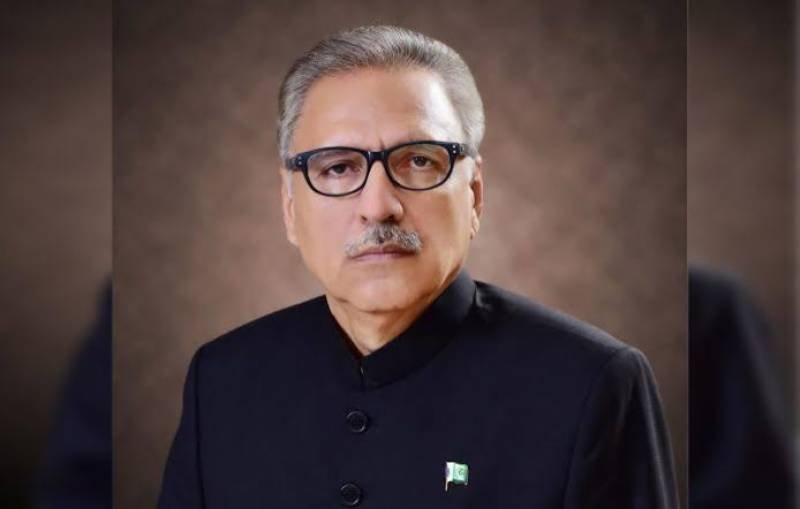
    Urging the nation to show unity in the persisting difficult time, President Dr Arif Alvi has stressed the need to form a China-like volunteer force in Pakistan to fight the new coronavirus.

    President Alvi, in a video message, said China has fought the coronavirus pandemic on the national-level and formed a force of volunteers which was also needed in Pakistan.

    He said that people must unite to face the challenge instead of panicking, and asked clerics to raise awareness regarding COVID-19. The president also asked media houses to play their role in spreading awareness so that people adopt prevention measures.

    WATCH VIDEO:

    The president said that China was facing isolation and extreme criticism from the West over the spread of coronavirus, but, he added, the Chinese leadership has appreciated Pakistan for exhibiting full confidence in Beijing and not bringing back students.

    He admitted that the Pakistani students, who had shown concerns over not being repatriated from China, studying in 15 different universities in the virus-hit country had also now changed their opinion after being looked after by Chinese authorities in a better way.

    “I have thanked Chinese President Xi Jinping over taking good care of them [Pakistani students in Wuhan/Hubei].”

    He also said the Chinese exhibited great resilience and unity against COVID-19 pandemic and Pakistan should learn from their experience to combat the disease.

    The president added that during his trip to the erstwhile epicentre of the virus, he held hours-long discussions with the Chinese leadership over effective measures adopted by Beijing to contain COVID-19.

  • Shah Mahmood Qureshi in self-isolation after China return

    Shah Mahmood Qureshi in self-isolation after China return

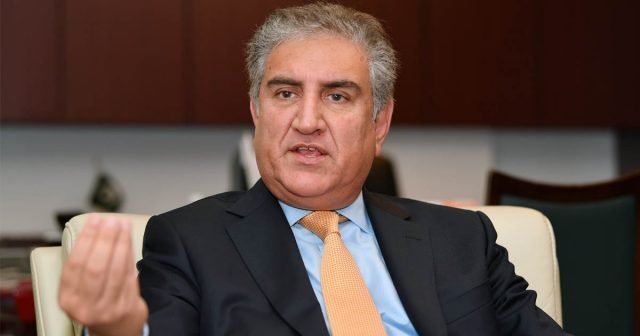
    Foreign Minister (FM) Shah Mahmood Qureshi, who on Wednesday morning returned from his trip to Beijing, has confirmed that he is in self-isolation as per instructions of the Pakistani government.

    Speaking to SAMAA TV, FM Qureshi, who was accompanied by President Arif Alvi and Minister for Planning, Development and Special Initiatives Asad Umar, said that he had self-isolated himself since the government had advised everyone returning from abroad to self-isolate in case they had contracted the new coronavirus — COVID-19.

    “Before leaving we did a swab test here and when we landed, Chinese officials took our blood samples. They both came back negative and we took another blood test after our meeting with President Xi Jinping. The results of the second test haven’t come back yet,” the minister said.

    However, he decided to isolate himself as a precaution for a few days. “My only interactions are over the phone,” he said, adding that he would undergo another swab test within five days. “I am going to follow protocol.”

    The delegation had on Monday reached China on a two-day visit at the invitation of the Chinese president.

    It was warmly welcomed by Chinese Minister of Agriculture and Rural Affairs, Han Changfu, Pakistan Ambassador to China Naghmana Alamgir Hashmi and other senior officials of the Chinese government as well as the Pakistan Embassy in Beijing.

    Other than signing multiple agreements to enhance cooperation between the two countries, the visit was aimed at expressing solidarity with China amid the deadly coronavirus outbreak.

  • ‘Recovered’ coronavirus patient dies

    A 36-year-old man, who was discharged from one of the makeshift hospitals built to contain the coronavirus outbreak, has died of respiratory failure in Wuhan, according to a report by a Shanghai-based news portal.

    South China Morning Post quoted the news portal as reporting that Li Liang had been admitted to the hospital built to treat patients with mild and moderate symptoms on February 12, according to his wife, surnamed Mei. He was discharged two weeks later with instructions to stay in a quarantine hotel for 14 days.

    Mei said her husband was not feeling well two days after leaving the hospital, with a dry mouth and gaseous stomach. On March 2, Li said he felt sick and was sent to a hospital, where he was later certified dead.

    The death certificate issued by the Wuhan health commission said the direct cause was COVID-19, and listed respiratory blockage and failure as the symptoms which could have led to his death.

    Since the death earlier this month, Fangcang Hospital — one of Wuhan’s makeshift facilities — has been issuing emergency notices saying that more discharged patients have been readmitting after falling ill again. The hospital is currently conducting antibody tests on all patients before discharging them, to ensure they are fully recovered.

    Last month, Xinhua — the official state-run Chinese press agency — had reported that the country had discharged a total of 36,117 patients from hospitals after recovery.

    The criteria for deciding if a patient has recovered varied between provinces, but in general, Chinese hospitals required people to test negative twice in a row, and to show no obvious symptoms such as a fever. Patients who were released were supposed to check in with their hospital and could face retesting — which was when some tested positive again.

    The Current had also quoted a key Chinese respiratory disease expert as saying that some discharged coronavirus patients could still carry the virus and be infectious, potentially posing another complication to Beijing’s efforts to control the epidemic.

    Zhao Jianping, the head of the coronavirus containment team in worst-affected Hubei province, had said a minority of patients who were discharged from hospital after tests showed they were negative for the virus later tested positive again. China counts patients whose throat or nose swabs show up positive for the virus in a nucleic acid test, and those whose CT scans show lesions in their lungs, as infected cases.

  • VIDEO: Senior journalist cracks netizens up by saying ‘coronavirus came from Italy’s corona city’

    VIDEO: Senior journalist cracks netizens up by saying ‘coronavirus came from Italy’s corona city’

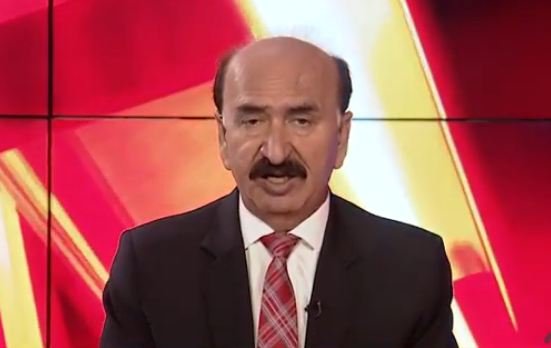
    A senior journalist and analyst has left netizens in fits of laughter after claiming that the new coronavirus “probably originated in the corona city of Italy” that is the most affected by the global pandemic.

    There is no city called ‘corona’ in Italy, and even if there was, we doubt it could have anything to do with the outbreak of the COVID-19 that, since its discovery in Wuhan city of China, has claimed over 4,500 lives with at least 126,000 infections.

    “…it’s happening in Italy that is very much affected and corona[virus] probably originated from its corona area,” senior journalist Nazir Leghari can be heard as saying in a video doing rounds over the internet.

    WATCH VIDEO:

    Here’s what Twitterati have to say about it:

    Some even went on to explain how COVID-19 — the new coronavirus — got its name.

    COVID-19 is an infectious disease caused by a new virus that had not been previously identified in humans. The virus causes respiratory illness (like the flu) with symptoms such as a cough, fever and in more severe cases, pneumonia. You can protect yourself by washing your hands frequently and avoiding touching your face.

    It was discovered in mainland China in mid-December and has since spread globally despite efforts to contain it.

  • China, Russia, Italy make Pakistan 11th largest arms importer in world

    Pakistan is the 11th largest arms importer in the world, a report by Stockholm International Peace Research Institute (SIPRI) — an institute that tracks arms deals around the world — has revealed.

    As per the figures released by SIPRI, China, Russia and Italy are the main suppliers of arms to Pakistan, with Beijing accounting for 73% of the total imports during 2015-2019, and Moscow as well as Rome accounting for 6.6% and 6.1%, respectively.

    The actual share of Pakistani imports in the world has, however, decreased by 39% during the said period, the report revealed. The overall decrease in Pakistan’s arms imports over the latest five-year period was linked to the United States’ (US) decision to stop military aid to the country.

    The institute further noted that Pakistan was among the top three buyers of arms from top weapons exporters like Italy and Turkey. Pakistan had a 7.5% share in arms imports from Italy between 2015-2019, and 12% share in Turkish arms over the same period.

    SIPRI also identified a significant drop in arms sales to South Asia by the US, which was listed as the largest arms exporter in the world between 2015-2019. The institute noted that US arms imports to Pakistan declined by 92%, and to India by 51% over this period. The US, which had accounted for 30% of Pakistan’s arms imports in 2010–14, was responsible for only 4.1% in 2015–19.

    Meanwhile, Islamabad was identified as the largest buyer of Chinese arms between 2015-2019, accounting for 35% of the arms exported by Beijing — the fifth largest exporter of weapons in the world in the five-year period.

    According to SIPRI, China accounted for 51% of Pakistan’s arms imports in 2010–14 and for 73% in 2015–19. SIPRI also noted that Pakistan continued to import arms from Europe, strengthening relations with Turkey with orders for 30 combat helicopters and four frigates in 2018.

    India, on the other hand, has retained its position as the second-largest arms importer in the world followed by Saudi Arabia that now imports 12% of its arms (2015-19) as against 5.6% in 2010-14 — a jump of 130%, the report said.

  • Apple, Nike and Samsung among 83 brands using Uyghur Muslim ‘forced labour’

    Apple, Nike and Samsung among 83 brands using Uyghur Muslim ‘forced labour’

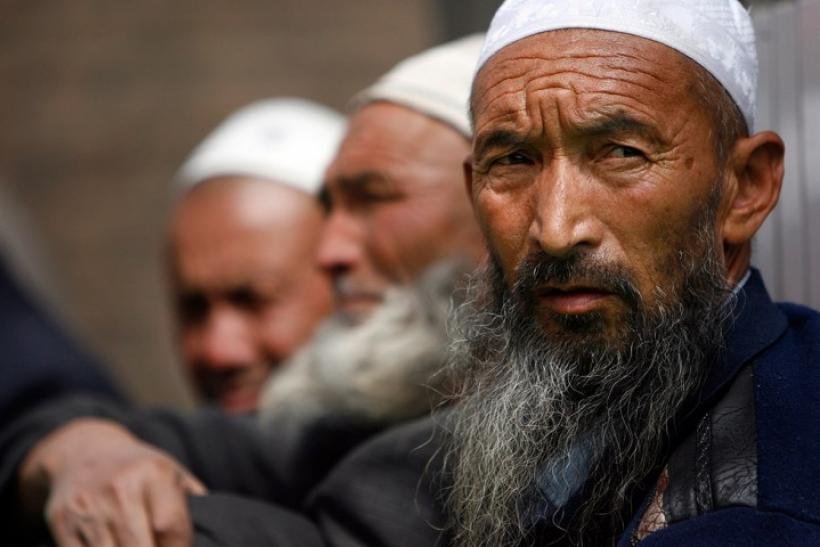
    Tens of thousands of Uyghur Muslims, who face persecution in neighbouring China, have been transferred out of the country’s western Xinjiang province and delivered as workers to major factories as part of a government scheme, a report by The Independent has claimed while citing the Australian Strategic Policy Institute (ASPI).

    As per the details, the Australian think tank has identified 83 global brands, including Apple, Nike, Samsung and Sony among others whose supply chains in China are employing Uyghur Muslims in conditions that could amount to forced labour.

    China has been accused of detaining more than a million Uyghurs in Xinjiang as part of what it calls a campaign to tackle Islamic extremism. It initially denied this, before recently saying that all those in the “vocational centres” had “graduated” and been given jobs.

    The ASPI report, based on analysis of government documents and local media reports, said the Uyghurs continued to live “a harsh and segregated life” once they entered the workforce of major factories.

    More than 80,000 Uyghurs had been transferred far from their homes to work in at least 27 factories across nine provinces, it said.

    There, the workers continued to be subject to surveillance, banned from practising their religion, forced to take part in mandarin language classes and restricted in their travel back to Xinjiang.

    “Under conditions that strongly suggest forced labour, Uyghurs are working in factories that are in the supply chains of at least 83 well-known global brands in the technology, clothing and automotive sectors, including Apple, BMW, Gap, Huawei, Nike, Samsung, Sony and Volkswagen,” the think-tank said in the introduction to its report.

    While ASPI describes itself as an independent think-tank whose core aim is to provide insight for the Australian government on matters of defence, security and strategic policy, the Chinese government has denied violating the rights of its workers, describing the report as “following along with the United States’ (US) anti-China forces that try to smear China’s anti-terrorism measures in Xinjiang”.

  • Iran blames Pakistan for spread of coronavirus

    Iran blames Pakistan for spread of coronavirus

    With the coronavirus death toll in Iran rising to 15 among 64 reported cases, Tehran has allegedly blamed Islamabad for the epidemic, saying it was brought to the country by Pakistani nationals illegally crossing into Iranian territory.

    The outbreak of the 2019 novel coronavirus — a severe acute respiratory syndrome named ‘COVID-19’ by the World Health Organization (WHO) — is an ongoing pandemic that originated in the central Chinese province of Hubei’s capital city, Wuhan.

    The virus, as of February 25, has claimed 2,663 lives with over 25,000 recoveries. COVID-19 spreading to other parts of Asia, the Middle East, Africa, North America and Europe, has infected more than 80,000 people globally.

    In Hubei, the number of cases appears to be stabilising, according to government figures. But the number of people infected elsewhere in the world is rising quickly, with clusters in South Korea, Italy, Iran and a cruise ship docked in Japan.

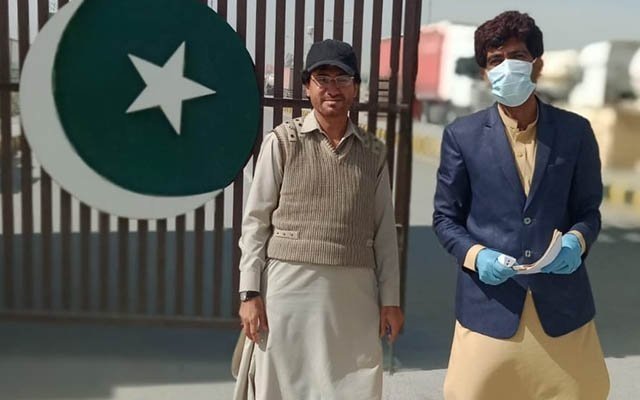
    While Pakistan International Airlines (PIA) has suspended flight operations to China and Japan till March 15 due to the outbreak, Pakistan has closed its border with Iran after casualties from the deadly coronavirus were reported on Monday.

    The outbreak in Iran began in the city of Qom, an often-visited religious destination.

    According to authorities, Islamabad has suspended trade activities across the western border and barred citizens from travelling to Iran through the five existing border gates. The border town of Taftan in Balochistan has been quarantined for screening, while a 100-bed tent hospital has been set up in the area for pilgrims coming back from Iran, officials told The Current.

    “The government is in close contact with Iranian authorities to save Pakistani pilgrims from coronavirus,” Federal Minister for Religious Affairs and Interfaith Harmony Noorul Haq Qadri said in a statement. He added that his ministry had deployed a special team in Taftan to protect Pakistani pilgrims returning from Iran.

    Amid Pakistani actions aimed at what the government calls “continuing to successfully avoid” an outbreak of the novel coronavirus, Iranian officials have claimed it reached the country with Pakistani, Afghan and Chinese nationals illegally crossing the border to enter Iran.

    “It is not possible for the virus to reach Iran otherwise,” an Iranian official said on the condition of anonymity. They added that Afghanistan had also confirmed its first infection, so the possibility of the virus reaching the country via its northern neighbour, could not be ruled out either.

    The claims were, however, contradicted by government sources.

    They said these “unverified” claims were untrue and being made by some local Iranian media agency, but it was not the time for blame game. “Coronavirus is a real threat. Every country in the region and the world is at risk. We all need to pool together our resources and fight it instead of shifting blame on one country or the other.”

    Government sources also said that both Pakistani and Iranian health advisers and their ministers knew each other for a long time. “Cooperation is quite good between the two health ministries and the governments are in close touch with each other. They are satisfied with the mutual assistance.”

    NO CORONAVIRUS IN PAKISTAN’:

    Speaking to The Current, National Institute of Health (NIH) Focal Person Dr Muhammad Salman rejected the claims and clarified that for Pakistan to be responsible for the pandemic in Iran, there should’ve been any cases on this side of the border first.

    “Pakistan has in a scientific way, and while using evidence-based public health measures, dealt with the threats of a coronavirus outbreak in the country, and not even a single case has surfaced until now,” he said and reiterated that all such claims were false.

    He maintained that Dr Zafar Mirza had been on the frontline in curbing the potential risk, and owing to the efforts of the government, Pakistan was safe until now despite the virus affecting neighbouring Afghanistan, Iran and reportedly even India.

    CORONAVIRUS:

    In late December, a cluster of pneumonia cases of unknown aetiology was reported by health authorities in Wuhan. The initial cases mostly had epidemiological links to the Huanan Seafood Wholesale Market and consequently, the virus is thought to have a zoonotic origin.

    The virus that caused the outbreak is known as SARS-CoV-2, a new virus which is closely related to bat coronaviruses, pangolin coronaviruses and SARS-CoV-1.

    The earliest reported symptoms occurred on December 1, 2019, in a person who had not had any exposure to the Huanan Seafood Wholesale Market or to the remaining 40 of the first cluster detected with the new virus.

    Of this first cluster, two-thirds were found to have a link with the market, which also sold live animals.

    A large response, both in China and globally, followed an increase in cases in mid-January 2020, bringing travel restrictions, quarantines and even curfews.

    Examples include the quarantine of the British cruise ship, Diamond Princess, in Japanese waters; the curfew of over 780 million people in China, a voluntary curfew in South Korea, and the curfew of a dozen towns with over 50,000 people in Italy.

    The outbreak has been declared a Public Health Emergency of International Concern (PHEIC) by the WHO, and airports, as well as train stations, have implemented body temperature checks, health declarations and information signage in an attempt to identify carriers of the virus.

    Among the wider consequences of the outbreak are concerns about potential economic instability and incidents of racism against people of Chinese and East Asian descent, which have been reported in several countries.