Tag: citizenship

  • Muslims not allowed to take citizenship of ‘kafir’ countries: Sheikh Assim Alhakeem

    Muslims not allowed to take citizenship of ‘kafir’ countries: Sheikh Assim Alhakeem

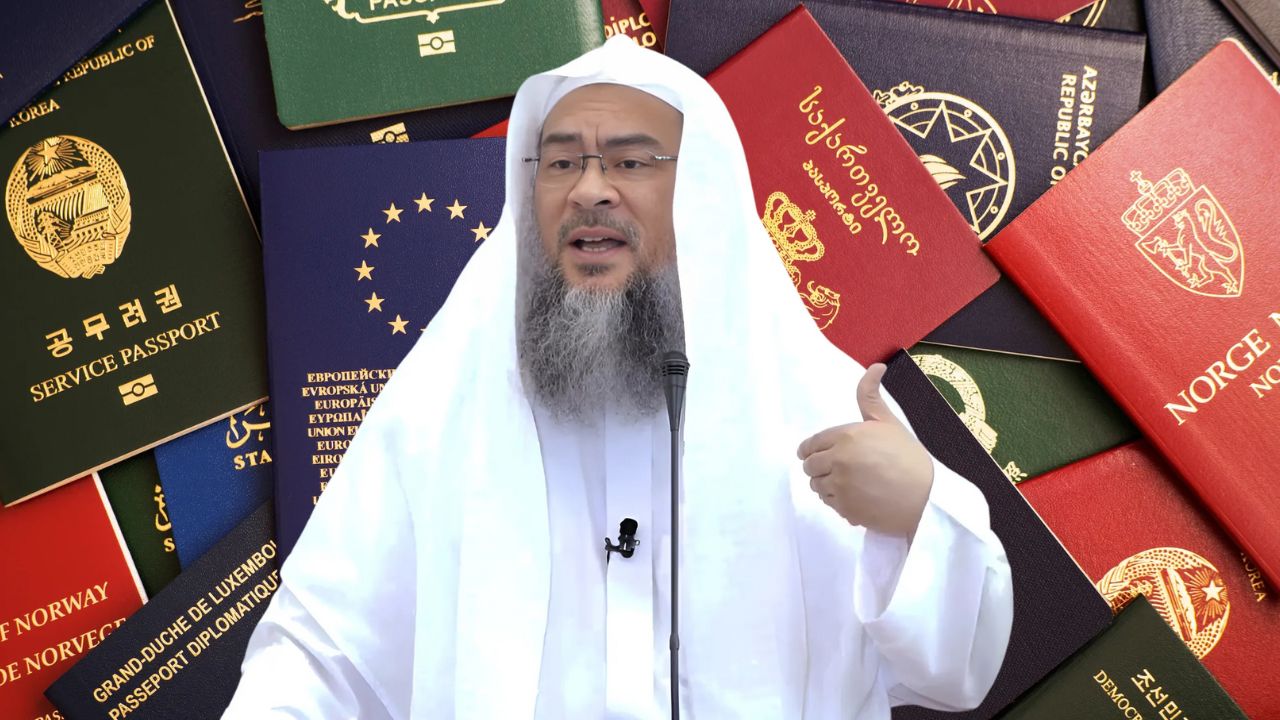
    Prominent Saudi cleric of Indonesian descent Sheikh Assim bin Luqman al-Hakeem has declared it forbidden for a Muslim to seek citizenship of a non-Muslim country. 

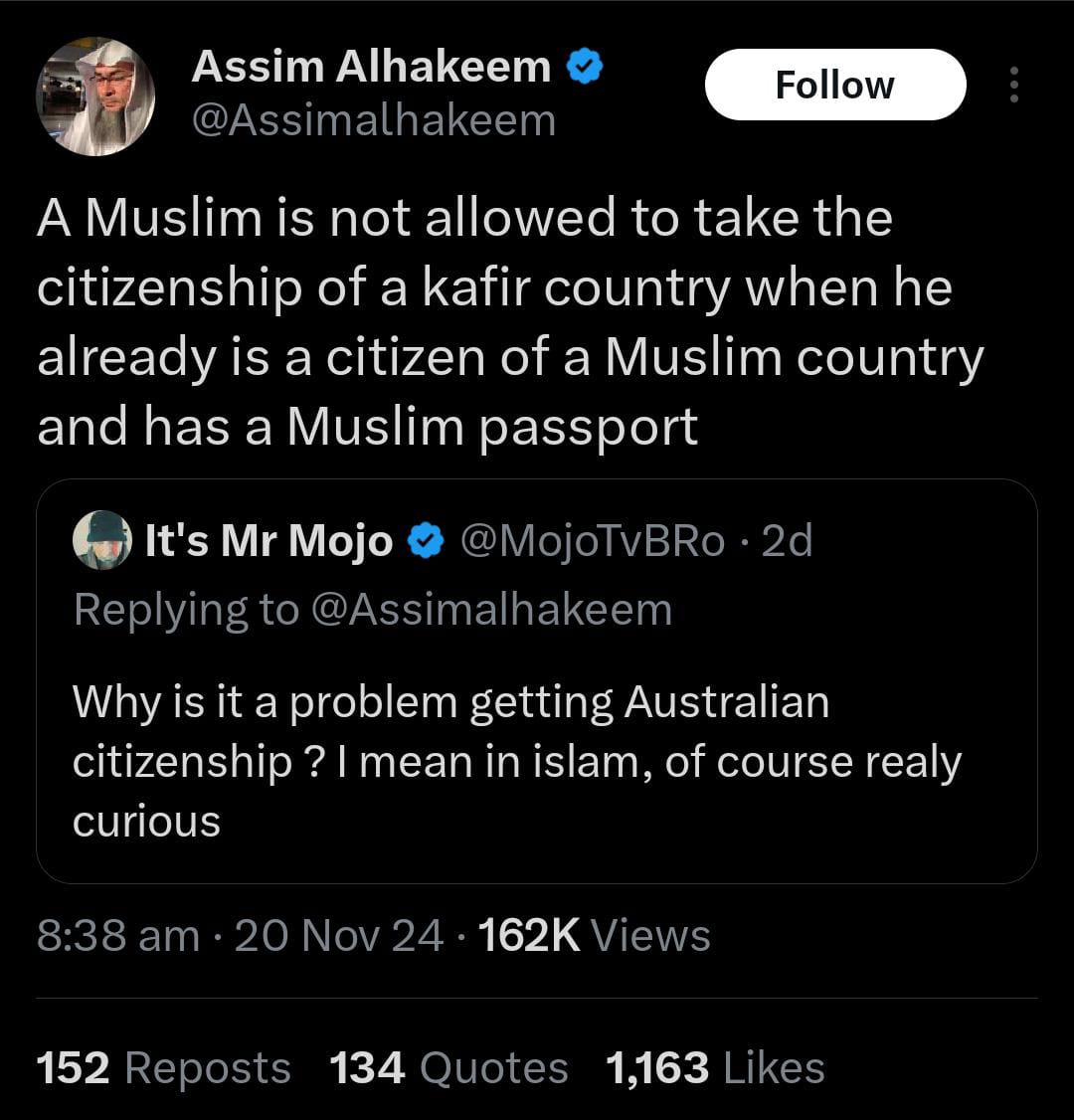
    As per the details, the cleric took to X (formerly Twitter) to respond to a follower’s query regarding why under Islamic principles was it a problem to get Australian citizenship.

    “A Muslim is not allowed to take the citizenship of a kafir country when he already is a citizen of a Muslim country and has a Muslim passport,” the cleric wrote in a post that has since gone viral.
     1732277892-EJEX4VVSVV.jpg

    While Sheikh Assim’s statement has triggered a debate on social media, the cleric himself is yet to respond to hundreds of follow-up questions being asked by netizens. 

    “How do you define a Muslim country, Sheikh?” asked one user.

    Another asked what it meant for Muslims born in a kafir country. “How about Muslims born in a kafir country? Should they migrate?”

    “So what qualifies a country as a kaafir? And if it wants to revert, how will it do the shahada? And how does the country follow the pillars of Islam??? [sic]” asked a third user.

    Who is Sheikh Assim Alhakeem?

    Based primarily in the Saudi city of Jeddah, Sheikh Assim hosts programmes dealing with Islam. He quickly rose to fame on social media due to his witty sarcasm and humorous approach.

    He has been an imam in Jeddah for the past 20 years, where he delivers weekly sermons before Friday prayer and lectures on various Islamic sciences. 

    Sheikh Assim mostly preaches in English, delivering Islamic programmes on social media channels, including Questions and Answers (ASK HUDA), Umdatul Ahkaam, Youth Talk and Mercy to the Worlds.

    He also preaches on television and radio channels, such as Huda TV, Zad TV, Peace TV, Iqraa, and Saudi 2.

    The cleric, deemed controversial by many, had earlier this year made headlines when a Montreal theatre denied him the use of its venue for having described Jews as “enemies of Islam”.

    Sheikh Assim was scheduled to speak at the Théâtre Rialto as part of a charity event organised by Penny Appeal Canada. However, following concerns raised by the Centre for Israel and Jewish Affairs (CIJA) and B’nai Brith Canada, the theatre informed the groups that it would not be hosting the event.

    The event was part of the Saudi cleric’s speaking tour across Canada, which sparked outrage from politicians and Jewish organisations.
  • 10 easiest European citizenships

    10 easiest European citizenships

    Many people from developing countries aspire to acquire citizenship in European states. Some countries offer relatively straightforward paths to citizenship, while others present significant challenges. Sweden stands out as the easiest country in Europe for obtaining citizenship, whereas Estonia and Latvia are the most challenging.

    A recent study by CIS analysed Eurostat immigration data from 2009 to 2021 to identify which countries have the highest and lowest rates of non-EU residents acquiring citizenship.

    The analysis revealed that the nine most challenging countries to obtain citizenship are located in Central Europe. Estonia ranks as the most difficult country for non-EU citizens to naturalise, with the lowest average acquisition rate—approximately one in 200 residents. Additionally, the acquisition rate for men in Estonia is lower at 0.58 percent compared to 0.69 percent for women.

    Latvia, the Czech Republic, and Lithuania also have acquisition rates of less than 1 percent for non-Europeans, contrasting sharply with the average of 3.56 percent across European countries. Austria, Liechtenstein, Slovakia, Slovenia, and Germany follow, granting citizenship to about one in fifty non-EU residents. Denmark, outside Central Europe, presents the next highest hurdle with an acquisition rate of 2 percent.

    Over the past decade, six of the ten most challenging countries have seen an increase in citizenship grants year-on-year, particularly Denmark, which experienced a notable rise. Germany’s acquisition rate remained stable, while Latvia, Lithuania, and Slovenia saw declines.

    Many countries implement various programs aimed at attracting foreigners, including opportunities for investment, as well as citizenship and tax benefits.

    Individuals seeking migration often favour Golden Visa and Golden Passport routes, terms that are sometimes used interchangeably despite minor distinctions.

    10 Easiest European Countries to Get Citizenship

    According to the report, Sweden ranks as the easiest country, with nearly one in ten (9.3 Perce) non-EU residents obtaining citizenship—more than double the EU average.

    Sweden boasts the highest acceptance rates for both genders, with women experiencing a slightly higher acceptance rate of 10.02 percent compared to 8.66 percent for men.

    Norway, the Netherlands, Portugal, and Iceland follow as the second to fifth easiest countries to acquire citizenship, with an acquisition rate of one in 25 (4 percent).

    Data shows that northern European countries generally have the highest citizenship acquisition rates, with Sweden, Norway, Iceland, and Finland leading the pack.

    In southern Europe, Portugal emerges as the easiest, while the Netherlands, Ireland, and the United Kingdom are the most accessible Western European states for citizenship. The UK ranks eighth, with nearly three in 50 (3.2 percent) residents granted citizenship.

    Poland and Croatia are the easiest countries in Central Europe for changing nationality, with acquisition rates of 4 percent and 3.9 percent respectively. Northern and Western Europe present the most accessible regions for nationality changes, with an acquisition rate of 5.9 percent compared to 1.9 percent in Central Europe and 3.6 percent in the South.

  • Pakistan to send humanitarian aid to Gaza

    Pakistan to send humanitarian aid to Gaza

    Pakistan has announced it will send humanitarian aid to Gaza.

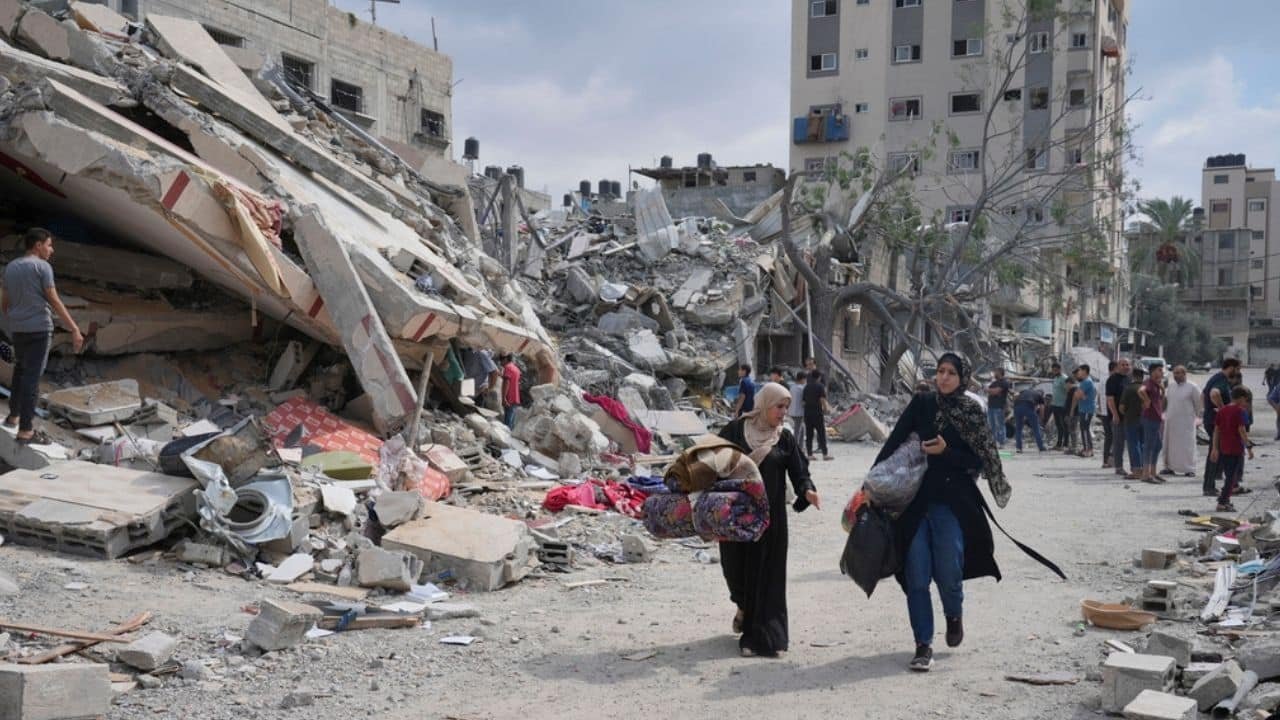
    In the light of severe dearth of food, water and healthcare, about 2.3 million Palestinians are struggling to survive. The spokesperson of the Foreign Office has thus stated that aid will be sent to the Palestinians.

    “In the wake of indiscriminate Israeli aggression and siege of the Gaza Strip, the already oppressed people of the densely populated Gaza are in urgent need of humanitarian assistance,”, the statement read.

    Pakistan is currently contacting the Egyptian government, the Red Crescent and the relevant agencies of the United Nations. Moreover, Pakistani missions abroad are also being contacted to finalise the delivery of aid.

    On Monday, Minister for Foreign Affairs Jalil Abbas Jilani spoke to his counterparts in Iran and Egypt and discussed the current atrocities being committed against Palestine.

    The spokesman said that the oppressed people of Gaza are in urgent need of humanitarian aid.

    However, how or if Pakistan would be able to send aid remains unclear as Israel has prevented other regional countries from sending aid. This includes Gaza’s neighbour Egypt whose borders meet the strip. It was proposed that Egypt would send relief goods through Rafah Crossing in exchange for allowing Americans and other foreigners to leave Gaza but Israel has not yet agreed to it.

  • Putin grants Russian citizenship to Edward Snowden, who disclosed top secret US surveillance

    Putin grants Russian citizenship to Edward Snowden, who disclosed top secret US surveillance

    Edward Snowden, a former security expert who exposed top-secret American surveillance programmes and is still wanted by Washington on espionage charges, was granted citizenship by Russian President Vladimir Putin on Monday.

    In order to avoid punishment, Snowden, who considers himself a whistleblower, left the United States and has been residing in Russia since that country gave him refuge in 2013.

    In a decree that Putin signed, Snowden, 39, was one of 72 foreigners who received citizenship.

    His attorneys stated at the time that he was filing for a Russian passport without renunciating his American citizenship when he was given permanent status in 2020.

    The state-run news agency RIA Novosti was informed on Monday by Snowden’s attorney, Anatoly Kucherena, that Snowden’s wife, Lindsay Mills, is also in the process of seeking for Russian citizenship. In 2014, Mills accompanied Snowden to Moscow. In 2017, they got married, and now they have a son together.

    Additionally, Kucherena stated that because of Snowden’s lack of combat experience, he would not be subject to the partial military mobilisation that Putin ordered last week to support Russia’s waning war in Ukraine. Putin claimed that only individuals with prior experience would be called up for partial mobilisation, but there have been several stories of other people receiving summonses, including those detained during anti-mobilization protests.

    According to CNN, White House press secretary Karine Jean-Pierre refused to comment on Snowden’s new passport, and instead referred questions to the prosecutors seeking his extradition. “Soc, since I believe there have been criminal charges brought against him, we would point you to the Department of Justice for any specifics on this,” Jean-Pierre said.

    Snowden’s revelations were the largest security breach in American history as it exposed the top-secret NSA programme PRISM’s use of surveillance and the collection of a wide spectrum of digital data.

    Putin stated in a documentary directed by American Oliver Stone in 2017 that he did not view Snowden as a “traitor” for disclosing official information.

    “As an ex-KGB agent, you must have hated what Snowden did with every fiber of your being,” Stone says in the clip.

    “Snowden is not a traitor,” Putin said. “He did not betray the interests of his country. Nor did he transfer any information to any other country which would have been pernicious to his own country or to his own people. The only thing Snowden does, he does publicly.”

    Snowden justified his decision to submit a dual citizenship application in 2020.

    “After years of separation from our parents, my wife and I have no desire to be separated from our son. That’s why, in this era of pandemics and closed borders, we’re applying for dual US-Russian citizenship,” Snowden wrote on Twitter at the time.

    “Lindsay and I will remain Americans, raising our son with all the values of America we love — including the freedom to speak his mind. And I look forward to the day I can return to the States, so the whole family can be reunited,” Snowden added.

  • UAE decides to grant citizenship to ‘talented and innovative’ people

    The United Arab Emirates (UAE) has adopted amendments that would allow Gulf state to grant citizenship to investors and other professionals, including scientists, doctors, engineers, artists, authors and their families, the government said on Saturday.

    “The UAE cabinet, local Emiri courts and executive councils will nominate those eligible for the citizenship under clear criteria set for each category,” Dubai’s ruler and UAE Vice President Sheikh Mohammed bin Rashid Al Maktoum tweeted.

    “The law allows receivers of the UAE passport to keep their existing citizenship,” Sheikh Mohammed added.

    It was unclear if new passport holders would benefit from the public welfare system. The UAE spends billions of dollars each year on free education, healthcare, housing loans and grants for its estimated 1.4 million citizens.

    Foreigners in the UAE usually have renewable visas valid for only a few years tied to employment. The government in recent has made its visa policy more flexible, offering longer residencies for certain types of investors, students and professionals.

    Last year, the government extended its “golden” visa system — that grants 10-year residency in the Gulf state — to certain professionals, specialised degree-holders and others.

  • Over a dozen Pakistani Hindus, who went to India for a better future, return with shattered dreams

    Over a dozen Pakistani Hindus, who went to India for a better future, return with shattered dreams

    At least 14 members of the country’s Hindu minority community returned from India after six months, saying their dreams of better economic prospects in the neighboring country had been shattered, Anadolu Agency reported.

    Speaking to reporters at the Wagah border crossing, Kanhaya Lal and Nanak Ram, the heads of the families, said they went to India hoping for better economic prospects, but it was a “farce” and they suffered great hardships.

    India recently passed a contentious law allowing Hindus, Sikhs, Parsis, Jains and Christians from Pakistan, Afghanistan and Bangladesh to apply for fast-track citizenship.

    Last month, a family of 11 Hindus, migrated from Pakistan, was found dead in a rented farmhouse in the city of Jodhpur in India’s Rajasthan state.

    The daughter of one Budha Ram, who was among those killed, had registered a case with Shahdadpur police station, accusing India’s Research and Analysis Wing (R&AW) for the crime. The first information report (FIR) revealed Ram had decided to return to Pakistan to expose spy traps offered by the Indian spy agency.

    “I knew that family, and most of them were educated. But there are no opportunities for any outsiders in India,” Lal told Anadolu Agency.

    “The fact is they were living in miserable conditions and suffered from extreme poverty and there were dangerous threats to their lives,” Lal said.

    He said more than 28,000 Pakistan Hindus are stranded in Jodhpur waiting to return home.

  • Sammy to be granted highest civilian award, Pakistan citizenship on March 23

    The Pakistan Cricket Board (PCB) on Saturday announced that West Indies cricketing star and Peshawar Zalmi skipper Darren Sammy will be the recipient of the highest civilian award and honorary citizenship of Pakistan for his contribution to the development of cricket in the country.

    President of Pakistan Dr Arif Alvi will confer both the citizenship and award, the ‘Nishane Pakistan’, on March 23, the board said on Twitter.

    The Windies player will be the first cricketer to receive the award.

    Following the announcement, Peshawar Zalmi’s franchise owner Javed Afridi said that the recognition of the side’s skipper would encourage other players to provide support. 

    “When Sammy was supporting Pakistan cricket, he did not do this for obtaining citizenship, but this award is in recognition of his services,” Afridi said, adding it would encourage everyone to support Pakistan cricket.

    Meanwhile, Sammy said that his support was in extension for his “love for the country” and that he did not seek any personal gains.

    “My love for Pakistan is natural, my contribution for this country is pure. I don’t need a passport to show my love for this country.  I didn’t do it for myself it is for my affection with the people and for the love I get from here,” Geo Super quoted Sammy as saying.

  • Pakistani Hindus reject Indian offer for citizenship

    Pakistan’s minority Hindu community has rejected India’s offer to grant them citizenship under a new law, a private media outlet reported.

    Citing the harassment of minorities in Pakistan, Bangladesh, and Afghanistan, the Indian parliament recently amended its citizenship law, offering citizenship rights to Hindu, Buddhist, Christian, Parsi and Jain communities migrating from these countries.

    The law, however, excluded Muslims, triggering mass protests across the country.

    “Pakistan’s Hindu community unanimously rejects this bill, which is tantamount to dividing India on communal lines,” Raja Asar Manglani, patron of the Pakistan Hindu Council, told Anadolu Agency.

    “This is a unanimous message from Pakistan’s entire Hindu community to Indian Prime Minister [Narendra] Modi. A true Hindu will never support this legislation,” he said.

    He added that the law has violated India’s own constitution.

    Anwar Lal Dean, a Christian member of the Pakistani parliament’s upper house or Senate, also said the law is meant to pitch religious communities against each other.

    “This is a clear violation of fundamental human rights. We categorically reject it,” said Dean, a leader of the opposition Pakistan People’s Party.

    “Through such unjust and uncalled steps, the Modi government wants to pitch religious communities against each other,” he said, citing scrapping of Jammu and Kashmir’s longstanding special rights law, Indian Supreme Court’s judgment on Babri Mosque, and growing violence against minorities in India.

    Pakistan’s tiny Sikh community has also denounced the controversial law.

    “Not only Pakistani Sikhs but the entire Sikh community in the world, including those in India, also condemn this move,” said Gopal Singh, leader of the Baba Guru Nanak.

    “The Sikh community is a minority both in India and Pakistan. Being a member of a minority, I can feel the pain and the fears of the Muslim minority [India]. This is simply persecution,” he said.

    Singh urged Modi not to push minorities “back to the wall.”

    While introducing the citizenship law, Indian Home Minister Amit Shah told parliament that non-Muslim population in Pakistan has alarmingly decreased over the years.

    He said the minorities comprised 23% of Pakistan’s population in 1947, when it was formed. “But now it has decreased to a mere 3.7%,” he said, adding that this means either they have been killed, migrated or forced to convert their religion.

    The official figures available with the Pakistan Census, however, contest his claims.

    The minority population was never 23% in the then-West Pakistan (present-day Pakistan).

    According to the 1961 census, the non-Muslim population was recorded at 2.83%. A decade later in 1972, the census recorded non-Muslim population at 3.25% of the total population. That means, it increased by 0.42%.

    In the 1981 census, the non-Muslim population was 3.30%. In the next census carried out in 1998, it was recorded as 3.70% of the total population.

    Though Pakistan carried out a fresh census in 2017, its religious data has yet to be released. However, according to Pakistan Hindu Council leader Manglani, Hindus make up 4% of the total 210 million population. Nearly 80% of Hindus — Pakistan’s largest minority — inhabit the southern part of the Sindh province.

    Pakistan’s government has accused India’s government led by Bharatiya Janata Party of toeing the ideology of “Hindutva Supremacy.”

    “The Modi government continues to curb and undermine the rights of minorities in accordance with Hindutva supremacist ideology,” Foreign Minister Shah Mahmood Qureshi said in a series of tweets on Monday.

    “Illegal annexation of Kashmir, [handing over of] Babri Masjid [to Hindus], and [the] Citizenship Amendment Bill which excludes Muslims, are all targeted towards subjugation of minorities,” he added.

    Condemning the use of force against students protesting against the controversial bill in different parts of India, Qureshi said: “Concerned about the brutal and indiscriminate use of force by the state on Indian Muslim students of Jamia Millia Islamia and Aligarh Muslim University, protesting against the Citizenship Amendment Bill.”

    Pakistan’s main opposition leader Shehbaz Sharif too decried the Modi government for stifling the voice of dissent through state force.

    “Disturbing news and images emanating from India. The state fascism being perpetrated on students of Jamia Millia Islamia and Aligarh Muslim University, is a reminder that Modi’s hatred of Muslims is ideologically driven,” he said in a twitter post.