Tag: colonialism

  • Buckingham Palace reject’s request to send remains of Ethiopian prince to family

    Buckingham Palace has once again rejected a request from Ethiopian officials to send back the body of Prince Alemayehu, who passed away at the age of 18 in the United Kingdom.

    Born in Magdala in 1861, Alemayehu was only seven years old when the British arrived in Ethiopia in 1868 and laid seige to Tewodro’s mountain fortress which led to a fierce battle that ended with the death of the emperor, Tewodros II.

    The British stole many valuable artefacts and heirlooms, along with the Empress Tiruwork Wube and her son, Prince Alemayehu. By the time the young prince arrived in the UK, he was an orphan after his mother died during the journey.

    After his arrival, Queen Victoria took sympathy upon the boy, taking up financial responsibility for his expenses.

    Alemaheyu was first sent to a public school, and then to a military college in Sandhurst where he was bullisd. A private tutor was hired to teach him at his home in Leeds, where he became ill and began refusing treatement, fearing he was poisoned.

    The prince also reportedly longed to go back home, as correspondence had shown, but this idea was constantly shut down.

    Alemayehu passed away at his home at the age of 18.

    Queen Victoria had written about her sadness in her diary:

    “Very grieved and shocked to hear by telegram, that good Alemayehu had passed away this morning. It is too sad! All alone, in a strange country, without a single person or relative, belonging to him,” she wrote.

    “His was no happy life, full of difficulties of every kind, and was so sensitive, thinking that people stared at him on account of his colour… Everyone is very sorry.”

    Demands for the return of the remains of Prince Alemaheyu date back to 2007, when the country’s then-president Girma Wolde-Gior sent a formal request to Queen Elizabeth II, but nothing came of it.

    Recently, a spokesperson from the Buckingham Palace sent a statement to the BBC explaining their refusal to send the remains back to his home, stating that shifting his remains would disturb the other bodies buried at St George’s Chapel in Windsor Castle.

    “It is very unlikely that it would be possible to exhume the remains without disturbing the resting place of a substantial number of others in the vicinity,” the palace responded.

    They further mentioned in the statement that the Royal Palace has awlays accomodated those from Ethiopia who wished to visit the prince’s resting place, and were aware of the need to honor Prince Alemaheyu’s memory.

    Speaking to the BBC, Faisal Minas, a descendant of the Royal Family in Ethiopia, said:

    “We want his remains back as a family and as Ethiopians because that is not the country he was born in. It was not right for him to be buried in the UK.”

  • 13 years later, Hassan and Bano’s tragic love story in ‘Dastaan’ is still a fan favourite

    Television in Pakistan went through a seismic shift when 13 years ago, the drama ‘Dastaan’ debuted on our screens. Featuring a star-studded cast like Fawad Khan, Sanam Baloch, Saba Qamar and Ahsan Khan, the series was an adaptation of the novel ‘Bano’ by Razia Butt, an exploration of the aftermath of the subcontinent’s partition.

    The main leads, Hassan (played by Khan) and Bano (played by Baloch), are two lovers who meet when their relatives Suraiya and Salim get married. At first Hassan tries to befriend Bano, but Salim refuses to let them marry because he wants to marry her off to another man. However, just as their families approve and both are engaged, Hassan has to leave for University, and then the partition of 1947 takes place after which their lives are completely changed.

    Pakistani dramas today can’t seem to move on from saas-bahu kay jhagray and toxic love stories where women are nothing but a prop for men, so many remember the magic of ‘Dastaan’ especially the tragedy of the love story between Hassan and Bano.

    A viral tweet on Twitter had asked about a couple from a drama series that had devastated them, and the most popular reply in the Pakistani context had to be Hassan and Bano’s tragedy from ‘Dastaan’.

    https://twitter.com/MaryamAmir59627/status/1647221392369147906?s=20

  • Emeralds, rubies and diamonds: report reveals jewels stolen from India by British Empire

    Emeralds, rubies and diamonds: report reveals jewels stolen from India by British Empire

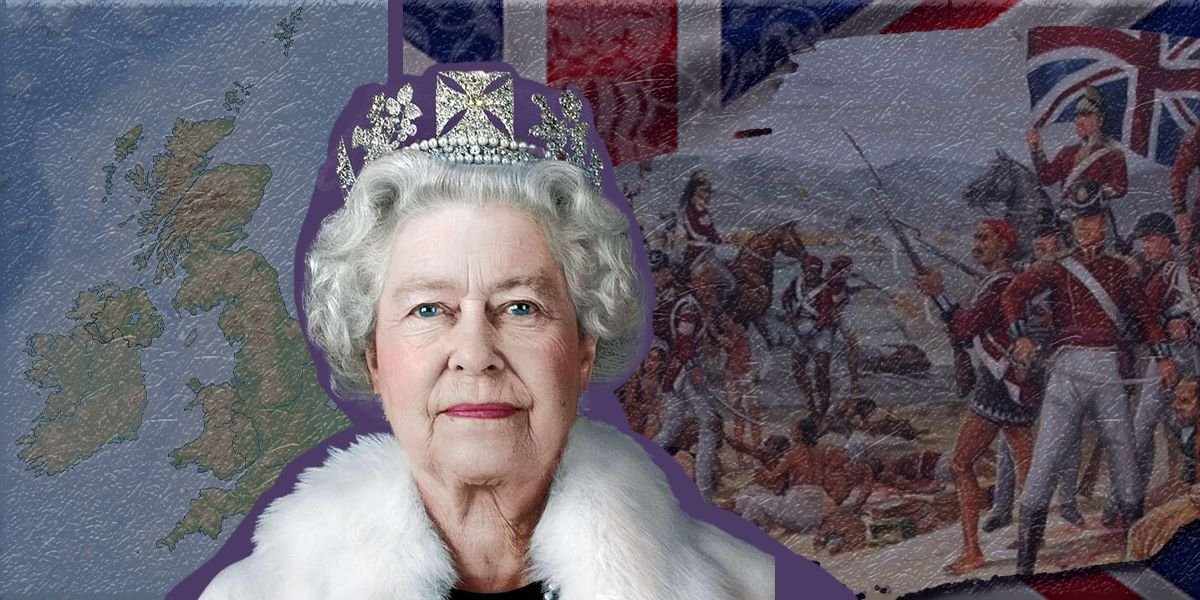
    As part of their ‘Cost Of The Crown’ series, investigating the British Royal Family’s wealth and finances, The Guardian has extracted a 46 page report from the Indian government which provided details of jewelry and other precious items stolen by the colonial British Empire during their reign over the sub-continent. Most of the gifts were handed over as gifts to Queen Victoria, the reigning monarch at the time.

    The investigation was commanded by the late Queen Elizabeth II’s grandmother, Queen Mary, to find out about the origins of her jewels.

    The report details the names of the jewels as well as their colonial origins and how they were stolen by the East India Company.

    1 Koh-i-Noor

    The legendary diamond Koh-i-Noor was taken from Maharaja Ranjit Singh’s kitty. The ruler of Lahorr had signed a treaty of friendship with the British in 1831, and six years later the then Governer-General of India, George Eden, and his sister, Fanny, visited him at his palace. The Guardian writes that Fanny had later written about Singh’s diamond collection, detailing how he decorated his horses with the finest diamonds she had ever seen:

    “If ever we are allowed to plunder this kingdom, I shall go straight to their stables.”

    in 1849, Singh and his heir, Duleep, were forced to sign over Punjab to the British army, who stole all of his jewels as a part of their conquest, along with the Koh-i-Noor.

    The diamond is part of the Imperial Collection, imbedded into Queen Elizabeth, the Queen Mother’s crown, worn by consorts.

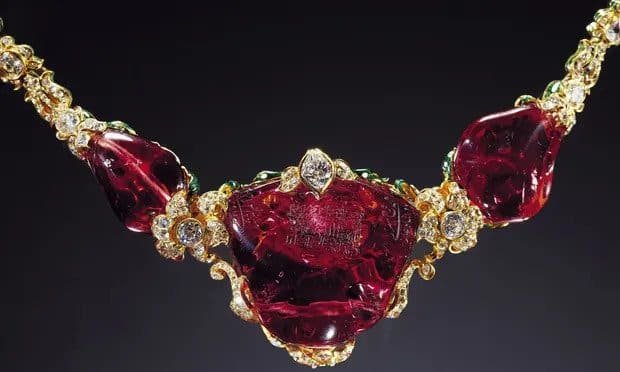
    2 The Timur Ruby gemstone

    Named after Timur, the founder of Timurind Empire in Central Asia, the gemstone is etched with the names of the five men who owned it: Jahangir (1569-1627), the 4th Mughal Emperor, Shah Jehan (1592-1666), the 5th Mughal Emperor, Farrukhsiyar (1685-1719), the 10th Mughal Emperor; Nader Shah (1688-1747), Shah of Iran; and Ahmad Shah Durrani (1722-1772), King of Afghanistan.

    By 1813, the gemstone was under the possession of Maharaja Ranjit Singh, who ruled over the Sikh Empire, and later was passed down to his heir Maharaja Sher Singh. From there, the necklace was inherited by his brother Duleep Singh, who became Maharaja when he was only five years old.

    During 1948- 49, when the British Empire waged wars over the Sikh Empire, the East India Company took over Punjab and forced the then ten-year-old Maharaja to hand over his possessions. Duleep Singh was placed under a Scottish guardian, isolated from contacting his fellow countrymen.

    3 Pearl necklace

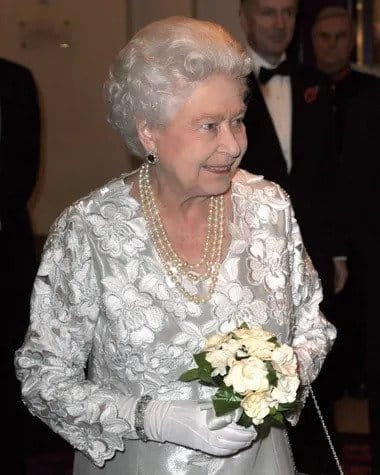
    Comprising of 244 pearls and a clasp of two magnificent rubies, the necklace had originally belonged to a ruler in Punjab, until it was stolen by the British. Queen Elizabeth II was spotted wearing this necklace at the Royal Opera House in London to celebrate her diamond jubilee.

    4 Emerald girdle of Maharaja Sher Singh

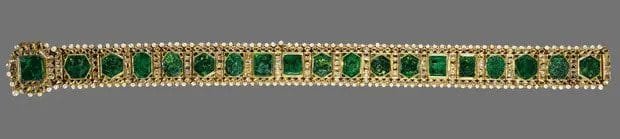
    The gold girdle inlaid with 19 emeralds first came to the public’s attention during Buckingham Palace’s celebration of Prince Charles’ 70th birthday, with a display of his favorite pieces from the royal collection. The item had previously belonged to an Indian Maharaja, Sher Singh, who used it to decorate his precious horses.

  • PM says doesn’t want to disrespect masses by talking in English

    PM says doesn’t want to disrespect masses by talking in English

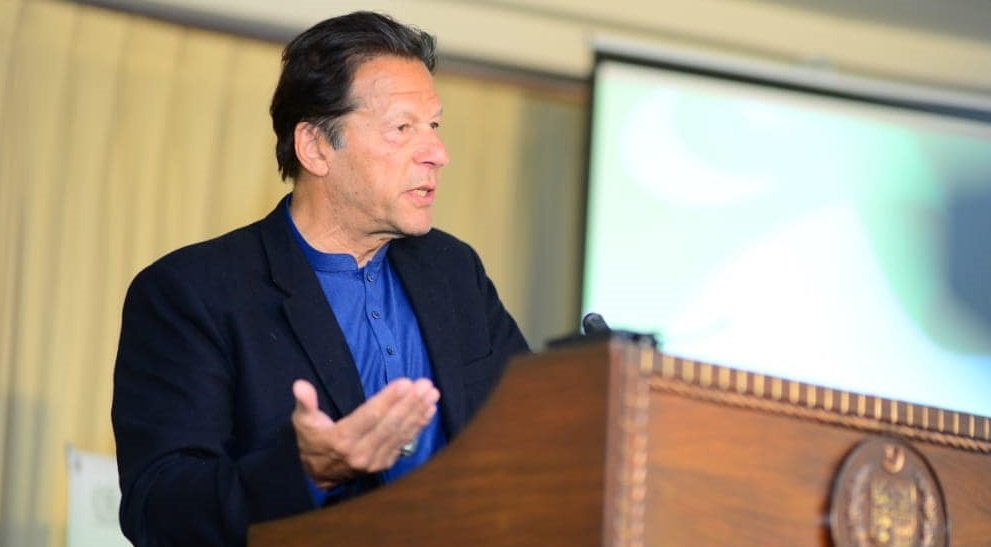
    Prime Minister Imran Khan has said that he doesn’t use English phrases in public because it would be disrespectful to the majority of Pakistani citizens who don’t speak or understand the language.

    The PM said he has an objection to using English as a language of communication because most people do not speak this language. “I would be fine with addressing events in English if everyone would speak the language,” the PM added.

    The remarks by the prime minister came a day after a much controversial video went viral on social media wherein the owners of a posh cafe in Islamabad were seen ridiculing their restaurant manager for his inability to speak English.

    Uzma and Diya, who own Cannoli Café Soul in Islamabad, have been at the receiving end of outrage for mocking and ridiculing their restaurant manager for his English speaking skills. In the video, the two women explained how their manager has been working at their café for nine years and has taken three language courses until now. 

    They then asked him to introduce himself in English and when he struggled with speaking fluent English, they made fun of him by commenting on the manager’s salary. The manager, Owais, was visibly uncomfortable in the video.

    They also issued a half-hearted apology after strong backlash.

    ‘INHERITANCE CERTIFICATES’:

    Addressing a ceremony in Islamabad on Thursday, the PM announced that inheritance certificates would now be issued within 15 days to make life easier for a common citizen. In past, it would take two years to get this letter issued, but now it will be done in two weeks.

    According to Radio Pakistan, the law ministry has devised a mechanism to establish Succession Facilitation Units in collaboration with the National Database and Registration Authority (NADRA) for the issuance of Letters of Administration and Succession Certificates within 15 days of initiation of the application by the legal heirs of the deceased.

    The PM also emphasised on reforming the civil procedure court, criminal justice system and ensuring women’s inheritance rights. “People friendly law reforms were being considered crucial by the present government aimed at ensuring justice through people-friendly legislation.