Tag: Community Development

  • New app revolutionises Hajj experience: Pilgrims to benefit from enhanced guidance

    New app revolutionises Hajj experience: Pilgrims to benefit from enhanced guidance

    In a significant move aimed at enhancing the experience of Hajj pilgrims, the Caretaker Federal Minister for Religious Affairs and Interfaith Harmony, Aneeq Ahmed, announced the launch of a dedicated mobile application during his visit to the New Haji Camp on Saturday.

    The app, unveiled to media representatives, is poised to streamline the journey for pilgrims, offering comprehensive guidance from their Hajj flight to their accommodation in Saudi Arabia.

    Minister Aneeq emphasised that the app will furnish essential information alongside instructional videos to aid pilgrims throughout their sacred journey.

    Among the innovative features, each pilgrim will receive a distinctive single-coloured QR code suitcase, easing the identification of personal belongings.

    Additionally, the government will provide a complimentary mobile SIM card from a Saudi company to every pilgrim, entailing 180 minutes for international calls.

    Notably, the caretaker government has also slashed the price of the official Hajj package by Rs 0.1 million, aiming to make the pilgrimage more accessible.

    Highlighting infrastructural enhancements, Minister Aneeq underscored the renovation of the New Haji Camp premises, coupled with the establishment of a vaccination centre tailored to cater to the needs of Hajj pilgrims.

    Furthermore, the Federal Ministry of Religious Affairs organised the ‘Interfaith Harmony Conference’, extending invitations to ambassadors from 30 nations in a concerted effort to foster global understanding and cooperation.

    In a bid to promote interfaith dialogue and mutual respect, Minister Aneeq outlined various initiatives, including the ‘Interfaith Harmony Dialogue’ held across prominent universities and religious institutions.

    Notably, scholars from diverse religious backgrounds, including Muslim, Christian, Sikh, Hindu, Parsi, and Jain, convened at St. Patrick’s Church, echoing a message of universal humanity and tolerance.

    Concluding his address, Minister Aneeq unveiled plans for the establishment of schools and clinics within mosques, commencing with the Badshahi Mosque in Lahore and slated for nationwide expansion, underscoring the government’s commitment to holistic community development.

    The collective efforts underscored by the Ministry reflect a comprehensive approach towards fostering harmony, facilitating pilgrimage, and promoting inclusivity, marking a pivotal stride towards a more cohesive and enlightened society.
  • Young Pakistanis in the UK lead in unemployment, govt stats confirm 

    Young Pakistanis in the UK lead in unemployment, govt stats confirm 

    Official data from the United Kingdom’s government shows that among different ethnic groups in the country, young Pakistanis are the least active in terms of work and education. 

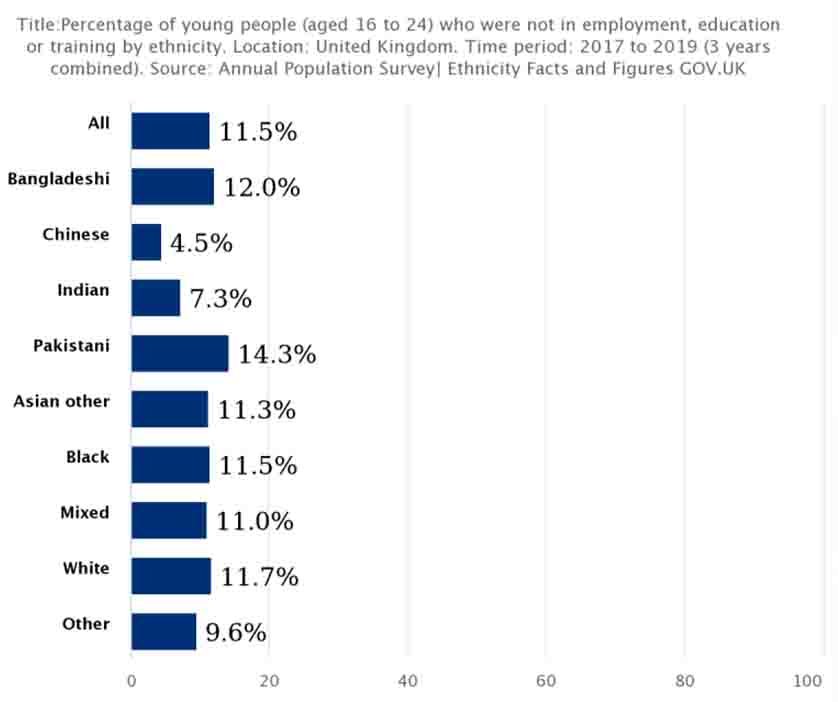
    The dataset in question is categorised as “unemployment,” encompassing individuals aged 16 to 24 who are neither employed nor engaged in any form of training or educational pursuits. This data was systematically collected over a three-year period spanning from 2017 to 2019. 

    Notably, within the spectrum of ethnic backgrounds in the UK, individuals of Pakistani origin stand out with the highest unemployment rate at 14.3 per cent, surpassing their counterparts from nine other nations. The next highest rate pertains to individuals of Bangladeshi descent at 12 per cent, while young individuals of Indian heritage exhibit a comparatively lower inactivity rate of 7.3 per cent, as indicated by the data. 

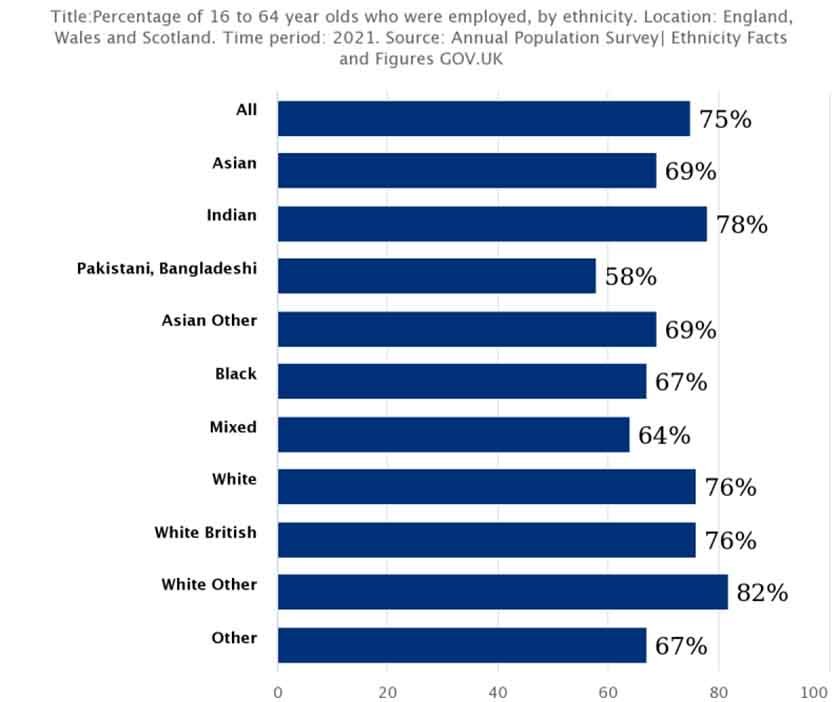
    A similar pattern is discernible when examining the overall employment data for the country, which encompasses individuals aged 16 to 64. In this context, Pakistani and Bangladeshi individuals are grouped together and collectively exhibit the lowest employment rate, standing at a mere 58 per cent, the lowest among ten defined categories. In contrast, individuals of Indian descent display a more favourable employment rate at 78 per cent, trailing only those of non-British white origin, of whom 82 per cent are gainfully employed. 

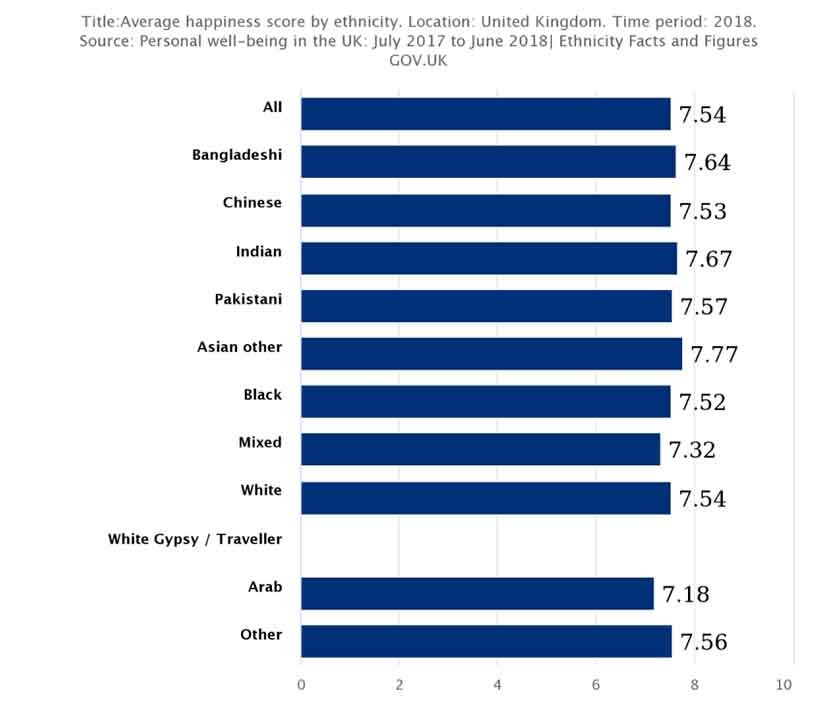
    It is worth noting, however, that the observed trends in employment and unemployment figures do not appear to have a conclusive impact on the overall happiness score, as the data does not differentiate by age and represents the broader community. The happiness index assigns a score on a scale of 10, and according to the data, individuals of Pakistani descent in the UK have a happiness score of 7.57, ranking as the fourth highest among the ten surveyed ethnic groups. 

    While individuals of Indian, Bangladeshi, and other ethnic backgrounds report higher levels of happiness than those of Pakistani origin, individuals of Arab, black, Chinese, and even white ethnicities exhibit lower happiness scores in comparison.