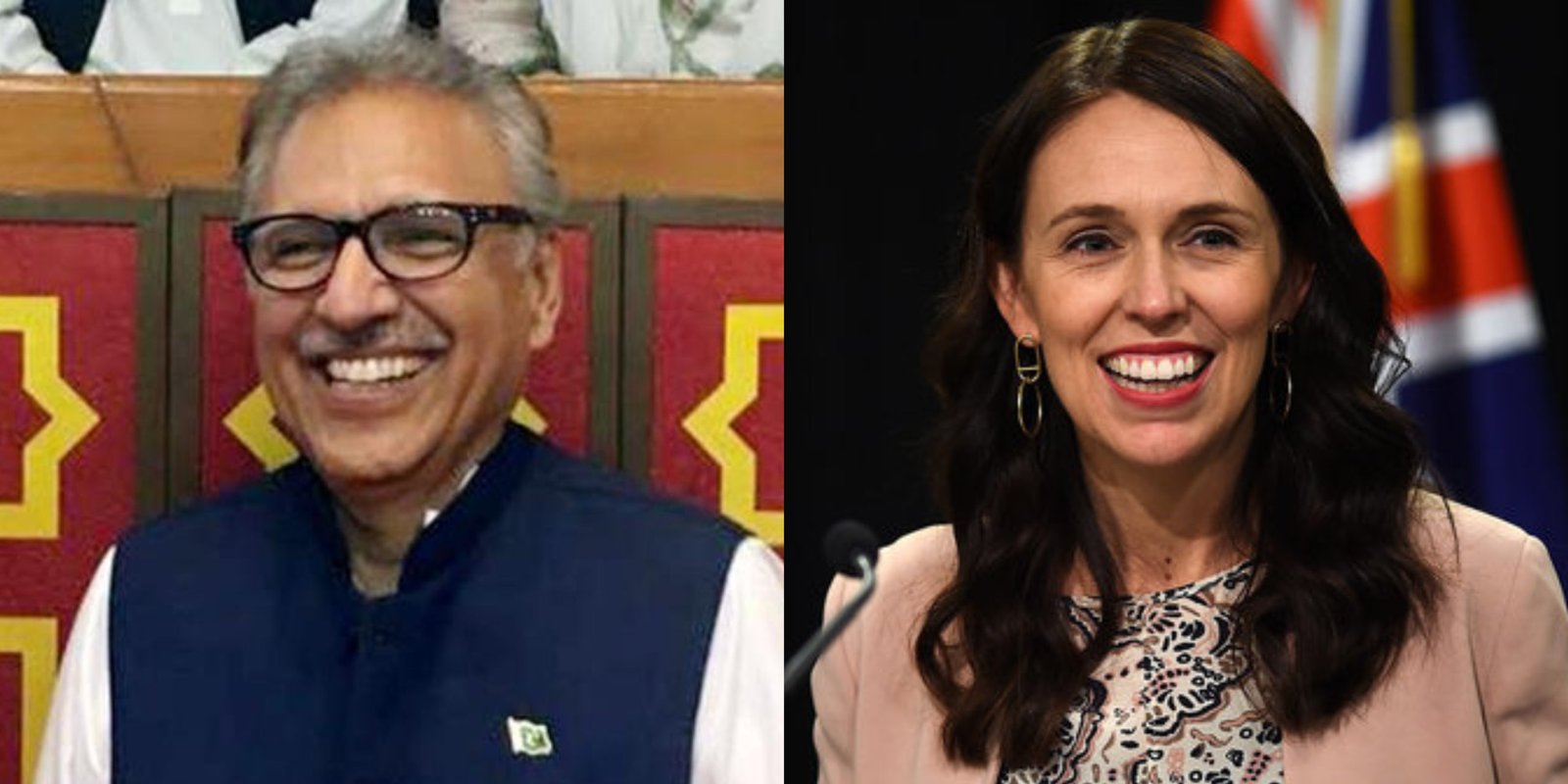
The story of New Zealand’s Prime Minister Jacinda Ardern and her fiancé, Clarke Gayford being turned away from a popular café in Wellington, which was full due to coronavirus social distancing rules, has gone viral on social media. People cannot stop appreciating Ardern for being modest and down-to-earth.
According to reports, Ardern and Gayford had gone to get brunch on Saturday at Olive, a popular restaurant in the capital, two days after the country eased many of its lockdown rules, but were turned down due to limited seating. Restaurants in the country are required to seat guests at least 1 meter (3 feet) apart from each other because of which many have limited their seating to comply with the rules.
Though the PM and her partner walked away, they were chased down by the restaurant’s management when a spot freed up.
Gayford even addressed the matter on social media and shared his side of the story.
I have to take responsibility for this, I didn’t get organized and book anywhere. Was very nice of them to chase us down st when a spot freed up. A+ service.
Meanwhile, a spokesperson from Ardern’s office, in an email, reportedly stated, that waiting at a cafe is something that anyone can experience during New Zealand’s virus restrictions.
“The PM says she just waits like everyone else,” read the email.
After Ardern’s story went viral on social media, President of Pakistan Dr. Arif Alvi’s son Awab Alvi came forward and recounted a similar story. Awab shared that a few days back, President Alvi had gone to buy Ras Malai from a local sweet shop, clad in a cap and mask. He said that President Alvi waited for half an hour in the line and followed all the necessary protocols.
dont have to look too far @PresOfPakistan does this often eg 2 days back clad in a Cap & Mask he went to buy Ras Malai at Jameels in ISB
He walked up to counter not realizing a social distancing line on side, was asked to follow line, he did & took him ½ hour to buy
Awab further said that if anyone has any doubts, they can check the CCTV footage.
Try and see if Jameels in Islamabad has CCTV ~4:30-4:45 this Friday you might actually see this incident
This is how I know one executive in Pakistan who tries his best to keep his feet on the ground (despite the security overload that comes with the office, which is imp) https://t.co/6rnSBy9oyt
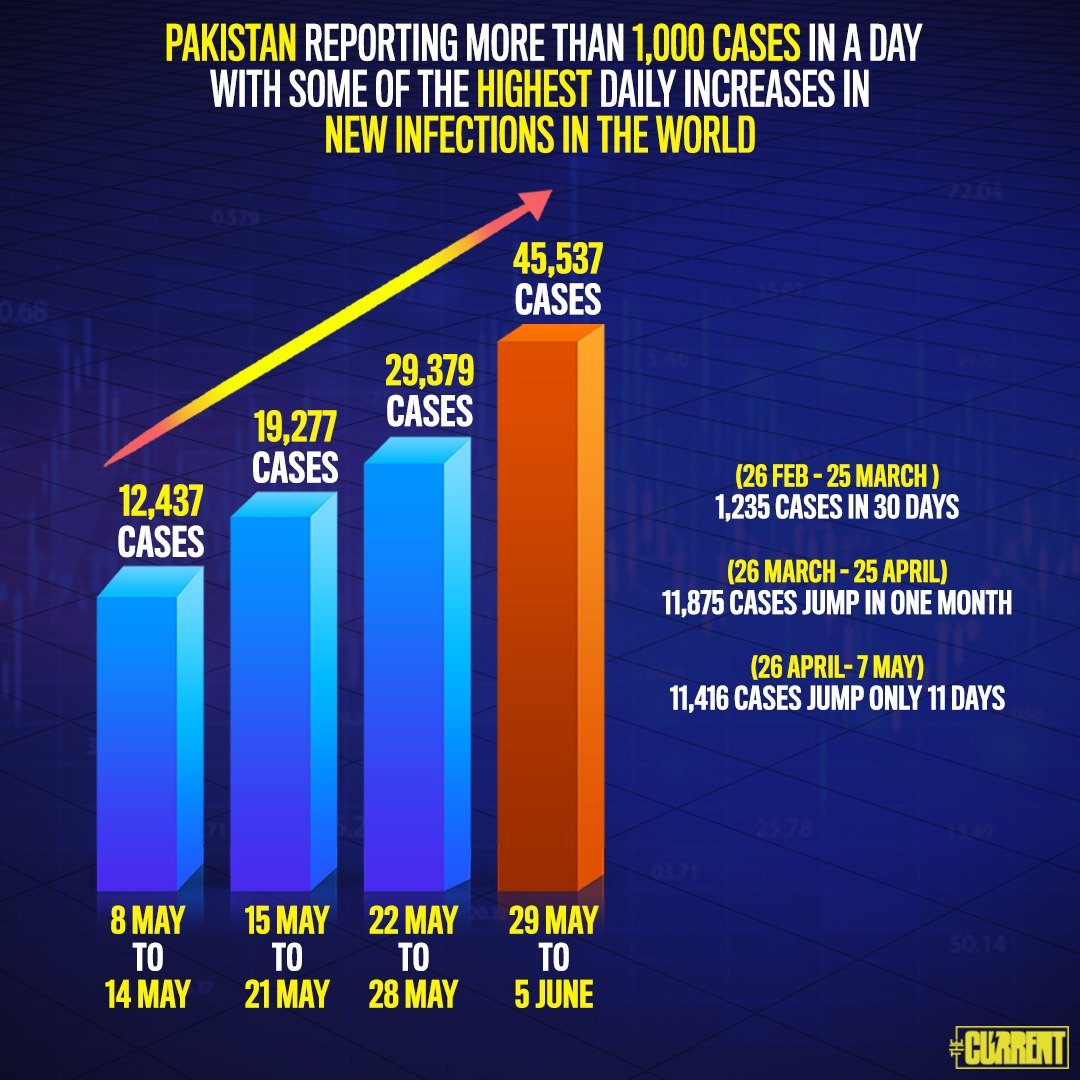
The number of coronavirus cases in Pakistan is likely to rise upwards of 45,000 by the first week of June, suggests the stable trend of rise in infections in the country since its first case of the COVID-19 was reported on February 26.
The tally reached 1,235 on March 25 (in 30 days), which was followed by an increase of 11,875 in a single month (until April 25) — putting the total number of infections past 12,000 — and later a record spike of 11,416 cases in just 11 days from April 26 to May 7.
The World Health Organization (WHO) has already warned that the number of COVID-19 cases in Pakistan can rise to 200,000 by mid-July if “effective interventions” are not taken.
Despite the rising number of cases, countrywide lockdowns have been eased to save the economy while the government is planning to entirely lift the ban on inter-city transportation ahead of Eid holidays.
The number of confirmed cases of coronavirus in Pakistan stood at 42,227 by the time this report was filed. The number of fatalities was 899 with 11,922 recoveries. Sindh had the most number of infections — nearly 18,000 — with Punjab trailing behind at 14,500 cases of COVID-19.
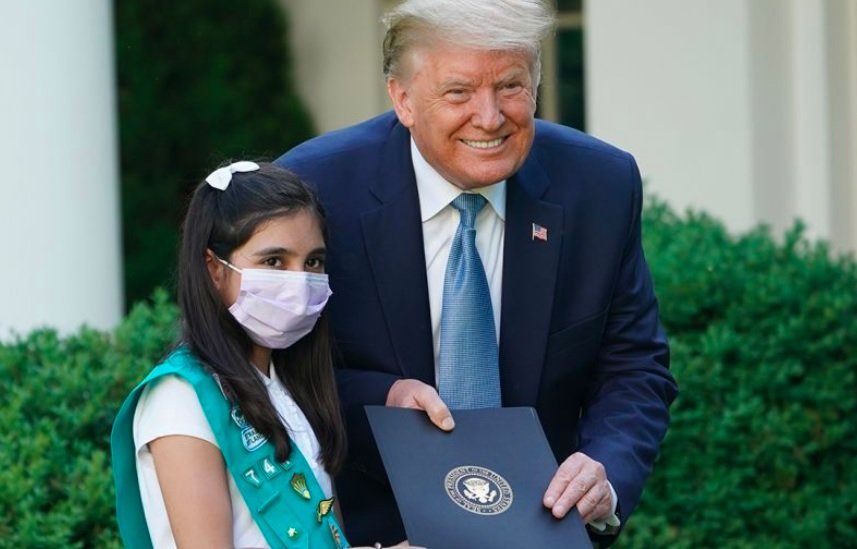
President Trump and first lady Melania Trump on Friday paid tribute to several American heroes who are helping on the front lines of the coronavirus crisis, including Girl Scouts from Maryland who donated cookies to nurses and firefighters. Among those girl scouts was a ten-year-old Pakistani-American girl Laila Khan.
According to a report in APP, Laila who hails from Maryland was recognised as American coronavirus hero as she had donated cookies to nurses and firefighters. Laila, along with Lauren Matney and Sravya Annappareddy – all 10 years old – had donated 100 boxes of Girl Scout cookies to local doctors, nurses and firefighters. They also wrote 200 personalized cards for health care workers.
Speaking about the recognition, Khan said: “While we are honoured that our troop was invited to be here today, we know that we are just part of the millions of other children out there that are doing amazing things to support their communities, their friends and their families. It is a privilege to be here representing all of them.”
Meanwhile, President Trump in a ceremony in the White House Rose Garden had said: “The men and women we honour today remind us that the bonds that unite us in times of hardship can also raise us to new heights as we reopen and recover and rebuild.”
Ambassador of Pakistan to the US Asad Khan also appreciated Laila and thanked President Trump for honouring her.
Thank you very much Mr President @realDonaldTrump. A moment of pride for the Pakistani Americans who are making important contributions in fighting Covid-19 both in the US and Pakistan. https://t.co/muldkkD5QZ
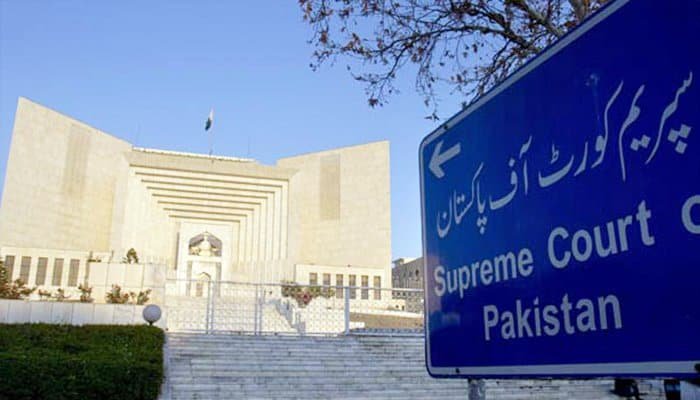
Despite coronavirus continuing to spread across the country, the Supreme Court (SC), which seems to be at odds with the government over the latter’s handling of the pandemic, has ordered the reopening of shopping malls across the country.
According to the details, a five-member larger bench of the apex court was hearing a suo motu case regarding measures taken to curb the spread of COVID-19.
The bench was headed by Chief Justice of Pakistan (CJP) Gulzar Ahmed while Justice Umar Ata Bandial, Justice Mazhar Alam Khan Miankhel, Justice Sajjad Ali Shah and Justice Qazi Muhammad Amin Ahmed were also on the bench.
During the hearing today, Chief Justice of Pakistan Gulzar Ahmed remarked that if the shops are shut down then shopkeepers will ‘die of hunger rather than the coronavirus’.
CJP Ahmed said that in Karachi, except for five big malls every market has resumed operations.
Upon which, Commissioner Karachi Iftikhar Shallwani said that a few markets were sealed for not following the Standard Operating Procedures laid out by the government.
“The sealed markets should be opened and instead of intimidating them (shop owners) make them understand (the situation and SOPs),” remarked the top judge.
The CJP noted that the SOPs will be ‘better implemented’ at the big shopping malls.
The apex court also ordered that on the weekends, all the small markets should remain open to public.
Last week when we wrote our editorial, there were a little more than 30,000 confirmed COVID-19 cases. At the time of writing this today, Pakistan’s confirmed coronavirus cases are more than 41,000. Deaths, too, have increased — last Sunday, they were more than 600… this Sunday, they are almost 900.
A spike of around 11,000 new cases and almost 300 deaths in just one week. This is the reality of coronavirus even though we will have to live with it. At least for a year or more.
And since we have to live with corona now, we should at least have some rules: face masks should be mandatory and for those who can’t afford them, the government should provide them. Qatar has made the wearing of face masks compulsory and anyone defying the order can face a jail term of up to three years. A fine of up to $55,000 has also bee announced for those who repeatedly fail to cover up.
We need to make and implement rules like these. If malls and shopping centres are open, proper protocols like social distancing must be followed and implemented by the local administration. Businesses and factories that have opened up or will be opening up soon should also follow strict SOPs. Anyone who fails to follow these rules should face imprisonment or heavy fines for endangering people’s lives. If there are no strict penalties, there will be no deterrent. And if there is no deterrent, then it is open season for coronavirus.
Just look at what happened at retail shops earlier this week. People thronged clothes shops and other markets. It was sheer madness. Some say it is because of the timings (shops are not allowed to open past 5 pm or over the weekend). But there is another view that says how many people still think of COVID-19 as flu and are not really bothered unless and until they or their loved ones get it. This is downright dangerous. Coronavirus is not flu. It has already taken more lives in just a few months than flu takes in an entire year. The damage coronavirus causes to vital organs of even those who survive it is way more dangerous than anything else.
Pakistan will see a peak at the end of this month and we can only hope that our health sector is able to deal with it.
We understand the economic implications of stricter measures but we should also realise that the global pandemic is leading the world to recession in the first place. Pakistan will be no different. The post-corona world is one that we may not even recognise. It will cause a lot of misery around the world, both in terms of being deadly and when it comes to financial hardships.
Shahid Afridi has contributed to Bangladesh’s COVID-19 relief efforts by buying a cricket bat put up on auction by Bangladeshi batsman Mushfiqur Rahim for $20,000.
The bat had been used by Rahim during his maiden double hundred in Test cricket. Rahim had made this score in Bangladesh’s match against Sri Lanka in the Galle Test of 2013.
This bat is very precious to me as I got my maiden double hundred in Test.Lots of memory is attached with it but decided to auction it for the welfare for my country men who are COVID-19 victims.Please come forward and let me help them. Stay tuned for further information-MR15 pic.twitter.com/b5RkHF6qlU
Afridi also shared the news and said that he and his foundation Shahid Afridi Foundation “believe that human suffering and empathy is beyond borders” and that he “hopes this small token will help build bigger bridges”.
In a video message shared by Rahim, Lala also appreciated Mushfiq for “doing wonderful work” for his people.
“Only real heroes undertake such efforts. We’re all experiencing unprecedented times, in which we need each other. I’ll always remember the love I received from Bangladesh,” said Afridi. “Buying your cricket bat on behalf of the Pakistani people, I wish to become a part of your journey.”
Cricketers and sportsmen around the world are auctioning their memorabilia to raise funds for coronavirus relief drives.
In the previous two years, Pakistan had started to pick its pace at a slightly high point and the economy had started to improve. Both the current account along with the non-oil current account had continued to improve after exchange rate reforms while sectors with the highest forward linkages i.e cement, iron and steel, had started to show an upward spike in production.
The fiscal side also seemed to strengthen over a period of time while growth in revenue collections at all levels, especially direct taxes, was also witnessed.
However, with the ongoing coronavirus pandemic raising its ugly head, the meager growth achieved is now threatened.
According to a World Bank (WB) assessment, the global impact of COVID-19 can reach $347 billion (0.4 per cent of Global GDP). Nearly all regions suffer a double-digit decline in trade volumes in 2020, with exports from North America and Asia hitting the hardest. But it is important to note that this hit was majorly experienced by countries with sizable exports due to trade problems while Pakistan has a low global value chains (GVC) exposure to the world, especially to People’s Republic of China (PRC), which means it has suffered lesser trade disruptions so far.
Trades have fallen steeper in sectors with complex value chains, particularly electronics and automotive products.
According to Urban Unit’s spatial industrial data, currently, 18 per cent of the industries in Pakistan are operational. These include the fertilizer industry, agriculture, agriculture spare parts and export industry, all of which are operating under conditions of following certain standard operating procedures (SOPs) developed by the Punjab government. However, strict monitoring from the government will also be required as an exemplary practice of these SOPs which will further encourage the authorities to open up other capital-intensive sectors.
On the monetary side, there are several efforts made by the government. Under a federal package, a Rs100 billion relief package has been provided to small and medium-sized enterprises (SMEs) and the agriculture sector along with concessional loans. Money is allocated to lower the input cost for farmers along with a Rs12,000 monthly package with facilities of panagahs [shelter homes] and langar centers [soup kitchens].
The Punjab government has also implemented tax reductions as all forms of GST have been removed from online platforms, businesses and services related to HR; deferment of tax has been implied for properties and CVT & stamp duties have been reduced to 2 per cent on property transactions, construction industries, hospitals and medical consultants. In addition to these, the State Bank of Pakistan (SBP) has provided relaxation in export schemes (EFS & LTFF) and has enhanced liquidity for exporters while providing extensions in the time period to ship and import goods against advance payment.
The central bank has also reduced its interest rate from 13.5 per cent to 9 per cent.
However, there are some further actions that the government can take in order to improve the current economic situation. A regulatory framework can be adopted keeping in view some of the best international practices from where many risk management practices can be learnt to determine the best price discovery (for example, the United States has dropped the interest rate to 0 per cent).
Secondly, allowing ease of entry for institutional capital in order to broaden the depth of the market i.e. attracting FDIs in newly established special economic zones in Faisalabad, Bhalwal, Vehari and Rahim Yar Khan by simplifying provincial and federal procedures. Thirdly, the role of aggregators, producers and organisations can be improved for better price negotiations for SME’s.
Fourth, access to foreign capital should be made easier and distortions should be minimised by developing linkages with the international markets. That means ease of doing business index, logistic performance index and reduced lead time for exports should be commenced. Lastly, e-markets should be developed where participants can access both international and domestic markets. An e-commerce policy at the provincial level must be put in place with incentives to increase documentation of economy and online trade at B2B B2C and C2C levels.
It is to be noted that Pakistan is not alone in this economic downfall. It is vital to have a positive outlook on the situation and prepare for the future with better resilience. Effective policies and active preparedness can give impetus to the post-pandemic industrial revival.
Meera, who recently returned from virus-hit New York after being stranded there for a couple of weeks has tested negative for COVID-19.
In a video posted to Instagram, Meera along with some other Pakistani students shared that they have tested negative for COVID-19 and are back home safe and sound. They said that they are ecstatic to be home, even though their journey took almost two days. They were quarantined at a local hotel in Lahore while they waited for their tests.
https://www.instagram.com/p/CAKXAtvnNxc/
Meera returned from United States on May 12 via a special flight arranged by the Government of Pakistan to repatriate stranded Pakistanis in the US.
In a video message posted to Instagram, the actor has shared that she is back in Pakistan and gave a special shoutout to the Pakistan Embassy in Washington and the New York Consulate for assisting her. Meera appreciated the work of the Pakistan Embassy and Consulate in the US and said that they facilitated her – and all other stranded passengers – at every step.
The new coronavirus may never go away and populations around the world will have to learn to live with it, the World Health Organization (WHO) has warned.
As some countries around the world begin gradually easing lockdown restrictions imposed in a bid to stop the novel coronavirus from spreading, the WHO said it may never be wiped out entirely, AFP reported.
The virus first emerged in Wuhan in China late last year and has since infected more than 4.2 million people and killed nearly 300,000 worldwide.
“We have a new virus entering the human population for the first time and therefore it is very hard to predict when we will prevail over it,” said Michael Ryan, the WHO’s emergencies director.
“This virus may become just another endemic virus in our communities and this virus may never go away,” he told a virtual press conference in Geneva. “HIV has not gone away — but we have come to terms with the virus.”
More than half of humanity has been put under some form of lockdown since the coronavirus crisis began.
But the WHO warned there was no way to guarantee that easing the restrictions would not trigger a second wave of infections. “Many countries would like to get out of the different measures,” said WHO chief Tedros Adhanom Ghebreyesus.
“But our recommendation is still the alert at any country should be at the highest level possible.”
‘LONG WAY TO GO’:
Ryan added that there was a “long, long way to go” on the path to returning to normal, insisting that countries would have to stay the course.
“There is some magical thinking going on that lockdowns work perfectly and that unlocking lockdowns will go great. Both are fraught with dangers,” the Irish epidemiologist said.
Ryan also condemned attacks on healthcare workers that were linked to the pandemic, saying more than 35 “quite serious” such incidents were recorded in April alone in 11 countries.
He said the attacks were often over-reactions from ill-informed communities — while others were more sinister.
“Covid-19 is bringing out the best in us, but it’s also bringing out some of the worst,” he said. “People feel empowered to take out their frustrations on individuals who are purely trying to help.
“These are senseless acts of violence and discrimination that must be resisted.”
But he insisted that in finding a way to conquer the virus was a chance for humanity to take major steps forward by finding a vaccine and making it widely accessible.
“It’s a massive opportunity for the world,” Ryan said.
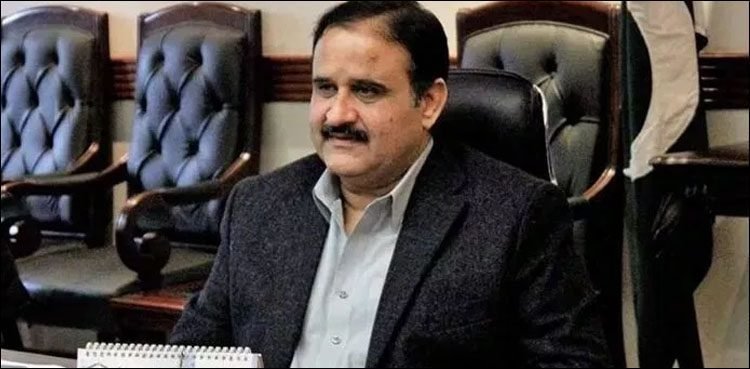
Punjab Chief Minister (CM) Sardar Usman Buzdar has given his permission for coronavirus patients with mild symptoms to quarantine themselves at home rather than being admitted to a government facility.
According to a notification issued by the Punjab Primary and Secondary Healthcare Department, the Punjab chief minister, on the directions of corona expert advisory group and technical working group, has advised for following standard operating procedures (SOPs), devised by the International Health Organisation (IHO) for home isolation.
He said that the patient would be kept in isolation under the supervision of the district health authority concerned in his or her house where all necessary facilities were available.
He said that such hotels, school buildings, mosques, hostels and community centres could also be used for isolation where all necessary facilities were provided by the government which would also take the responsibility to disinfect the buildings on a daily basis.
“However, buildings, where cooling and heating systems can cause the spread of the virus, cannot be used for isolation,” he made it clear.
Buzdar said that solid waste of patients would be disposed of according to the given guidelines.
The CM said that food would be provided to the patient in only disposable packs. He said that decision of home isolation of any patient would be made by home isolation committee, formed by the assistant commissioner of the area and assistant commissioner or his representative, DDO Health and chief officer of the area concerned would be members of the committee.
“Population Welfare, Livestock, Excise and Taxation staff would monitor and report about the isolation committee and three isolation committees would be formed in one union council in which at least one doctor would also be a member of the committee, whereas one committee would be constituted in a rural union council with one doctor in it,” the CM said.
The chief minister said that the committee would also review space for keeping patients in home isolation according to the number of family members whereas the family would be informed about the SOPs before allowing any patient home isolation.
“The patient would be bound to inform the authorities about his condition on a daily basis and testing protocol would be mandatory for the patient,” he said.
The chief minister said that the period of home isolation would be for 10 days and for removal of home isolation conditions, the patient had to show at least two negative corona tests and after the termination of home isolation, another test would be conducted after five days.
In case of non-availability of the test, the patient would have to stay in quarantine for more than two weeks.