Tag: coronavirus

  • Nabila says that she will not be bullied

    Nabila says that she will not be bullied

    One of Pakistan’s leading salons, which has branches in major cities of Pakistan, Nabila’s Salon, recently announced that they would open up the salon for business after taking all the necessary precautions.

    Nabila, in a video, said that the service industry is suffering the most due to the pandemic but that “we all have a choice”.

    “We all have a choice. We can either live in the circle of concern, freak out, watch the news or wait for things to happen, or we can live in the circle of influence and take full charge,” said Nabila.

    She then went onto say that because she is an optimist, she would choose the latter option and make decisions regarding her personal and professional life by ‘Raising the Bar’.

    https://www.instagram.com/p/B_pgjS8he47/

    The salon, in a video, stated that it will be “a safe space with a superior level of hygiene combined with best practices and medical level sanitisation to ensure the health and well being of everyone who walks through our doors.”

    https://www.instagram.com/p/B_pvVhwBZgx/

    Read more – ‘Barber on Wheels’ offers haircuts at home with all safety measures

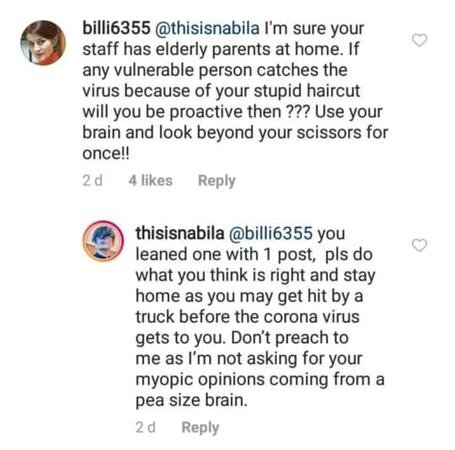
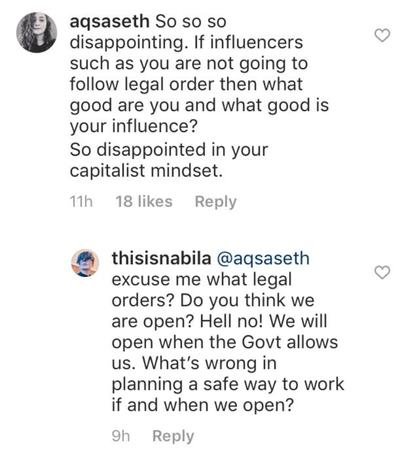
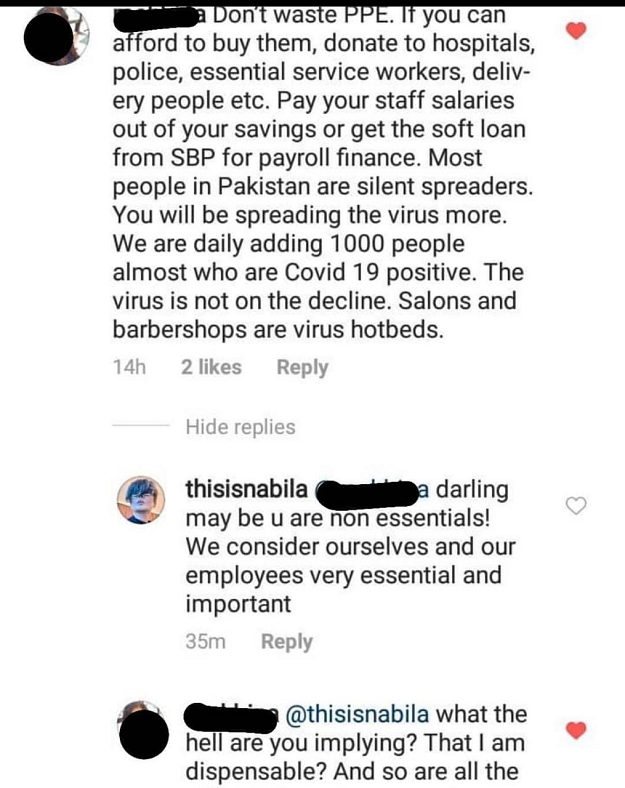
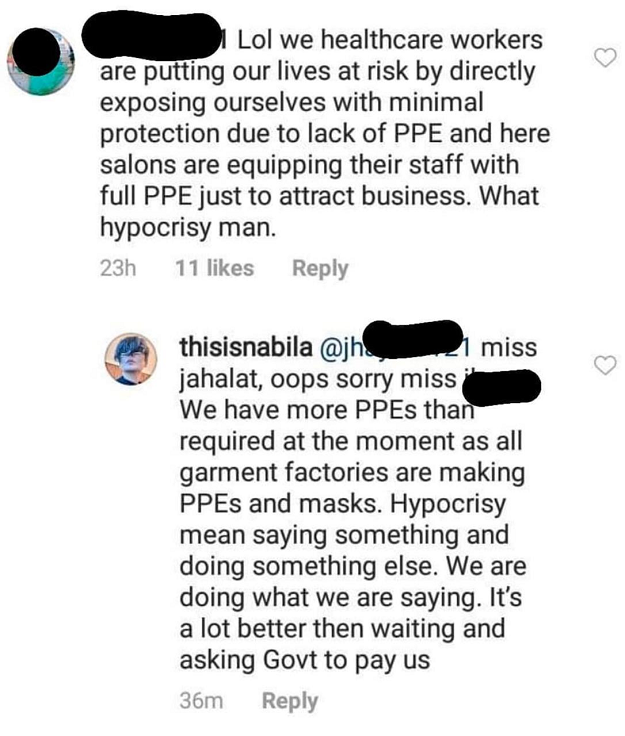
    The salon’s announcement to open was met with immense backlash and Nabila took to personally respond to them and defend her decision. While comments have now been disabled on the post, screenshots are being widely circulated on social media.

    Later while speaking to various media outlets, Nabila said that she will not be bullied. She said that she has not opened the salon as yet but will wait for the government to give the green signal. She said the videos the salon had posted were to tell their clients of the precautions they will be taking once they open and to also let the government know that they are fully equipped to provide services. Nabila shared that she consulted doctors and experts before making her decisions.

    https://www.instagram.com/p/B_1Y9MSJiG2/

    The entrepreneur further added that as the President of Pakistan’s Hair and Beauty Association, it is her duty to ensure that her industry, which employs thousands of workers, is also looked after. She said that she spoke to several salon owners who were also feeling the brunt of the pandemic as they have workers and staff to pay and they decided that they will prepare themselves and then approach the government to allow them to provide services with the necessary SOPs and precautions in place.

    On the question of wasting PPEs, Nabila said that the country is now producing a surplus of protective equipment and that a friend of her’s who has a garment factory lent her kits for the promotional videos. She said that if needed, she will place an order with him for the salon.

    Nabila stood her ground and said that she is being responsible and proactive. She said that she also has employees to pay and that for the past two months, she has been paying them from her own pocket.

    Nabila added: “We are responsible for the bread and butter of hundreds of families. How can we not think of ways to fall in line with this new norm? Should we not be considering the possibilities on how the world would work post-corona?”

  • Pakistan to lose Rs628,000,000,000 by June

    Pakistan to lose Rs628,000,000,000 by June

    A report prepared by the sub-committee of the National Coordination Committee (NCC) for coronavirus has said that the country, due to an adverse impact of COVID-19 on the economy, will record a loss of over Rs628 billion by the end of the current financial year.

    The report ‘COVID-19: Preliminary Macroeconomic and Socioeconomic Assessment’ said almost all the departments of the country were going in a loss due to lack of human activity in the wake of the pandemic that has killed over 200,000 people worldwide.

    Giving a breakdown of the losses, the report said the Aviation Division will face an estimated financial loss of Rs13.6bn; the Pakistan Stock Exchange Rs250bn; Petroleum Division Rs 87bn; Ministry of Energy (Power Division) Rs136bn; Pakistan Railways over Rs7 bn; National Food Security Rs 55bn; Overseas Pakistanis over Rs 76bn; Ministry of Information Technology Rs1-5bn under the head of withholding tax; and Maritime Affairs will report a loss of Rs30 million.

    It further said that the Federal Board of Revenue will face a total estimated revenue shortfall of Rs600bn in the last three months of the current financial year.

    The report also suggested the way forward to deal with losses, saying some measures have already been taken.

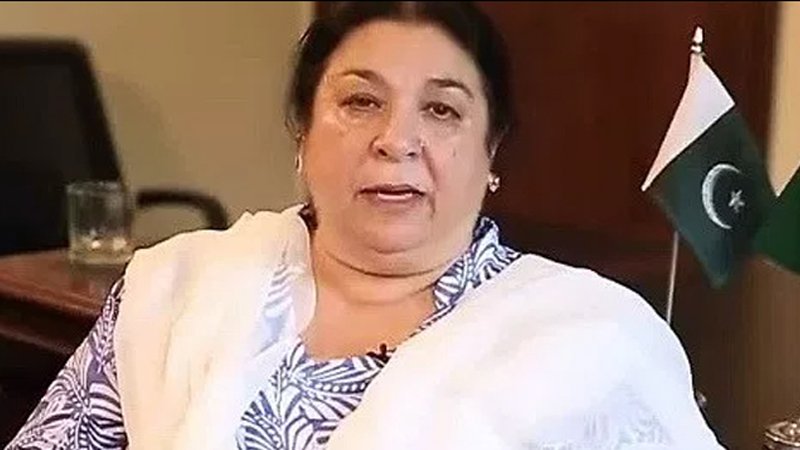
  • Can’t test people only to see if they have coronavirus or not: Dr Yasmin Rashid

    Can’t test people only to see if they have coronavirus or not: Dr Yasmin Rashid

    In a statement for which she is being trolled, Punjab Health Minister Dr Yasmin Rashid has said that the government cannot conduct tests of people “only to check if they have coronavirus or not”.

    Reports quoted the minister as contradicting the only utility of the tests amid the global COVID-19 outbreak, leaving people wondering what else were tests being conducted for.

    She further said that 90 per cent of coronavirus patients reported to the health officials had shown no symptoms after contracting the virus.

    “We need to create awareness among the masses regarding coronavirus and how it could be avoided,” the minister said, adding that Pakistan had less cases as compared to several other countries across the globe.

    Dr Yasmin further said that the nation had to show a compassionate behavior towards the masses at the time of the pandemic.

    Separately, she said that the Punjab government had conducted 101,897 tests so far, out of which 5,043 were conducted in a single day on May 4.

    “8103 cases were reported positive, we sadly lost 136 people but by the grace of Allah SWT 2,716 patients recovered fully to return home safe & sound [sic],” she tweeted.

    PUNJAB LOCKDOWN:

    Meanwhile, the Punjab government has decided to ease the ongoing lockdown after May 9 as the provincial tally of COVID-19 infections reaches 8,693 — highest in the country.

    Textile, steel and spare part shops will be allowed to operate for six hours. Shopkeepers have reportedly been directed to strictly follow SOPs while dealing with the public.

    Parks will also be reopened but swings will remain closed.

    The province made the announcement prior to the National Command and Operation Centre meeting that is due to take place today.

    Planning Minister Asad Umar will chair the meeting in Islamabad to decide whether the country-wide lockdown will be extended after May 9 or not. The chief ministers from all provinces will attend the meeting via video link.

    It is expected that the provinces will be told to decide on lockdown restrictions by themselves.

  • LUMS breaks silence on fee hike amid coronavirus outbreak

    LUMS breaks silence on fee hike amid coronavirus outbreak

    Lahore University of Management Sciences (LUMS) clarified on Monday that the hike was decided before the Covid-19 outbreak in the country. This official statement came when people were protesting on Twitter against 41 per cent tuition fee increase.

    The statement was issued by the office of Vice-Chancellor Dr Arshad Ahmed which states that the increment was “entirely consistent with prior years and took into account extraordinary increases in inflation, energy costs and currency devaluation.”

    According to reports, per credit hour fee has been increased by 13 per cent. On average, students opt for 16 credit hours per semester, this adds up to 41 per cent overall increase in tuition fees.

    “The increase was 13 per cent which we will monitor in determining the next fee card. Previously, a blanket fee was being charged for students registering between 12 to 20 credit hours. This fee is now [being] calculated on per credit hour basis which will increase the semester fees for some and decrease it for others [depending on the number of registered credit hours],” the statement said.

    Furthermore, one of the reasons behind increasing the fee is to “discourage students from taking course overloads which negatively impacts their learning.”
    “LUMS fees cover a fraction of the total costs. As a not-for-profit university, gifts from donors, trustees, etc. helps to subsidize one out of three students.”

    Yesterday, ‘#LUMSFeeHike’ was trending on twitter after the Lahore University of Management and Sciences (LUMS) confirmed its students through email that they would increase tuition fee by 40 per cent for the upcoming semesters.

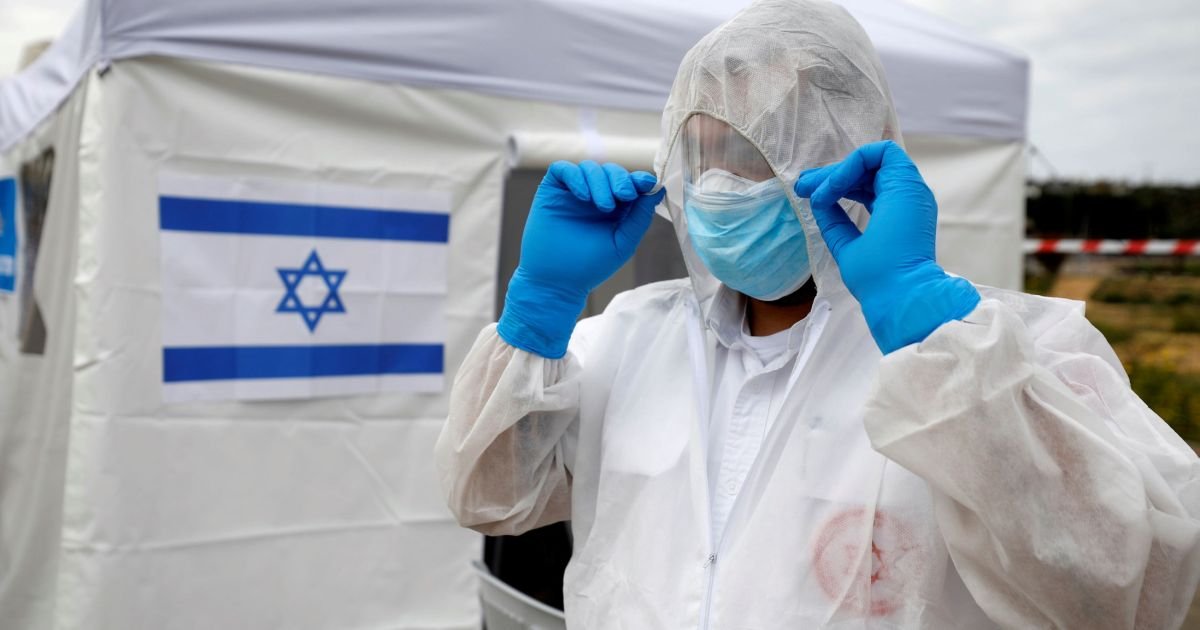
  • Israel makes ‘significant breakthrough’ as it develops protein that can overcome coronavirus

    Israel makes ‘significant breakthrough’ as it develops protein that can overcome coronavirus

    Israel has isolated a key coronavirus antibody at its main biological research laboratory, the Israeli defence minister said on Monday, calling the step a “significant breakthrough” toward a possible treatment for the COVID-19 pandemic.

    The “monoclonal neutralising antibody” developed at the Israel Institute for Biological Research (IIBR) “can neutralise the disease-causing coronavirus inside carriers’ bodies,” Defence Minister Naftali Bennett said in a statement.

    The statement added that Bennett visited the IIBR on Monday where he was briefed “on a significant breakthrough in finding an antidote for the coronavirus”.

    It quoted IIBR Director Shmuel Shapira as saying that the antibody formula was being patented, after which an international manufacturer would be sought to mass-produce it.

    The IIBR has been leading Israeli efforts to develop a treatment and vaccine for the coronavirus, including the testing of blood from those who recovered from COVID-19, the respiratory disease caused by the virus.

    Antibodies in such samples — immune-system proteins that are residues of successfully overcoming the coronavirus — are widely seen as a key to developing a possible cure.

    The antibody reported as having been isolated at the IIBR is monoclonal, meaning it was derived from a single recovered cell and is thus potentially of more potent value in yielding a treatment.

    Elsewhere, there have been coronavirus treatments developed from antibodies that are polyclonal, or derived from two or more cells of different ancestry, the magazine Science Direct reported in its May issue.

    Israel was one of the first countries to close its borders and impose increasingly stringent restrictions on movement to hamper the domestic coronavirus outbreak. It has reported 16,246 cases and 235 deaths from the illness.

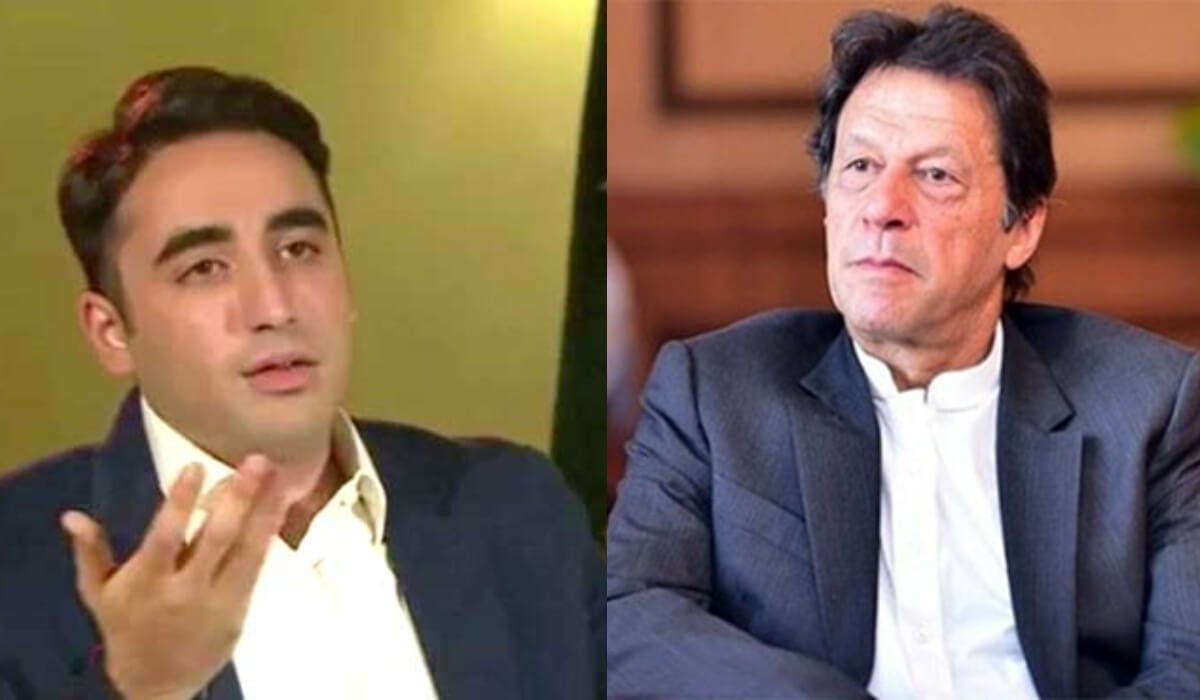
  • Bilawal seeks Imran’s voluntary resignation over ‘coronavirus failures’

    Bilawal seeks Imran’s voluntary resignation over ‘coronavirus failures’

    Pakistan People’s Party (PPP) Chairman Bilawal Bhutto-Zardari has said that Prime Minister (PM) Imran Khan should voluntarily resign and appoint someone else in his stead, as tensions between the Centre and Sindh government continue to rise as COVID-19 cases continue to spike across the country.

    Talking to Sindhi language news channels, Bilawal slammed the premier for a lack of consensus in the country on how to tackle the persisting coronavirus situation.

    “We [PPP] have been demanding the prime minister to step down since day one,” said the PPP chief. “Keeping in mind the coronavirus situation, I am not asking for his resignation. But Imran Khan should start working as a prime minister. He should play his role in uniting provinces in this crisis.”

    Bilawal urged PM Imran to voluntarily resign under these difficult circumstances and appoint someone else in his stead. The PPP chairman said that a national consensus was necessary to win the fight against the coronavirus. “The whole state should be on the same page against the coronavirus,” he said, adding that the prime minister was responsible for the absence of it. “The federal government is responsible for ensuring a consensus is reached.”

    Bilawal praised the Sindh government for providing relief to the masses as cases in the province continue to surge. “Sindh government is taking brilliant steps to provide relief to people,” he said. “CM Sindh has also joined hands with welfare organisations. People are being provided relief today due to the initiatives taken by the PPP,” he added.

    He said that Sindh government was about to kick off “phase two” of its plan to ward off the coronavirus. “We are providing relief to the people despite facing a shortage of resources,” he said.

    Referring to criticism over his statement on Karachi and Sindh a few days ago, Bilawal said that some people were presenting his remarks in a negative light and taking them out of context. “I consider it an insult to answer these [accusations],” he said, adding that those who were criticising him were working on their agenda to break up Sindh.

    The remarks came a few days after the PPP chairman hit out at the federal government in a fiery presser, slamming it for neglecting doctors and medical officers throughout the country.

    “Can you imagine Pakistan declaring war and sending its army without guns, bullets, and a uniform?” he had said.

    The PPP chairman had lamented that the doctors were only demanding two things — protective gear and a reduced burden on hospitals so that they may carry out their jobs more effectively.

    “The prime minister has failed to deliver […] He mentioned daily wagers in all of his addresses, but sadly none of them has received a single dime yet,” he had regretted.

    It is our responsibility to provide for them like we would provide for our armed forces, he said, adding: “We are trying to provide for our doctors who are in contact with COVID-19 patients, I know that all provincial governments are playing their due role as well.”

    “But the Centre should also play its role in supporting the provinces in the war against coronavirus,” he had said.

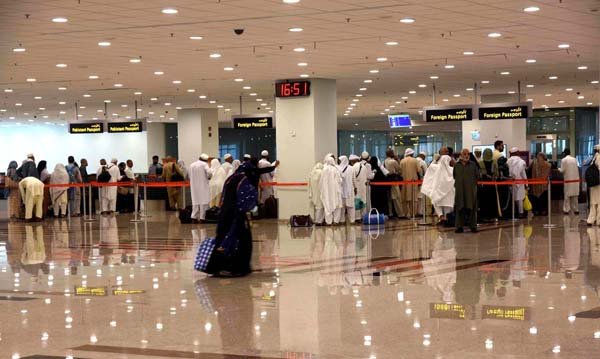
  • Flight from UAE carries 104 coronavirus patients to Pakistan

    Flight from UAE carries 104 coronavirus patients to Pakistan

    The Rawalpindi district administration on Monday said that 104 passengers who were flown in from Abu Dhabi have tested positive for coronavirus.

    “Out of 209 passengers, 104 tested positive for COVID-19,” the district administration said, adding that the flight carrying the passengers had arrived in Islamabad on April 28.

    Following the SOPs prepared by the government, all the passengers were screened at the airport and were shifted to the quarantine centre at Fatima Jinnah Women University.

    With the country having blocked all international commercial flights since mid-March — a ban that’s now set to continue for an indefinite period of time — many of the country’s residents have struggled to find a path back to their homeland, making government repatriation flights a necessity.

    On the other hand, Pakistan has reported 22 more fatalities from novel coronavirus as the death toll in the country has reached 471. The nationwide tally of COVID-19 patients jumped to 20,725 while over a thousand cases were reported in 24 hours.

    According to the latest figures by the National Command and Operation Center, Sindh remains the worst-hit province by the pandemic followed by Punjab, Khyber Pakhtunkhwa (KP) and Balochistan.

    Till now 7,882 coronavirus cases have been confirmed in Sindh, 7,646 in Punjab, 3,129 in KP, 1,218 in Balochistan, 415 in Islamabad, 364 in Gilgit-Baltistan and 71 in Azad Jammu & Kashmir (AJK).

    Earlier in the day, it was reported that three crew members of a special PIA flight from Australia had also tested positive for COVID-19.

    The PIA staffers had performed duties on the flight from Melbourne to Lahore.

  • Mixed signals in the time of corona

    The total number of coronavirus cases in Pakistan, by the time this was written, stood at 19,854 and the same is likely to reach the 20,000 mark some time today or by tomorrow morning.

    Every ten days, the number of COVID-19 cases in Pakistan double. Just look at the month of April and how many cases increased, especially after easing down the lockdown. The government, however, thinks that coronavirus has not been “as fatal in Pakistan as it has been in many other countries”, especially the west.

    Minister for Planning, Development and Special Initiatives Asad Umar recently said, “Coronavirus has caused 58 per cent more deaths in the United States (US), 207 per cent more in Spain and 124 per cent more in the United Kingdom (UK) as compared to Pakistan in the same period.” Even if we think the mortality rate is lower when compared to other countries, it does not mean we have to be lax about it. Official projections predict 150,000 cases by the end of this month.

    What was even more surprising was how, in a recent speech, Prime Minister (PM) Imran Khan shifted the blame of the lockdown to the “elite”. He said the decision to impose a lockdown was taken by the elite and the rich, without thinking of the poor. PM Imran tweeted to that effect also while felicitating Muslims for Ramzan.

    The premier blames the elite and rich for taking this decision when it was indeed he and his government that imposed the lockdown. Granted that Imran himself was against the lockdown and finally gave in due to the health emergency but blaming the elite, in this case, is quite misplaced. The World Health Organization (WHO) and others who are dealing with the coronavirus pandemic have recommended lockdowns and aggressive testing apart from social distancing and other measures that we have to take in order to avoid falling prey to this pandemic.

    China went for a lockdown and PM Imran doesn’t tire of giving China’s example so why blame the rich and the elite for a lockdown in Pakistan — a lockdown that is now not much of a lockdown either. Traffic has increased, more shops are open, and except for Sindh, mosques are open as well during Ramzan.

    While we acknowledge that self-isolation is a privilege that isn’t afforded by many, especially the poor, we do not have the answer to how we will cope with an outbreak if cases start to rise exponentially. Doctors have recently warned that Pakistan’s healthcare system will collapse if this happens. So where will the poor go if lockdown is relaxed and they get coronavirus?

    The rich and elite and privileged will go to private hospitals but what about the poor? We have to choose between struggle and death, and can only hope that the cases in Pakistan remain low.

  • Rethinking a post-COVID-19 future

    Rethinking a post-COVID-19 future

    “We should not go back to the old ways.”

    We are living through a global pandemic and life as we knew it will perhaps never be the same again, That’s the hope anyway. Because there are a lot of things about the way life was before that need rethinking — and COVID-19 has given us an opportunity to do this.

    In the 21st century, there was life before the virus, there is now lockdown and life during the virus and, at some point, there will be life after the virus — but will the latter be the same as our old way of living? There is much discussion now of ‘getting the economy going’ again, of getting things back to ‘normal’ again but is our plan just to restore the same economic model and the same old systems?

    Or is now the time to rethink the way we live?

    Several falsehoods about our lives have been exposed by the lockdown. Key among these is the myth that the old way of working and studying was the only way: fixed hours of attendance at sites you had to physically travel to. It turns out that this ‘hazri’ culture is not actually essential, and many of these ways of working were just constructs whose aim was to strengthen a type of corporate or darbari culture. Not allowing people to work from home stemmed perhaps from a reluctance to lose control of staff. The institutions that would hire expensive consultants to help them ‘save money’ and work efficiently told us that it was too expensive to have individual desks for staff and subjected them to the horrors of hotdesking. This apparently ‘saved’ some money yet these same organisations would be reluctant to allow staff to work from home routinely even though that would have saved even more money. The permission for ‘working from home’ was given not as the norm, but as some kind of great favour or concession which involved HR, applications and a degree of workplace politics.

    Well now nearly everybody’s working from home and we realise this has actually been possible for many, many years and that perhaps the workplace would have caught up with technology long ago if there weren’t so many dubious management practices and vested interests involved. Apart from the workplace, there is the question of the classroom and what it is — is it a physical reality or an intellectual one? In Britain, university education was once state-funded and all about education rather than businesses.

    “We’ll have to rethink education completely — especially university education.”

    But in the last decade universities have been turned into businesses which are less about education and more about profits. The students are called ‘clients’ and since university fees are now more than three times what they were ten years ago, they are saddled with crippling student debt (student loans are given by a private profit-seeking company). Students invest so much that they are afraid to challenge intellectual views of question anything professors say because they know that they need to get good grades because of their investment. Instead of concentrating on the wellbeing of their students, universities seem to have become more focused on marketing their brand in order to attract a maximum number of ‘customers’ or ‘clients’. But even when the riches poured in, it never seemed to be the academic staff who’d benefit but rather the ‘managers.’

    We’ll have to rethink education completely — especially university education. In Argentina, most young people get their first degree while working full time. Work by day and take evening classes. It might take longer but it definitely seems to be a more productive way to live. Oh, and state universities are free.  Of course, education can not all be virtually based but perhaps a large part of it does need to be.

    Then there’s the question of how society values work. Of how bankers are more highly paid and valued than ‘unskilled’ workers. How financial managers are much better paid than medical professionals. Now we realise who are the professionals that society really needs when in times of trouble: they are the medical professionals, the cleaners, the garbage collectors, the bus drivers, the police, the fire brigade, the people who run food shops and stack shelves. These are essential, these are the people we should value, these are the jobs we need to pay people well to do.

    We need to think of new businesses too. Instead of having an endless number of restaurants and coffee shops to ‘provide employment’ perhaps we should have more businesses whose goal is to contribute to community welfare employing people. We need more cooperative models of working and more localised businesses. Instead of manufacturing fast fashion and throwaway clothes which encourage frivolous spending and whose plastic fibres are clogging up the oceans and rivers, we perhaps should concentrate on businesses that produce food.

    “And guess who governments need to fund now? Not bigshot entrepreneurs and investment bankers, they need to support medical professionals, health workers and research scientists.”

    The virus and subsequent lockdown exposed a number of vulnerabilities in life as we were living it, and one of these was the matter of food production and supply. Perhaps now we need to have a national policy of localised production: local dairy farming, local livestock, locally grown fruit and vegetables. Apart from the fact that this will avoid the issue of complicated supply chains, many people in the health, economic and development sectors have long argued that this is a healthier and more sustainable way to live. This way food production would be organic and fresh – not shipped from the other side of the world. And in terms of food, we need to unlearn the mantra that endless choice is good. The illusion that the more choice you have in choosing, for example, a brand of chocolate shows how ‘free’ you are as people needs to be dispelled. And we need to move back to the idea of quality not quantity in the way we live.

    And new initiatives need to be set up to care for the environment. The enforced detox brought on by the lockdown has shown us bluer skies, clearer air and cleaner waters. We need to have a policy of setting up local initiatives to support this which are goal-oriented and not just motivated by a profit motive.

    And guess who governments need to fund now? Not bigshot entrepreneurs and investment bankers, they need to support medical professionals, health workers and research scientists. And they need to provide free broadband and digital access to all citizens because when push comes to shove this is something that will benefit the whole of society. We need more government spending, new frameworks and new initiatives based on a clear vision of what our priorities are now.

    People and governments need to come together and come up with a new way to live and a new model of economics, We can make a whole new sort of world; a world minus dodgy ‘outsourcing’, privatisation, unsound financial instruments, economic disparity and unbridled greed. But what’s needed is a lot of imaginative ideas and a bold new way of thinking. We need to be creative.

  • Did Sindh governor pass on coronavirus to an assistant commissioner?

    An assistant commissioner of Sindh’s Matiari district has tested positive for the coronavirus, according to lab reports.

    Saeedabad AC Ammar Hussain Rizvi was among the officials who had performed duties during the visit of Sindh Governor Imran Ismail, who tested positive for the virus earlier this week, to Matiari on April 22, Dawn reported.

    Rizvi, who is originally a resident of Hyderabad, has been quarantined in a facility located in his own office, an administration official said.

    Unconfirmed reports said he had come into contact with some pilgrims as well aside from being a part of the governor’s visit.

    Earlier, Governor Ismail confirmed on his Twitter account that he had tested positive for COVID-19.

    “I have just been tested Covid 19 positive, Allah Kareem inshallah will fight it out. @ImranKhanPTI taught us to fight out the most difficult in life and I believe this is nothing against what we are prepared for. May Allah give strength to fight this Pandemic inshallah,” he tweeted.

    The tweet was followed by Prime Minister (PM) Imran Khan wishing hi a speedy recovery.

    “Praying for Governor Imran Ismail’s speedy recovery from COVID19. May Allah grant him the strength to fight this,” the premier had tweeted.