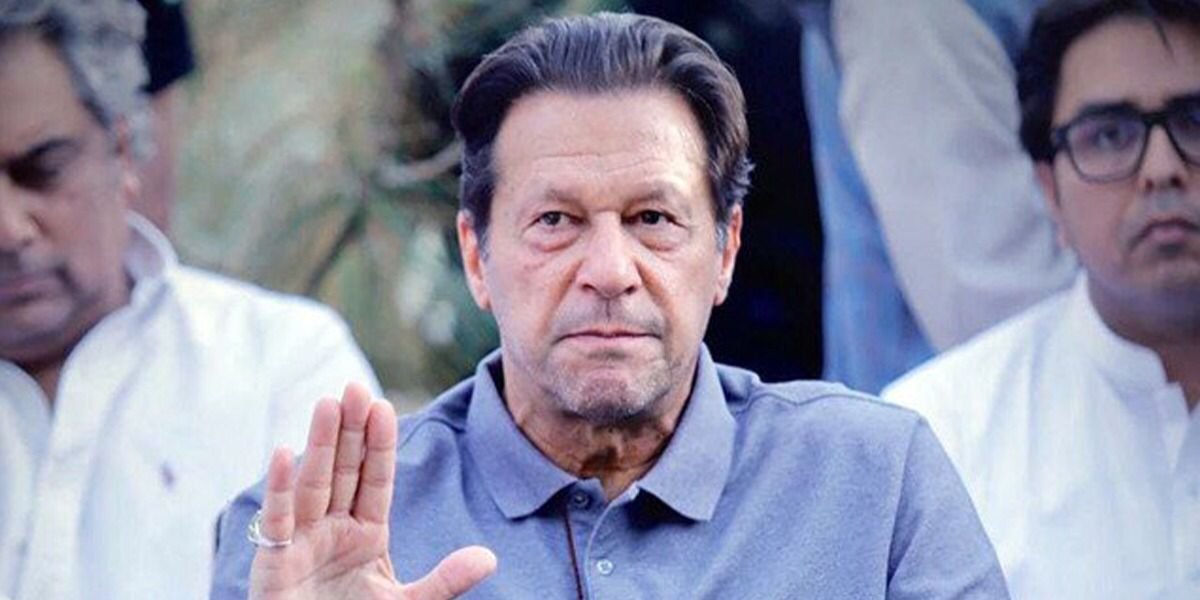
Pakistan Tehreek-e-Insaf (PTI) Chairman Imran Khan has said that he has had enough of the Pakistan Democratic Movement’s (PDM) “cabal of crooks” who are trying to launch propaganda against him.
Khan on September 4, alleged that Pakistan Muslim League-Nawaz (PML-N) supremo Nawaz Sharif and Zardari wanted to appoint their favourite as Chief of Army Staff (COAS) because if a “strong and patriotic army chief” was appointed, they would be questioned about their corruption.
In a tweet, the PTI chairman said, “Am following intense propaganda launched by PDM cabal of crooks against me.This stems from their being petrified of PTI’s soaring popularity.”
Am following intense propaganda launched by PDM cabal of crooks against me.This stems from their being petrified of PTI’s soaring popularity. Today in Peshawar jalsa I will give proper reply to all those who have deliberately been distorting my words to malign me.Enough is enough
“Today in Peshawar jalsa I will give proper reply to all those who have deliberately been distorting my words to malign me. Enough is enough,” said Khan.
Pakistani Army on Monday, August 5, expressed extreme displeasure over Khan’s recent statement against the establishment and said that the institution was “aghast” over it.
Read more: ‘Disappointing’, Pak Army says Khan should not ‘scandalise’ Army Chief selection
“Pakistan Army is aghast at the defamatory and uncalled for statement about the senior leadership of Pakistan Army by Chairman PTI during a political rally at Faisalabad. Regrettably, an attempt has been made to discredit and undermine senior leadership of Pakistan Army at a time when the institution is laying lives for the security and safety of the people of Pakistan every day,” said the military’s media wing, Inter-Services Public Relations (ISPR).
In order to ensure the prompt resolution of all disciplinary cases and inquiries against tax employees engaged in corruption and dishonest activities in field formations, the Federal Board of Revenue (FBR) established a new Section on Friday called “Discipline/Inquiries.”
A new Section with the nomenclature “Discipline/Inquiries” is hereby created in the Admn/HR Wing, FBR (HQ), Islamabad with immediate effect in order to ensure proper follow-up of all disciplinary cases/inquiries of officers (BS-16 and above) of FBR (HQ) and IR field formations with a view to ensuring timely disposal of such cases, according to an office order issued by the FBR on Friday.
According to Brecoder, a secretary or second secretary who works for the specified Section will be in charge and reporting to the Chief (HRM-IR), FBR.
The FBR has also been ordered by Prime Minister Shehbaz Sharif to fully abide by the guidelines of the Civil Servants (Efficiency and Discipline) Rules, 2020 when taking disciplinary action and conducting investigations against dishonest tax officers.
The FBR chairman has directed the Revenue Division/FBR to rigorously adhere to the following instructions in all disciplinary processes and inquiries launched against the officers, in accordance with the directives of the prime minister:
The Civil Servants (Efficiency & Discipline) Rules, 2020, Rule 10 read with Rule 12 shall govern how the chosen inquiry officer would conduct the inquiry processes. The same must be finished within sixty (60) days of the date the inquiry order was issued, or within any further time the authority may provide.
All Directors General, Chief Commissioners, Chief Collectors, Commissioners, and Collectors of FBR shall keep the relevant case record in safe custody while forwarding the recommendation to begin disciplinary proceedings against any officer(s) or official in order to ensure safe custody of the record in an inquiry.
In accordance with the guidelines outlined in Rule 8 of the Civil Servants (Efficiency and Discipline) Rules, 2020, all heads of field offices shall also see to it that pertinent records of the case and other related documents are timely provided to the inquiry officer or the inquiry committee, as the case may be, through the designated departmental representative (DR). This must be done within seven days of the date of the inquiry order.
Since its formation, the National Accountability Bureau (NAB) has recovered Rs864 billion from corrupt elements, directly and indirectly.
The anti-graft watchdog, NAB has collected Rs584 billion during the tenure of incumbent Chairman Justice Javed Iqbal.
Due to the NAB’s aggressive prosecution, the Accountability Courts penalized 1,405 accused persons and imposed substantial fines on them, as per a NAB spokesman.
In the Accountability Courts, NAB has a 66 per cent overall conviction rate. NAB received a total of 405,768 complaints since its formation. A total of 405,212 complaints were handled. The inquiry of 556 complaints is still ongoing.
100,865 complaints have been acknowledged by the NAB. There were around 100,425 complaints investigated. While 779 complaints were still being investigated. 9883 queries have been approved by NAB.
8,953 queries were followed through to completion. A total of 930 inquiries were investigated.
NAB allowed 4,547 investigations since its establishment. A total of 42,100 investigations have been completed. While working on 346, the probe is still ongoing. Since its founding, the NAB has filed 3,645 referrals in accountability courts. 2,398 references were disposed of in accordance with the law. Currently, 1,237 referrals worth Rs1,335 billion are being tried in various accountability courts.
Lahore Police has planned to utilise Body Worn Cam at E-Police checkpoints on the entry and exit points of the provincial capital for the welfare of the public, according to the Senior Superintendent of Police (SSP) Operations Wing Lahore Captain (retd) Mustansir Feroze.
He claimed that the Lahore Police Department’s plan will not only keep the city secure but also minimize citizen-police conflicts. He added that the interaction (audio and video) between police officers and civilians would also be recorded by the Body-Worn Cam.
According to SSP Operations, this measure will aid in identifying criminals as well as eliminating terrorism. He claimed that this method would re-establish public trust in the police force, and also that citizens can lodge complaints on 1787.
Senior police officials will supervise the programme and would offer on-the-spot instructions to address the public’s complaints.
Body cameras are already being used in a number of other nations, but they have never been deployed by police in Pakistan. This idea will undoubtedly aid higher-ranking Lahore police officials in combating crime and monitoring how officers perform throughout the day and their attitude toward civilians.
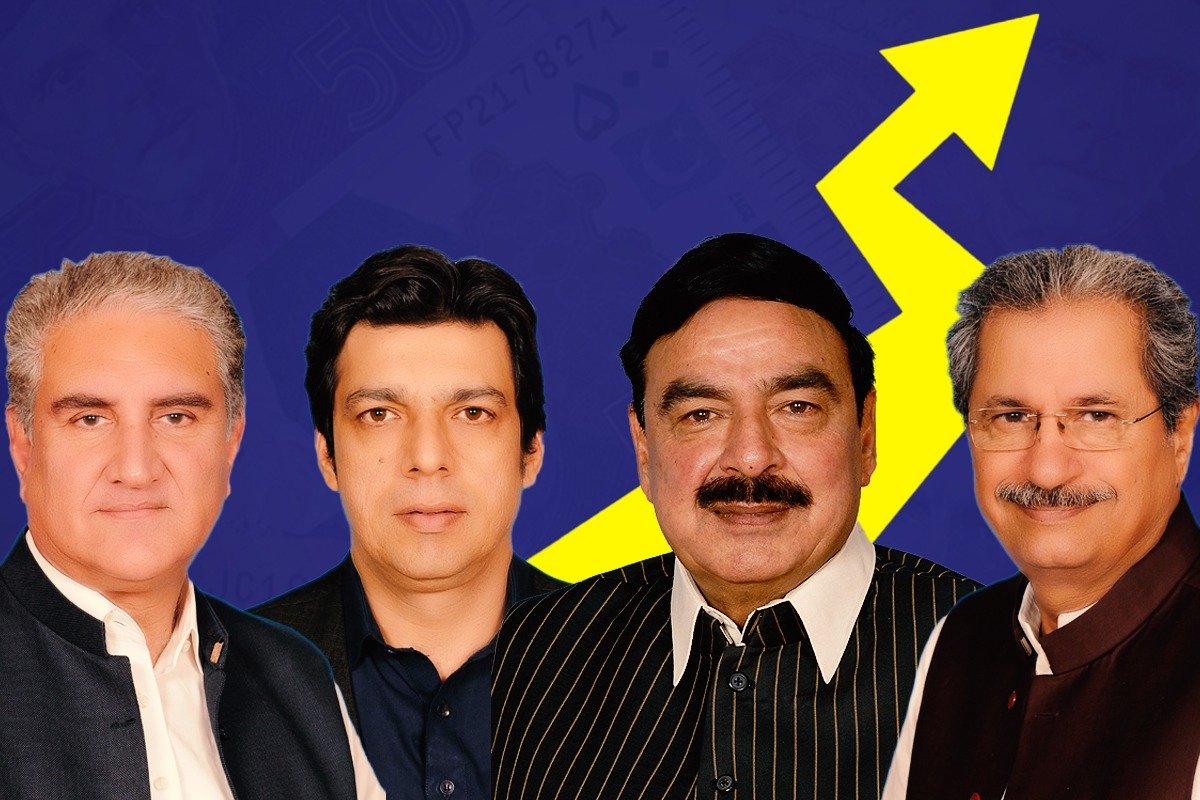
Official documents revealed that several members of Pakistan Tehreek-e-federal Insaf’s cabinet enjoyed gains in their fortunes during their term in parliament and as ministers, despite being elected on pledges of fighting corruption.
According toSAMAA TV, Shah Mehmood Qureshi and Sheikh Rasheed Ahmad, Omar Ayub Khan, Azam Khan Swati, Khusro Bakhtiar, Faisal Vawda, Shafqat Mehmood, Fehmida Mirza, Zubaida Jalal, Mahboob Sultan, and Tariq Cheema are among the listed former ministers.
Since select ministers received notices to explain their excessive wealth, the majority blamed weak wealth and asset declaration regulations, which did not contribute to increases in the valuation of assets overtime or the amalgamation of entities.
An inquiry into assets spontaneously declared before the Election Commission of Pakistan (ECP) and Pakistan’s tax authorities — primarily the Federal Board of Revenue (FBR) — by cabinet members who worked under former Prime Minister Imran Khan disclosed that plenty of of them saw a tremendous upsurge in their riches, with growth proportions primarily in the triple digits.
As per the official record, the ECP sent notices to at least six former ministers while they were still in government in 2019 and 2020, requesting them to clarify their wealth-related issues.
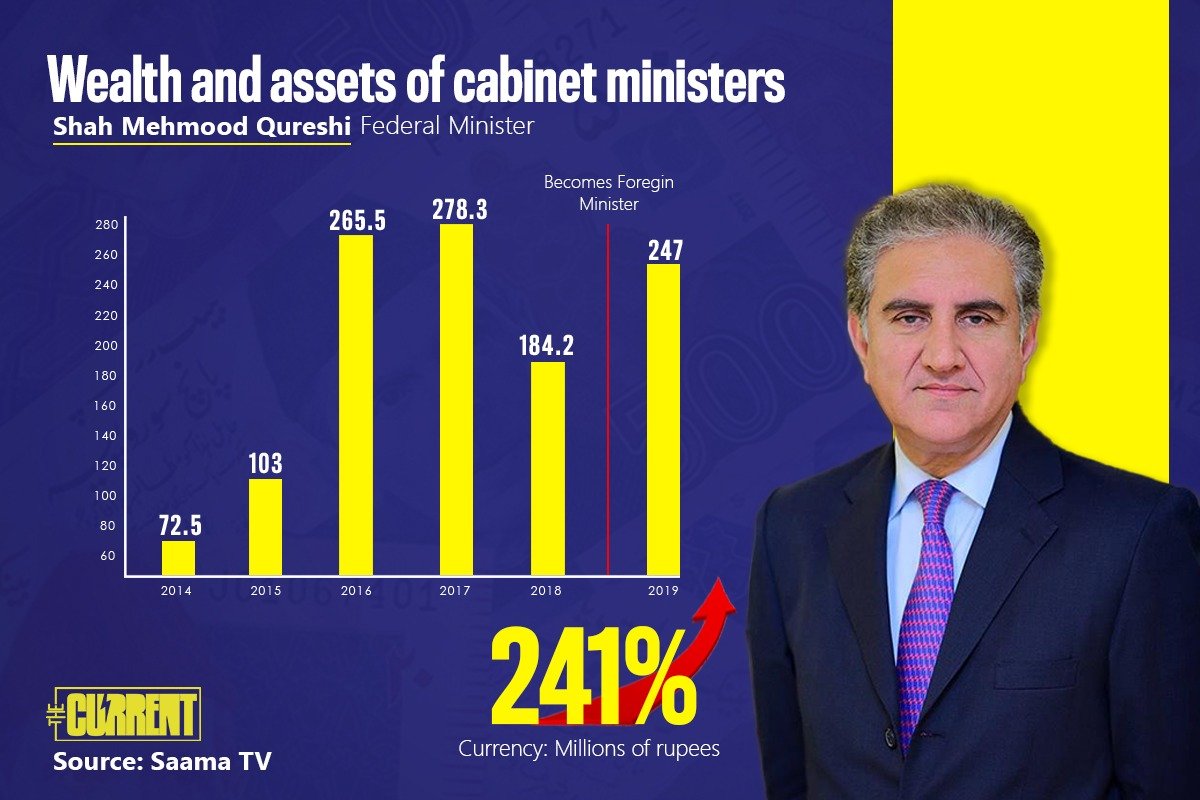
From 2014 to 2019, former foreign minister Shah Mahmood Qureshi, who has been a staple of the parliament for more than a decade and served twice in the federal cabinet in two different governments, had a 241 per cent growth in his wealth.
He and his wife held assets worth only Rs72.5 million in 2014, according to asset declarations he submitted to the ECP and the FBR. In the following three years, his assets nearly quadrupled, reaching Rs278.3 million, a 283.86 per cent increase over his wealth in 2014. Qureshi’s fortune dropped dramatically to Rs184.2 million in 2018, the year he returned to the Treasury benches, albeit with a new party, the PTI. However, while in power, it soon increased to Rs247.1 million in 2019, a rise of 240.82 per cent since 2014.
When questioned, Qureshi recounted how the worth of his assets had evolved over the years.
“The reason for the increase in assets was that during 2015-16, my wife received her share from the sale of property situated in Lahore, which had been gifted by her mother, and shares from sale proceeds of inherited property worth Rs169.6 million and Rs22.6 million,” he claimed. In October 2017, duplicates of sale deeds were handed to the ECP, according to the former minister.
“The ECP raised this observation too,” he said regarding the increase in his wealth, adding, “I and my dependent family members are all filers with the FBR”.
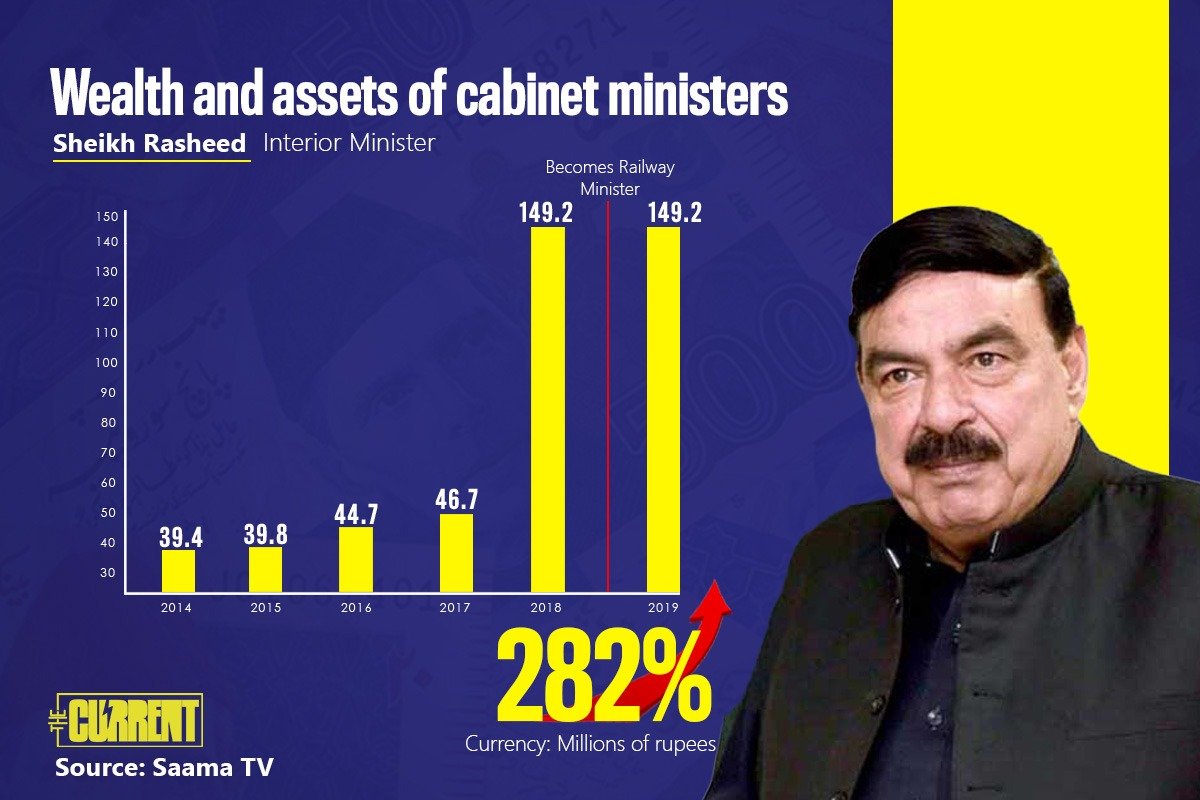
Sheikh Rashid, the former interior minister, watched his fortune increase by nearly 278.68 per cent between 2014 and 2019.
The financial disclosures for 2014 revealed that he only had Rs39.4 million in assets. Earnings climbed by Rs0.4 million to Rs39.8 million. His holdings steadily expanded over the next two years, reaching Rs44.7 million in 2016 and Rs46.7 million in 2017.
Conversely, in 2018, the time he was elected to power, his assets boosted by Rs100 million to Rs149.2 million. In 2019, there was no movement in reported assets. After inquired why his assets had suddenly changed, Rashid said that the discrepancy was due to an advance payment he had obtained for reselling a portion of land in 2018.
“I received Rs100 million as advance after making a deal of land to be sold last year, [2021],” he said, adding, “There is no such increase in my assets”. The former interior minister stated that the rise in his declarations submitted with the FBR and the ECP had been properly disclosed.
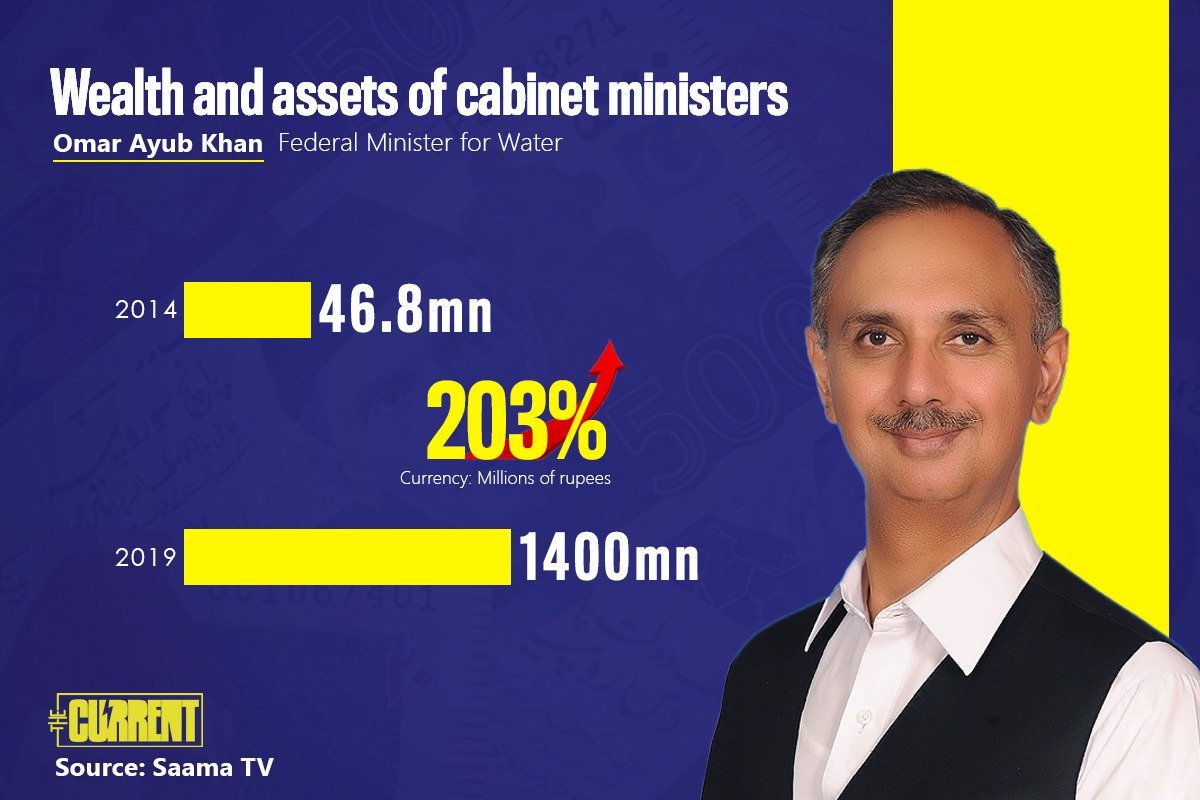
Between 2014 and 2019, the fortune of former federal minister of water Omar Ayub and his wife jumped by 203 per cent.
As per Ayub’s filings to the ECP and FBR in 2014, he and his wife held assets worth Rs461.8 million. This comprised Rs132 million in assets held by his wife and Rs329 million in assets owned by the minister. This value had risen to Rs1.4 billion by 2019. Surprisingly, while his wife’s holdings increased slightly to Rs201 million, Ayub’s assets increased to Rs1.2 billion. Each has debts worth only Rs26.3 million, according to the disclosures.
As a result, the ECP expressed concerns about Ayub’s and his family’s unexpected surge in wealth.
“It was explained to the ECP in 2019 that it [increase in wealth] is because of group formation having no cash involvement,” Ayub said, confirming that the top poll body had issued him a notice on this subject. Ayub claimed that he owned shares in Nova Synpac Ltd. and NovaGene Pharmaceuticals Ltd., which increased in value by approximately Rs1.071 billion.
“My assets have decreased (excluding this group formation) since I took an oath as a minister because I resigned from my group,” he claimed, adding that the increase was due to the consolidation of all of his businesses under the group.
“This cannot be reflected in a declaration, which is always a reflection of statements submitted to the FBR and there cannot be any difference [between them] otherwise it would have been challenged there,” he explained.
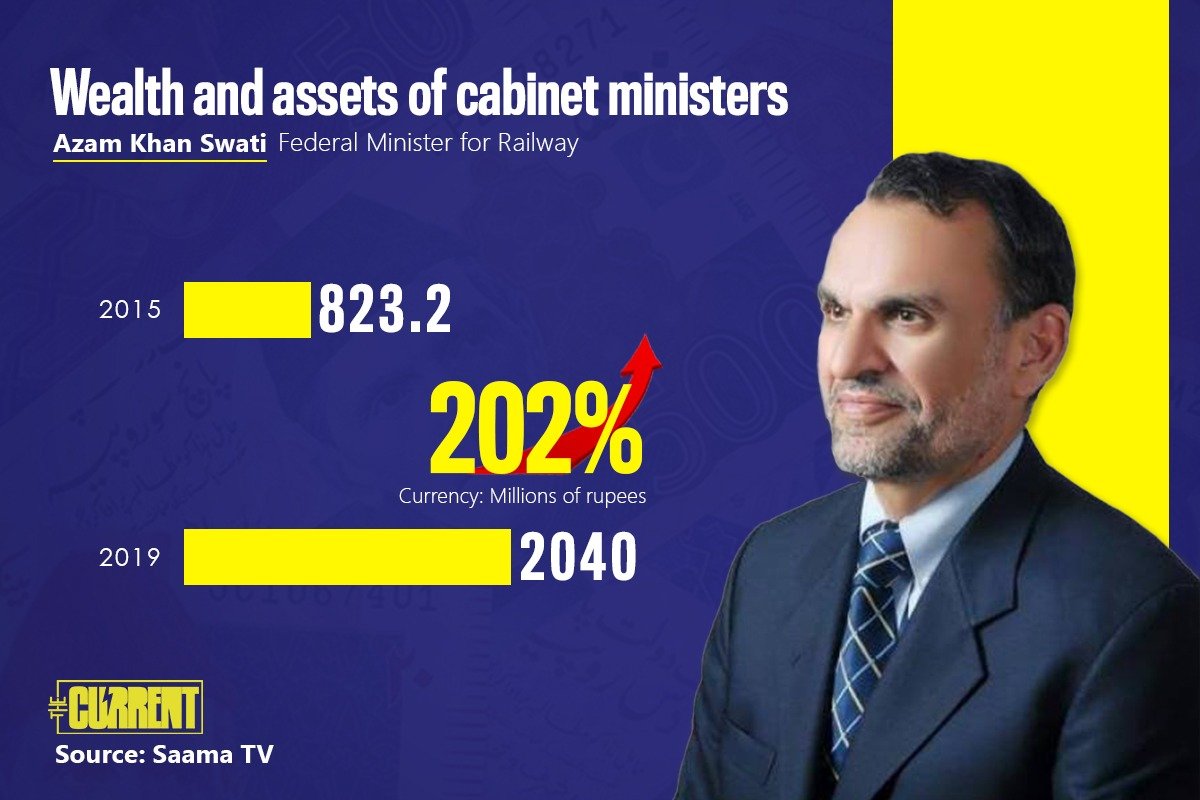
Azam Swati, the former federal railways minister, saw his fortune grow by 202 per cent from Rs823.2 million in 2015 to about Rs2.04 billion in 2019. He reported that his liabilities increased from Rs417 million in 2015 to Rs811 million in 2019.
“[Your] figures are wrong due to incomplete information being furnished before ECP by members and cabinet members owing to faulty legal requirements mentioned in ECP Act 2017,” he explained.
He further said that his situation was slightly unusual. “In Pakistan, I have no income and no business.” I am confident that our FBR wealth statement [filed] will be compared to ECP in 2019 [asset declarations],” he remarked, worried that the statistics may contain a few errors.
“ECP has no efficiency and capability to audit assets and liabilities,” he disclosed, adding, “We were making mistakes filing combined [wife and husband together]”.
“Now we have corrected the mistake and filed separately because the wife is not dependent,” Swati told SAMAA TV.
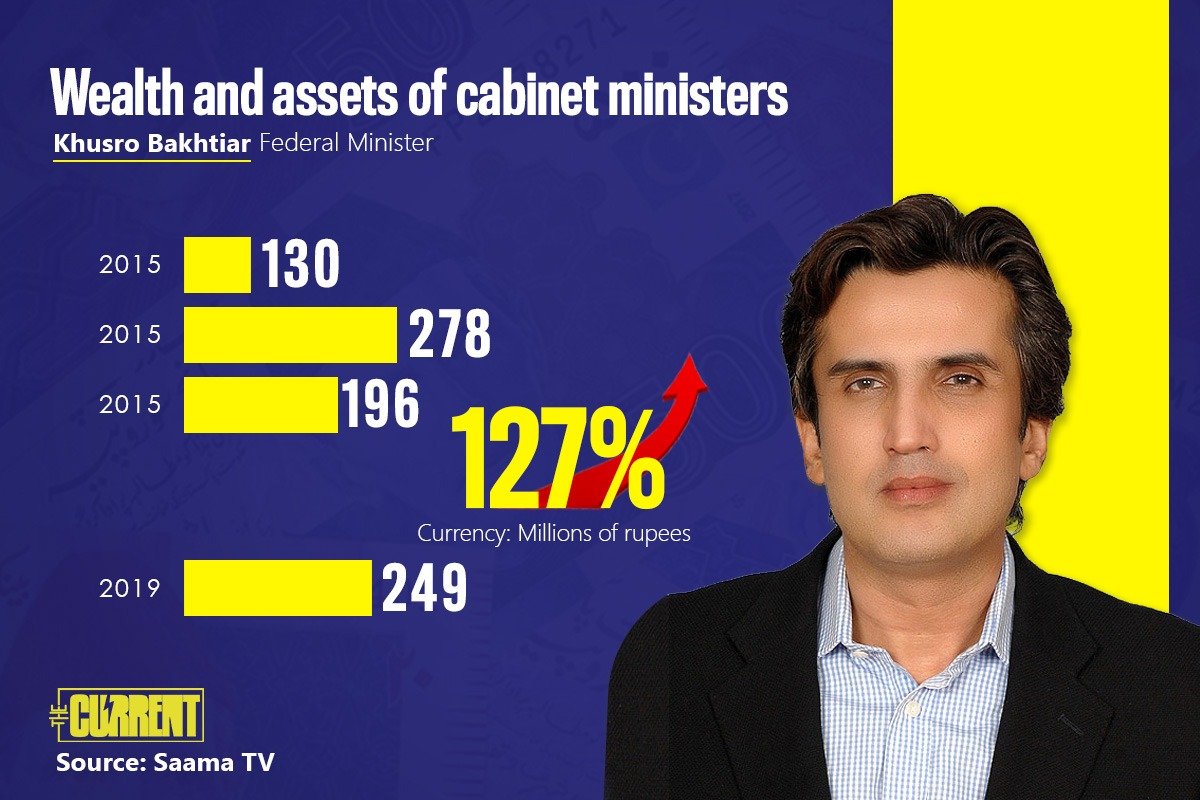
Khusro Bakhtiar, the former federal commerce minister, saw his fortune rise by 127.8% from Rs109.3 million in 2013 to Rs249 million in 2019. In 2014, he had assets of Rs130 million, which more than doubled to Rs278 million in 2015, shrank to just Rs196 million in 2016, and then surged again in the next three years.
“Increase in assets were mainly comprised of [various] sources during the year 2014 to 2019,” he told SAMAA TV, detailing that these sources included savings from agricultural income, proceeds from the sale of land worth Rs40 million, other sources which contributed Rs20 million.
Bakhtiar also claimed that he actually paid Rs27.5 million in agricultural taxes from 2017 to 2020, and that he owed Rs60 million in 2016.
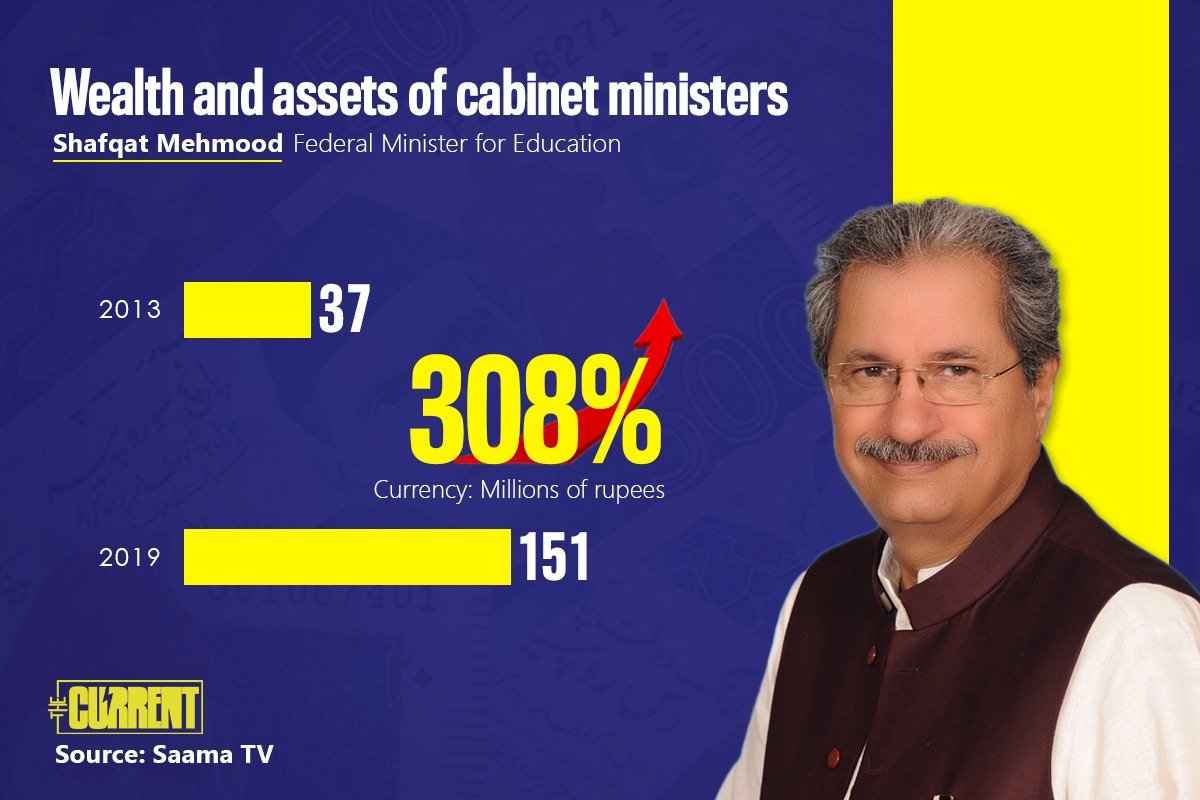
Former federal minister for education Shafqat Mahmood and his family had a 308 per cent growth in asset valuation between 2013 and 2019, making them one of the most successful federal ministers in terms of percentage increases. According to Mehmood’s filings, his and his family’s assets were valued at just Rs37 million in 2013, but had grown to Rs151 million by 2019.
“My assets have not changed since 2013 onwards,” Mehmood asserted, explaining “The change that you see is the cost re-evaluation from purchase price to market price”. The ex-minister further said that he has 360 kanals of hereditary land, a few more plots, and automobiles that he never assessed.
“There will, of course, be some variation regarding bank accounts. There will also be a slight difference in detail offered to FBR and ECP with regards to bank accounts,” he maintained. He went on to say that in his previous disclosure, he had combined the amounts in all of his bank accounts to present a single total.
“My wife is a distinct taxpayer because she works, but I have included her assets as well”, he explained.
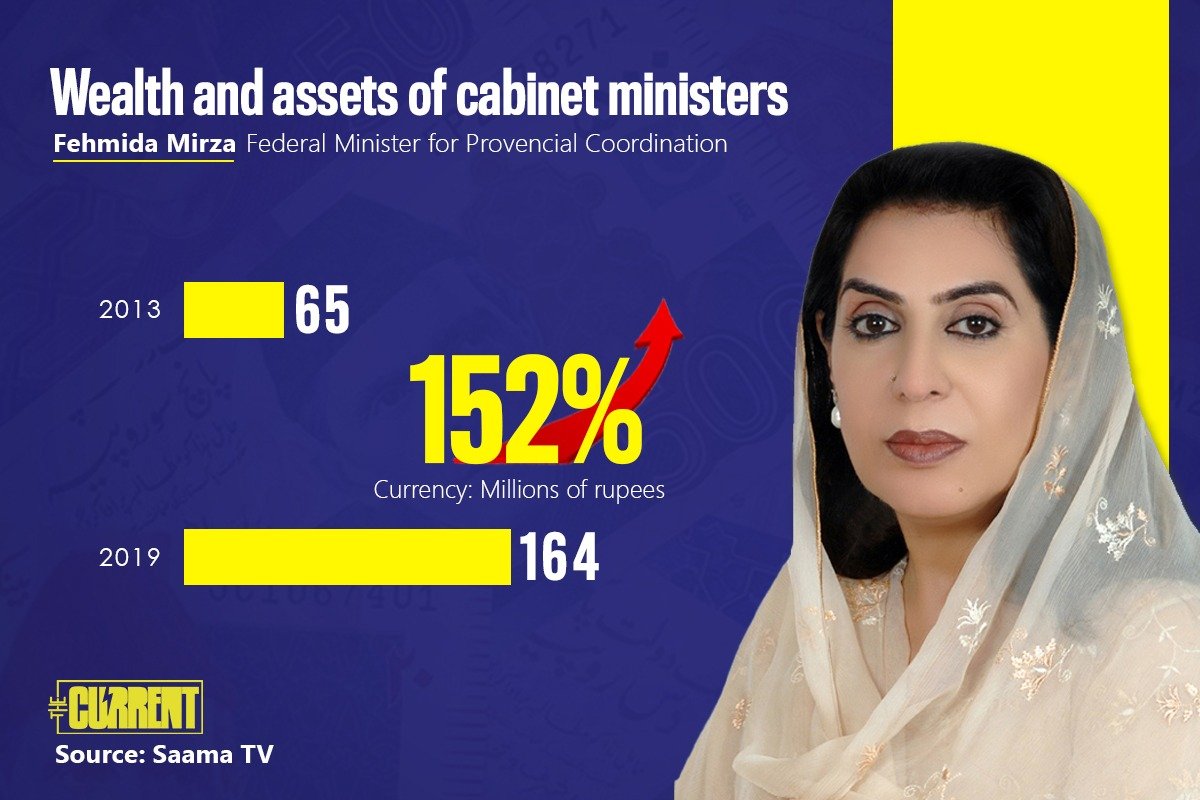
Fehmida Mirza, the former federal minister for interprovincial coordination, had a similar scenario, with her net worth rising from Rs65 million in 2013 to Rs164 million in 2019.
“I did not see any rise in my assets and wealth at all,” she told SAMAA TV. She did, although, reveal that she had sold some property in Pakistan in order to purchase a home in the United Kingdom.
“This new increase in my assets has already been declared with the FBR and the ECP,” she stated.
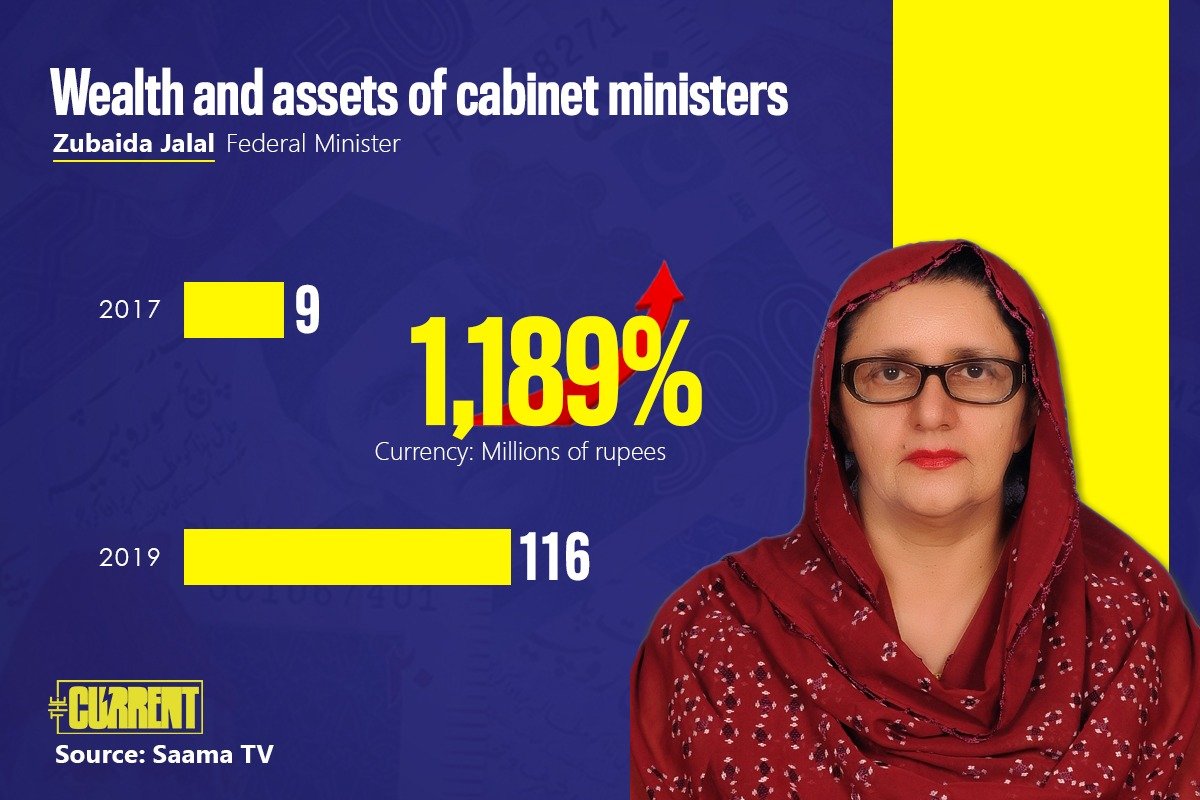
Contrary to the PTI’s cabinet’s millionaire members, one of the “weakest” members of the federal cabinet, former federal minister Zubaida Jalal and her husband, had a 1,189 per cent growth in their fortune in a short period of time. Their riches increased from Rs9 million to Rs116 million in 2019.
Jalal, on the other hand, described the quick spike in wealth as the outcome of changes in declaration requirements.
“There is no big difference in my assets’ declaration” she asserted while speaking to SAMAA TV. The value of immovable assets was not mentioned in data provided in past elections, she said, noting that the ECP declaration requirements changed over time.
“[We are] required to mention values of assets in the asset declaration for this time,” she stated. She explained that the variations in asset values were attributable to market forces working on enterprises.
“Ups and downs will keep happening [in mining operations and business],” she said, as she reminded that her husband owns the National Coal Mining Company since the 1960s.
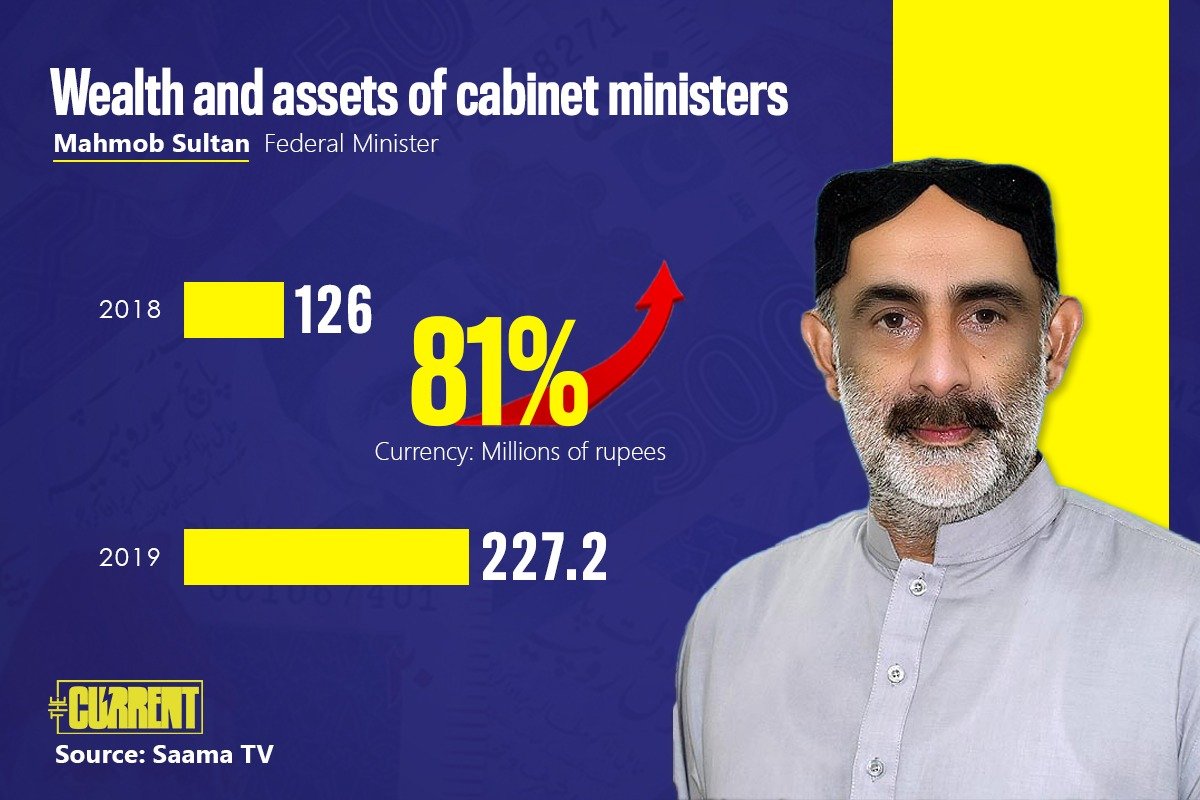
Former state minister Mahboob Sultan was one among the ministers who saw only double-digit asset growth. Only 81 per cent of his assets increased from Rs126 million in 2018 to Rs227.2 million in 2019. It’s worth noting, however, that his growth of nearly Rs100 million occurred while he was in the cabinet of ministers.
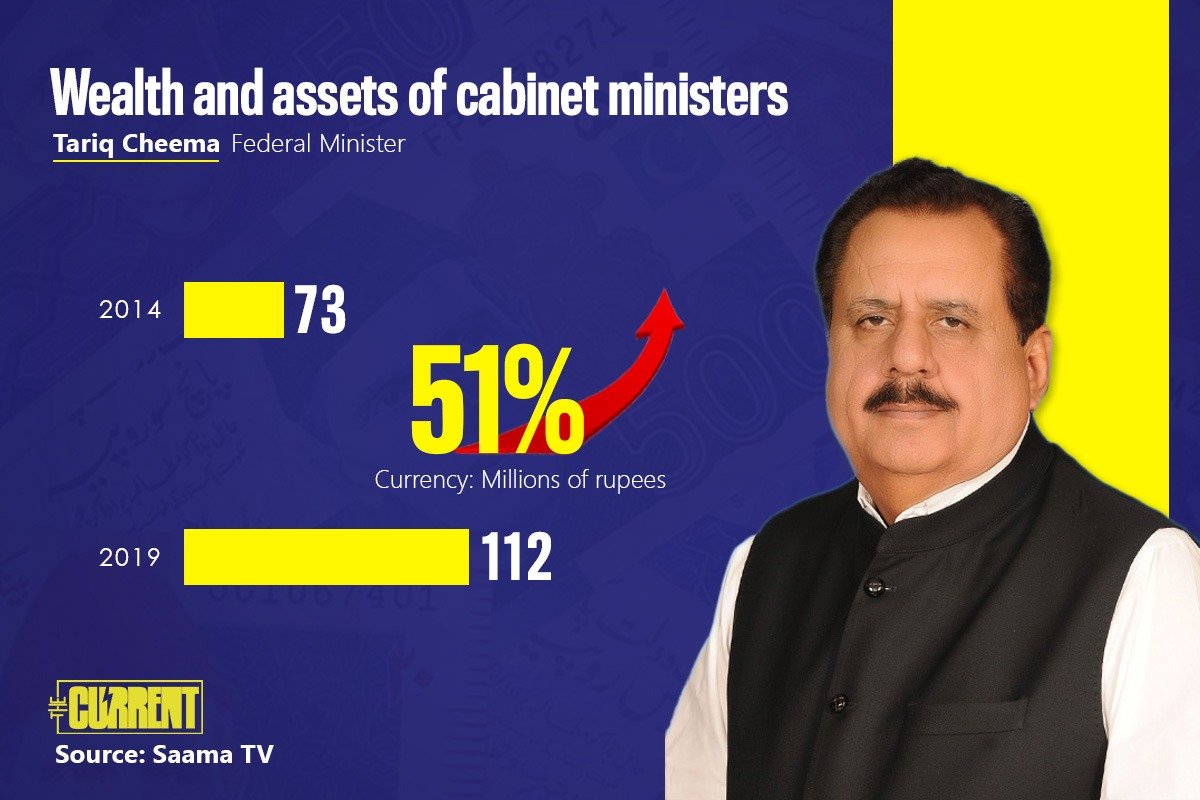
Tariq Cheema, the former federal minister for housing and infrastructure, showed the smallest growth in his wealth, going from Rs73 million in 2014 to Rs112 million in 2019. He did not, however, assess the value of his inherited assets and report them to the electoral or tax authorities.
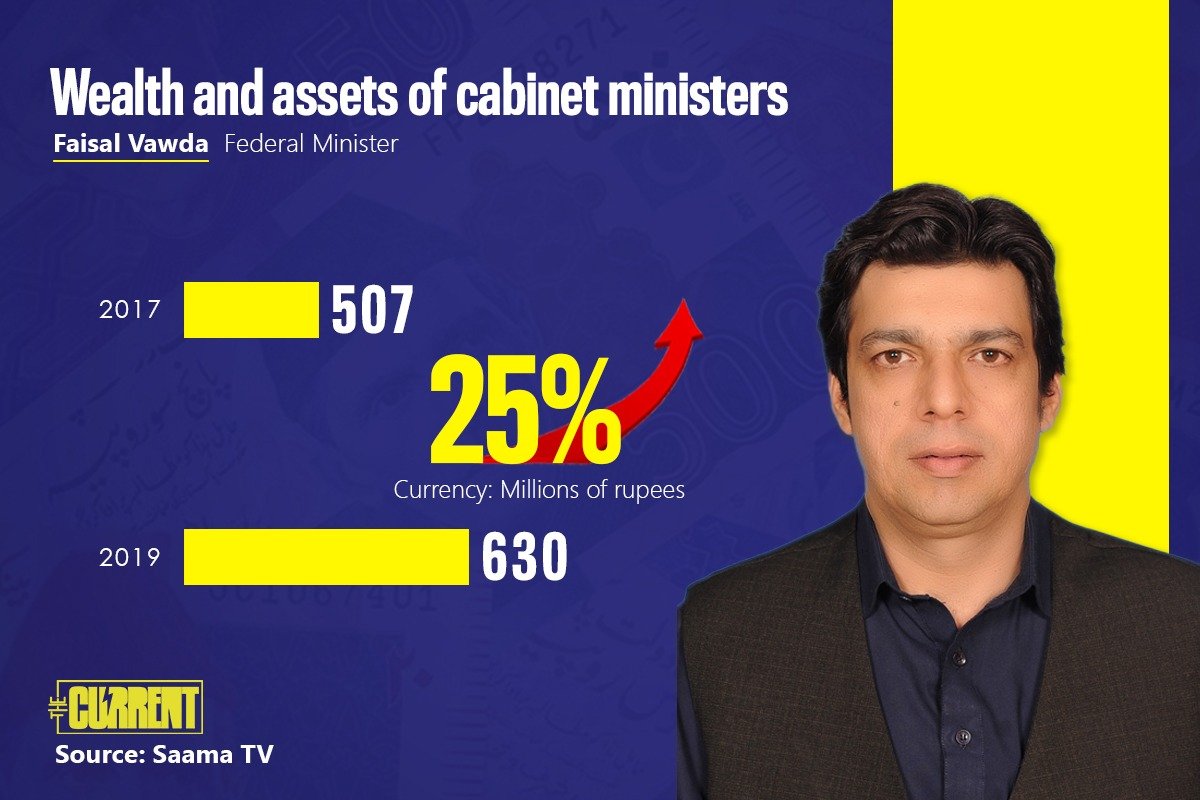
Former federal minister Faisal Vawda and his family witnessed their fortune increase by 25 per cent from Rs507 million in 2017 to Rs630 million in 2019. He was among the most controversial cabinet ministers who were eventually dismissed by the ECP.
Despite multiple requests from SAMAA TV, neither Sultan, Cheema, Vawda, nor an ECP official have commented on inquiries regarding their wealth.
Prime Minister Shehbaz Sharif has revealed that former premier Imran Khan took gifts worth Rs140 million from Toshakhana and sold them in Dubai. Sharif made these claims during a meeting with senior journalists at PM House on Friday, reports Ayaz Akbar Yousafzai for The News.
“I can confirm that Imran Khan took gifts from Toshakhana and sold them in Dubai for Rs140 million. Valuable gifts include diamond jewellery, bracelets, watches and sets,” revealed PM Shehbaz.
Former federal minister Fawad Chaudhry said that Shehbaz Sharif is confused and cannot fathom how to level allegations against PM Khan so he has resorted to “throwing dirt at Imran Khan”.
Fawad Chaudhry claimed that Khan bought a watch from the government of Pakistan, which he had received from a foreign country, and sold it.
“What is the offence if the [then] prime minister sold the watch he bought from the government? It doesn’t matter if the watch is worth Rs50 million or 100 million […] if it is mine and I sold it, there shouldn’t be any objection,” said Chaudhry.
So what if Imran Khan sold the gifted watch in 5 crore rupees when he was PM, Fawad Chaudhary says pic.twitter.com/8nmSe0IiOL
Toshakhana is a word of Persian origin that literally translates into “treasure-house”. In Mughal ruled India, Toshakhana was a place where princes stored gifts and emblems of honour that they received for their posterity, whereas in modern times, it is where gifts received from foreign dignitaries or countries are kept.
Joining the chorus of blames, Opposition Leader in the National Assembly (NA) Shehbaz Sharif said, “Corruption rampant in ‘Naya’ Pakistan of anti-corruption Mujahid, PTI govt has broken all records of corruption in the last 20 years.”
Corruption rampant in ‘Naya’ Pakistan of “anti-corruption Mujahid”. According to Transparency International, PTI govt has broken all records of corruption in the last 20 years. Among Asia-pacific region, Pakistan has unfortunately been ranked as the 5th most corrupt country. pic.twitter.com/I9dt98bBUI
He further tweeted that under his brother and Pakistan Muslim League- Nawaz (PML-N) supremo Nawaz Sharif’s rule, corruption had decreased despite massive development projects being undertaken. Shehbaz further wrote that it went down due to “transparency, good governance, and legal reforms”.
During PM Nawaz Sharif’s government, corruption decreased despite the massive development, which was the result of transparency, good governance & legal reforms. Now corruption has hit an all-time high despite the fact that no worthwhile development has taken place. https://t.co/x4q7kgXWdy
PML-N’s Vice President Maryam Nawaz said, “Imran Mafia, who emptied the pockets of the people, bravely wiped his hands on Pakistan.”
عمران حکومت سے زیادہ کرپٹ، بدعنوان اور رشوت خور حکومت پاکستان کی تاریخ میں نہیں آئی۔ہر شعبے میں تنزلی کے ریکارڈ بنانے والے عمران خان کے دور میں صرف ایک شعبے میں ترقی ہوئی اور وہ ہے چوری اورلوٹ مار۔عوام کی جیبیں خالی کر نے والےعمران مافیا نے دیدہ دلیری سے پاکستان پر ہاتھ صاف کیے۔ pic.twitter.com/ZJ1UDocsIH
Pakistan People’s Party (PPP) MNA Shazia Marri said that Imran Khan’s past claims that he would root out corruption from the country were lies.
Jamaat-i-Islami (JI) emir Siraj-ul-Haq said that PM Khan had proven, quite literally, that he was dangerous for the country. He claimed that the blunder committed by this government over three years was unmatched in the country’s 74-year history.
Prime Minister (PM) Imran Khan said that the Pakistan Tehreek-e-Insaf (PTI) government has taken the most steps against corruption in the country’s history.
The premier, while chairing a session of the federal cabinet on Tuesday, discussed the report released by Transparency International according to which Pakistan has been ranked 140 out of 180 countries, slipping further down to 16 spots over the last year, on the Corruption Perceptions Index (CPI) 2021.
Federal Minister for Information and Broadcasting Fawad Chaudhry, commenting on Pakistan’s low ranking on Transparency International’s CPI, said that it was because of the absence of rule of law in the country and state capture as opposed to financial corruption.
State capture is a type of systemic political corruption in which private interests significantly influence a state’s decision-making processes to their own advantage.
The minister said all the international institutions that helped determine country rankings had Pakistan maintaining its previous ranking — except the Economist Intelligence Unit (EIU), which dropped the country’s ranking.
“If you ascertain that who is heading the Economist in Pakistan, you will find that why Pakistan’s ranking was dropped,” he added.
Pakistan has been ranked 140 out of 180 countries, slipping further down to 16 spots over the last year, on the Corruption Perceptions Index (CPI) 2021 by Transparency International, reports The News.
Pakistan’s score dropped by three points to 28 on the global corruption index. Last year, the country’s score was 31.
“It shows that corruption has increased in Pakistan as compared to the last year,” said the anti-graft watchdog in its report.
“The index, which ranks 180 countries and territories by their perceived levels of public sector corruption according to experts and businesspeople, uses a scale of zero to 100, where zero is highly corrupt and 100 is very clean,” the organisation said.
The top countries on the index are Denmark (88), Finland (88), and New Zealand (88), all of which also rank in the top 10% in the world on the Democracy Index civil liberties score.
However, Somalia (13), Syria (13), and South Sudan (11) remain at the bottom of the CPI. Syria is also ranked last in civil liberties.
Of the 23 countries whose CPI score significantly declined since 2012, 19 also declined on the civil liberties score.
Moreover, out of the 331 recorded cases of murdered human rights defenders in 2020, 98% occurred in countries with a CPI score below 45, read the statement.
Interior Minister Sheikh Rasheed during a press conference, while taking a jibe at the Opposition, said, “They [Opposition] want that the hand [protecting] Imran Khan should be on their head as well,” adding, ” this hand can be on their [Opposition] neck but never on their head.” Rasheed’s words hint towards the establishment.
Talking to the journalists, Rasheed said, “If the Opposition goes to International Monetary Fund (IMF) its halal but if Imran Khan does the same its considered haram.”
“These people went 23 times to the IMF. This time around, the conditions of IMF were pretty tough, hence we were not left with any option but to go to IMF,” said Rasheed.
Addressing the Opposition, Rasheed said that the Opposition is planning two different long marches toward the capital. He said that the government will provide them the way to continue their march but the Opposition should keep in mind the importance of March 23 and the respect one gives to the country on [the Resolution Day of Pakistan].
“Important personalities from Organisation of Islamic Cooperation (OIC) are coming to Pakistan on March 23 and all eyes from India will be directed towards Pakistan as well,” said Rasheed.
Accusing the Pakistan Muslim League-Nawaz (PML-N) leaders of corruption, Raseed said, ” Shehbaz Sharif is more corrupt than Nawaz Sharif,” adding, “I am saying this based on my own knowledge.”
“I would like to say a historical sentence that all four Sharif’s are minus from the politics of Pakistan,” said Rasheed.