Tag: cotton production

  • Tax free cotton imports threaten livelihoods of 1.3 million farmers across Pakistan

    Tax free cotton imports threaten livelihoods of 1.3 million farmers across Pakistan

    Cotton farmers grow worried with each bale of cotton that reaches Pakistani shores at the behest of the textile sector. It might be the final straw for the already struggling industry, as imports are crucial with cotton production having fallen by approximately 50 percent.

    Cotton farmers are already facing neglect at the hands of the government in terms of ‘minimum support prices’ (MSP).

    The MSP refers to the lowest guaranteed price that farmers can receive if they are unable to sell their produce in the market. This neglect by the government can be attributed to the International Monetary Fund (IMF), which views the existence of MSPs as a significant burden on the cash-strapped nation.

    In fact, the IMF has set a condition to remove MSPs entirely by 2026.

    While this sounds like bad news for cotton farmers, this is not even the worst part.

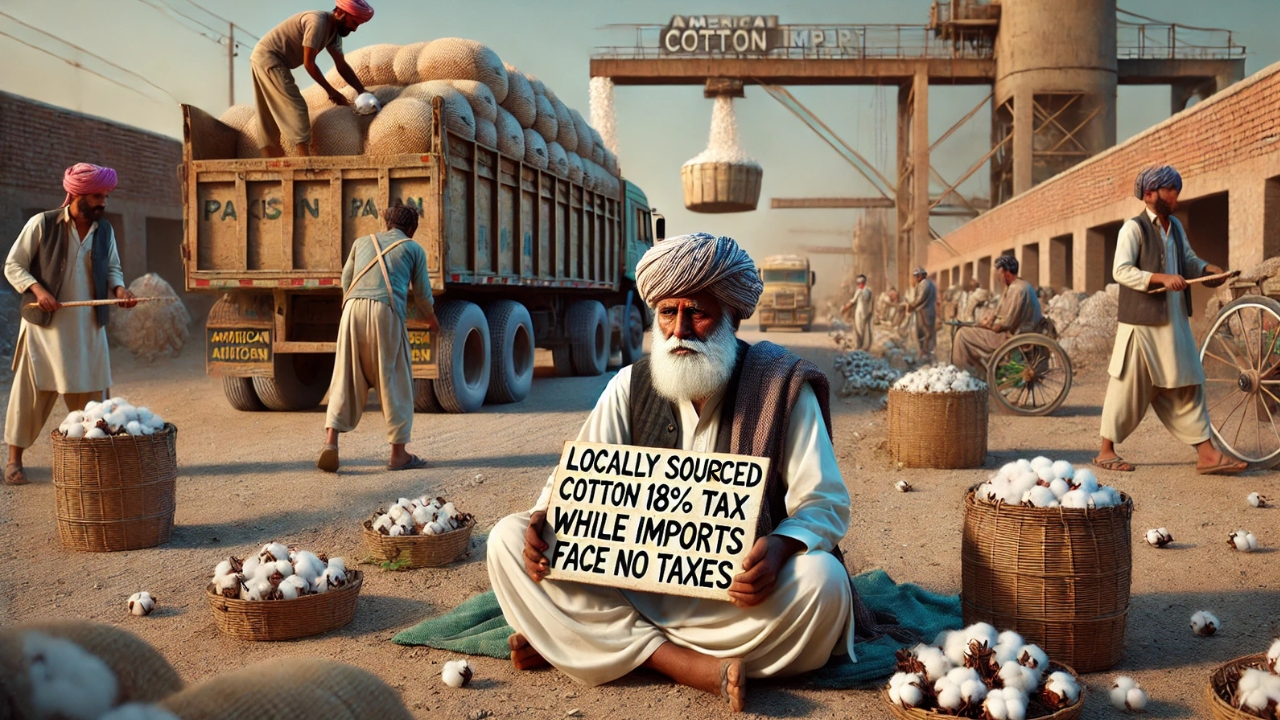
    The kicker here is that textile manufacturers have to pay an 18 per cent sales tax if they are to source cotton locally while no such taxes exist on imports. As such, business owners in the textile sector are now gravitating towards imported cotton and yarn.

    While imports are helping increase profit margins for textile exporters, cotton farmers could be getting pushed to the brink of financial destitution. This should ring alarm bells in Islamabad because importing cotton and yarn tax-free might endanger the livelihoods of a staggering 1.3 million farmers.

    The situation is so severe that yarn is even being imported from India via the United Arab Emirates (UAE). Bureaucratic red tape surrounding yarn imports from India and cotton shipments taking up to 44 days to arrive from the United states, brew inefficiency in the local industry.

    This inefficiency can be eliminated if textile manufacturers source cotton locally as it will reduce travel times associated with imports. However, the textile industry seems to be willing to bear the longer travel times if they can get cotton for a lower cost.

    This could possibly drive local farmers out of the agricultural sector entirely.

    In the worst case, the closure of farms in the light of cheaper imports will drive over a million farmers off of the six million acres they currently cultivate. It is possible that the unemployment rate in Pakistan might then surge beyond the already high 6.3 per cent.

    Moreover, as imports rise, so will the import bill. For the State Bank of Pakistan (SBP), this will be a huge set back that has been consistently working hard to build up its foreign reserves. Just this week, SBP reserves rose by $84 million to cross $11.26 billion but the trend of rising imports may nullify the gains that the SBP has achieved.

    Experts, however, are predicting that the textile sector will be favoured over cotton farmers as it accounts for approximately 60 per cent of national exports. It will be interesting to note now how cotton farmers will navigate the uncharted waters of unfavorable taxation policies ahead of them.


  • Cotton’s potential revival: Strong harvest drives 52 per cent increase in ginning factories

    Cotton’s potential revival: Strong harvest drives 52 per cent increase in ginning factories

    Cotton farmers breathed a sigh of relief as the final bale of their successful harvest was loaded onto trucks en route to the ginning factories. After a 48 per cent decline in cotton output from last year, the first fortnight of October recorded an 8.87 per cent increase compared to the same period last year, reigniting the hopes of many in the cotton industry.

    The cotton harvest crossed the one million bale mark compared to the same time last year. This increase in the yields, amounting to an extra 90 thousand bales of cotton, resulted in 184 ginning factories reopening. That is an incredible 52.27 per cent increase in the number of operational factories. The owners of these factories are set to benefit as the factories have gone from collecting dust to receiving cotton trucks.

    At these factories, cotton is cleaned and refined by separating it from impurities such as leaves, dirt and, most importantly, cotton seeds. These seeds are a major byproduct of the purification process and a source of profit for the factory. If farmers manage to increase yields, factory owners can count on getting more seeds with each additional deposit of raw cotton to the factory.

    The availability of these extra seeds will likely translate into an increase in the production of cottonseed oil and animal feed. This is going to spell good news for businesses involved in poultry as the increased supply of animal feed in the market will potentially result in lower feed prices for their hens.

    Due to lower cotton production levels earlier in the year, import deals to bring in approximately 3 million bales of raw cotton have been formalised. However, the cotton is still not on Pakistani shores.

    The wait times associated with the import of cotton by Pakistan from the United States, which sources most of Pakistani cotton imports, is a staggering 44 days. If this cotton was sourced internally from local farmers, however, this time could be cut down to just 2-3 days. Unfortunately though, farmers cannot currently scale up production to meet the domestic demand of cotton.

    If cotton farmers can continue to ramp up production, the business community will not be the sole beneficiary. Pakistan has been importing billions of dollars of cotton, recently being the 5th largest importer of the raw material in 2022. If local farmers can meet domestic demand, the economy will be spared a huge import bill, thereby reducing the balance of the trade deficit, which stood at a glaring $24.8 billion in FY 2023.

    October may mark the end of the woes faced by farmers this year. However, only time will tell if they can reach the level of production they enjoyed just a year prior.

  • Pakistan’s cotton production surge offers hope for forex reserves 

    Pakistan’s cotton production surge offers hope for forex reserves 

    Cotton production this year is proving to be a silver lining for Pakistan’s foreign exchange reserves, with an impressive 83 per cent increase in production for the 2023-24 season, totalling 6.79 million bales. 

    According to an estimate by the Pakistan Cotton Ginners’ Forum, cumulative production in the current season may reach around 9 to 9.5 million bales, a significant improvement from the previous year’s production of 5 million bales. This can be attributed to favourable weather conditions. 

    However, it’s worth noting that the production is still below the government’s target of 11.5 million bales. 

    According to Express Tribune, the recent 193 per cent increase in gas prices has exacerbated challenges faced by textile manufacturers and exporters, reducing the country’s competitiveness among regional textile exporters. 

    Another discouraging factor is for the farmers, as the market is offering them Rs7,000 per 40 kilogrammes, falling short of the government’s announced support price of Rs8,500 per 40 kilogrammes.

    The government has yet to fulfil its promise of purchasing cotton to stabilise market prices.  

    The Caretaker Prime Minister has urged the activation of the Trading Corporation of Pakistan, but this action is contingent on approval from the Economic Coordination Committee of the Cabinet, which has not yet occurred. 

    Ginners has mentioned that the increase in cotton production will save the country approximately $1 billion in import costs. 

  • Cotton production in Pakistan drops to 40-year low due to flood damage

    Cotton production in Pakistan drops to 40-year low due to flood damage

    According to data released by the Pakistan Cotton Ginners Association (PCGA), cotton production in the country has decreased by 34 per cent this year compared to the previous season. The final figures for the crop year 2022-23 show that Pakistan produced 4,912,069 bales, which is the lowest in around four decades, as opposed to 7,441,833 bales produced in the 2021-22 season, resulting in a year-on-year decline of 2,528,764 bales or a 34 per cent loss.

    This drop in production means that the textile industry will have to import around 10 million bales to meet its annual demand of 15 million bales. However, mill consumption in the year 2022-23 has also been reported at 8.8 million bales, the lowest in over 20 years, primarily due to severe import financing issues.

    Market sources state that textile mills have so far signed import agreements for 5.5 million bales, while they have purchased 4,605,449 bales from the local market. Last year, the mills had bought 7,332,000 bales from the domestic market. Ginners report that they are still holding 301,720 bales in their stocks, compared to last year’s inventory of 93,833 bales.

    The massive drop in cotton arrival is blamed on flash floods and heavy rains during last year’s monsoon that devastated large swathes of agricultural land in the country, particularly in Sindh and Balochistan provinces.

    Interestingly, despite strong demand in international markets, only 4,900 bales of white lint were exported this year, compared to the previous year’s figure of 11,000 bales, a fall of over 69 per cent. The main destinations for Pakistan’s raw cotton are the Philippines, Italy, Bangladesh, Greece, and France.

    Province-wise, Punjab registered over a 32 per cent year-on-year decline in output, producing 3,033,050 bales this season against 3,928,690 bales last season. Sindh reported over a 46 per cent year-on-year loss in yield, with the lint production in the province this year standing at 1,879,019 bales against 3,513,143 bales last year.

    Pakistan’s cotton output reached a high of 14.1 million bales in the year 2004-05. But it dropped to 7 million bales in 2020-21 and about 9.45 million bales in 2021-22, as the country’s per acre yield contracted to half of the crop productivity in other countries of the region.

    A recent meeting of the Economic Coordination Committee (ECC) expressed concern over the continuous decline in cotton production and acreage over the years. As a result, the ECC approved Rs8,500 per 40kg as the intervention price on a summary submitted by the Ministry of National Food Security and Research to attract growers towards the crop.

    The ministry informed the ECC that in order to draw up a cotton intervention price proposal, consultations were held with all stakeholders, including the provincial governments, growers, and cotton associations in January and February. Stakeholders, including the All Pakistan Textile Mills Association, called for pegging the cotton intervention price with the import parity price in line with the policy adopted over the past two years.

    To review market prices and propose intervention on a fortnightly basis, the ECC constituted a cotton price review committee with the mandate to review market prices and propose intervention on a fortnightly basis.