Tag: COVID-19 pandemic

  • Neelam Muneer recovers from COVID-19

    Neelam Muneer recovers from COVID-19

    Neelam Muneer Khan has recovered from the novel coronavirus after a two-week battle.

    In a video posted to Instagram, Neelam said: “I am doing fine after recovering from the virus. I will make another video soon to tell people about the diet I was on during the two weeks I remained in self-isolation.”

    She also thanked everyone for their prayers and encouragement.

    The actor had tested positive for the virus on December 9.

    “This has been one of the most challenging and difficult things that personally me and my family have ever had to endure,” Neelam had shared at the time.

  • Study finds babies born to COVID-positive mothers have antibodies

    Study finds babies born to COVID-positive mothers have antibodies

    All five babies born to women with COVID-19 infection during a study in Singapore have had antibodies against the virus, although the researchers said it is not yet clear what level of protection this may offer.

    The findings from a study of 16 women released on Friday also found that most were mildy infected, while more severe reactions occurred in older women with a high body mass index – a trend that is mirrored in the general population.

    Of the five who had delivered their babies by the time the study was published, all had antibodies, according to the Singapore Obstetrics and Gynaecology Research Network.

    The number of antibodies in the babies varied, and was higher among those whose mothers’ had been infected nearer to the time of delivery, the researchers said. Further monitoring is required to see whether the antibodies will decline as the babies get older, they added.

  • Pakistanis prefer China’s COVID-19 vaccine over US, UK and Russia: Survey

    Pakistanis prefer China’s COVID-19 vaccine over US, UK and Russia: Survey

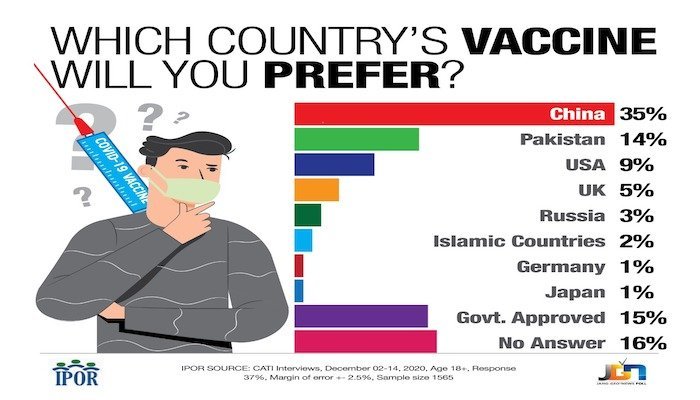
    A survey done by the Institute for Public Opinion Research (IPOR) has revealed that majority of the respondents would prefer a China-made coronavirus vaccine over Pakistan, United States, Russia and others. 

    According to details, 1,500 participated in the survey between December 2 and 14 this year. It found that 35% of the respondents preferred China’s vaccine while 14% backed Pakistan and 9% chose the US. A government-approved vaccine got the green-stamp of 15% of the respondents while 16% did not give any answer.

    The majority of respondents in the survey believe the virus to be a reality, while 25% said it doesn’t exist and termed it a global conspiracy.

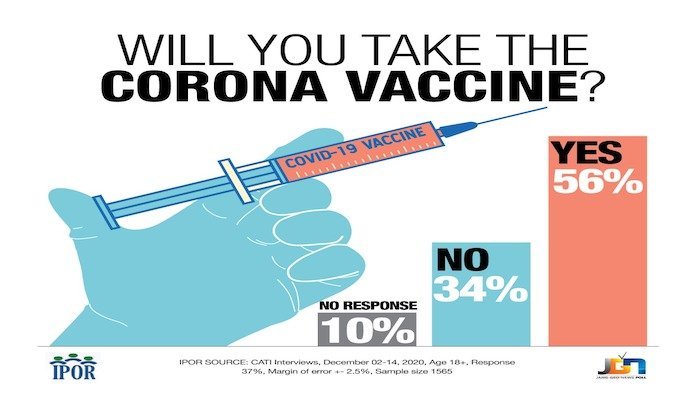
    Most of the participants said they would take the vaccine. Five in 10 said they would be willing to be administered the vaccine. Most of the respondents mentioned different conspiracy theories about the corona vaccine behind the reason for not going for the vaccine. In a previous survey, 67 percent of respondents were willing to administer the vaccine.

  • Tom Cruise loses it after crew members break COVID-19 protocols on ‘Mission: Impossible’ sets

    Tom Cruise loses it after crew members break COVID-19 protocols on ‘Mission: Impossible’ sets

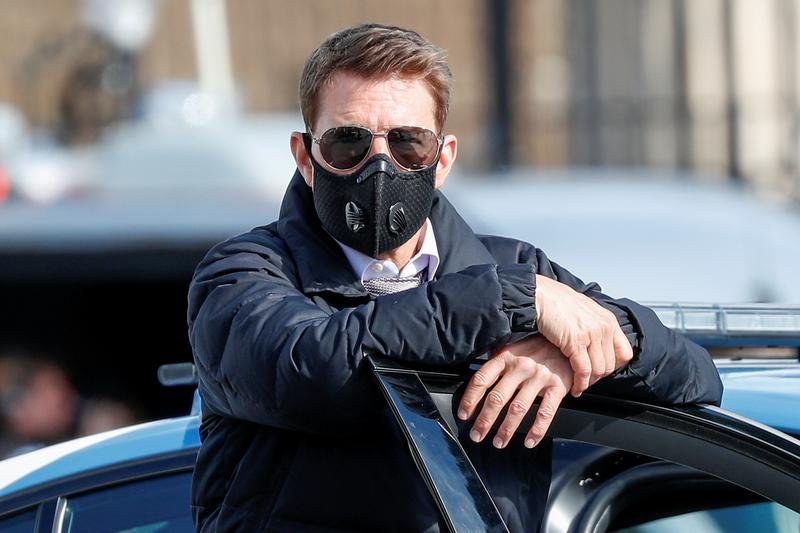
    Tom Cruise reportedly lost his cool after an apparent breach of COVID-19 safety protocols on the London set of the new Mission: Impossible movie, telling crew members they would be fired if they don’t obey the rules.

    In expletive-filled remarks captured on audiotape obtained by The Sun, the star and producer of the action film yelled at the crew about lapses of social distancing and other rules that allow movies to be made during the coronavirus pandemic.

    A source close to the production said the tape was authentic. However, Cruise’s representative declined to comment on the matter.

    “I’m on the phone with every fucking studio at night, insurance companies, producers, and they’re looking at us and using us to make their movies,” Cruise told the crew on the set.

    “Do you understand the responsibility that you have? Because I will deal with your reason. And if you can’t be reasonable and I can’t deal with your logic, you’re fired,” he can be heard saying in the audiotape.

    The Sun did not say when the incident took place, but the filmmakers arrived in London in early December.

    The seventh Mission: Impossible was one of the first movies to shut down production because of the coronavirus when it abandoned filming in Venice, Italy, in February.

    Production resumed in September, with filming in Italy, Norway and London. Cruise in July personally appealed to Norway’s prime minister to shoot parts of the film in Norway under modified quarantine rules.

    Cruise told the crew Hollywood was relying on movies like Mission: Impossible to keep the beleaguered industry going.

    “We want the gold standard. They’re back there in Hollywood making movies right now because of us! Because they believe in us and what we’re doing,” he said.

    Mission: Impossible is one of the biggest franchises in Hollywood, with 2018’s Mission: Impossible-Fallout taking more than $791 million at the worldwide box office.

    The Paramount Pictures film is scheduled to be released in November 2021.

  • Teachers should receive vaccine priority: UNICEF

    Teachers should receive vaccine priority: UNICEF

    The head of the UN children’s agency, UNICEF, has said that teachers should be among those given priority access to the COVID-19 vaccines.

    “The Covid-19 pandemic has wreaked havoc on children’s education around the globe. Vaccinating teachers is a critical step towards putting it back on track,” Unicef chief Henrietta Fore said in a statement.

    Teachers should be “prioritised to receive the Covid-19 vaccine, once frontline health personnel and high-risk populations are vaccinated,” she said.

    “This will help protect teachers from the virus, allow them to teach in person and ultimately keep schools open.”

    According to UNICEF, at the peak of the first wave of the pandemic at the end of April, “school closures disturbed the learning of almost 90% of students worldwide.”

    Assuming that schools are not the main driver of community transmission, Unicef said in its statement that unfortunately, classes currently remain closed for “nearly one in five schoolchildren globally — or 320 million children.”

    We must “do everything in our power to safeguard the future of the next generation. This begins by safeguarding those responsible for opening that future up for them,” Fore said.

    “The consequences of extended, missed or impaired education are steep, especially for the most marginalized. The longer children remain out of school, the less likely they are to return, and the more difficult it is for their parents to resume work,” she said.

  • Pakistani doctor develops COVID-19 diagnostic test using smartphone

    A Pakistani doctor based in Toronto has launched an instant COVID-19 diagnostic test using a smartphone.

    Pakistan High Commissioner to Canada Raza Bashir Tarar has congratulated Dr Naqeeb Khalid for his achievement.

    Dr Naqeeb Khalid has graduated from King Edward Medical University in 1983 and has experience in the invention of medical devices and systems. The doctor told High Commissioner for Pakistan to Canada Raza Bashir Tarar that his invention will be used with the help of a digital platform that shows the result promptly on any smartphone. It can also communicate or save the results along with time and GPS information.

    He said that instant, precise and low-cost testing that does not rely on laboratory is vital in handling the pandemic. “Together with vaccines, we can control the COVID-19 outbreak and bring our lives and economies to normal.”

    In a video conversation with Dr Khalid, the high commissioner said the idea of a Covid test being displayed and communicated by the smartphone is admirable.

    He hoped such a quick, hassle-free, accessible and affordable invention would be of huge help to humanity in overcoming the current pandemic.

    Tarar says that clinical trials of the innovation would prove its efficacy for the COVID-19 test and make the way for necessary approvals before put to use at the mass level.

    The smartphone application would soon be available to download from the AppStore.

  • Sindh govt revises restaurant timings for outdoor dining, takeaways

    Sindh govt revises restaurant timings for outdoor dining, takeaways

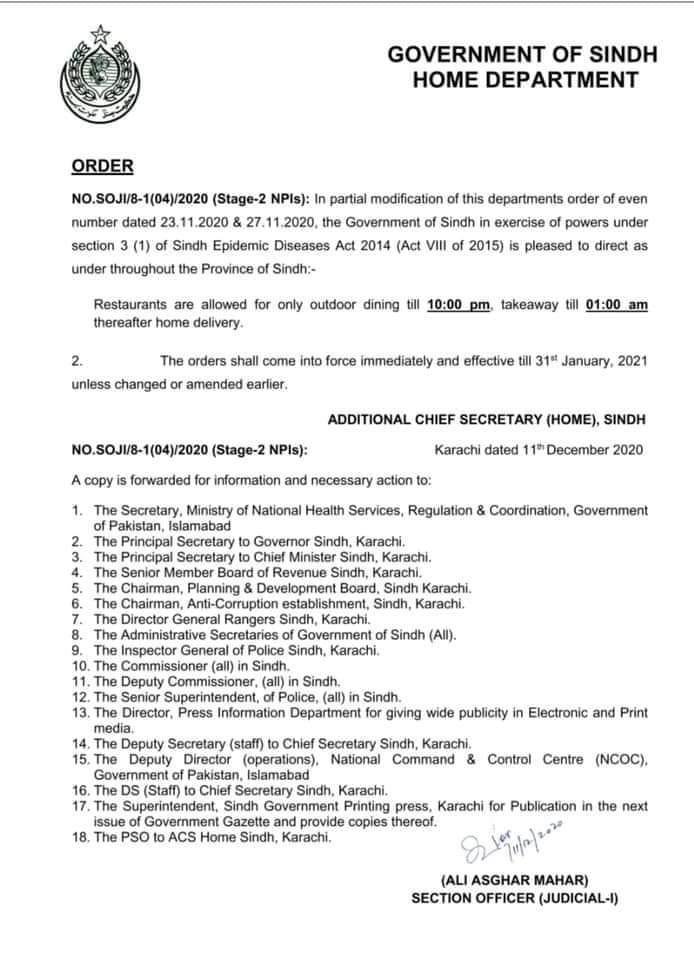
    The home department of Sindh government has released new COVID-related instructions allowing take-aways and deliveries of restaurants till 1 am.

    The notification reads that the restaurants can provide dine out service until 10 pm while they can facilitate customers for take-away services for up to an hour into the midnight.

    Previously, the restaurants were only allowed to operate  till 10 pm for dine-out, take-aways and deliveries.

    The notification is valid until January 31.

  • Men with COVID-19 three times more likely to need intensive care than women: study

    Men with COVID-19 three times more likely to need intensive care than women: study

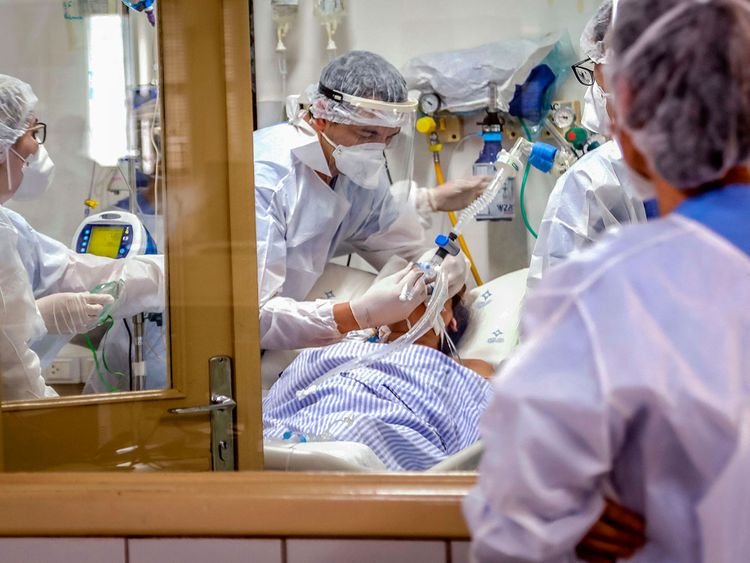
    Men infected with COVID-19 are three times more likely to require intensive care than women and are at significantly higher risk of dying from the virus, scientists said Wednesday.

    Researchers analysed over three million confirmed coronavirus cases from 46 countries and 44 states in the US between January 1 and June 1, 2020.

    They found that the risk of Sars-Cov-2 infection was the same for women and men, as “exactly half” of the confirmed cases were male patients.

    But men are almost three times more likely than women to be hospitalised in an intensive care unit and are 39 percent more likely to die from the virus, the study said.

    “These data may help doctors to recognise that sex is a risk factor for severe disease when managing patients,” co-author Kate Webb told AFP.

    “Sex is an under reported variable in many studies and this is a reminder that it is an important factor to consider in research,” the Cape Town University researcher said.

    The trend is global – aside from a few exceptions – and can mostly be put down to biological differences, researchers said.

    “Sex differences in both the innate and adaptive immune system have been previously reported and may account for the female advantage in Covid-19,” the authors said.

    Women naturally produce more type I interferon proteins that limit the abnormal immune response known as a cytokine storm, believed to play a role in provoking severe forms of Covid-19.

    The “female” oestradiol hormone may also help women to fend off grave forms of the virus, as it boosts the response of T cells – which kill infected cells – and increases the production of antibodies, the study said.

    “In contrast, the male sex hormone testosterone suppresses the immune system,” the authors noted.

    Sex-based differences in co-morbidities associated with severe Covid-19 may put men at outsize risk, they wrote in the study, published in Nature Communications.

    But data to account for the role of other medical conditions is lacking, they added.

    In addition, the authors noted the similarity in the proportions of women and men with hypertension and diabetes globally, “the most common reported comorbidities in hospitalised Covid-19 patients.”

    The findings may have implications for future vaccines, the authors said.

    Webb noted previous vaccines to other infections have shown differences in response between women and men.

    “It is still to be determined whether the same will be true for Sars-CoV-2 vaccines,” Webb said.

    “But we hope that our paper highlights the need to include sex as a variable when considering vaccine research.”

  • ‘A Year To Remember’: Adnan Siddiqui on why he ‘admires 2020’

    ‘A Year To Remember’: Adnan Siddiqui on why he ‘admires 2020’

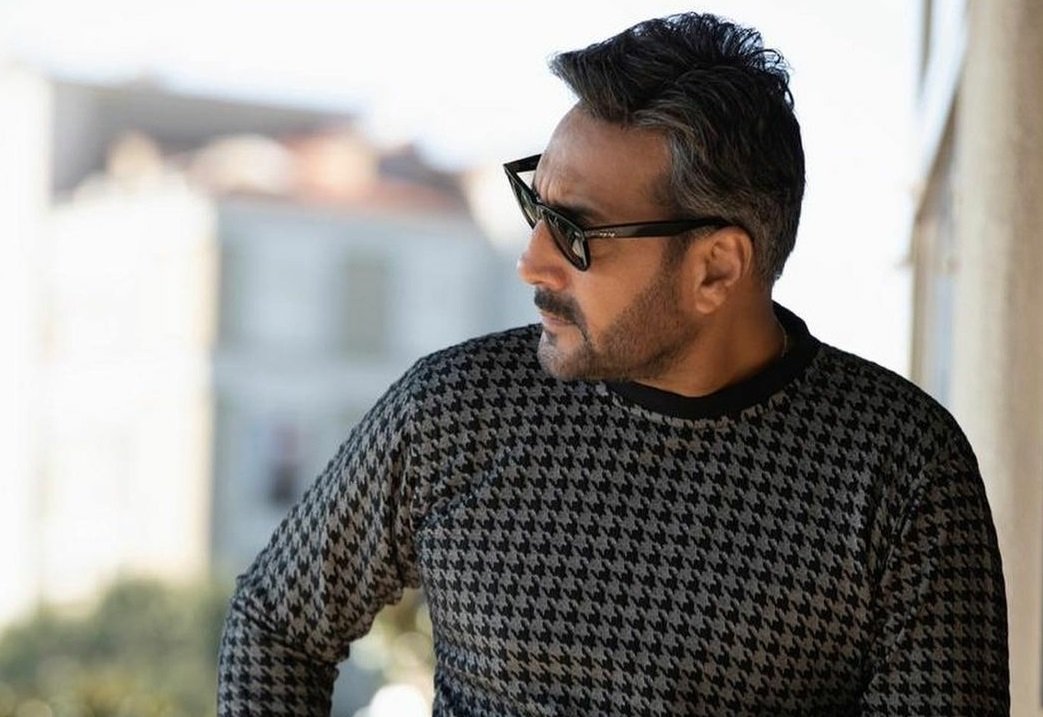
    2020 has been quite the year, for all of us and none of us would like to relive it. But Adnan Siddiqui, who had a great year as far as his acting projects are concerned (Meray Paas Tum Ho, Ye Dil Mera) says that he admires 2020, calling it ‘A Year To Remember’.

    “In three weeks from now, 2020 will be behind us,” wrote the actor on Instagram. “A most extraordinary year. When we rang it in, I don’t think anyone had even a vague idea that three months into it and our lives, as we knew it, would come to a halt. A thriving world came to an abrupt standstill and we are still waiting for normalcy to return. No wonder, our most common refrain since March 2020 is, ‘when will life be back to old normal’.”

    He then went on to share why he admires 2020 so much.

    “I often get asked why I admire 2020 so much when it caused a life-altering crisis across the globe. I have always felt that in every adversity lies an opportunity. We only need to discover that. The amount of free time I had on my hands, thanks to the lockdown, was God sent. I loved the languid pace at which life was moving all those months. And as Mac Davis crooned, I stopped and smelled the roses,” the actor added.

    Sharing about time spent with his kids, Adnan wrote: “My kids were the happiest to have me around 24 hours and I would like to imagine myself as a more patient and wiser parent while dealing with the millennials. I finished a book that was mocking me for years for having left it in between. Caught up on sleep, wrote poetry.”

    Read more – Quarantine turns Adnan Siddiqui into Wolverine

    “But most of all, 2020 enlightened me to a new perspective of life–to accept it in a larger scheme of things. I learnt that man, even if he fancies himself as omnipotent, can never conquer nature.”

    “2020 also taught me to slow down a bit, to hold my loved ones closer, to pray a little longer, and never to take life for granted,” concluded Adnan.

  • COVID-19 vaccines to be provided in three phases

    COVID-19 vaccines to be provided in three phases

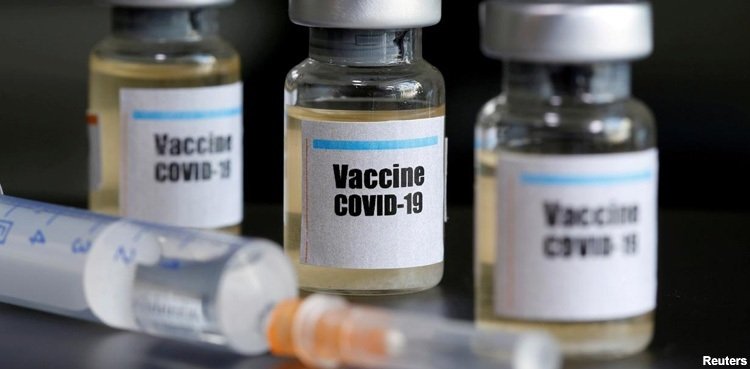
    The federal government has completed the plan for the COVID-19 vaccination drive. Vaccines will be distributed in three phases with the first phase expected to start from March 2021.

    A spokesperson for the Ministry of National Health Sajid Hussain Shah told The Current that in the first phase, vaccines will be provided to 0.5 million frontline essential health workers while in the second phase, it will be given to the population over 65 years of age.

    The remaining population will be given COVID-19 vaccines in the third phase. During the third phase,  the number of people to get the vaccination will depend on the available quantity of COVID-19 vaccines.

    Earlier, a special cabinet committee led by Federal Minister Asad Umar, had been formed for the procurement of the COVID-19 vaccine.

    The National Command and Operation Centre (NCOC) had approved the ‘Vaccine Administration Plan’, the comprehensive strategy prepared by the Expanded Programme on Immunisation (EPI) of the health ministry.