Tag: COVID-19 pandemic

  • 830 COVID-19 hot-spots sealed in Punjab

    830 COVID-19 hot-spots sealed in Punjab

    Provincial authorities have sealed numerous areas in Lahore under the micro-smart lockdown strategy. 

    As per reports, the Punjab government has sealed 830 areas across the province after a rise in COVID-19 cases. A total of 1416 coronavirus cases were reported in these areas.

    The micro-smart lockdown has been imposed in 435 spots in Lahore, 37 hot-spots in Bahawalpur, 35 places in Bhakkar, 17 areas in Dera Ghazi Khan, 34 places in Faisalabad and 14 in Gujranwala district.

    Moreover, 44 places in Multan, 29 in Gujrat and many areas in Sahiwal, Sargodha, Shekhupura, Sialkot and other districts of Punjab have been sealed under the micro-smart lockdown.

    Meanwhile, Federal Minister for Planning and Development and NCOC Chairman Asad Umar has stressed for strict implementation of SOPs to control the COVID-19 spread in the country.

    Read more – COVID-19: Pakistan’s positivity rate exceeds 3% after 70 days 

    NCOC has also recently launched a helpline to report COVID-19 related violations by the public.

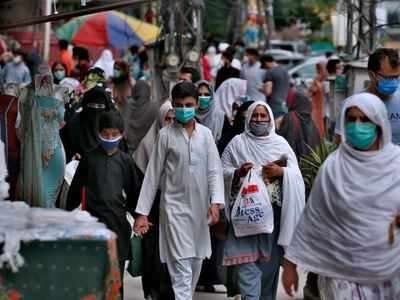
     People can report the violation of COVID-19 SOPs like non-wearing of the mask, non-adherence to Social distancing, over-crowding at public places, etc, at 03353336262 (0335333NCOC) along with a picture and the following details:

    Location Name:

    Tehsil/district/city:

    Date and Time:

    Event:

    Coronavirus seems to be gradually spreading again across the country as 1,078 new cases have reported over the past 24 hours. According to the NCOC, the total number of confirmed patients of coronavirus has risen to 332,186. 20 people succumbed to the infection during the past 24 hours, pushing the death toll to 6,795.

  • COVID-19: Pakistan’s positivity rate exceeds 3% after 70 days

    COVID-19: Pakistan’s positivity rate exceeds 3% after 70 days

    Minister for Planning, Development and Special Initiatives Asad Umar on Thursday announced that the country’s coronavirus positivity ratio was higher than 3% on October 29.

    In a tweet, the minister wrote that the coronavirus positive rate exceeded three percent after a period of more than 70 days. 

    “However, the rising spread of the disease can only be controlled if people believe in the need for precautions,” added the minister, appealing to everyone to follow the necessary SOPs.

    Meanwhile, the National Command and Operation Center (NCOC) has tightened restrictions on some high-risk public activities to address the coronavirus pandemic.

    NCOC has also launched a helpline to report the COVID-19 related violations by the public.

    Now people can report the violation of COVID-19 SOPs like non wearing of mask, non-adherence to Social distancing, over-crowding at public places etc, at 03353336262 (0335333NCOC) along with a picture and the following details:

    Location Name:

    Tehsil/district/city:

    Date and Time:

    Event:

    The coronavirus seems to be gradually spreading again across the country as 1,078 new cases have reported over the past 24 hours. According to the NCOC, the total number of confirmed patients of coronavirus has risen to 332,186. 20 people succumbed to the infection during the past 24 hours, pushing the death toll to 6,795.
  • Unmasked model tests positive for COVID-19 days after walking the ramp

    Unmasked model tests positive for COVID-19 days after walking the ramp

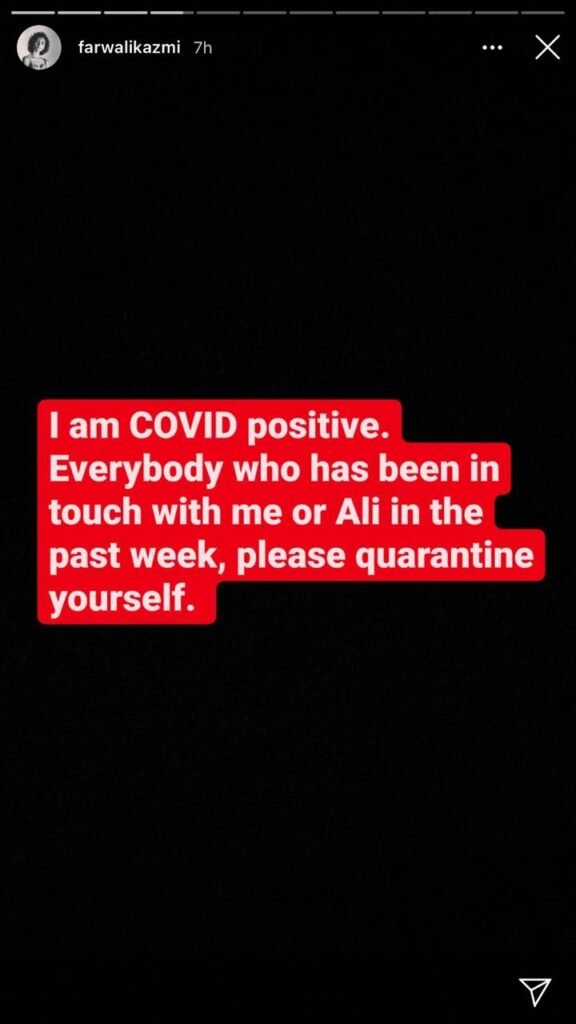
    Model Farwa Ali Kazmi tested positive for COVID-19 less than a week after walking the ramp for Hussain Rehar’s solo show in Lahore. According to writer and stylist Haiya Bokhari, the model “frolicked sans mask throughout the event” after assuming it was seasonal flu.

    “Super-spreader event but make it fashion,” wrote Bokhari on Twitter.

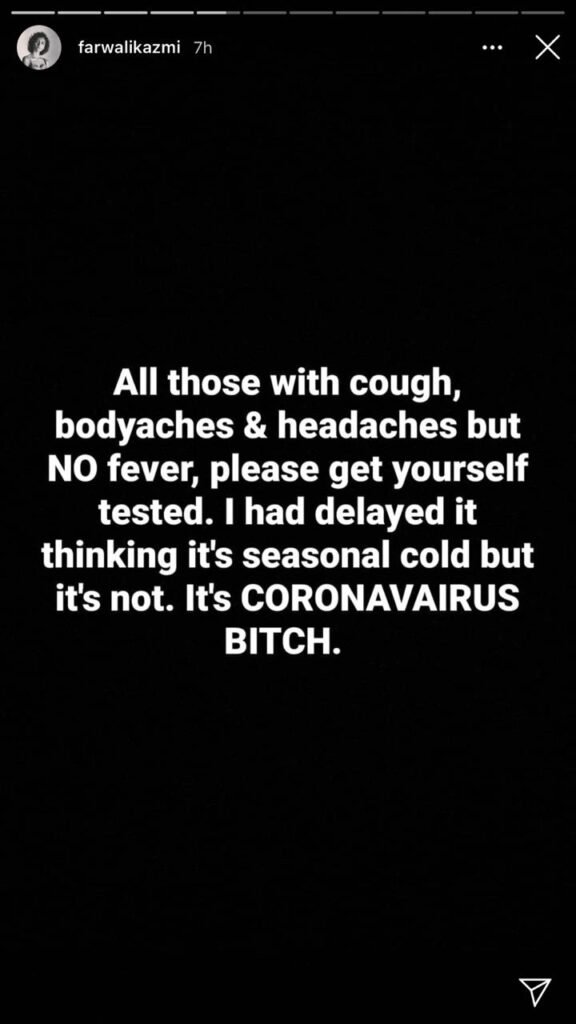
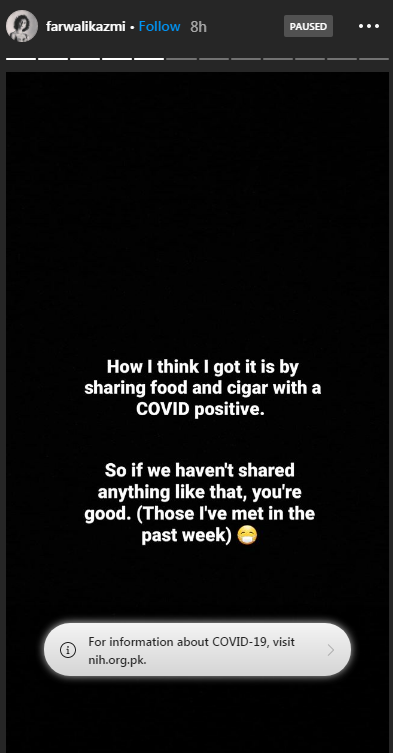
    Later it emerged that the model in question was Farwa Kazmi, who announced in an Instagram story that she has tested positive for coronavirus and is in quarantine.

    She also advised people who were in contact with her or husband Ali to quarantine themselves.

    “All those with cough, body aches and headaches but no fever, please get yourself tested. I had delayed it thinking its seasonal cold but it’s not,” added the model.

    Farwa further said that she thinks she got it by “sharing food and cigar with a COVID-positive”.

    The model also shared her quarantine experience.

    Designer Hussain Rehar had organised a solo fashion show in Lahore in which he showcased his traditional wedding-wear. The show was a glamorous event attended by celebrities, critics and socialites.

    According to details, Hussain’s brides, bridegrooms and a colourful entourage of baraatis twirled to the tunes of popular wedding songs and the beats of the shehnai played out by a live wedding band, enacting the events that are inherent to the big fat Pakistani wedding.

  • 10 streets in Islamabad sealed after surge in COVID-19 cases

    10 streets in Islamabad sealed after surge in COVID-19 cases

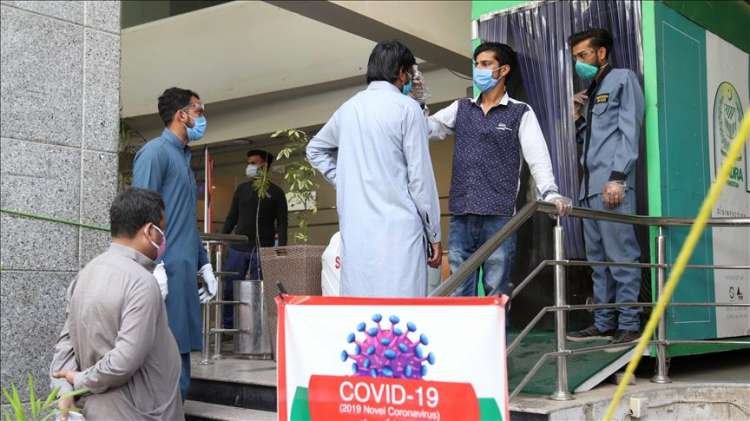
    The capital administration has sealed 10 streets in seven residential sectors after coronavirus cases surged in the city.

    Deputy Commissioner Islamabad Hamza Shafqaat took to Twitter to announce the COVID-19 hot spots, adding that “only people with jobs in essential services and negative COVID-19 certificate will be allowed to leave” in those areas.

    Islamabad has reported 19,012 coronavirus cases so far.

  • Asia crosses 10 million coronavirus cases after India becomes worst hit after US

    Asia crosses 10 million coronavirus cases after India becomes worst hit after US

    Asia surpassed 10 million infections of coronavirus on Saturday, the second-heaviest regional toll in the world, according to a Reuters tally. Cases continue to mount in India despite a slowdown and sharp declines elsewhere.

    Behind only Latin America, Asia accounts for about one-fourth of the global caseload of 42.1 million of the virus. With over 163,000 deaths, the region accounts for some 14% of the global COVID-19 toll.

    The Reuters tally is based on official reports by different countries. The true numbers of cases and deaths are likely much higher, experts say, given deficiencies in testing and potential underreporting in many countries.

    Despite the Asian spikes, the region overall has reported improvement in handling the pandemic in recent weeks, with daily caseloads slowing in places like India – a sharp contrast to the COVID-19 resurgence seen in Europe and North America.

    Within the region, South Asia led by India is the worst affected, with nearly 21% of the reported global coronavirus cases and 12% of deaths.

    India is the worst-hit country in the world after the United States. India is reporting more than 57,000 cases of the virus a day and averaging 764 COVID-19 deaths a day.

    The country has reported nearly 7.8 million infections, behind the U.S. tally of 8.5 million, and nearly 118,000 deaths, versus 224,128 in the United States. Unlike the recent U.S. surge, however, India’s slowdown saw the lowest daily caseload in nearly three months on Wednesday.

    But India’s infections may surge again, doctors fear, with a holiday approaching and winter bringing more severe pollution from farmers burning stubble, worsening the breathing difficulties that many COVID-19 patients suffer.

    India’s eastern neighbour Bangladesh is Asia’s second-worst hit country, with nearly 400,000 cases. But daily infections have slowed to 1,453, less than 40% of the July peak.

    Despite Asia’s patchy record, a World Health Organization expert said on Monday that Europe and North America should follow the example of Asian states in persevering with anti-COVID measures and quarantine restrictions for infected people.

    Mike Ryan, head of the UN agency’s emergency programme, said the global death toll from COVID-19 could double to 2 million before a successful vaccine is widely used and could be even higher without concerted action to curb the pandemic.

  • Japan researchers claim masks do not block coronavirus ‘perfectly’

    Japan researchers claim masks do not block coronavirus ‘perfectly’

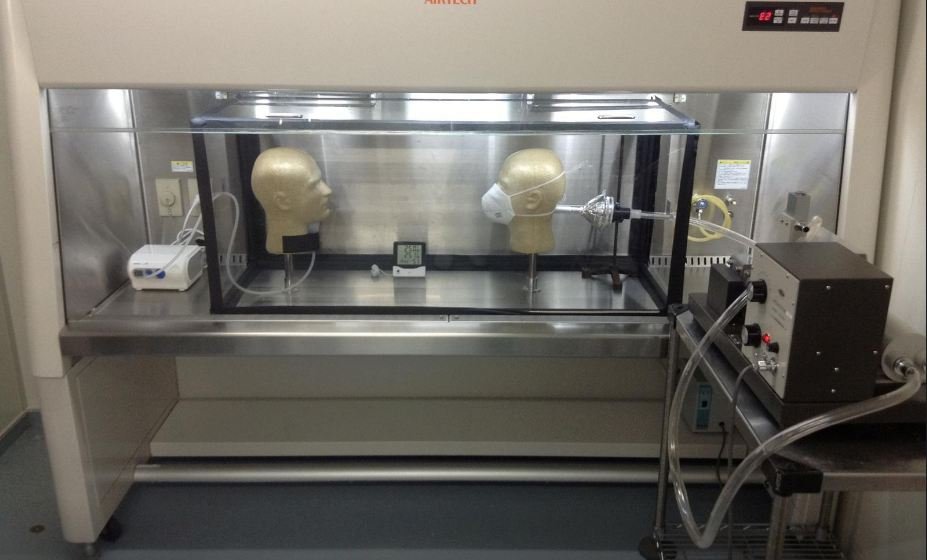
    Japanese researchers have demonstrated that though masks can offer protection from coronavirus particles, but even professional-grade coverings cannot eliminate the risk of the contagion completely.

    Scientists at the University of Tokyo built a secure chamber with mannequin heads facing each other. One head, fitted with a nebulizer, simulated coughing and expelled actual coronavirus particles. The other mimicked natural breathing, with a collection chamber for viruses coming through the airway.

    A cotton mask reduced viral uptake by the receiver head by up to 40% compared to no mask. An N95 mask, used by medical professionals, blocked up to 90%. However, even when the N95 was fitted to the face with tape, some virus particles still sneaked in.

    When a mask was attached to the coughing head, cotton and surgical masks blocked more than 50% of the virus transmission.

    “There was a synergistic effect when both the virus receiver and virus spreader wore masks,” the researchers wrote in their study.

    There has been a growing consensus among health experts that the COVID-19 virus can be spread through the air. The US Centers for Disease Control and Prevention (CDC) has revised its guidance this month to say the pathogen can linger in the air for hours.

    A separate team of Japanese researchers used supercomputer simulations to show that humidity can have a significant effect on the airborne dispersion of virus particles.

  • Gujranwala protesters booked for violating coronavirus SOPs

    Gujranwala protesters booked for violating coronavirus SOPs

    Gujranwala police have booked at least Pakistan Democratic Movement (PDM) members over violation of coronavirus SOPs during its power show in the city last week.

    The case registered at the Civil Lines police station against the PDM workers alleged that the political workers flouted measures put in place to contain COVID-19 and also blocked roads.

    The FIR nominates Pakistan Muslim League-Nawaz (PML-N) leaders Khurram Dastgir, Chaudhry Mehmood Bashir, Salman Khalid Butt, and Muhammad Bashir Virk among others.

    Last week, the joint opposition held its first rally in Gujranwala as it kicked off its anti-government drive. The rally was termed by the opposition a resounding success, but the government called it a flop show.

    Police had also booked over 100 people, including internet service providers, sound system organisers and residents in at least seven FIRs [First Information Reports] for violating coronavirus guidelines ahead of the gathering in Gujranwala.

    COVID-19 GUIDELINES FLOUTED:

    The massive gathering also blatantly flouted the anti-coronavirus measures, especially at a time when the second wave is in the offing. It is understandable that social distancing was not possible in a small stadium, but face masks — an effective precautionary measure — were also conveniently ignored.

    Out of the party leaders, only some were covering their faces, but they too removed them once they started addressing the gathering. PML-N’s Maryam Nawaz and JUI-F chief Fazlur Rehman and his party leaders did not wear masks at all. As for the crowd, a negligent number of people bothered to wear face masks as a measure to contain the spread of COVID-19.

  • Coronavirus infections to spike in polluted cities, fears PM

    Coronavirus infections to spike in polluted cities, fears PM

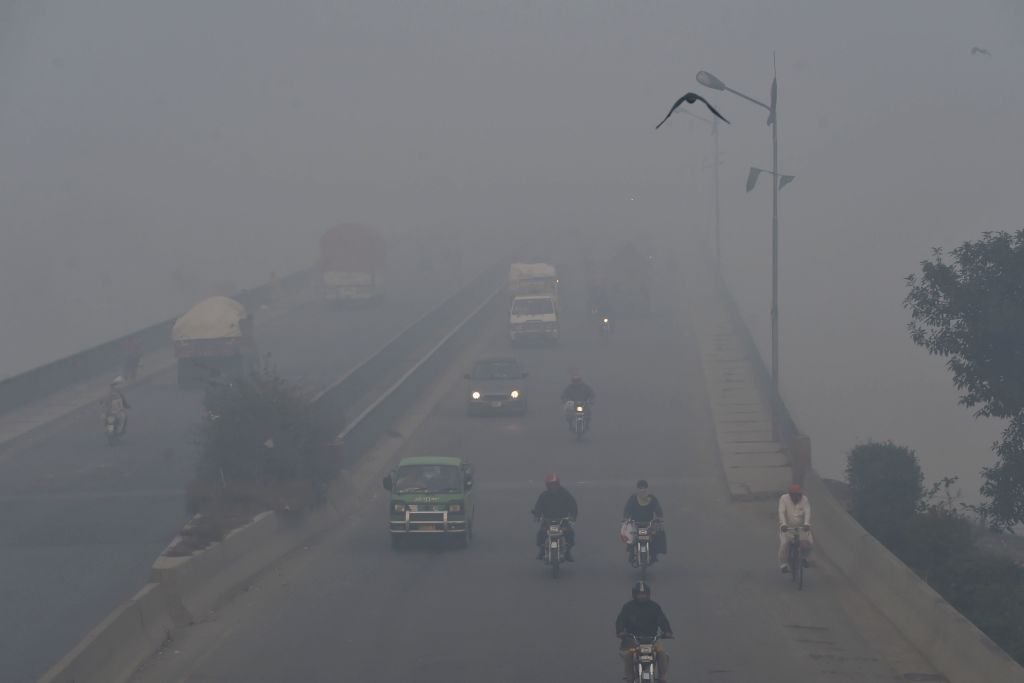
    Prime Minister Imran Khan has warned that the second wave of coronavirus infections was imminent, especially in cities that face higher air pollution levels.

    In an award ceremony pertaining to clean green index programme, the prime minister said that he feared there might be a resurgence of COVID-19 infections in cities where the rate of pollution increases in October and November.

    “I fear that in October and November […] cities like Faisalabad, Lahore, Karachi, Peshawar and Gujranwala where there is more pollution […] there might be a second spike in coronavirus cases. The cases are rising gradually and we hope that they don’t increase quickly; we are monitoring it,” he added. According to the PM, the infections could increase during winter as ‘pollution becomes stagnant in the atmosphere’.

    This is not the first time that the premier has warned of a resurgence of the deadly virus. At the start of this month, he had urged people to follow precautionary measures to curb the spread of coronavirus.

    Even though there have been multiple warnings by the government officials about the imminent spike in coronavirus infections, the federal and provincial governments have yet to take any serious measures to thwart a potential catastrophe. In March when the virus had started making inroads in Pakistan, the federal government through its reckless attitude enabled the outbreak.

    The prime minister had said the coronavirus infection was just like normal ‘flu’ which could be cured with ‘hot water’. This attitude didn’t help the government or public living under the shadow of a pandemic.

    This time again, the government is dilly-dallying on measures to prevent COVID-19 outbreak. Despite a gradual spike in cases since September, the government has allowed schools and businesses to operate, exposing millions to the virus.

    SMOG AND CORONAVIRUS:

    Experts say the pollutants could also aid the spread of coronavirus, said a BBC report. “In addition to air pollution decreasing immune defences, it is thought that particulate and nitrogen dioxide found in air pollution can act as vectors for the spread and survival of airborne particles such as Covid [virus],” Mary Prunicki, director of air pollution and health research at Stanford University, said.

    Studies have shown that exposure to high levels of pollution worsens the condition of patients who have diabetes, hypertension, coronary disease and asthma. And it also weakens the immune system of healthy people.

    “The lung is the gateway to the body and any damage to the organ can cause severe problems. And that makes people more susceptible to Covid-19,” Dr DJ Christopher, head of pulmonary medicine at the prestigious Christian Medical College in Tamil Nadu, said. Christopher said. “It’s akin to fighting a war with weakened front-line soldiers.”

    In Lahore, the air quality index has crossed 200 –very unhealthy– since the past week. According to the IQAir website, “Air quality in Lahore usually worsens during the winter season from October to February.” It says that winter air pollution is ‘worse due to temperature inversion, which results in a layer of warm air that is prevented from rising trapping air pollutants’.

  • Study reveals COVID-19 can survive on human skin for nine hours

    Study reveals COVID-19 can survive on human skin for nine hours

    Japanese researchers have discovered that COVID-19 stays on human skin for nine hours, stressing the need for frequent hand washing to fight the on-going pandemic.

    The pathogen that causes the flu, by comparison, survives on human skin for about 1.8 hours, said the study, published this month in the Clinical Infectious Diseases journal.

    The study backs World Health Organisation guidance for regular and thorough hand washing to limit the spread of the virus.

    “The nine-hour survival of SARS-CoV-2 (the virus strain that causes COVID-19) on human skin may increase the risk of contact transmission in comparison with IAV (influenza A virus), thus accelerating the pandemic,” the study underscored.

    “The longer survival of SARS-CoV-2 on the skin increases contact-transmission risk; however, hand hygiene can reduce this risk,” the study said.

    Both the contagious diseases, the COVID-19 and the flu virus are inactivated within 15 seconds by applying ethanol that is used in the hand sanitizers.

  • US could have saved trillions had it handled COVID-19 like Pakistan: American economist

    Economist and the former United States (US) Treasury secretary, Lawrence H Summers, while admiring Pakistan’s COVID-19 pandemic strategy, has said that Washington could have saved trillions had it handled the outbreak like Islamabad.

    In a conversation with CNN’s Fareed Zakaria on Sunday, he said, “America’s failure on COVID-19 is almost unimaginable. Heck, if the US had handled the pandemic as well as Pakistan, we would have saved in the neighbourhood of $10 trillion.”

    “The costs of an expanded testing system are trivial compared to the costs of tens of thousands of early deaths. Expanding testing should be a matter of utmost urgency,” tweeted.

    The US has recorded more than 8.35 million cases, 224,389 deaths, and over five million recoveries from the virus. US President Donald Trump and First Lady Melania Trump also tested positive for coronavirus on October 2.