Tag: covid 19

  • Are Punjab’s hospitals ready to continue dealing with COVID-19?

    Are Punjab’s hospitals ready to continue dealing with COVID-19?

    An additional burden has been placed on hospitals due to the sharp increase in confirmed COVID-19 cases across the country, including Punjab where the number of coronavirus cases is way past 38,000 and is likely to cross the 40,000 mark by tomorrow (Tuesday).

    But while Punjab Health Minister Dr Yasmin Rashid says the “situation is still not alarming” and Special Assistant to the Prime Minister (SAPM) on Health Dr Zafar Mirza says authorities have “ample resources to deal with coronavirus patients so far”, here’s what the situation in the country’s most populous province looks like:

    No. of Hospitals No. of Beds No. of HDUs (High Dependency Units) No. of Ventilators
    249 9644 944 568

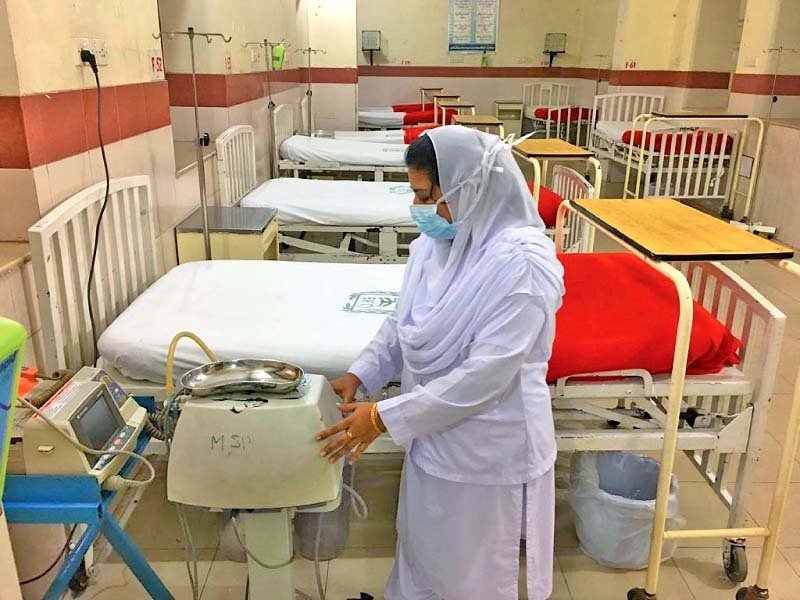
    The Punjab government has allocated 249 hospitals for COVID-19 patients with 9,644 beds, of which 53 hospitals (21.2%) are private. According to data provided to The Current by Punjab Health Department, 7,346 beds are vacant so far across the province as most people are choosing to quarantine themselves at home amid reports of the dreadful conditions at government facilities.

    While the availability of beds is not yet an issue, other necessities do not seem up to the mark.

    As per estimated stats, almost 2,272 (7.3%) patients in the province are admitted to different hospitals. Of the total 2,272, at least 497 (21.8%) patients are in Intensive Care Units (ICUs) or HDUs, which means they are in a critical condition.

    Almost 1,500 beds were allocated by the government for ICUs and HDUs, of which 473 (30%) are at private hospitals, or so the authorities claim.

    When contacted by The Current, Lahore’s Shalamar Hospital, which according to official claims is supposed to be treating at least five coronavirus patients, refused to share any details pertaining to treatment or costs, saying no infected persons were being treated by the hospital. The response received from Sargodha’s Central Hospital was not that different either, even though the government claims to have mandated it to treat at least three patients.

    By the time this report was filed, 21% of patients admitted to hospitals were reported to be critically ill. If a mere 5% of patients visiting hospitals need HDUs or ventilators, within the next two weeks, the healthcare system of the country’s most populous province could collapse, suggests the current number of life-saving facilities available in Punjab.
  • Air travellers to now be sent home after checkup as govt abolishes 48-hour quarantine policy

    Air travellers to now be sent home after checkup as govt abolishes 48-hour quarantine policy

    The federal government has abolished the 48-hour quarantine condition for Pakistanis returning home from abroad, and they would now be sent to their homes after a medical check-up and test at the airports, The Express Tribune reported.

    The report stated that the government changed the standard operating procedures (SOPs) because the capacity at quarantine centres had been contracting due to an increase in the number of COVID-19 cases.

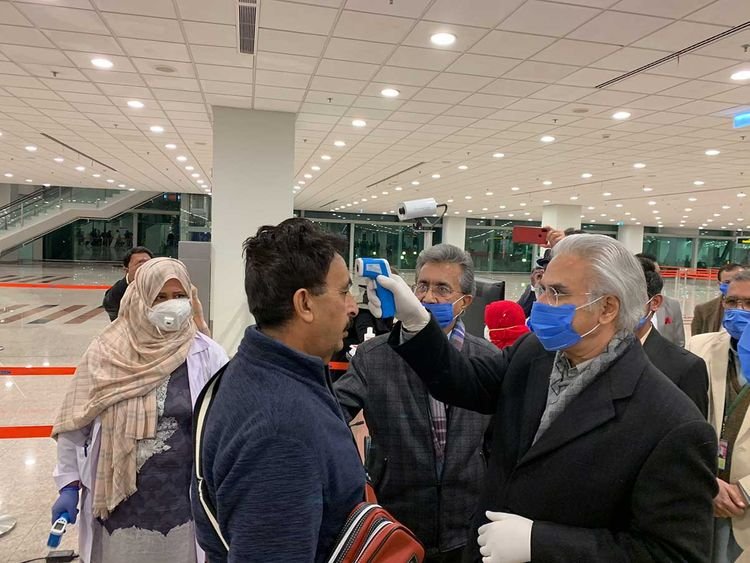
    According to the new SOPs, all passengers would undergo a complete medical check-up at the airports, while the staff deputed by the National Institute of Health (NIH) and provincial health departments at the airports will test the travellers for coronavirus.

    After the medical check-up and the coronavirus test, the passengers will be allowed to go their homes, instead of the quarantine centre, if they do not show any symptoms of COVID-19. The decision about suspected coronavirus patients has been left at the discretion of doctors.

    Under the new policy, all the passengers will be checked at the health counters of the airports. The record will carry the names and addresses of suspected coronavirus travellers and will be quarantined at home upon not showing any symptoms.

    On Wednesday, the NIH team conducted medical check-ups and coronavirus tests of all the passengers including 281 travellers coming from the United States (US) and 253 travellers coming from Saudi Arabia via a special Pakistan International Airlines (PIA) flight at the Islamabad airport, after which all the travellers were permitted to go to their homes, the report said.

    Meanwhile, with yet another record hike in number of infections, the tally of coronavirus cases in Pakistan now stands at 85,264 with at least 1,770 deaths.

  • Students protest outside HEC Islamabad demanding to waive of semester fees

    Students protest outside HEC Islamabad demanding to waive of semester fees

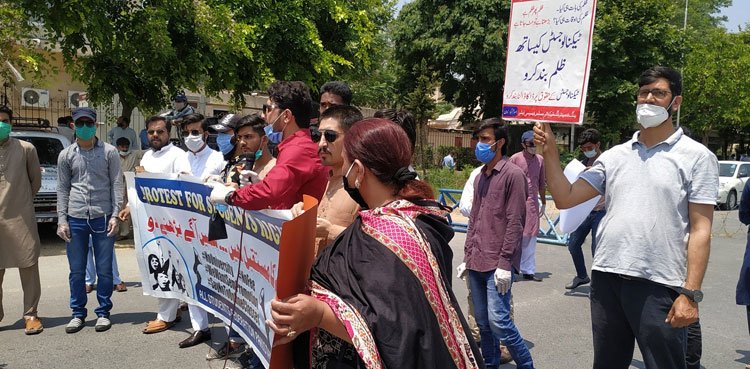
    Several university students from across the country protested outside the Higher Education Commission (HEC) office in Islamabad demanding the board to waive their full semester fee, suspended online classes and promote all students to the next semester without examinations.

    Blocking Islamabad’s Service Road, the students had placards in their hands and raised slogans against the HEC.

    They called out universities for charging full semester fees despite the coronavirus pandemic.

    Many students also took to social media to voice their concerns.

    Earlier, on May 12, Chairman Higher Education Commission (HEC) Dr Tariq Banuri had chaired a meeting with university vice-chancellors and discussed possible ways to conduct annual examinations.

    Suggestions were given to conduct examinations based on an open book, multiple-choice questions, assignments and viva-voce methods. The vice-chancellors put forth complaints made by students regarding internet connectivity issues and asked HEC to help in this regard.

    .

  • Record 3,938 COVID-19 cases with 78 deaths in 24 hours in Pakistan

    Pakistan from Monday to Tuesday reported a record number of 3,938 new coronavirus cases with 78 deaths within 24 hours.

    The latest surge in cases took the nationwide tally of reported cases to 78,128 while the death toll crossed the 1,600 mark. According to statistics provided by National Command and Operation Centre (NCOC), Pakistan has broken its previous record number of 3,039 new COVID-19 cases reported over 24 hours on May 31.

    Earlier on Sunday, Pakistan reported its most number of deaths during 24 hours with 88 new fatalities, however, given the swelling number of coronavirus cases, doctors and health experts have warned that the number of cases will continue to rise unless a strict lockdown is not imposed.

    Sindh and Islamabad also recorded the highest number of cases reported over 24 hours with 1,402 and 304, respectively, on June 1. However, Punjab reported the most number of deaths and new cases reported over 24 hours with 1,610 cases and 43 new fatalities due to the COVID-19.

    On Monday, Prime Minister (PM) Imran Khan, in a live televised address, had apprised the nation on the decisions made regarding the lockdown in Pakistan to contain the novel coronavirus during the National Coordination Committee (NCC) meeting.

    “Since day one when we got to know that the coronavirus had started spreading in Pakistan, we imposed a lockdown following a national security committee meeting,” he had said.

    “We observed the conditions in the Chinese city of Wuhan and in Europe when the virus started spreading and we were seeing how the world was responding. But at that time, when we had discussions and meetings, I was very clear on the path Pakistan had to take.

    “Pakistan’s situation is different than that in China or Europe,” he had said, noting that he had earlier informed the nation that 25% of the country’s population was below the poverty line, which “means that nearly 50 million people in our country do not eat two full meals a day”.

    PM Imran had said doctors, elite, and the poor all had diverse opinions but it was the downtrodden ones of the society who did not have a voice.

    “But in hindsight, I should not have stopped businesses and construction because we had to balance it. Coronavirus is not going away until a vaccine is not formulated. We have to live with it,” he had noted.

  • Queen Elizabeth enjoys horse ride as Britain eases coronavirus lockdown

    Queen Elizabeth enjoys horse ride as Britain eases coronavirus lockdown

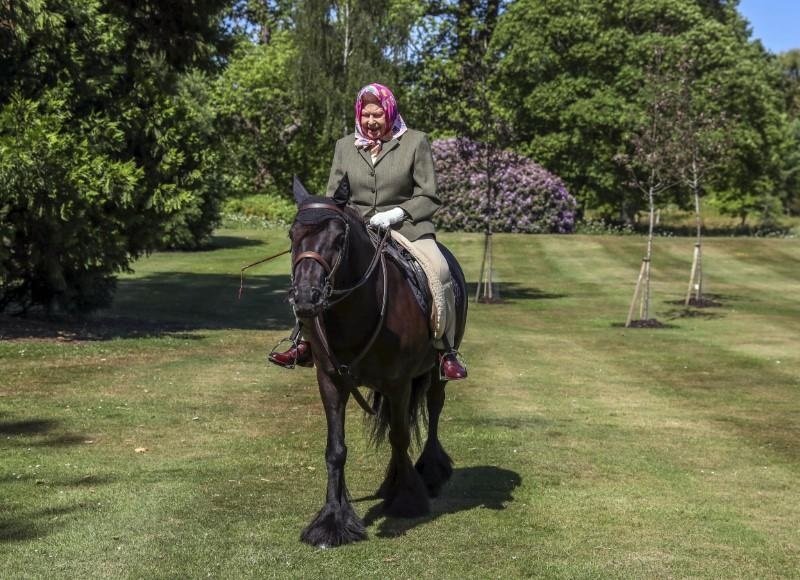
    Britain’s Queen Elizabeth was photographed riding a 14-year-old Fell pony in Windsor Home Park as the country eases lockdown to control the spread of the novel coronavirus.

    The Queen has been living at Windsor Castle, west of London, during the lockdown with her 98-year-old husband Prince Philip.

    As per reports, Windsor is said to be the Queen’s favourite royal residence and the 94-year-old regularly rides in the grounds of Windsor.

    She has issued several rallying messages to the nation from there, including televised addresses that have been a rarity during her 68-year reign.

    The last public picture of the Queen was taken as she was driven away from Buckingham Palace to her Windsor Castle home.

    The Queen leaving Buckingham Palace for Windsor Castle to socially distance herself amid the coronavirus pandemic 

    274,762 cases have been reported in the UK so far and a lockdown has been imposed to curb the virus spread.

  • 670,000 coronavirus infections in Lahore alone?

    670,000 coronavirus infections in Lahore alone?

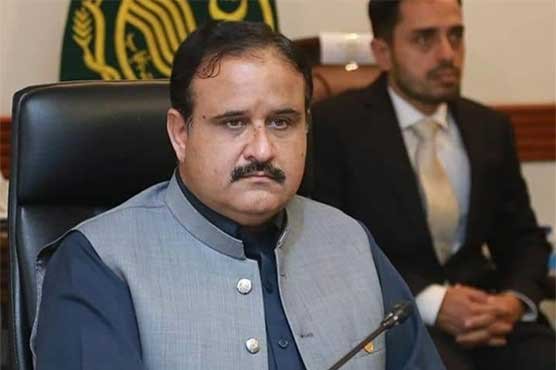
    A summary forwarded to Punjab Chief Minister (CM) Usman Buzdar by Primary & Secondary Health Secretary Captain (r) Usman last month estimated that there could be 670,000 cases of the new coronavirus — COVID-19 — in Lahore alone.

    The summary was forwarded to Buzdar on May 15, Geo quoted the secretary as saying, and reported that it contained results of samples collected from hotspots, residences and offices in Lahore.

    As per the summary, 6 per cent of the total samples collected, tested positive for COVID-19. In some towns, the percentage of positive cases went up to 14.7 per cent. The report said that there wasn’t a single area in Lahore where the infection had not reached. 

    Members of the Technical Working Group — formed to ascertain the number of coronavirus affected persons in the city — have recommended imposing a complete lockdown for four weeks and quarantining persons aged above 50 years. The group has also advised the government to declare it essential for people to stay inside their homes. 

    Lockdown restrictions have, however, only been eased since before Eidul Fitr last month.

    Amid soaring cases, the Punjab government has decided to further ease lockdown restrictions that were imposed to contain the outbreak. Buzdar last week chaired a meeting of the Cabinet Committee on Anti-Coronavirus Measures, wherein it was agreed that recommendations for the opening of the different departments and institutions, according to the standard operating procedures (SOPs) defined by the government, would be forwarded to the federal government.

    In the meeting, Buzdar said that a request would be made to the federal government to provide 1,500 ventilators. He added the instructions of the federal government regarding opening of restaurants, cafes etc, would be followed by the provincial government.

    The Cabinet Committee allowed the Punjab Public Service Commission to conduct interviews of one thousand lady doctors. It was also decided in the meeting that the Drug Regulatory Authority Of Pakistan (DRAP) would be approached for permission to prepare ventilators and respirators at the local level.

    It was decided the National Command and Operation Centre ( NCOC ) would take final decision to reopen the parks’ proposal, new working hours for the commercial enterprises and two-day holidays.

  • ‘There is no corona’: Mob attacks Karachi hospital as health workers remain at risk amid rising fatalities

    ‘There is no corona’: Mob attacks Karachi hospital as health workers remain at risk amid rising fatalities

    In yet another incident of a hospital being ransacked by survivors of a deceased coronavirus patient, a mob on Friday night attacked Civil Hospital Karachi while also harassing and attempting to assault the medical staff on duty.

    According to the hospital’s management, at least 70 people entered the hospital and took the body of the deceased from the emergency ward.

    The hospital’s medical superintendent, Dr Khadim Qureshi, reportedly confirmed the incident and said the police were asked to lodge an FIR [First Information Report] against those involved in the attack.

    No medical staffer were, however, injured in the attack.

    WATCH VIDEO:

    “Doctors are demanding security. It’s hard for them to work under this kind of situation,” Dr Qureshi said.

    Another doctor who was on duty at the time, said the incident took place at around 11 pm. He and other doctors on duty were also tortured and abused. “It’s the third time in a week, ” he claimed, alleging that the police deployed outside the hospital gate did not help the medical staff.

    While no arrests have been made as of yet and doctors have demanded deployment of Sindh Rangers for security, it is worth mentioning that it is not the first incident of its kind as hospitals across the country are being attacked every day amid the rising number of deaths due to COVID-19.

    Among other incidents being reported across the country, over a dozen people last week barged into and vandalised the isolation ward at Karachi’s Jinnah Postgraduate Medical Centre (JPMC) after a coronavirus patient being treated there died, officials said.

    Videos taken of the ward, where 37 coronavirus patients were being treated, after the attack showed pieces of glass, furniture and fans strewn on the floor. The glass windows of a counter were also shattered.

    Pakistan has so far reported 1,395 deaths due to the novel virus.

  • Young health workers who sacrificed their lives  fighting COVID-19

    Young health workers who sacrificed their lives fighting COVID-19

    Coronavirus cases in Pakistan are on the rise and according to the latest numbers, there are 64,028 cases of COVID-19 in the country. Healthcare workers, who are fighting on the frontlines, have been badly affected by the virus.

    As per reports, until May 28, 17 medical professionals had died of COVID-19 in Pakistan out of the total 1,904 who tested positive; this figure included 299 nurses, 570 others healthcare staff and 1,035 doctors.

    This is the total data of medical staff, as far as young doctors are reported, many of these were among them who sacrificed their lives fighting against coronavirus.

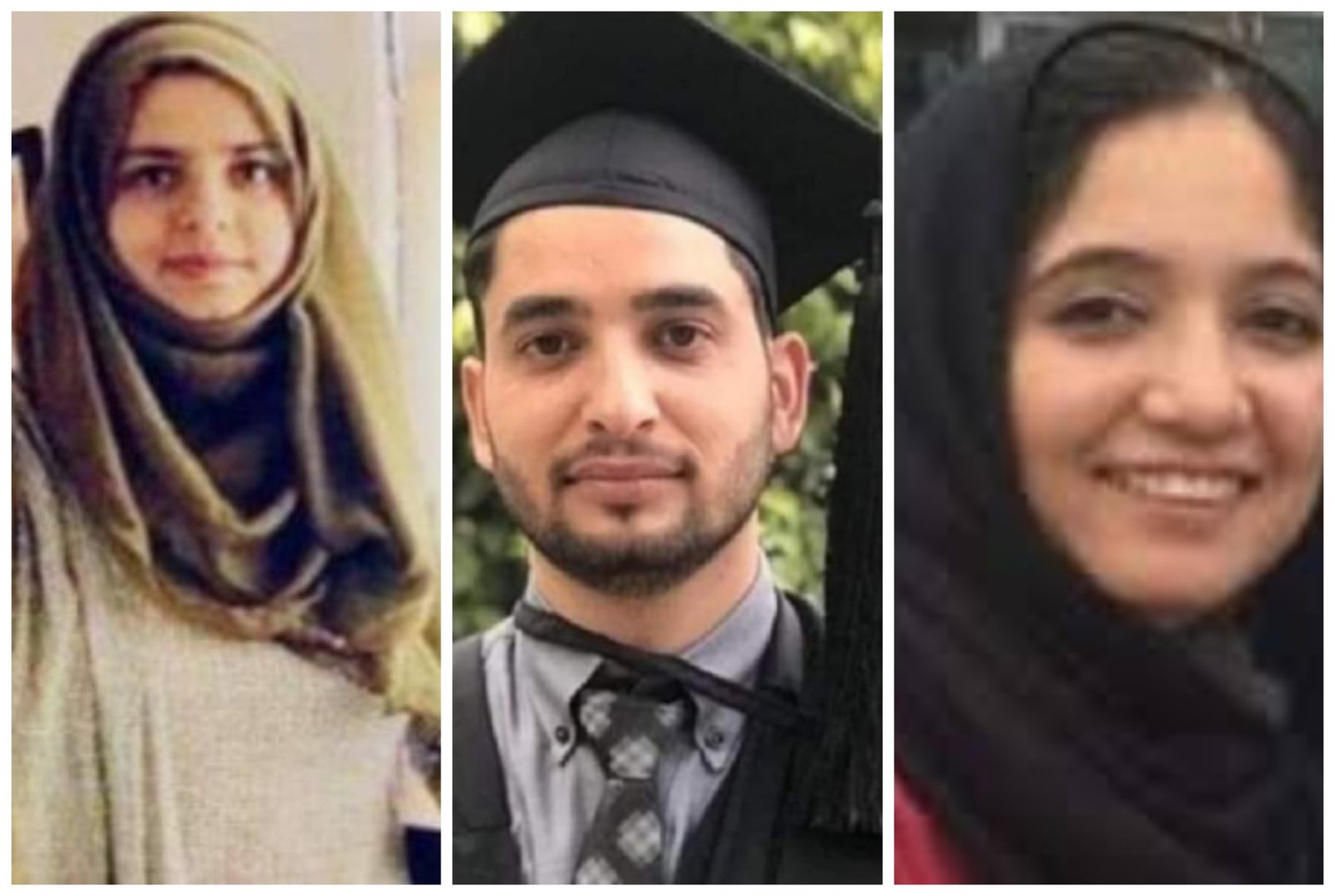
    Here are a few young doctors who lost their lives because of this pandemic.

    Dr Sana Fatima

    The doctor lost her life due to coronavirus on May 29. She was admitted to Lahore General Hospital after being tested positive for Covid-19 on May 20.

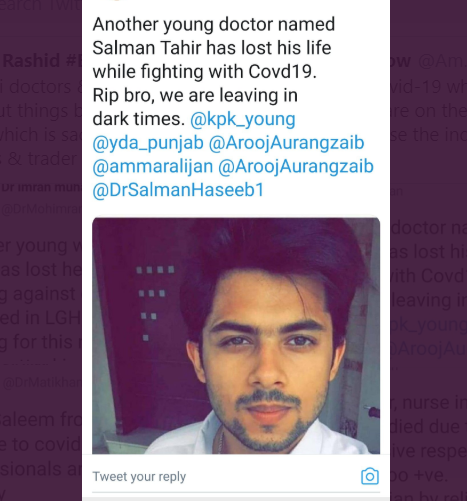
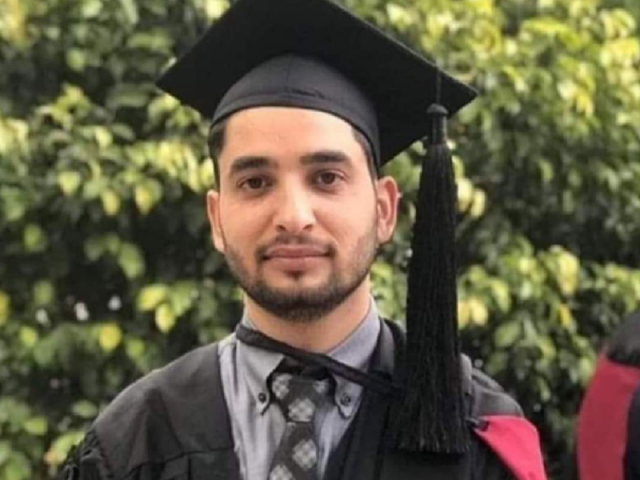
    Salman Tahir

    Salman Tahir, an MBBS fourth-year student of a private medical college in Lahore, was admitted due to high fever, but due to the high viral load of the virus, he died in the ICU of a private hospital within 24 hours. Dr. Salman Tahir’s father Prof. Tahir Saleem is in charge of the pediatric ward in a private hospital while his mother Dr. Shabana is a gynecologist in a private hospital.

    Mussarat Dilbar

    Mussarat Dilbar, a nurse at the Kohat Development Authority (KDA) hospital, was tested positive for the virus a few days ago. She had been admitted to the facility but her health condition continued to worsen and on May 29, she succumbed to the virus.

    Dr Usama Riaz

    The 26-year-old was infected with the coronavirus while screening infected pilgrims who had returned from Iran and Iraq in Gilgit-Baltistan and lost his life to COVID-19 disease on March 22. He was among the first healthcare workers to succumb to the disease.

    Dr Rabia Tayyab

    26-year old Rabia Tayyab succumbed to coronavirus at Rawalpindi’s Holy Family Hospital after battling the infection for almost two weeks.

    The doctor, who hailed from Gujjar Khan, was the daughter of a renowned teacher Mohammad Tayyab. She graduated from the Quaid-e-Azam Medical College in Bahawalpur and was due to start her house job from May 1.

    Healthcare workers are risking their lives and fighting on the forefront to save us from COVID-19. We can play our part in controlling the spread of the virus by following the SOPs and precautionary measures issued by the government and the World Health Organisation (WHO). Here’s what you can do:

    • Avoid going out unnecessarily
    • Clean your hands often. Use soap and water, or an alcohol-based hand rub to disinfect them
    • Maintain a safe distance from anyone who is coughing or sneezing
    • Don’t touch your eyes, nose or mouth with dirty hands. Cover your nose and mouth with your bent elbow or a tissue when you cough or sneeze
    • Stay home if you feel unwell
    • If you have a fever, cough and difficulty breathing, seek medical attention as soon as possible
  • Herd immunity against COVID-19: 3.7 million deaths projected at 2.11pc mortality rate in Pakistan

    With life in Pakistan returning to normalcy, it is feared that number of cases of the new coronavirus – COVID-19 — will increase further, wreaking havoc in the lives of the general public.

    Special Assistant to Prime Minister (SAPM) on Health Dr Zafar Mirza has also warned of the same while Minister for Science & Technology Fawad Chaudhry predicts that Pakistan is expected to see the peak of COVID-19 cases by mid-June.

    Meanwhile, epidemiologists are of the view that it is difficult to predict exactly when the virus will hit its peak in the country since there is always a risk of the number of infections escalating even after positive cases start declining.

    For a little perspective it may be noted that the United States (US) and Italy are the most-affected countries where the pandemic curve hiked and changed several times.

    Coronavirus hit its peak in the US between the 10th and 14th weeks since the first case was reported. More than 800,000 cases were reported during these weeks.

    Italy, on the other hand, witnessed a peak between the 6th and 10th weeks as more than 424,120 cases were reported.

    Pakistan entered its epidemic curve on April 29 (9th week) and the number of cases in Pakistan is still increasing as there is a possibility that the country might experience the peak after June 15.

    Pakistan may experience another curve later on because limited tests are being conducted as for now. According to experts, the country’s testing capacity should be between 40,000 to 50,000 at this point, while Pakistan is testing 7,000 to 13,000 people every day, which is not sufficient.

    Enter herd immunity, which opposition parties do not seem to be a huge fan of.

    Herd immunity is a form of indirect protection from infectious disease that occurs when a large percentage of a population has become immune to an infection, whether through vaccination or previous infections, thereby providing a measure of protection for individuals who are not immune.

    Here are some facts and consequences of herd immunity if the government goes on to consider it an option.

    Any population develops herd immunity when 40 per cent of the total number of people develop immunity against an infectious disease. In some cases, it can go up to 80 to 90 per cent of the total population.

    So, an important question is how much of the total population needs to get infected to develop herd immunity? So far, there is no evidence of herd immunity against coronavirus, as the Netherlands, which had planned to go for it and treat only critically ill patients, also stepped back from the said policy after a spike in mortality rate.

    According to predictions by some experts, it can take up to four or five years to develop herd immunity.

    To develop herd immunity in Pakistan, 176,000,000 people (80 per cent of the total population) have to get infected. This could cause 3,713,600 deaths as per the current 2.11 per cent mortality rate.

  • Significant drop in freelance work amid COVID-19, but rates remain stable

    Significant drop in freelance work amid COVID-19, but rates remain stable

    The global coronavirus pandemic has not only affected regular jobs but changed the landscape of freelance work as most Pakistani freelancers observe a decrease in demand amid COVID-19.

    Freelancers form more than 100 countries, including Pakistan, have shared insights with a digital payment platform called Payoneer, saying that freelance work has dropped drastically.

    The results of the survey show that businesses and companies have cut freelancing costs and halted new projects and contracts.

    Payoneer’s report titled ‘Freelancing during COVID-19’, showed 64 per cent of Pakistani freelancers, 33 per cent of whom are graphic designers, said that the demand for work had dropped significantly.

    15 per cent of freelancers said that the demand remained usual, while 18 per cent reported that demand for their services had increased.

    Regarding the strength of team , 24 per cent Pakistani freelancers said they would maintain the same team or grow it while 9 per cent said they would cut down on team members.

    In Pakistan, 82 per cent of freelancers said the demand will increase after COVID-19. However, they predict a more competitive landscape.

    According to the survey, freelancers who work with international clients based in North America and Europe saw the highest slowdown in demand. Those with clients in Asia and Australia, saw less of a decrease in demand for freelance projects.

    Globally, the report pointed out, freelancing rates, however, remained stable despite the slowdown.