Tag: CPJ

  • ‘Deadliest month’ for journalists: CPJ on Israeli attacks in Gaza

    ‘Deadliest month’ for journalists: CPJ on Israeli attacks in Gaza

    The Committee to Protect Journalists (CPJ) has reported the month following October 7 attacks has been the deadliest for journalists and media workers since CPJ began gathering data in 1992.

    CPJ’s “preliminary investigations” reveals that as of November 21, at least 50 journalists and media workers are among the 14,000 plus people killed since October 7.

    The deadliest day for journalists was October 7 itself as six journalists were killed; followed by November 18, the second-deadliest day when five were killed.

    CPJ highlights that up until November 21:

    • 50 journalists and media workers were confirmed dead: 45 Palestinian, four Israeli, and one Lebanese.
    • 11 journalists were reported injured.
    • Three journalists were reported missing.
    • 18 journalists were reported arrested.
    • Multiple assaults, threats, cyberattacks, censorship, and killings of family members has also been recorded.

    CPJ is also probing a number of unconfirmed reports of other journalists being killed, being missing, detained, hurt, or threatened, and of damage to media offices and journalists’ homes.

    “CPJ emphasizes that journalists are civilians doing important work during times of crisis and must not be targeted by warring parties,” states Sherif Mansour, CPJ’s Middle East and North Africa program coordinator.

    “Journalists across the region are making great sacrifices to cover this heart-breaking conflict. Those in Gaza, in particular, have paid, and continue to pay, an unprecedented toll and face exponential threats. Many have lost colleagues, families, and media facilities, and have fled seeking safety when there is no safe haven or exit.”

  • ‘India should stop harassing journalists’: Human Rights Watch

    ‘India should stop harassing journalists’: Human Rights Watch

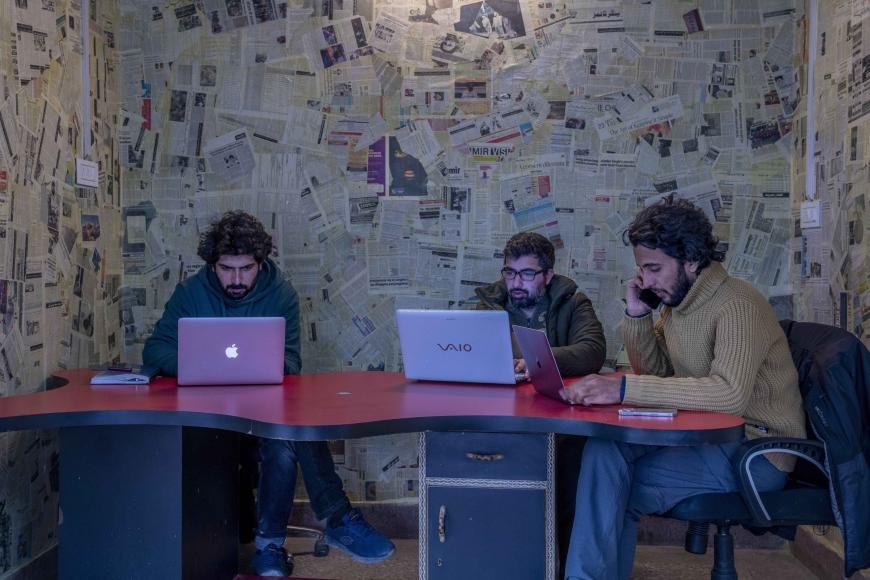
    Human Rights Watch (HRW) has released its report to address the unlawful arrest of journalists in Indian-Occupied Kashmir (IoK). According to the report, so far at least 35 journalists in IoK have faced police interrogation, raids, threats, physical assault, or fabricated criminal cases for their reporting.

    The recent arrest of Fahad Shah, an editor-in-chief of a leading Kashmir-based news site The Kashmir Walla, has led to condemnation from several journalism organisations including United States (US)-based Committee to Protect Journalists (CPJ).

    South Asia director at Human Rights Watch (HRW) said, “Instead of ensuring justice for security force violations in Kashmir, the [Indian] government is more interested in silencing those who bring these abuses to light.”

    Ganguly also demanded Indian authorities in Kashmir to release Shah and all journalists, activists, and critics jailed on “politically motivated charges” and stop harassing them with draconian laws.

    Furthermore, HRW has stated a number of journalist names who are behind bars on baseless grounds. Last month, the police arrested another journalist at the Kashmir Walla.

    In September, the police raided the homes of four Kashmiri journalists and confiscated their phones and laptops. Not only this, the Indian authorities give threats to journalists with jail if their work criticises them and pressured them to self-censor, says the HRW report.

    It states that India has placed over 40 people, including 22 journalists, on lists to stop them from travelling abroad.

  • 293 journalists jailed, 24 killed in 2021: CPJ report

    Record number of journalists were jailed around the world in 2021 with China remaining the world’s worst jailer of journalists for the third year in a row with 50 journalists behind the bars, states a report by Committee to Protect Journalists (CPJ).

    Apart from China, 26 journalists are behind bars in Burma, 25 in Egypt, 23 in Vietnam and 19 in Belarus.

    Adding those jailed in Saudi Arabia, Iran, Turkey, Russia, Ethiopia and Eritrea, the CPJ said a total of 293 journalists were in prison worldwide as of December 1.

    Forty of the 293 detained journalists – less than 14 per cent – are women.

    Executive director of the group Joel Simon said, “This is the sixth year in a row that CPJ has documented record numbers of journalists imprisoned around the world. It’s distressing to see many countries on the list year after year, but it is especially horrifying that Myanmar and Ethiopia have so brutally slammed the door on press freedom.”

    According to the report, 24 journalists are believed to be killed around the world this year. India has the highest number of journalists – four – confirmed to have been murdered in retaliation for their work. A fifth was killed while covering a protest. While, in the west, Mexico is at the top as three journalists were murdered for their reporting and the motives for six other killings are under investigation.

    The CPJ said the number of journalists behind bars reflects “increasing intolerance for independent reporting around the world”.

    Last month, Freedom Network reported that two dozen journalists in Pakistan had been prosecuted (2019-21) over the past under the Prevention of Electronic Crimes Act (Peca).

  • Imran govt denies entry to Committee to Protect Journalists coordinator

    Imran govt denies entry to Committee to Protect Journalists coordinator

    Pakistan’s immigration authorities have barred entry of Committee to Protect Journalists’ (CPJ) Asia Programme Coordinator Steven Butler, saying that his name had been placed on a “stop list”.

    “Last night [Wednesday], Pakistani immigration authorities denied entry to CPJ Asia Programme Coordinator Steven Butler, citing a blacklist managed by the Ministry of Interior,” the CPJ said in a statement issued Thursday as journalists across the country accuse the ruling Pakistan Tehreek-e-Insaf (PTI) of placing bars on media.

    “A border officer at Allama Iqbal International Airport in Lahore told Butler that his journalist visa was valid, but it was voided because his name was ‘on a stop list of the Interior Ministry’,” it quoted Butler as saying.

    According to the statement, Butler’s passport was “confiscated” by airport authorities and he was forced to board a flight bound for Doha. When he arrived in Doha, authorities there placed him on a flight to Washington, the statement read further.

    While on the flight, Butler told the CPJ that the flight crew had seized his passport and boarding pass and that he was in “a kind of restrictive custody”.

    “Pakistani authorities’ move to block Steven Butler from entering the country is baffling and is a slap in the face to those concerned about press freedom in the country,” the statement quoted CPJ Executive Director Joel Simon as saying.

    “Pakistani authorities should give a full explanation of their decision to bar Butler from entering and correct this error. If the government is interested in demonstrating its commitment to a free press, it should conduct a swift and transparent investigation into this case.”

    Butler had landed in Lahore to participate in the Asma Jahangir Conference — Roadmap for Human Rights in Pakistan, said the statement.

    BARS ON MEDIA:

    The development came two days after Geo News, one of Pakistan’s major news channels, took off the air a press conference of Jamiat Ulema-e-Islam-Fazl (JUI-F) chief Maulana Fazlur Rehman with its anchor explaining it was because the Pakistan Electronic Media Authority (PEMRA) has banned a live telecast of the event.

    Veteran journalist and analyst Hamid Mir also tweeted on October 12 that PEMRA has “forced TV channels not to show” Fazl’s press conference. He said that the government was showing weakness by “imposing unannounced censorship” in Pakistan.

    The incident is not the first of its kind as channels have been barred from airing press conferences or interviews of opposition leaders especially ever since the Imran Khan-led PTI government rose to power.

    Asif Zardari, former Pakistani president, and Maryam Nawaz, the daughter of jailed former prime minister (PM) Nawaz Sharif, have faced similar restrictions.

    “The current wave of censorship is not very current,” journalist Munizae Jahangir was quoted as saying by SAMAA.

    “Unfortunately, this has been going on for a while,” Jahangir said. “I would even say that during the time of Nawaz Sharif it started even then.”

    When asked if the government was behind it, Jahangir said, “If the government is not behind this current wave of censorship, then why is it still happening? It should stop.”

    She pointed a finger at “undemocratic forces” for censorship in the media and added, “If you do have undemocratic forces influencing democracy, then you will see censorship in the media.”