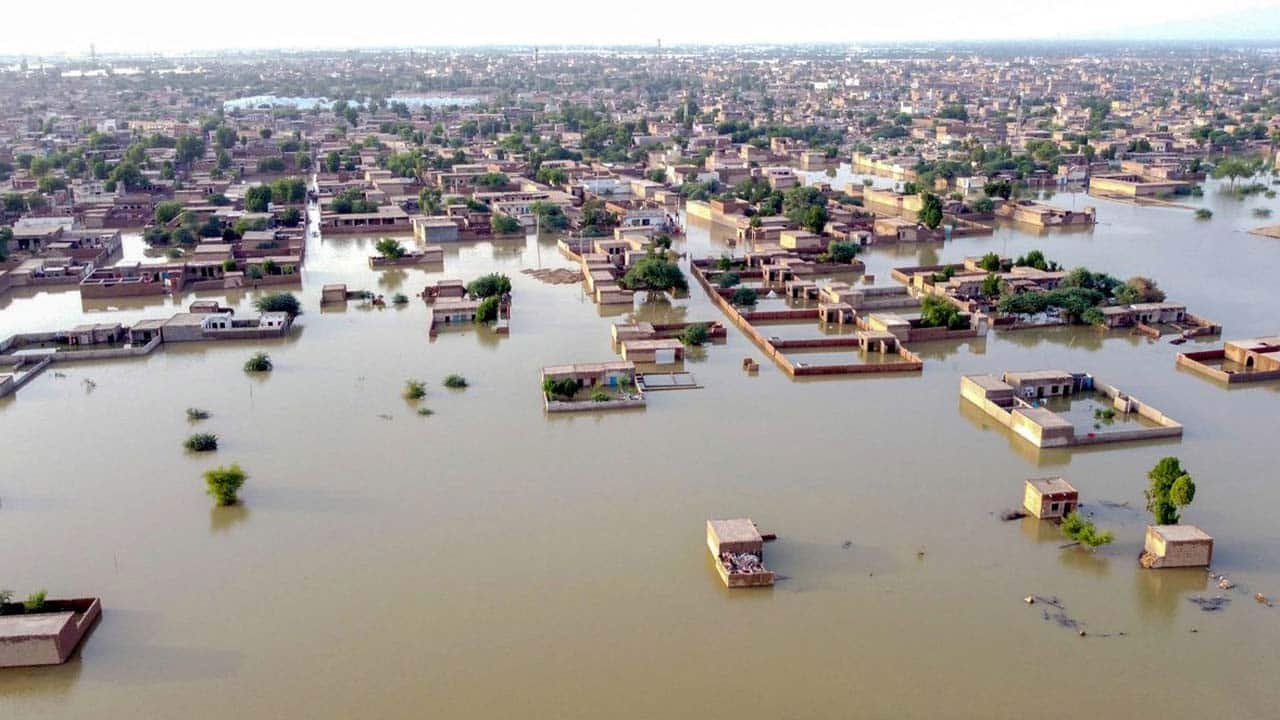
Syed Zafar Ali Shah, Secretary of the Ministry of Planning, Development, and Special Initiatives, stated on Thursday that a preliminary estimate indicated that the GDP growth rate may remain at two percent in the current fiscal year and that the estimated cost of damage repair, including reconstruction, may be $30 billion as a result of the nation’s floods.
He stated that we are gathering damage assessment data for a preliminary report and that the preliminary report and verification procedure would both be finished by October 15.
According to The Nation, teams from the government and ten international development organisations, such as the World Bank (WB), the Asian Development Bank (ADB), the United Nations (UN), and others, are working together to prepare the preliminary report for the damage assessment of the country’s floods.
In order to prepare early estimates on damage and reconstruction, he claimed that 100 specialists from development partners, such as the World Bank, the ADB, the UN, the EU, Turkey, etc., are currently working in 12 to 17 sectors.
According to him, the Pakistani government would take the initiative in relief operations, and technical skills will be provided by professionals to evaluate the field damage and the cost of rehabilitation. The administration will solicit donations for reconstruction after making the final determination.
In relation to the evaluation of the damage to the railways, Zafar Ali stated that it has been initially predicted that $2.3 billion will be needed for the reconstruction of the railroad tracks, bridges, and other associated facilities that have been harmed by floods. In total, 113 districts in Pakistan have been damaged by flooding, but 83 of those areas are catastrophe hit and require complete repair and rehabilitation work, according to him.
He claimed that the cost to rebuild homes is projected to be $3 billion. However, he said that the provinces are consistently reassessing damage. When the water recedes, he said, the Sindh government will begin work on reassessing those places. He claimed that water covers the majority of Sindh’s railroad rails.
He claimed that the Sindh flood had a significant negative impact on cotton, rice, and other crops. According to him, three million cotton bales are thought to have been lost. However, it appears that things are improving and the loss may only total 2.7 million bales, the secretary said, adding that it is still too early to provide a precise estimate of the cotton crop’s losses. He predicted that future wheat crop farming in Sindh and Khyber-Pakhtunkhwa would also be impacted.
He claimed that the nation’s severe flooding has had an impact on 4.3 million families. He stated that more than 0.3 million people in Balochistan had been impacted by the floods. According to him, the ADB has authorised a $3 million grant to boost the Pakistani government’s emergency relief efforts in the wake of massive flooding around the nation.
The planning secretary also mentioned that a Dutch expert would be working with NESPAK to update the flood prevention strategy for 2017. He said that the administration has so far used $303 million in donor funding that was intended for disaster relief. According to him, this sum consists of $3 million from the ADB and $300 million from the World Bank.
Despite the $160 million in pledges made so far by the world community, he claimed that much more money will be needed to complete the reconstruction and rehabilitation.
The planning secretary responded to a question concerning diverting PSDP-2022–23 monies for flood victims by saying that work is still being done on this issue, but no decisions have been made as of yet. He stated that the Benazir Income Support Program is now supporting the flood-affected population with Rs70 billion from the government.