Tag: currency

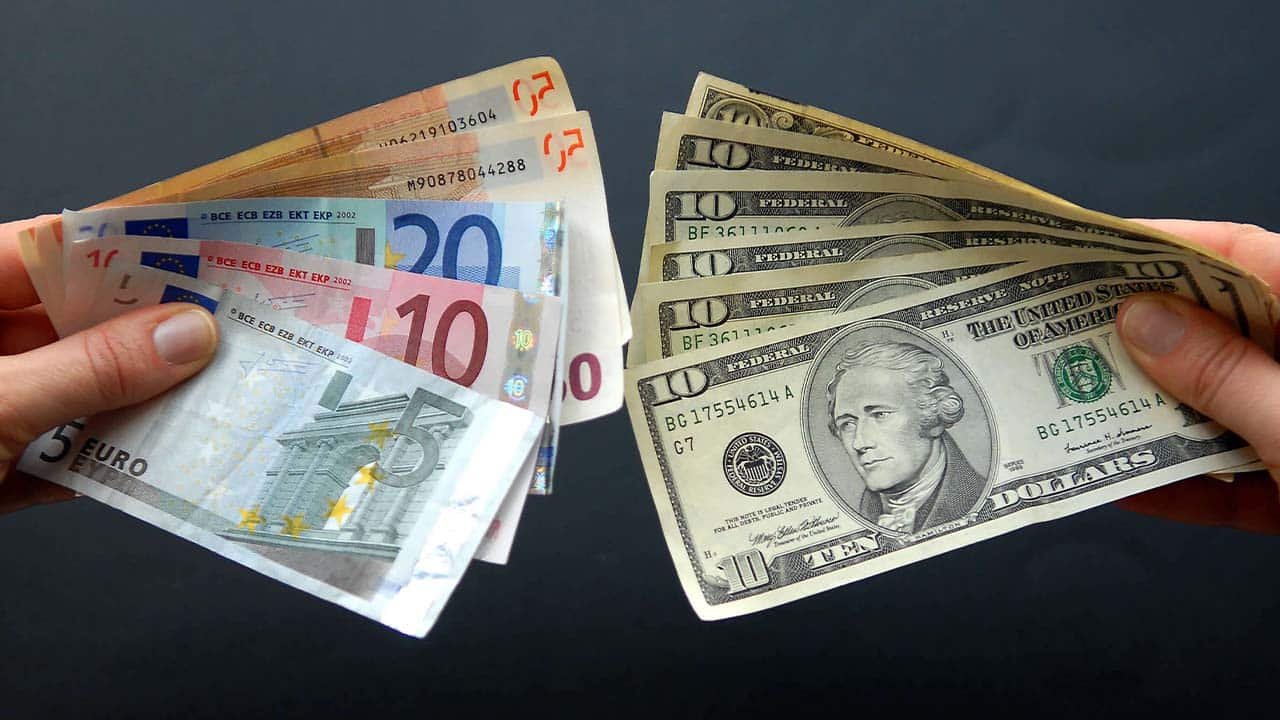
  • One Euro is equal to one US dollar for the first time in 20 years

    One Euro is equal to one US dollar for the first time in 20 years

    The euro reached its lowest level in more than 20 years by 10:00 GMT on Tuesday, falling to $1.

    The stock markets declined as a result of the euro’s parity with the dollar and the possibility of additional central bank tightening as well as concerns over the global economy’s stability.

    Recent weeks have seen the US dollar soar to two-decade highs against a variety of other currencies, strengthening its position as the preferred currency for investors concerned about the economic outlook.

    A continuing rise in natural gas prices’ impact on the local economy as well as the conflict in Ukraine have made the euro particularly vulnerable. The European Central Bank has lagged behind competitors in increasing interest rates.

    The move towards parity, according to Mizuho analysts, is taking place as “the downturn in the eurozone is priced in,” and the overall environment does not appear to be improving risk sentiment.

    For the European Union, this is a “catastrophe,” according to SG Futures, as energy imports may become more expensive.

    “Energy supply is already unaffordable and as we head into winter it’ll likely get even worse,” it added on a tweet.

    The dollar index has been moving higher as a result of the euro’s weakness, as well as concerns about global economic growth as China, in particular, enforces strict zero-COVID policies to control new outbreaks.

    The presumption that the Federal Reserve will raise rates faster and further than peers is, however, arguably the main reason for the dollar’s increase.

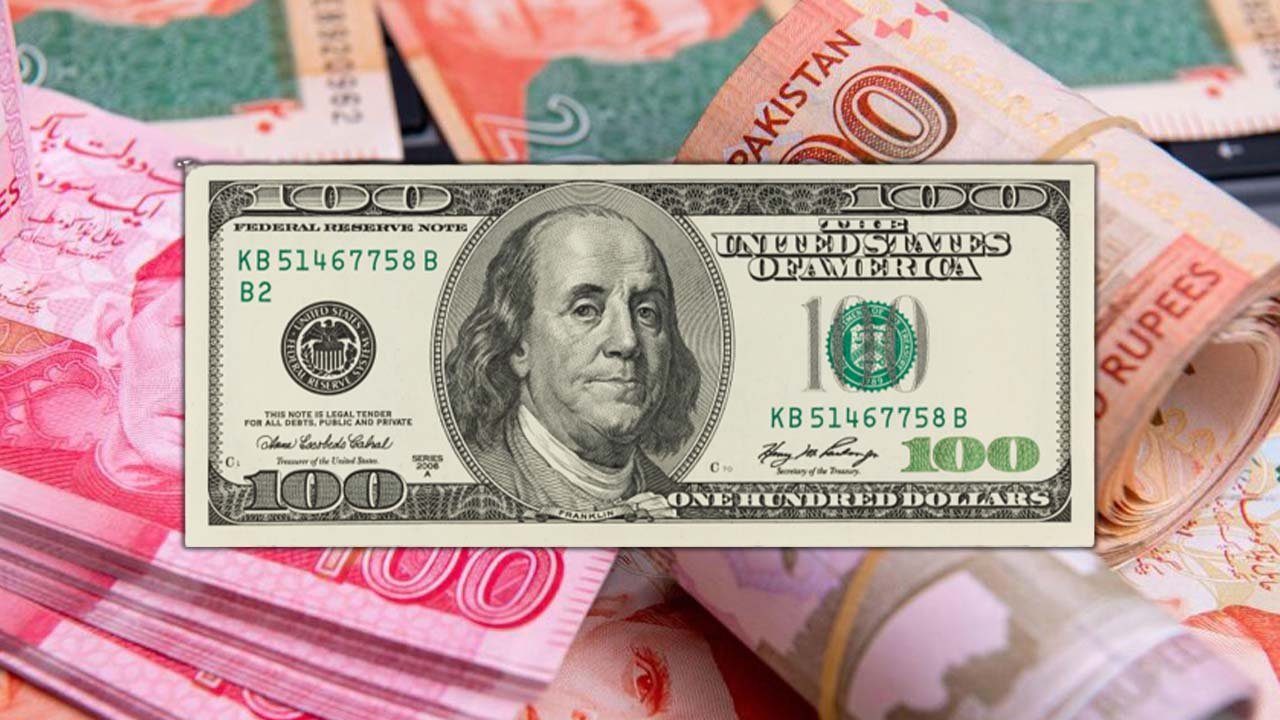
  • Pakistani rupee climbs versus dollar for fourth consecutive day, closes at Rs204.56

    Pakistani rupee climbs versus dollar for fourth consecutive day, closes at Rs204.56

    On Monday, the rupee continued to strengthen for a fourth consecutive day, rising a meagre 0.14 per cent against the US dollar on hopes that the International Monetary Fund (IMF) bailout plan will be reinstated.

    In relation to the US dollar, the local currency increased by Rs0.29, or 0.14 per cent, to settle at Rs204.56. Since falling as low as Rs211.93 on June 22, 2022, the currency has increased by Rs7.37.

    The market now anticipates a relatively easy restart of the programme, which coincides with Pakistan’s efforts to meet various IMF-imposed requirements.

    Following discussions between the two parties, Pakistan received the IMF Memorandum of Economic and Financial Policies (MEFP) last week.

    In addition, Pakistan’s Prime Minister Shehbaz Sharif has stated that the IMF will combine the seventh and eighth assessments of Pakistan’s Extended Fund Facility (EFF) and distribute around $1.9 billion in the coming days.

    Experts claim that the most recent developments in the IMF programme, which is largely seen as being essential to Pakistan’s economy, have enhanced investor sentiment.

  • Gold surges to Rs147,250 per tola in local market

    Gold surges to Rs147,250 per tola in local market

    On Monday, gold prices in the local market rose by Rs1,450 per tola to a new all-time high, pushed up by the Pakistani currency’s continued depreciation against the US dollar.

    Despite no change in gold rates in the international market, gold rates in the local market increased to Rs147,250 per tola, according to data released by the All Sindh Saraf Jewelers Association. Similarly, the price of a gramme of gold increased by Rs1,243 to Rs126,243.

    However, gold prices on the international market remained unchanged at $1,840 per ounce.

    The price of silver per tola remained unchanged at Rs1,560. The price of a gramme of silver also remained unchanged at Rs1,337.44. When compared to rates in the Dubai gold market, local jewellers said prices in the local market remained below Rs3,000 per tola.

    Pakistani rupee dips to new lows

    Experts predict that the Pakistan rupee will continue to fall against the US dollar and other major currencies owing to concerns regarding the IMF’s $6 billion program’s restoration, the country’s expanding current account deficit, and dwindling foreign exchange reserves.

    The PKR which lost 32.5 per cent of its value in the current financial year 2021-22 is forecasted to remain under stress as the dollar is in high demand in the market due to economic crises.

    The central bank appears helpless to stem the rupee’s speculative fall, as demand for the US dollar continues to rise due to quarter-end payment strain.

  • Pakistani rupee drops to Rs202 as market ambiguity extends

    Pakistani rupee drops to Rs202 as market ambiguity extends

    Pakistani currency slid to another historic low of Rs202 versus the US dollar on May 25 and lost ground in the interbank market.

    It fell 0.25 per cent against the US dollar today, closing at Rs201.92 after losing 51 paisas in the interbank market. During today’s open market session, the rupee hit an intraday low of Rs202.12 against the US dollar. In two weeks, the dollar has gained Rs15.23 against the rupee, and Rs18.98 since the new regime took power.

    The political situation in Pakistan also played a significant role in keeping the forex market on its toes, as players on both sides of the fence intensified their narratives against one another. Riots have broken out across the country after the month-old government shut down roads leading to Islamabad, where former Prime Minister Imran Khan’s party is planning a large rally calling for the removal of the incumbent and immediate general elections.

    International oil prices maintained Monday’s gains as concerns about tight global supply continued to outweigh short-term trade forecasts. Brent crude rose to $114 per barrel, while West Texas Intermediate (WTI) crude in the United States rose to $111.

    Today, the PKR fell further against the majority of the other major currencies in the interbank market. It fell two paisas against the Pound Sterling (GBP), 13 paisas against the Saudi Riyal (SAR), and 38 paisas against the Australian Dollar (AUD).

    In today’s interbank currency market, it gained 12 paisas against the Canadian Dollar (CAD) and 17 paisas against the Euro (EUR).

    It is worth noting that the PKR reported losses against the greenback for the fourteenth day in a row.

  • Pakistani rupee reaches a new all-time low of Rs190 against the US dollar

    Pakistani rupee reaches a new all-time low of Rs190 against the US dollar

    In the interbank market on May 11, the US dollar soared to an all-time high against the Pakistani rupee (PKR), reaching Rs190.10.

    In the morning. the local currency was trading at Rs189.89 to Rs190.04, with deals reported at Rs190.

    The dollar gained Rs1.44, surpassing the prior day’s finish of Rs188.66. The greenback touched an all-time high on May 11, when it surpassed the Rs189 level.

    It had gone down in the immediate aftermath of the April 11 change of government, but the adjustment soon ran out of steam, and the greenback is now flying again, hitting a new all-time high.

    Read more: CNG prices pushed to Rs140 per kg for sales tax collection

    Experts say the rupee is under pressure because of increased oil import bills and speculation about the Saudi package. Foreign reserves were also under strain due to delays in talks with the International Monetary Fund.

  • New bank timings announced by SBP, Saturday will now be observed as a working day

    New bank timings announced by SBP, Saturday will now be observed as a working day

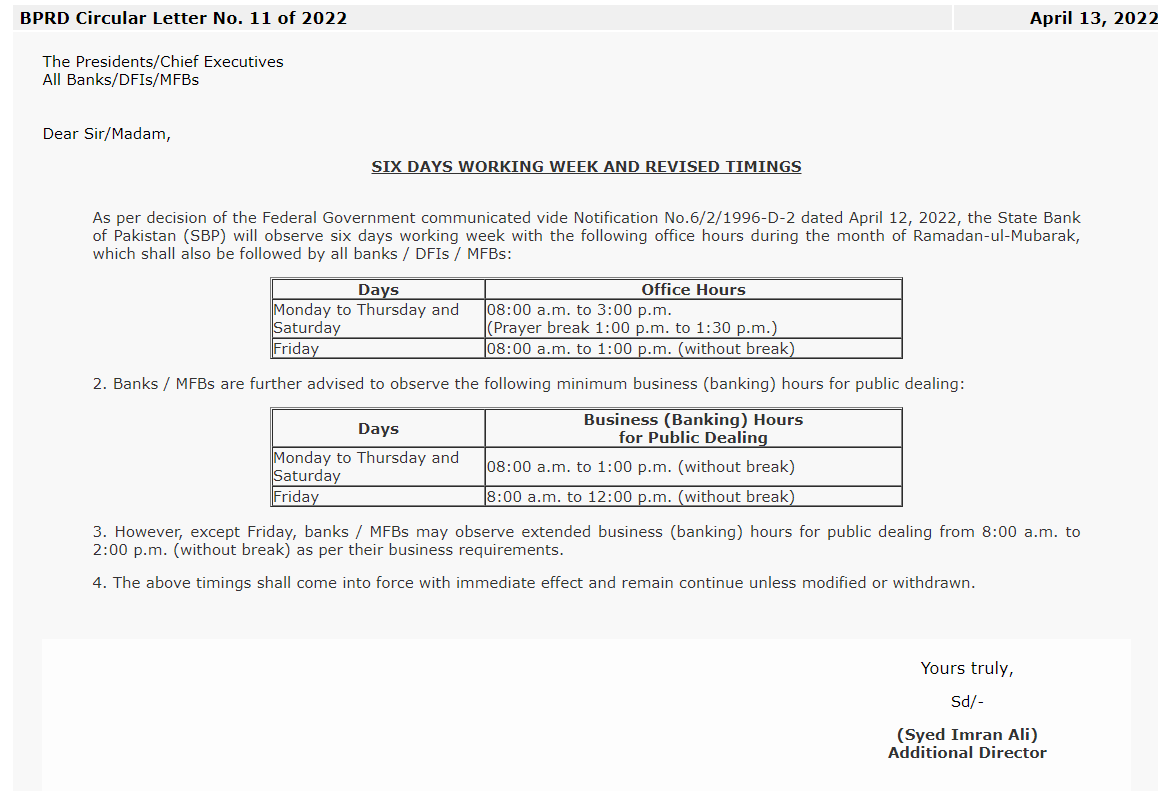
    Pursuant to the federal government’s directive issued on April 13, the State Bank of Pakistan (SBP) would observe a six-day work week with amended timings.

    During Ramzan, working hours for the central bank, development finance institutions (DFIs), microfinance banks (MFBs), and all commercial banks, are as follows:

    Monday to Thursday and Saturday from 8:00 am to 3:00 pm with a prayer break from 1:00 pm to 1:30 pm.

    Fridays: from 8:00 am to 1:00 pm without a break, according to a notification from SBP.

    Public dealing hours

    Banks and MFBs have been advised to adhere to the following public dealing business hours:

    Monday through Thursday and Saturday from 8:00 am to 1:00 pm (no break).

    Fridays from 8:00 am to 12:00 pm (no break).

    Banks and MFBs may observe longer business (banking) hours for public dealing from 8:00 am to 2:00 pm (without break) on weekdays excluding Fridays, depending on their business needs.

    The abovementioned schedule will take effect immediately and will not be changed or withdrawn unless it is amended or canceled.

  • US Dollar continues to slide, reaches Rs183

    US Dollar continues to slide, reaches Rs183

    The US Dollar fell by Rs1.43 shortly after the interbank market opened, and is now being traded at Rs183.25.

    Following days of depreciation, the Pakistani rupee (PKR) rebounded against the US dollar in the interbank market on April 11, signaling that the currency value is stabilizing.

    On Friday, the Pakistan Stock Exchange (PSX) index KSE-100 reversed course and experienced an uptrend, adding 657.75 points, or 1.50 per cent, to close at 44,444.58 points, up from 43,786.83 points the previous working day.

    The KSE-100 index began on Monday morning to strong investor optimism, following a historic weekend in which Imran Khan became the first prime minister in Pakistan’s history to be removed by a vote of no confidence, putting an end to the country’s ongoing political crisis.

    According to foreign currency dealers, the greenback is now selling at Rs183.20, after weakening Rs1.83 versus the PKR in early trade.

  • Pakistani rupee records impressive gains against US Dollar, highest single-day gain

    Pakistani rupee records impressive gains against US Dollar, highest single-day gain

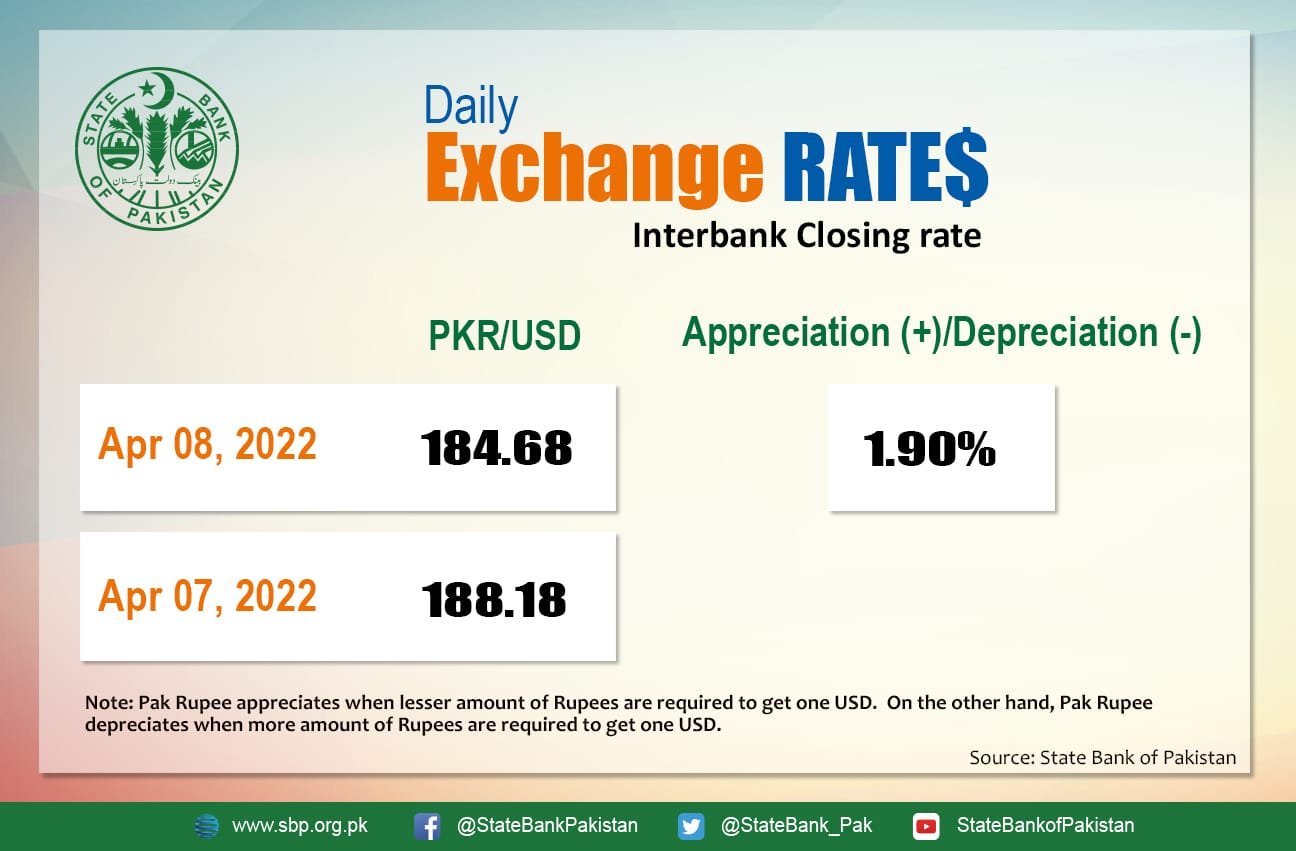
    In the intra-day trade on Friday, the Pakistani rupee (PKR) gained an impressive Rs3.5 against the US dollar, the highest single-day gain in two years after the Supreme Court (SC) pronounced the National Assembly (NA) deputy speaker order unconstitutional and restored the NA.

    The US dollar is currently trading at Rs185, as per foreign currency dealers, after weakening Rs3.5 versus the local currency in early trade. The USD is currently trading for above Rs186 on the open market.

    On Thursday, the rupee concluded at Rs188.18 against the USD in the interbank market.

    Consequently, the Pakistan Stock Exchange’s (PSX) benchmark KSE-100 index, reversed its downtrend shortly after starting on Friday and surpassed the 44,000 mark, a day after the Supreme Court of Pakistan annulled the deputy speaker’s decision against a no-confidence motion.

    Considering the trading which continued at 44, 198 on the Pakistan Stock Exchange, the KSE-100 benchmark index gained 411 points.

    The stock market has been under pressure since April 4, when it crumbled, losing over 900 points amid Pakistan’s ongoing political crisis, which arose after the National Assembly deputy speaker declared Prime Minister Imran Khan’s no-confidence resolution unconstitutional.

    SBP’s rate increase of 250 basis points and establishment of cash margins on 177 commodities is a marker that the economic system is in a slump and that prior initiatives were inadequate. This protective approach will aid in limiting the import of certain products, consequently bolstering the balance of payments.

  • Pakistani rupee continues its record-breaking decline against the US Dollar

    Pakistani rupee continues its record-breaking decline against the US Dollar

    The Pakistani Rupee (PKR) continued its decline against the US Dollar (USD) today, reporting losses in the interbank market. At the close of the session today, the local currency lost 30 paisas against the US dollar.

    It fell 0.16 percent against the US dollar, closing at Rs182.64 after losing 30 paisas and closing at Rs182.34 in the interbank market on Tuesday, March 29.

    Pakistan’s ongoing political volatility and economic problems continue to weaken currency reserves as the country attempts to remove obstacles toward financial relief.

    After global oil prices surged on Monday, the PKR maintained its downward trend against the greenback.

    The rupee has lost about 17 per cent of its value since its last peak in May 2021. To date, the local currency has lost more than 13.6 per cent of its value.

    It is worth noting that the Pakistani currency depreciated 30.5 per cent against the US dollar in the last three years under the government of Prime Minister (PM) Imran Khan.

  • Pakistan bonds fall as investors brace for Afghanistan fallout

    Pakistan bonds fall as investors brace for Afghanistan fallout

    Pakistan’s international bonds came under selling pressure on Monday as market investors brace themselves for the fallout from the crisis in Afghanistan.

    Afghanistan’s US-backed government collapsed over the weekend as Taliban fighters seized the capital, Kabul, following a stunning advance that had seen the Islamist group take over most of the country.

    The likely evacuation of refugees from Afghanistan could strain the finances of neighbouring countries, fund managers say, and there is also concern over the potential for ‘western retaliation’ against Pakistan for providing a safe haven for the Taliban.

    As per a report of Financial Times, Pakistan’s dollar-denominated bonds fell by about one per cent to just above 100 cents on the dollar, with some longer dated issues sinking to their lowest prices in nine months. The yield on a 10-year bond issued in April this year, which moves in the opposite direction to the debt’s price, climbed by about a quarter of a percentage point to roughly 7.3 per cent.

    The country’s $8.8bn of dollar bonds have now fallen by about four per cent since mid-June.

    “There are a few concerns driving this move,” said head of emerging market debt at Legal and General Investment Management, Uday Patnaik to Financial Times. “One is the refugee crisis — clearly Pakistan is going to be affected by that, and that’s going to be expensive.”

    “A lot of people are also debating the possibility of formal or informal sanctions on Pakistan for working with the Taliban. We’ve been underweight for the last couple months because of these issues but like everyone else we didn’t expect this to happen so quickly.”

    Even prior to the recent sell-off, Pakistan already had some of the highest bond yields among emerging economies that are not considered to be at immediate risk of default. Its debt is rated B minus by Standard & Poor’s and by Fitch.

    The market’s focus has fallen on Afghanistan’s neighbours as the country itself does not have any internationally traded debt, with the ousted government having received most of its financing from western governments and other donors such as the World Bank and the IMF.

    The Current reached out to Chairman of KASB Securities, Ali Farid Khwaja for a word on this situation and said: “Global investors are and will be concerned about the spillover impact of the fall of Kabul and takeover by Taliban. Of course, they will need assurance that such a thing cannot happen in Pakistan and a Taliban government in Afghanistan will not destabilize Pakistan. The jury is still out. I think there are two important aspects of this. First the world would want to see whether Pakistan is standing by them on the values they claim to preach and promote, or do we share the ethos with Taliban. So far, from the commentary it seems that it is the latter. Except for a few media celebrities most politicians seems to be pleased with the Taliban victory. This alone is a bit disturbing purely from an image perspective. Secondly, we need to prove that the wall we have made on the border with Afghanistan will be strong enough to keep Taliban out of Pakistan. Global markets are sensitive to sentiment and hence managing perception is very important,” he added.

    While a Bloomberg journalist in Pakistan, Faseeh Mangi has also shed some light on the situation of Pakistan’s dollar bonds after Taliban takeover in Afghanistan.