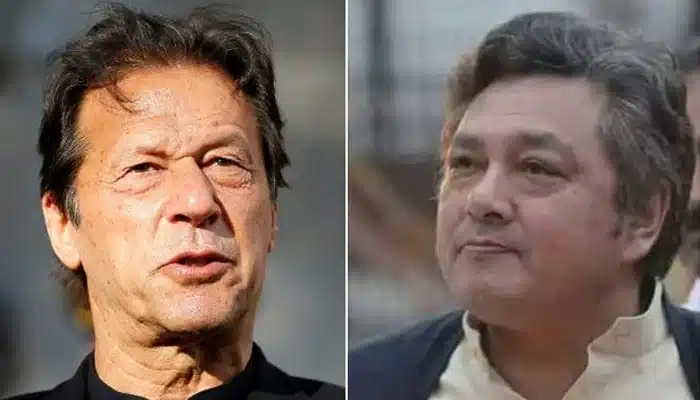
A report carried by The Intercept, a US publication, says that Imran Khan’s cypher which he blamed for his removal from power, did include American official Donald Lu pressurising Pakistan to oust Khan. The Intercept says it has the cypher.
The conversation took place during a meeting held on March 7, 2022.
The meeting between the Pakistani ambassador to the United States and two State Department officials has drawn significant attention, controversy, and rumours in Pakistan.
On August 5, Khan was given a three-year prison sentence in the Tosha Khana case and was arrested for a second time since being ousted. Khan’s supporters deny the accusations as unfounded.
One month after the meeting with U.S. officials documented in the leaked Pakistani government document, a no-confidence vote was held in Parliament, leading to Khan’s removal from power.
The text of the Pakistani cable that the ambassador sent to Islamabad following the meeting has not yet been made public. The cable, internally referred to as a “cypher,” promises improved relations if Khan was ousted and isolation if he was not, The Intercept says.
An unnamed insider in the Pakistani military who claimed to have no connections to Imran Khan or Khan’s party gave The Intercept access to a
the document.
Here is the complete text of the cipher as published in The Intercept:
“I (the former Pakistani Ambassador to the US) had a luncheon meeting today with Assistant Secretary of State for South and Central Asia, Donald Lu. He was accompanied by Deputy Assistant Secretary of State Les Viguerie. DCM, DA and Counsellor Qasim joined me.
At the outset, Don referred to Pakistan’s position on the Ukraine crisis and said that “people here and in Europe are quite concerned about why Pakistan is taking such an aggressively neutral position (on Ukraine), if such a position is even possible. It does not seem such a neutral stand to us.” He shared that in his discussions with the NSC, “it seems quite clear that this is the Prime Minister’s policy.” He continued that he was of the view that this was “tied to the current political dramas in Islamabad that he (Prime Minister) needs and is trying to show a public face.” I replied that this was not a correct reading of the situation as Pakistan’s position on Ukraine was a result of intense interagency consultations. Pakistan had never resorted to conducting diplomacy in public sphere. The Prime Minister’s remarks during a political rally were in reaction to the public letter by European Ambassadors in Islamabad which was against diplomatic etiquette and protocol. Any political leader, whether in Pakistan or the U.S., would be constrained to give a public reply in such a situation.
I asked Don if the reason for a strong U.S. reaction was Pakistan’s abstention in the voting in the UNGA. He categorically replied in the negative and said that it was due to the Prime Minister’s visit to Moscow. He said that “I think if the no-confidence vote against the Prime Minister succeeds, all will be forgiven in Washington because the Russia visit is being looked at as a decision by the Prime Minister. Otherwise, I think it will be tough going ahead.” He paused and then said “I cannot tell how this will be seen by Europe but I suspect their reaction will be similar.” He then said that “honestly I think isolation of the Prime Minister will become very strong from Europe and the United States.” Don further commented that it seemed that the Prime Minister’s visit to Moscow was planned during the Beijing Olympics and there was an attempt by the Prime Minister to meet Putin which was not successful and then this idea was hatched that he would go to Moscow.
I told Don that this was a completely misinformed and wrong perception. The visit to Moscow had been in the works for at least few years and was the result of a deliberative institutional process. I stressed that when the Prime Minister was flying to Moscow, Russian invasion of Ukraine had not started and there was still hope for a peaceful resolution. I also pointed out that leaders of European countries were also traveling to Moscow around the same time. Don interjected that “those visits were specifically for seeking resolution of the Ukraine standoff while the Prime Minister’s visit was for bilateral economic reasons.” I drew his attention to the fact that the Prime Minister clearly regretted the situation while being in Moscow and had hoped for diplomacy to work. The Prime Minister’s visit, I stressed, was purely in the bilateral context and should not be seen either as a condonation or endorsement of Russia’s action against Ukraine. I said that our position is dictated by our desire to keep the channels of communication with all sides open. Our subsequent statements at the UN and by our Spokesperson spelled that out clearly, while reaffirming our commitment to the principle of UN Charter, non-use or threat of use of force, sovereignty and territorial integrity of States, and pacific settlement of disputes.
I also told Don that Pakistan was worried of how the Ukraine crisis would play out in the context of Afghanistan. We had paid a very high price due to the long-term impact of this conflict. Our priority was to have peace and stability in Afghanistan, for which it was imperative to have cooperation and coordination with all major powers, including Russia. From this perspective as well, keeping the channels of communication open was essential. This factor was also dictating our position on the Ukraine crisis. On my reference to the upcoming Extended Troika meeting in Beijing, Don replied that there were still ongoing discussions in Washington on whether the U.S. should attend the Extended Troika meeting or the upcoming Antalya meeting on Afghanistan with Russian representatives in attendance, as the U.S. focus right now was to discuss only Ukraine with Russia. I replied that this was exactly what we were afraid of. We did not want the Ukraine crisis to divert focus away from Afghanistan. Don did not comment.
I told Don that just like him, I would also convey our perspective in a forthright manner. I said that over the past one year, we had been consistently sensing reluctance on the part of the U.S. leadership to engage with our leadership. This reluctance had created a perception in Pakistan that we were being ignored and even taken for granted. There was also a feeling that while the U.S. expected Pakistan’s support on all issues that were important to the U.S., it did not reciprocate and we do not see much U.S. support on issues of concern for Pakistan, particularly on Kashmir. I said that it was extremely important to have functioning channels of communication at the highest level to remove such perception. I also said that we were surprised that if our position on the Ukraine crisis was so important for the U.S., why the U.S. had not engaged with us at the top leadership level prior to the Moscow visit and even when the UN was scheduled to vote. (The State Department had raised it at the DCM level.) Pakistan valued continued high-level engagement and for this reason the Foreign Minister sought to speak with Secretary Blinken to personally explain Pakistan’s position and perspective on the Ukraine crisis. The call has not materialized yet. Don replied that the thinking in Washington was that given the current political turmoil in Pakistan, this was not the right time for such engagement and it could wait till the political situation in Pakistan settled down.
I reiterated our position that countries should not be made to choose sides in a complex situation like the Ukraine crisis and stressed the need for having active bilateral communications at the political leadership level. Don replied that “you have conveyed your position clearly and I will take it back to my leadership.”
I also told Don that we had seen his defence of the Indian position on the Ukraine crisis during the recently held Senate Sub-Committee hearing on U.S.-India relations. It seemed that the U.S. was applying different criteria for India and Pakistan. Don responded that the U.S. lawmakers’ strong feelings about India’s abstentions in the UNSC and UNGA came out clearly during the hearing. I said that from the hearing, it appeared that the U.S. expected more from India than Pakistan, yet it appeared to be more concerned about Pakistan’s position. Don was evasive and responded that Washington looked at the U.S.-India relationship very much through the lens of what was happening in China. He added that while India had a close relationship with Moscow, “I think we will actually see a change in India’s policy once all Indian students are out of Ukraine.”
I expressed the hope that the issue of the Prime Minister’s visit to Russia will not impact our bilateral ties. Don replied that “I would argue that it has already created a dent in the relationship from our perspective. Let us wait for a few days to see whether the political situation changes, which would mean that we would not have a big disagreement about this issue and the dent would go away very quickly. Otherwise, we will have to confront this issue head on and decide how to manage it.”
We also discussed Afghanistan and other issues pertaining to bilateral ties. A separate communication follows on that part of our conversation”.
Rana Sanauulah said in his tweet late Wednesday night “It should not be forgotten that Imran Khan Niazi had a copy of the cypher, which he has not returned and has accepted (on record) that he misplaced or lost it. If proven guilty, Khan should be tried under the Official Secret Act”.
Though there is nothing new in this story, the investigation needs to held to establish the authenticity of the information or source document. Potentially, it is a very sinister, treacherous, and seditious act.
(1/2)
— Rana Sana Ullah Khan (@RanaSanaullahPK) August 9, 2023
I can say with 100% confidence that this claim from the New York Times is completely untrue. Khan was not our source. Neither was any other civilian. Our source was in the Pakistan military. If the Times has evidence to the contrary, publish it. Otherwise retract this. https://t.co/K8FfcPChyO
— Ryan Grim (@ryangrim) August 9, 2023
“The decision [to table no-confidence motion] was taken long before Imran Khan’s visit to Russia. We took many decisions during our CEC meeting in January,” @BBhuttoZardari https://t.co/ipqd0wD8MD
— Kasim Gilani (@KasimGillani) August 9, 2023
United States confirmed that documents published on Asad Majeed and Donald Lu conversation on Imran Khan was kind of accurate but made it clear that United States was not involved in any conspiracy. He confirmed United States was concerned of Imran Khan visit of Moscow and his… pic.twitter.com/njc6EHrhZq
— Jahanzaib Ali (@JazzyARY) August 9, 2023