According to the State Bank of Pakistan (SBP), the Pakistani rupee (PKR) strengthened by Rs0.01 against the US dollar in the interbank market on Tuesday.
The local currency managed to recover and closed at Rs284.96.
In contrast, the dollar is being traded at Rs290 in the open market.
It’s worth noting that the rupee had reached a record low of Rs298.93 against the US dollar last week.
Market speculation suggests that the rupee’s gains were further supported by reduced demand for foreign currency, resulting from a significant import payment between May 9 and 11, coinciding with the period of heightened political drama in the country.
Reports indicate that the substantial dollar payment for imports had been arranged by the oil refineries. Oil imports constitute approximately one-fourth of the total import bill for a month.
Earlier, the rupee experienced a sharp decline of 4.71 per cent or Rs14.09 in just two days (May 10-11), hitting a record low of Rs298.93/$ due to worsening political turmoil and deteriorating law and order following the arrest of former Prime Minister Imran Khan. However, the rupee managed to recover some of its losses after Khan’s release on May 12, as ordered by the court.
The manufacturing industry in Pakistan, which is responsible for about 20 per cent of the country’s economic growth, has experienced its eighth consecutive month of decline. This is a major cause for concern as it could have negative impacts on the overall economy.
In February, the rate of decline was particularly severe, with a contraction of 11.59 per cent compared to the same period in the previous year, according to data from the Pakistan Bureau of Statistics.
This decline will impact Pakistan’s overall economic growth, with the gross domestic product (GDP) also expected to suffer a significant blow this fiscal year.
The negative growth of the sector is due to both domestic and global factors, including high energy costs, rupee devaluation, and the government’s tightening of monetary and fiscal policies. Industrial output fell by 5.56 per cent in the first eight months (July-February) of the ongoing fiscal year, compared to the same period last year.
The global economic slowdown has further worsened the situation, with many businesses scaling back operations or reducing operating hours, while others have shut down their plants. The LSM sector has witnessed a decline in production from August 2022 to February 2023.
All major and small sectors’ output contracted in February, including textile, food, coke and petroleum products, chemicals, automobile, pharmaceuticals, cement, fertilisers, iron and steel, furniture, leather products, electrical equipment, and non-metallic mineral products.
To combat soaring inflation, the State Bank of Pakistan (SBP) also raised the discount rate to 21 per cent, hindering industrial activities by making bank financing more expensive.
Twitter users have slammed a sexist policy authorized by The National Database and Registration Authority (NADRA) after a user shared a screenshot of the message she received from the government organization that informed her that the husband was designated as the head of the household.
The user went on to criticize NADRA as she had not nominated her husband as the head of the household, per the message stated.
The user further went on to question how this policy would become a threat for women trying to escape abusive marriages, because their private information is being sent to their spouses without their consent.
Also, how are you affording safety to women who may need to requisition docs to get out of abusive relationships, mostly from their partners? @NadraPak You need to rethink this policy. Privacy is the right of every citizen regardless of gender.
Other women also slammed NADRA for refusing to recognize female agency, and pointed out how this policy alienates single parent households, especially with women who had escaped abusive relationships.
Imagine you are a woman who has escaped from domestic violence. You do not have your cnic and need a new one. You want to start khula process. When you apply Nadra notifies your abusive husband which makes it ten times worse for you! What the actual fuck is this process https://t.co/K9nzFMzrZg
Sharing their experiences of being turned away from offices while applying for their CNIC card, female tweeps blamed the policy that demands that a male guardian verify themselves as the head of their household.
I’m a single independent woman. When I went for my CNIC to NADRA they turned me away twice saying I need a to bring a man as my head of family. Eventually had to give up and take younger brother. Otherwise wouldn’t have been issued the card. https://t.co/bAmI7PgUuR
Passport office does the same. I applied for my daughter’s passport and since my husband was abroad, they didn’t submit the documentation and asked for “attestation” from any govt officer. Why a mother’s signatures aren’t enough to apply for her children’s documents?? https://t.co/XkOjzvRGl2
NADRA responded to the tweet by sharing that this policy was designed to guard family data from unauthorized access, because of which they had decided to inform the family head about procedures related to family data.
“It is one of the security features to guard family data from unauthorised access. In order to maintain the integrity of family data, @NadraPak informs every family head about any processing through which someone becomes part of his family.”
It is one of the security features to guard family data from unauthorised access.
In order to maintain the integrity of family data, @NadraPak informs every family head about any processing through which someone becomes part of his family. 1/
This tweet was bashed by Twitter users are regressive for refusing to recognize women as the head of their households, as activist and researcher Ammar Rashid tweeted that the government body should not have violated the privacy of women by leaking their data this way.
“Maybe @NadraPak should try to institute measures to confirm identities that don’t openly violate the constitutional right to privacy of adult female citizens? Other countries seem to be managing data security just fine without such archaic rules.”
Maybe @NadraPak should try to institute measures to confirm identities that don’t openly violate the constitutional right to privacy of adult female citizens? Other countries seem to be managing data security just fine without such archaic rules. https://t.co/xVuz5eVa50
If anything women in the house should be getting notifications in case someone joins the man's family specially considering how fond men in Pakistan are about that whole 4 wives thing. https://t.co/jAj9BphuGk
Another user said: “A married woman is usually above the age of 18 and that makes her legally a citizen. She must have access to her OWN security features without having man govern her changes to the card.”
The Chairman of NADRA, Tariq Malik addressed the controversy in a tweet on Thursday, sharing that the policy did not discriminate against women from becoming the head of the household, and shared statistics that showed more women were nominated for this position than men.
“@NadraPak policy of declaring head of family is not gender specific. See thru lens of #realdata 28 million citizens declared their mother, 291,039 declared their sisters, 116,800 men declared their wife as head of family. And, 3.69 million females who are self head of family.”
@NadraPak policy of declaring head of family is not gender specific. See thru lens of #realdata28 million citizens declared their mother, 291,039 declared their sisters, 116,800 men declared their wife as head of family. And, 3.69 million females who are self head of family /1
Malik further went on to reveal that the backlash to this policy has encouraged the department to reform it in order to prevent discrimination of any kind:
“Declaring head of family is self reported event. I have directed our Public Engagement Department to sit down with social scientists and subject matter experts to bring reform in policies and SoPs. Suggestions welcomed. We have revamped quite a few since a year.”
Declaring head of family is self reported event. I have directed our Public Engagement Department to sit down with social scientists and subject matter experts to bring reform in policies and SoPs. Suggestions welcomed. We have revamped quite a few since a year. /2
The Pakistan Telecommunication Authority (PTA) announced that voice and data services have been disrupted in several flood-affected areas.
“Due to torrential rains & flash floods in Balochistan and damage to optical fibre cable, voice and data services have been impacted in Quetta, Ziarat, Khuzdar, Loralai, Pashin, Chaman, Panjgor, Zhob, Qila Saifullah and Qila Abdullah,” PTA said in a tweet on Friday (August 26).
“Efforts are being made to resolve this unprecedented situation. PTA is monitoring the situation and further updates will be shared,” it added.
Efforts are being made to resolve this unprecedented situation. PTA is monitoring the situation and further updates will be shared.
At least 937 people have died in floods caused by heavy rains in Sindh and Balochistan provinces. According to the data issued by the National Disaster Management Authority(NDMA), 234 people have lost their lives to rain and flood-related incidents in Balochistan and 306 people have lost their lives in Sindh. 165 people have lost their lives in Punjab and 185 have lost their lives in Khyber Pakhtunkhwa (KP).
Twitter is allegedly giving user email addresses and phone numbers to marketers without their permission, which has put the social media giant in more legal trouble.
The business admitted in 2019 that it may have utilised the personal data customers provided in exchange for a security feature for targeted advertising.
Two Twitter users filed a proposed class action lawsuit against the social media platform on Thursday in a federal court in Northern California. Billy Moses and Christina McClellan, both of Texas, claim in the 38-page complaint that they would not have given Twitter their phone numbers and email addresses if they had known that the firm would utilise the information for targeted advertising.
According to CNET, the lawsuit is the most recent repercussion Twitter is facing because of purported privacy infractions. Twitter reportedly violated the Federal Trade Commission Act and a 2011 FTC order by misrepresenting how it will use nonpublic user contact information, and in May, Twitter agreed to pay a $150 million fine.
Users of Twitter have filed lawsuits against the social media site for violating their privacy in other jurisdictions, including Washington.
Twitter urged users to enter their phone numbers and email addresses for two-factor authentication, an additional security measure, but failed to disclose that the information would be used for targeted advertising.
Because marketers could utilise emails and phone numbers to determine a potential customer’s identity and learn about where they reside, what items they buy, where they shop, and other useful information, the lawsuit claims that Twitter made money off of this data without user consent.
Due to the possibility of using phone numbers and email addresses to identify a person, there are additional hazards associated with their disclosure. According to the lawsuit, hackers may attempt to access a user’s social media accounts through email or gather other data in order to commit identity theft.
Additionally, the corporation is said to have broken both its agreement with users and California’s Unfair Competition Law. At the time, Twitter’s privacy policy stated that while it doesn’t provide its partners access to user information like email addresses and phone numbers, it may link the data it supplies to other data if a user gives their approval to that partner.
The latest data from Pakistan Telecommunication Authority (PTA) reveals that the number of 3G and 4G users grew by 1.14 million from 112.75 million in April 2022 to 113.89 million in May 2022.
Pakistan’s cellular subscriber base grew by 0.25 million to 193 million by the end of May 2022, up from 192.75 million at the end of April, according to Brecorder.
By the end of May, cellular mobile teledensity had risen from 87.6 per cent to 87.67 per cent. By the end of May, the total teledensity had risen to 88.81 per cent, up from 88.74 per cent in April.
The monthly penetration of Next Generation Mobile Services (NGMS) at the end of April had risen to 51.73 per cent, up from 51.24 per cent.
Network providers
The total number of 3G users on Jazz fell from 6.222 million at the end of April to 6.068 million at the end of May, a reduction of 0.154 million. By the end of May, the number of Jazz 4G users had risen from 36.567 million to 37.168 million.
Zong 3G subscribers fell from 3.357 million at the end of April to 3.272 million at the end of May, while 4G users grew from 27.952 million at the end of April to 28.317 million at the end of May.
Telenor 3G subscribers fell from 3.696 million at the end of April to 3.613 million at the end of May, whereas Telenor 4G users enhanced from 21.216 million at the end of April to 21.494 million at the end of May.
By the end of May, there were 3.576 million Ufone 3G users, up from 3.673 million at the end of April. Ufone’s 4G users increased from 8.761 million at the end of April to 9.052 million at the end of May, a 0.291 million increase over the previous month.
Following a massive tax hike, telecom companies in Pakistan have warned the public of initiating ‘loadshedding’ of phone calls, similar to power cuts, across the country.
Telecommunication officials informed senators during a meeting of the Senate Standing Committee on Finance that, like electricity, load-shedding of phone calls would be observed in the coming days, according to ARY News.
During the meeting, telecom company representatives stated that the federal government has enhanced the advance tax on imported fibre optic cable by 15 per cent while boosting duty by 20 per cent.
The senators were informed that the companies are experiencing severe financial difficulties as a result of the enhanced financial strain of importing fiber-optic.
Telecom company representatives claimed that fibre optic cable is only used in 10 per cent of towers across the country, and that unless the government lowers fibre optic cable taxes, Pakistan will fall behind in the global connectivity race.
After hearing the telecom companies’ arguments, the Senate committee recommended that the federal government reduce relevant taxes on fibre optic imports.
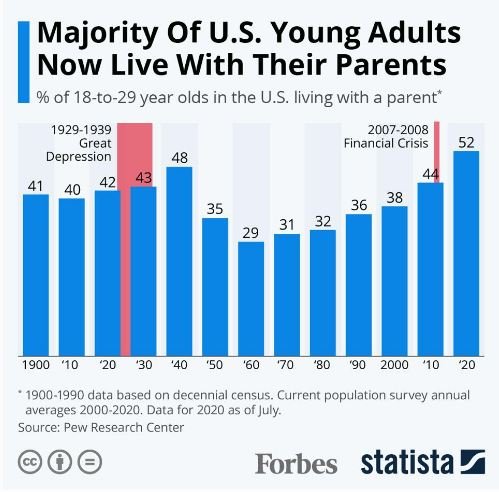
A record number of young adults in the United States (US) have had to move back in with their parents because of the COVID-19 pandemic, a recent analysis by the Pew Research Center has shown.
About 52% of 18-to-29-year-olds are now living with one or both parents. This is recorded for the first time that more than half of that age group has lived with their parents, the research center said.
The highest historical value was previously recorded in the 1940 census towards the end of the Great Depression when 48 percent of young adults lived with a parent.
The Great Depression was a severe worldwide economic downfall that took place mostly during the 1930s. Though the timing of the Great Depression differed across the world, it began from the United States in 1929 and continued until the late 1930s in most countries. It was the longest, deepest, and most widespread depression of the 20th century.
The graph shows that the share reached its lowest point in 1960 at 29 percent. It has increased gradually ever since, hitting 49 percent by February 2020. The Pew Research Center states that the number of 18-29-year-olds living with a parent increased by 2.6 million since February and the total number stood at 26.6 million in July.
According to Pew polling conducted in June, among all of the grown-ups who moved as a result of the pandemic, 28% said that they wanted to avoid the spread of the virus, 23% moved because their college campus shut down and 20% wanted to spend time with their family.
Money seems to have played a big part in young people’s decisions, as young Americans have faced some of the worst financial impacts of the COVID-19 pandemic. In April and May, 40% of workers ages 18 to 29 reportedthat they’d lost their job or taken a pay cut.
According to the June poll, about 18% of all adults who moved because of COVID-19 said that the biggest reason was related to money or losing their job.
The first three weeks of June saw not only a rapid spread of the new coronavirus but deaths attributed to the COVID-19 also stood at around a daily average of 100.
While the country, since the last week of June, has witnessed a significant decrease in the number of coronavirus infections amid conflicting claims regarding what has led to the drop, Pakistan has an optimistic recovery rate as 67.5% of people who had contracted the virus have so far recovered.
While it is still unclear if the virus has already peaked in Pakistan or not, testing, active cases and the recovery rate are the major factors proving helpful in estimating not only the spread of the virus but also the pandemic situation.
So far, July hasn’t been as bad as last month as government statistics from the first two weeks show there has been an increase in COVID-19 recoveries while the number of new cases has also dropped significantly.
While the reason behind the sudden drop still remains unclear as government boasts of its successful strategy and experts attribute the decline to Pakistanis’ better immunity due to exposure to various vaccinations, it cannot be denied that the drop has been led to also because of lower testing as compared to the month of June.
People are realising that they would recover if they have mild symptoms and only need to isolate themselves without actually heading out to get tested, surveys suggest.
Special Assistant to Prime Minister (SAPM) on Heath Dr Zafar Mirza has also confirmed that not many people are voluntarily showing up to get tested anymore. “We are unable to conduct as many tests as we were earlier, despite having a daily capacity 60,000. Pakistan has set up more than 125 labs for COVID-19 testing but we need human resources to run those labs as the testing capacity needs to continuously be enhanced.”
Meanwhile, a majority of people are also making use of telehealth services by consulting their doctors over the phone or contacting the government’s coronavirus helpline (1166). According to a doctor working at a COVID-19 helpline centre, she alone receives around 40 calls a day for medical advice.
NADRA, PTA spokespersons reject claims against their respective departmentsas data leakmakes headlines
In a massive breach of privacy, personal and sensitive data of millions — if not hundreds of millions of Pakistanis — has been leaked over the internet as blame game continues between the authorities concerned with none of them willing to take the fall for the divulgence.
According to the details, multiple smartphone applications and websites, one of which is Sim Database Online, are hosting millions of Pakistani telecom users’ sensitive data such as their Computerised National Identity Card (CNIC) numbers, names and even residential addresses, all of which can be accessed by simply entering the victim’s mobile number.
Not only does the web-based application further goes on to reveal other mobile numbers registered in the name of the privacy breach victim, but also claims to be providing services such as mobile phone tracking.
A screen grab of ‘Sim Database Online’
“Such applications have been around for quite some time now and most probably are the reason behind the recent spike in number of identity theft incidents in Pakistan,” sources told The Current, adding that leaks of government-held databases remain the biggest contributor to identity theft-related crimes in the country, around 50,000 of which were reported in 2019 alone.
Some groups on Facebook are also offering information regarding driving licences, current location, call details and even criminal records associated with any CNIC numbers if you pay them, sources claimed. “You can even dig out the National Database and Registration Authority (NADRA) family trees associated with a CNIC for a few hundred rupees.”
They went on to claim it wasn’t just Pakistanis’ confidential data that was being hosted by such web applications. “Sensitive personal information of Afghans and Indians can also easily be accessed through these websites, but there appears to be no urgency among authorities of the three countries to protect their citizens,” they claimed.
When asked if NADRA or the Pakistan Telecommunication Authority (PTA) were to be held responsible for the leak, they blamed the latter, saying the watchdog had failed to keep an eye on what the country’s telecommunication companies were doing with sensitive data of their customers.
“How else do you the inboxes of so many people get flooded with text advertisements?” sources questioned, alleging that a data archive of registered telecom users was leaked online in August 2017.
“The archive contains information about registered mobiles users of Pakistan categorised by their telecom companies. It is publicly available and contains personal information recorded to verify SIM cards. Despite the leaked information being brought to light by many, the data remains available.”
Speaking to The Current, an information technology (IT) expert said that e-governance came with a set of standards across the world. “If you give access to someone, you have to follow these standards and maintain a certain security level. But unlike the rest of the world… where they have emergency response teams to investigate such issues, Pakistan has had no such probes I know of.”
“Instead of having teams that react to such incidents, we need certain proactive measures,” the IT expert said, adding that privacy over the internet was a right of the users, and most identity theft-related crimes could be linked to data leaks associated with government bodies over the years.
NADRA & PTA:
When approached, NADRA spokesperson Faik Ali told The Current that there was no truth to the claims being made regarding the role of the authority in the data leak as it very carefully managed the sensitive registration database of all citizens.
“NADRA has nothing to do with it,” he said and also rubbished claims regarding a data breach from two years ago.
“We had in 2018 also denied accusations of leakage of voters’ data ahead of the general election,” he said, adding that it was also clarified by the authority in a letter to the Election Commission of Pakistan (ECP). “There has never been a data breach in the history of NADRA and we have never shared any citizen’s data with anyone.”
Faik also reiterated NADRA’s commitment to protect sensitive data of all citizens come what may.
PTA Public Relations Director Khurram Mehran, on the other hand, rejected all claims regarding the watchdog’s alleged inability to protect the data of telecom networks’ customers, saying that no telecommunication companies were involved in releasing confidential information of their customers.
He, however, said that action would be taken against any company if evidence to support such claims is there.
To a query, the PTA spokesperson further said if there were any such cases, they were to be dealt under the Prevention of Electronic Crimes Act (PECA) provisions by the agency concerned, as they were cybercrime cases.
Repeated attempts were made to contact the chairperson of Senate Standing Committee on IT and Telecommunication, Rubina Khalid, but she was unavailable.