Tag: Default

  • Army gets more land for ‘agriculture’

    Army gets more land for ‘agriculture’

    The Pakistan Army is set to start agriculture farming on 41,000 acres of land in South Waziristan’s Zarmalam area.

    Peshawar Corps Commander Lieutenant General Sardar Hasan Azhar Hayat has said that the army was determined to increase agricultural farming in Khyber Pakhtunkhwa, as per Geo News.

    Lt Gen Hayat said the army has prepared a farming plan on 41,000 acres of land that had been barren for years.

    The officer was of the view that there is a vast opportunity for investment in minerals, hydropower, agriculture, and tourism in KP that can help boost the province’s resources.

    The three-star officer said the army has worked together with the civil government to bring investment in minerals, agriculture, hydropower, and tourism to the province, which is yielding positive results.

    The Pakistan Army’s decision has sparked mixed reactions among locals and experts, with some expressing concerns over the potential implications for the region.

    The move, which involves the cultivation of 41,000 acres of land, has raised questions about the long-term impact on the area’s ecosystem and implications for local communities.

    Critics argue that the project’s scale could lead to significant land and water resource depletion, impacting the livelihoods of communities dependent on the land.

    Additionally, there have been concerns about the army’s increasing involvement in civilian sectors, with some experts cautioning against potential overreach and the need to ensure civilian oversight in such initiatives.
    On October 1st this year, The Pakistan Army launched the first agriculture project under the Special Investment Facilitation Council (SIFC) to make barren lands cultivable in South Waziristan.

    The pilot project launched in the Zarmalam district of South Waziristan oversaw 1,000 acres of barren land made suitable for cultivation.

    The Pakistan Army’s decision has sparked mixed reactions among locals and experts, with some expressing concerns over the potential implications for the region.

    The move, which involves the cultivation of 41,000 acres of land, has raised questions about the long-term impact on the area’s ecosystem and the implications for local communities.

    Critics argue that the project’s scale could lead to significant land and water resource depletion, impacting the livelihoods of communities dependent on the land.

    Additionally, there have been concerns about the army’s increasing involvement in civilian sectors, with some experts cautioning against potential overreach and the need to ensure civilian oversight in such initiatives.
  • Pakistan receives $1.2 billion deposit from IMF

    Pakistan receives $1.2 billion deposit from IMF

    The State Bank of Pakistan (SBP) has received a substantial deposit of $1.2 billion from the International Monetary Fund (IMF), offering a glimmer of hope to the economically strained nation that has been on the verge of default for an extended period.

    This deposit follows the approval by the IMF’s executive board, during a late-night session, of a nine-month programme under a $3 billion Stand-By Agreement (SBA). The agreement, reached after arduous negotiations over fiscal discipline lasting eight months, marks a significant milestone for Pakistan.

    Last month, Pakistan successfully reached a staff-level agreement with the IMF, securing a short-term pact that exceeded expectations in terms of funding for the country, which is home to 230 million people. This achievement is of particular importance given the acute balance of payments crisis that Pakistan faced, with its central bank reserves barely sufficient to cover a month’s worth of controlled imports.

    During a televised address from Islamabad, Finance Minister Ishaq Dar expressed that Pakistan will receive the remaining balance of the agreed amount following two reviews. The first review is scheduled for November, while the second review will take place in February.

    These reviews are crucial milestones that need to be met to ensure the disbursement of the funds by the IMF, thus supporting Pakistan’s pursuit of economic stability.

  • Government mulling handing over Karachi Ports to UAE

    Government mulling handing over Karachi Ports to UAE

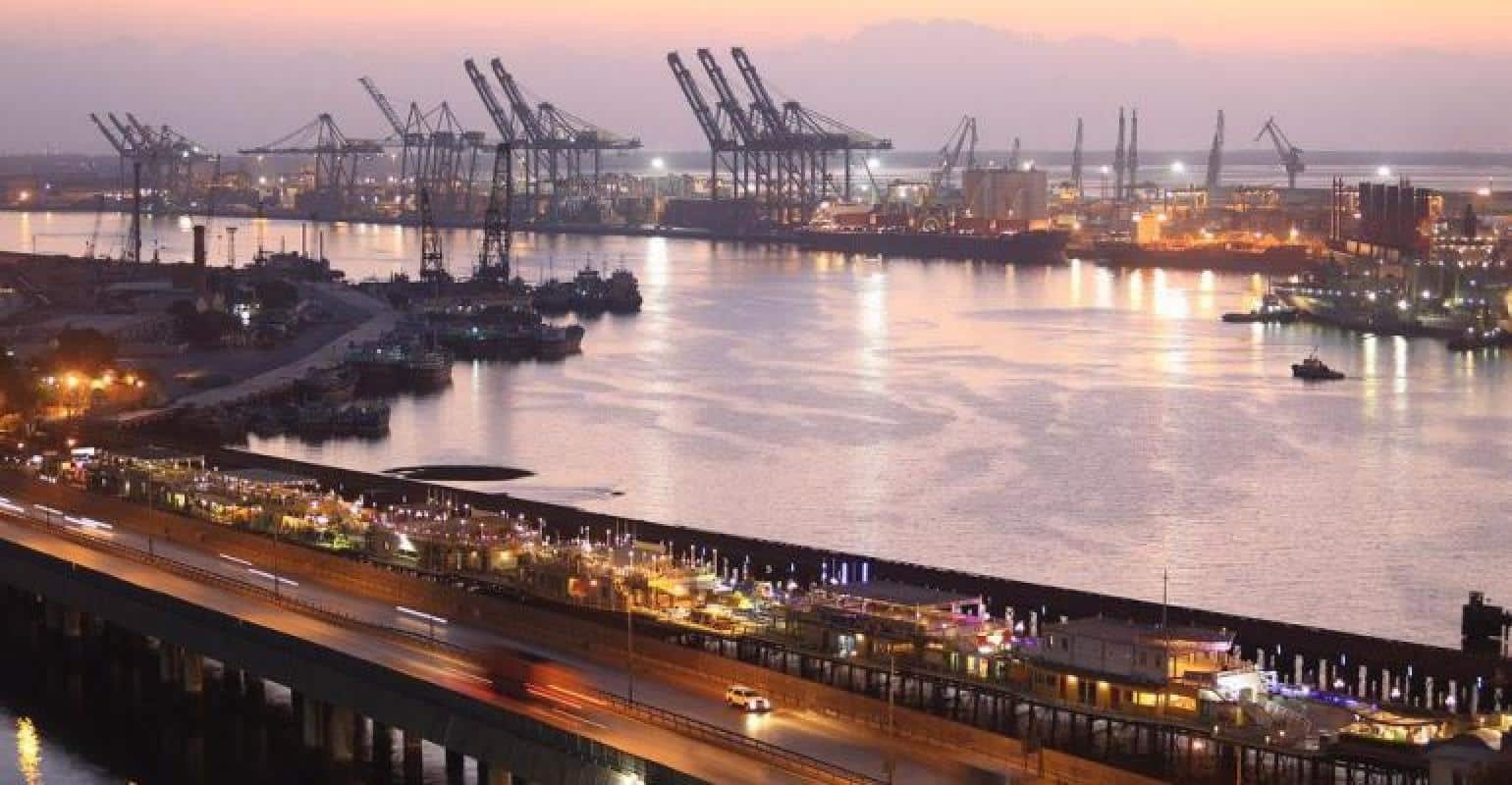
    In a last-ditch attempt to raise much needed foreign exchange, Pakistan’s government is planning to finalise a deal to hand over Karachi’s port terminals to the United Arab Emirates (UAE).

    This move may constitute the first intergovernmental transaction under the Intergovernmental Commercial Transactions Act, a law which was enacted last year in 2022. This law is aimed at selling state assets on a fast-track basis to raise funds.

    Last year, Pakistan’s coalition government created the effective-immediately bill to raise emergency funds.

    Finance Minister Ishaq Dar chaired the meeting of the Cabinet Committee on Inter-Governmental Commercial Transactions on Monday. A decision was made to set up a committee that would negotiate a commercial agreement between the Karachi Port Trust (KPT) and the UAE government, as reported by The Express Tribune.

    The negotiation committee constituted to finalise a framework agreement will be headed by the Minister for Maritime Affairs, Faisal Sabzwari. Committee members include the additional secretaries of Finance and Foreign Affairs, the special assistant to PM Jehanzeb Khan, the Chairman of the Karachi Port Terminal (KPT), and the general managers of the KPT.

    The UAE government had shown interest in acquiring the Karachi port terminals that were under the administrative control of Pakistan International Containers Terminals (PICT) last year. However, for now, PICT will maintain operational control over the ports.

    The Ministry of Maritime Affairs (MoMa) released the following statement, as reported by Dawn: “KPT was of the view that they couldn’t operate the terminal due to lack of time and resources and interface with the clients/shipping lines and the timeframe for bidding had lapsed and the events have created an unforeseeable situation where the time limits laid down for open or other methods of procurement cannot be met.”

    The MoMA said and went on to report that “the (KPT) has, therefore, recommended that in the given circumstance only PICT is in a position to provide management services to keep the terminal operational”.

    According to The Express Tribune, sources indicate that the government needs to be extra careful when finalising a deal with the UAE, considering it is the first transaction of its kind and the outgoing operator is posing some challenges.

    Pakistan’s IMF loan of $6.5 billion was signed in 2019 and is set to terminate on June 30. Its termination date drawing closer has sent panic through the Pakistani government. Already suffering one of the worst economic crises Pakistan has faced, the threat of the country defaulting looms ominously near.

    Prime Minister Shehbaz Sharif held a meeting with the ambassadors the United States, the United Kingdom, France, Germany, the European Union, Japan, China, Saudi Arabia, Qatar and the United Arab Emirates. Sharif wants to rouse support for the revival of Pakistan’s stalled deal with the IMF.

    The prime minister stressed that the government was keen to get at least the $ 1.2 billion IMF loan tranche out of the remaining $2.6 billion, which is attached with the completion of the pending 9th review of the program, according to sources at The Week.

  • Pakistan’s IMF bailout programme revival delayed: blame game between Pakistani authorities and IMF

    Pakistan’s IMF bailout programme revival delayed: blame game between Pakistani authorities and IMF

    Pakistani authorities and the International Monetary Fund (IMF) are blaming each other for the delay in reviving the IMF bailout programme. The IMF approved a $6.5 billion bailout package for Pakistan in 2019, of which $1.1 billion is still outstanding.

    However, issues related to fiscal policy adjustments have delayed the release of the funds since November. The delay has raised concerns as Pakistan has less than a month’s worth of foreign exchange reserves and needs the IMF package to avert defaulting on external payment obligations.

    With the expiry of the existing IMF programme on June 30, 2023, Pakistan’s options for reviving the IMF programme are shrinking with every passing day.

    While Pakistani authorities argue that the IMF is playing politics, IMF sources say they are still waiting for confirmation on the remaining $2 billion from the World Bank and Asian Infrastructure Investment Bank, as well as seeking commercial loans from banks.

    According to Geo, Dr Khaqan Najeeb, former adviser Ministry of Finance, has called for short-term measures, such as funding from friendly countries, the revival of the IMF programme, clarity on programme completion dates, and work on the budget for 2023-24 to be undertaken to avoid Pakistan being near the brink of default.

  • Pakistan’s sustainable policy framework crucial to avoid default risk, says IMF

    Pakistan’s sustainable policy framework crucial to avoid default risk, says IMF

    Whilst serving as Finance Minister, Ishaq Dar has repeatedly assured the public that Pakistan has not defaulted and will not do so in the future. Kristalina Georgieva, Managing Director of the International Monetary Fund (IMF), has endorsed Dar’s views and stated that Pakistan has not yet reached the level of default.

    Speaking at a news conference during the spring meeting of Breton Wood Institutions at the Fund’s headquarters in Washington, Georgieva said that the Fund was seeking confirmation from international partners to meet Pakistan’s financing gap requirements. Responding to a question about Pakistan’s looming default risk, she stated that the country had not yet reached that level, but required a sustainable policy framework to avert such risks.

    Georgieva emphasized that the lender has been working closely with the authorities in Pakistan, within the context of the current programme, to ensure that the country has the policy framework in place to prevent reaching the point of unsustainable debt. Pakistan has less than a month’s worth of foreign exchange reserves and is awaiting a $1.1 billion bailout package from the IMF that has been delayed since November due to issues related to fiscal policy adjustments.

    Georgieva expressed hope that, with the goodwill of all parties involved and the implementation of what has already been agreed upon by the Pakistan authorities, the current programme can be completed successfully. Islamabad is required to provide assurance that its balance of payments deficit is fully financed for the fiscal year ending in June in order to unlock the next tranche of IMF funding.

    During the IMF-World Bank spring meetings, Dar attended via Zoom from Islamabad with IMF Deputy Managing Director Antoinette Moniso Sayeh. Sources report that Sayeh stated that Pakistan has yet to meet its external financing gap of $6 billion, of which $3 billion would need to be financed before striking a staff-level agreement.

    At this point, the State Bank of Pakistan’s Jameel Ahmed, who is presently in Washington, reportedly told participants that the United Arab Emirates (UAE) had shared a draft agreement for the provision of an additional $1 billion deposit to meet the requirement for signing the staff-level agreement. A top official expressed hope that the UAE deposit would be confirmed shortly and suggested that it may be confirmed as early as next week.

    Regarding the cross-fuel subsidy, the IMF was informed that it was only an idea floated by a relevant ministry and would be implemented only after an agreement on the salient features of the scheme. The Pakistani authorities agreed with the IMF that the scheme appeared good on paper but its transparent implementation would be challenging.

  • Pakistan has averted default, Army Chief assures businessmen of economic prosperity

    Pakistan has averted default, Army Chief assures businessmen of economic prosperity

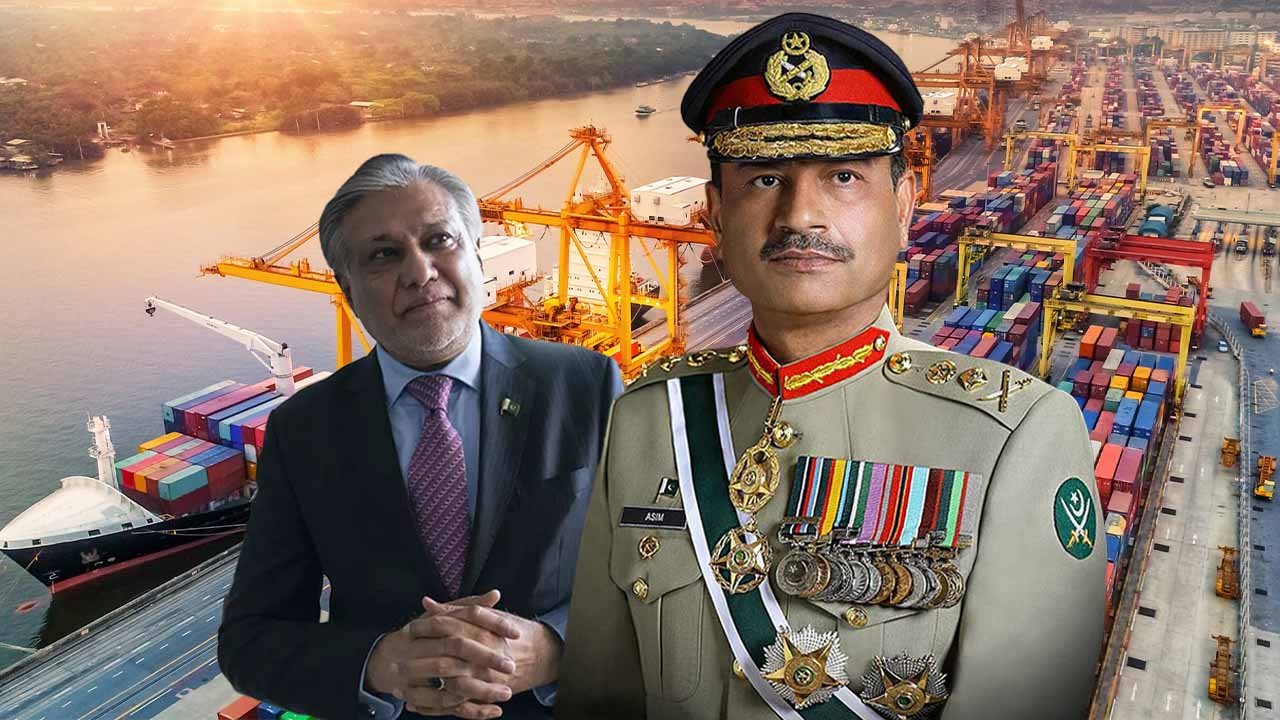
    The Chief of Army Staff (COAS), General Asim Munir, held a meeting on Monday night with the top businessmen in the country, in the presence of Finance Minister Ishaq Dar. While no official statement has been issued about the meeting, sources suggest that the army chief expressed optimism and confidence that the current economic difficulties would be overcome. He assured the businessmen that Pakistan has overcome the possibility of default, and urged them to remain firm and confident.

    The businessmen raised concerns about political polarization and chaos, and urged the military to ensure that this did not deepen further. They asked the army chief why politicians were not being brought together to meet the country’s challenges.

    The army chief emphasized that difficult times are a natural part of a nation’s progress, and reassured the businessmen that the worst is behind them. He referred to Islamic teachings to reinforce his message of resilience and strength.

    One participant, who requested anonymity, said that the businessmen had requested the meeting with the army chief. The meeting was deemed successful by the participants, and it was revealed that all prior conditions of the IMF had been met.

    The businessmen were told that agreements with friendly countries to provide dollars for the country’s foreign exchange reserves should be documented, and commitments had been secured for investments in agriculture, mining, and IT, with advanced equity expected from these countries.

    Sources further said the business community also expressed hope that army won’t allow unrest in the country. 

  • Ishaq Dar denies reports of financial emergency amidst economic turmoil

    Ishaq Dar denies reports of financial emergency amidst economic turmoil

    On Friday, Federal Minister for Finance and Revenue Ishaq Dar denied reports suggesting Pakistan should impose a financial emergency, amidst constant criticism over the current economic turmoil. He berated Imran Khan-led Pakistan Tehreek-e-Insaf (PTI) for spreading “fake news” about Pakistan heading towards default. Dar blamed the previous PTI government for pushing the nation of 220 million people on the brink of default, claiming that it was the coalition government that saved the country by prioritising the state over politics.

    Dar recalled that when the Pakistan Democratic Movement (PDM) ousted Khan through a no-confidence motion, the leaders of the coalition government had decided to keep aside all political interests in the wider interest of the state. He stated that the PTI leaders have been calling him out since the rupee plunged to a historic low of Rs285.09 a day earlier while February’s inflation hit nearly a 50-year high of 31.5 per cent.

    Expressing his surprise and concerns over Khan’s continuous criticism of the coalition government, he said: “I am unable to understate whether he (Khan) has a problem in his leg or brain.” Instead of protecting the national interest, PTI’s leadership tried to sabotage the International Monetary Fund (IMF) deal, Dar said. “Khan’s attitude is selfish.”

    According to Geo, Dar reiterated that Pakistan has neither defaulted in the past nor will it default in the future. Referring to Khan’s remarks about default, the finance minister said that the PTI chairman’s statements adversely affect the country’s financial markets. He, however, admitted that the State Bank of Pakistan’s (SBP) reserves fell below $3 billion. It should be noted that the liquid foreign reserves held by the country stand at around $9 billion as of February 24 while the net reserves held by commercial banks stand at around $5.5 billion.

    The finance minister revealed that China has renewed a facility under which Pakistan expected an additional inflow of $500 million in the “next few days”. He highlighted the PDM-led government’s economic achievements, stating that the foreign exchange reserves held by the SBP climbed to $3.8 billion from $2.8 billion recorded last month. He maintained that the government returned $6.5 billion of foreign debt during the current fiscal year.

    Dar drew a comparison between the economic performance of nearly four years of PTI and almost 11 months of PDM-led government. He shared numeric data to prove that Khan and Co. did everything to “destroy the country,” but the numbers show who is sincere with the country. Dar argued that the opposition — the PTI — has not really improved Pakistan’s standing. However, Pakistan will escape the economic quagmire, he said, adding that the country is making repayments to bilateral and multilateral lenders and has made payments beyond its capacity.

  • ‘Pakistan default ho chuka hai’: Khawaja Asif

    ‘Pakistan default ho chuka hai’: Khawaja Asif

    Defence Minister Khawaja Asif has said that Pakistan has already defaulted, and that we’re all citizens of a bankrupt country.

    “You all have heard that Pakistan is going to default. That has already happened. Pakistan has defaulted and we’re all living in a bankrupt country,” the Pakistan Muslim League-Nawaz leader said on Saturday while addressing a public gathering.

    “If we sell two golf clubs we will be able to pay off two third of our debt. These golf clubs are constructed on 1500 kanal of land in Pakistan. Have seen leaders begging for 230 million dollars.” said Khawaja.

    The minister also said that houses of the poor are demolished so that the real estate mafia can make money.

    “A cheetah killed a man in Islamabad, no one had the guts to register the FIR on the right person. The FIR was registered against an ‘unknown’ person,” said Khawaja while addressing the crowd.

    He also said that terrorism came to Pakistan because of our leaders.

  • Pakistan will take fiscal measures set by IMF but there will be no burden on the common man: Ishaq Dar

    Pakistan will take fiscal measures set by IMF but there will be no burden on the common man: Ishaq Dar

    Federal Minister for Finance and Revenue Ishaq Dar has categorically denied rumours suggesting that the government is considering “access to foreign exchange held with commercial banks.”

    “It is categorically denied and clarified that there is no such move under consideration of the government,” said Dar, in a series of tweets.

    The statement come days after the finance minister said that the country’s foreign exchange reserves stand at $10 billion, a much higher amount than the SBP’s $5.6 billion reserves as of December 30, 2022, since “dollars held by commercial banks also belonged to the country.”

    This comment gave rise to fears that the government may confiscate dollars from private banks as had been done in 1998 when Dar was the finance minister.

    However, Dar said that his comment was “greatly misconstrued” and nothing like this would happen.

    Dar explained at a press conference with Prime Minister Shehbaz Sharif and other federal cabinet members that before 1999, all foreign currency was deposited with the State Bank of Pakistan (SBP), and private banks were not permitted to hold any foreign currency.

    “In February 1999, when I was the finance minister, we devised a system whereby a substantial amount [of dollars] remain with [private] banks. It was on June 30, 1999 that reserves were broken down into three columns — those with the SBP, commercial banks and total.

    “Whenever Pakistan’s reserves are quoted anywhere in the world — a survey or a document — the [total figure] is quoted and then a breakdown is given. I gave a breakdown too,” he added.

    The minister claimed that certain people were to blame for the country’s dire circumstances, which caused it to drop from the 24th to the 47th largest economy in 2016.

    “Even now, they cannot tolerate any good development. They gave such a twist [to my statement],” he said, adding that while the federal cabinet was busy working for Pakistan under PM Shehbaz’s guidance, such people were spreading rumours that the government would take dollars from commercial banks.

    “Nothing of that sort will happen. Everything is all worked out … and in order. Nothing to worry about,” he assured, urging those “spreading the rumours” to play a positive national role.

    Dar also tweeted about the reserves later, saying national foreign exchange reserves always include forex held with SBP and commercial banks.

    Furthermore, Dar tweeted about the reserves and stated that SBP and commercial bank holdings are usually included in the nation’s foreign exchange reserves.

    “Recently I quoted the forex reserves figure based on this principle. Some vested elements who ruined this country’s economy in the past, gave it a deliberate twist and started a campaign as if govt was considering access to foreign exchange held with commercial banks which indeed is the property of the citizens.

    “It is categorically denied and clarified that there is no such move under consideration of the government,” he emphasised.

    The finance minister once again claimed that Pakistan’s foreign exchange reserves would increase soon.

    As of December 30, 2022, Pakistan’s foreign exchange reserves had decreased to $5.6 billion, an eight-year low. This is equivalent to imports for three weeks.

    The swift decrease has made it impossible for the government to repay its international debts without taking out new loans from allies.

    Govt to comply with IMF conditions without burdening common man

    The International Monetary Fund (IMF) programme’s ninth review, which would release $1.18 billion, has been postponed for months due to the government’s refusal to comply with some conditions imposed by the international lender.

    In today’s press conference, Dar acknowledged the delay and claimed that it was due to revenue collection. The Federal Board of Revenue (FBR) missed its goal in December, the finance minister said, and the super tax that the administration enacted in June of last year had been declared unlawful by a high court.

    Dar said that his team informed the IMF that Pakistan could recover the amount easily after the Supreme Court takes a decision on the super tax.

    “We are not changing the fiscal budget target and we will achieve it,” he claimed.

    Dar said that the IMF suggested that the government implement fiscal measures and eliminate some subsidies. “We have identified some budgetary measures, but the average person won’t be overburdened.”

    He asserted that the measures would be very specific and classified.

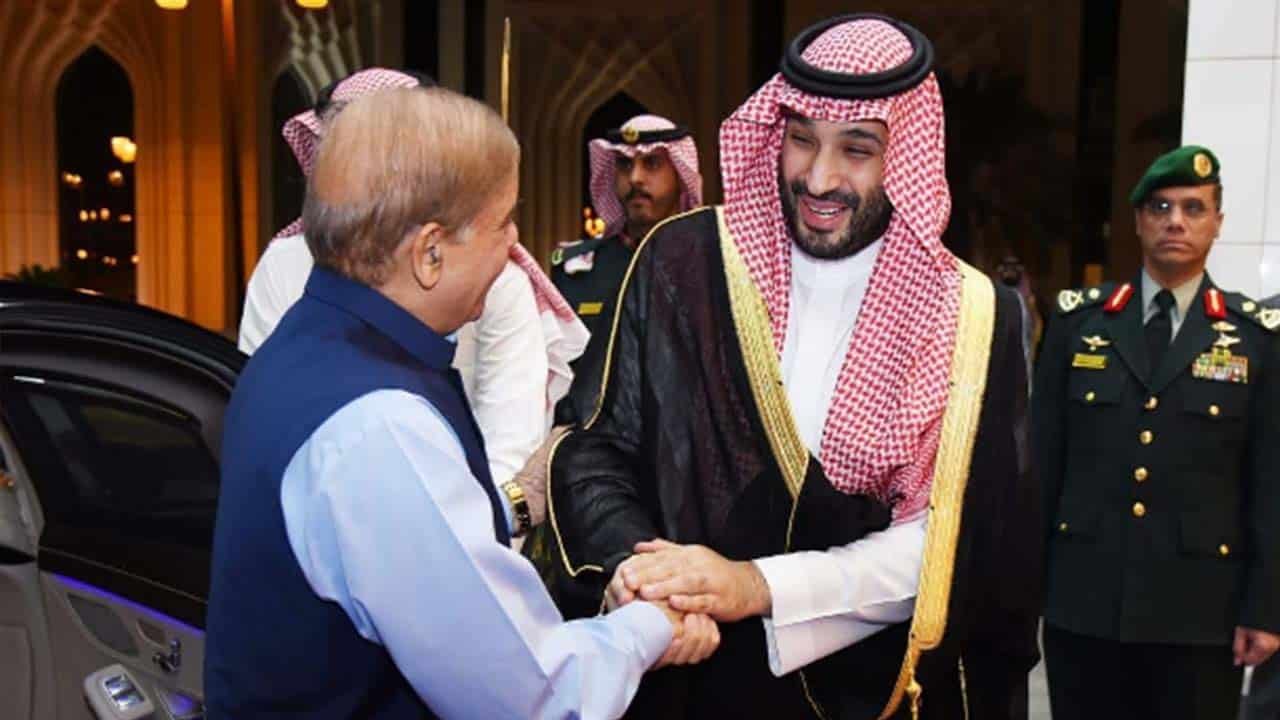
  • Saudi Arabia mulls increasing investments in Pakistan to $10 billion

    Saudi Arabia mulls increasing investments in Pakistan to $10 billion

    Saudi Crown Prince Mohammed Bin Salman has directed the Saudi Development Fund (SDF) to study increasing the deposit amount in the State of Bank of Pakistan (SBP) to $5 billion.

    “His Royal Highness Prince Mohammed bin Salman bin Abdulaziz Al Saud, Crown Prince and Prime Minister, has directed to study augmenting the Kingdom of Saudi Arabia’s investments in the sisterly Islamic Republic of Pakistan which have previously been announced on August 25, 2022, to reach $10 billion,” it said.

    “The crown prince also directed the Saudi Development Fund to study increasing the amount of the deposit provided by the Kingdom of Saudi Arabia in favour of the Central Bank of Pakistan which have previously been extended on December 2, 2022, to hit a $5 billion ceiling,” according to Saudi Press Agency.

    The move, according to SPA, confirmed Saudi Arabia’s commitment to assist Pakistan’s economy and its sisterly people.

    The development was reached within the framework of the ongoing dialogue between Prime Minister Shehbaz Sharif and Prince Salman.

    The announcement made today comes the day after Prince Salman and Chief of Army Staff General Asim Munir met in Madina to discuss ways to strengthen bilateral ties between the two nations. Munir was on a week-long official visit to Saudi Arabia and the United Arab Emirates.

    The SBP and SFD entered into a contract in 2021 for the SBP to receive $3 billion, which would be deposited in the central bank’s account to increase its foreign exchange reserves.

    The SFD subsequently acknowledged the rollover of a $3 billion deposit for an additional year in September of last year. The deposit was supposed to maturity on December 5 but Saudi Arabia extended its term on December 2.

    Saudi Arabia had previously committed to restart its financial assistance to Pakistan in the final week of October 2021, providing $1.2 billion in oil deliveries on a deferred payment plan and around $3 billion in safe deposit boxes.

    The accord was made the same month when former prime minister Imran Khan visited Saudi Arabia.