Actor Angus Cloud, breakout star of the HBO series ‘Euphoria’, has passed away at the age of 25. According to TMZ, his mother called the Fire Department at around 11:30 am on Monday, reporting a “possible overdose” and said Angus did not have a pulse. He was pronounced dead on the scene.
According to a source close to the family, Cloud had been battling severe mental health issues since he came back from Ireland after burying his father.
According to the statement released by the family:
“It is with the heaviest heart that we had to say goodbye to an incredible human today. As an artist, a friend, a brother and a son, Angus was special to all of us in so many ways.”
“Last week he buried his father and intensely struggled with this loss. The only comfort we have is knowing Angus is now reunited with his dad, who was his best friend. Angus was open about his battle with mental health and we hope that his passing can be a reminder to others that they are alone and should not fight this on their own in silence.”
Several of Euphoria stars like Javon Walton sent their condolences to the actor and his family.
Euphoria’s Javon Walton pays tribute to Angus Cloud:
A study conducted by the University College London (UCL) has highlighted that men also have a high risk of depression during the transformative period of parenthood. The research, which analyzed medical records of 90,000 men who became fathers within the previous year, focused on the mental health of new fathers and its relation to postnatal depression.
Led by Professor Irene Petersen, the study found that men with a history of depression who had previously used antidepressants were 30 times more likely to be prescribed them again in the first year after their child’s birth. It was emphasized that postnatal depression in fathers was not a risk for all men but rather more likely to affect those already prone to depression.
This study brings attention to the mental well-being of new fathers, an area often overshadowed by the focus on mental health during pregnancy and postpartum for women. It suggests that fathers should consider having a mental health check-up in the first year after becoming a parent.
According to Professor Petersen, some of the men in the study continued their existing treatment for depression, while others experienced a relapse of depression without a recent prescription. It’s possible that these individuals were more aware of the symptoms and sought treatment voluntarily. The study focused on the use of antidepressant treatment rather than making a formal diagnosis. The research showed that paternal post-natal depression is not a risk for all men but primarily affects those who are already prone to depression.
“However, having a child might act as a trigger for depression in some men,” he concluded.
Another researcher and PhD candidate involved in the study emphasized the intricacy of the connection between depression and fatherhood. They noted that previous antidepressant treatment played a significant role in determining whether antidepressants were used in the year after becoming a parent. This could be attributed to some men continuing the treatment they were on before becoming fathers, while others might be more susceptible to experiencing depressive feelings again, which may be exacerbated by the challenges of parenthood.
The study also revealed that fathers living in the most deprived areas had an 18 percent higher risk of being prescribed antidepressants compared to fathers in the least deprived areas.
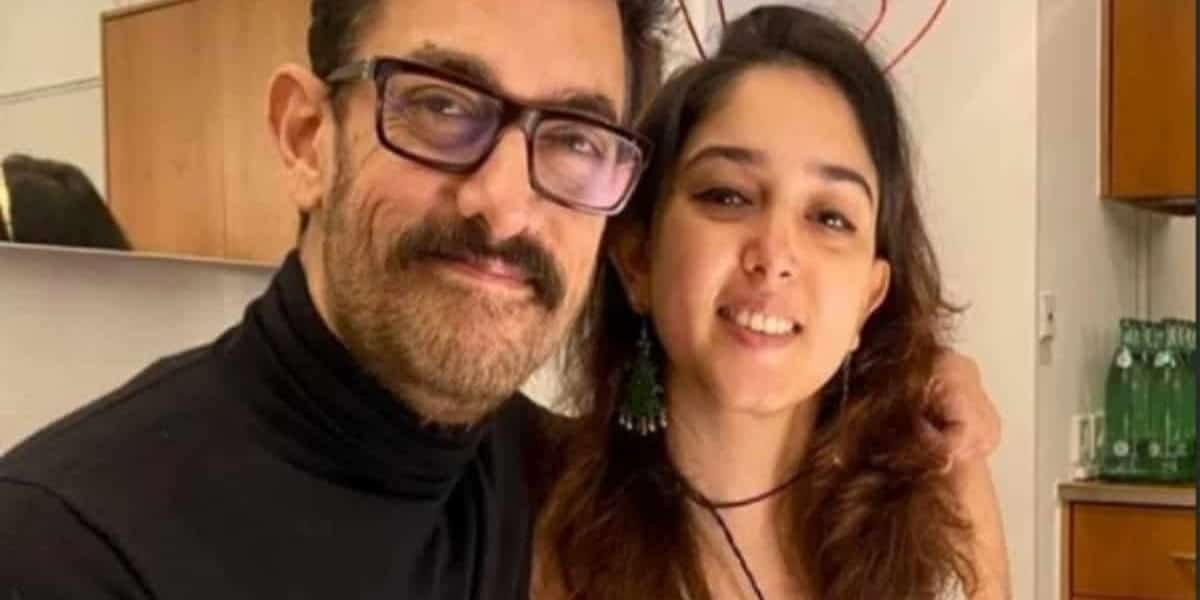
Speaking to The Times Of India, Aamir Khan’s second daughter Ira opened up about mental health struggles, especially with clinical depression which she was diagnosed with five years ago. It was through the help of her father, film star Aamir, that she began seeking help for her mental illness, and learned that her family has a history of mental health disorders.
Khan revealed that altough her parents divorce had not impacted her much, there were still signs that led her to believe something was wrong and led her to come back to India from the Netherlands:
“My mom pointed out that I didn’t want to be alive so I would just sleep my day away so that I would have fewer hours to live in a day.”
Ira said she was on medication now, but still experiences bouts of anxiety, which is taking some time for her to understand how mental health issues are common in her family.
“Every 8-10 months I will have a big crash. It’s partly genetic, partly psychological, and partly social. It took me a while to figure it out. But I have mental health disorders in my family. I also did not make healthy choices and I systematically walked into depression.”
Khan spoke about the organisation she had set up Agastu Foundation, which aimed at education people about mental health support and providing them with resources to get better. Her parents, Aamir and Reena Dutta, are both members of the advisory board, and her dad had helped in setting up until Ira was able to recieve funding.
Feroze Khan is once more going viral on the internet for all the wrong reasons. The actor is now promoting the most absurd ways to help women overcome depression.
In a viral now-deleted post, a person had asked the actor how she could cure depression about her future, to which Khan responded:
“Obey your men. Give them your responsibility and sit back and enjoy grapes. I’d do that if I was a woman. Be a queen.”
Sir, how is this even proper advice? Cure your depression by completely submitting yourself to the men in your life?
Once more, Feroze jee proves how undefeatable his critical thinking skills are, when a fan questioned him about his misogynist views by reminding him that it was due to the struggles and hard work of his sister, ‘Maula Jatt’ actress Humaima Malick, that Khan was able to achieve such monumental fame, which brings into question why he holds such misogynist views.
To this Feroze had to respond:
1 , I’m gonna be loud. 2, will have no fear. 3, do you think she would’ve achieved this without my dad and us brothers backing her up ? *mic drop*
Classy behavior, putting down the hard work of your sister just to boost up your ego.
Twitter users obviously did not have the time or the fortitude to put up with Khan’s misogynist views and were ready to shut him down.
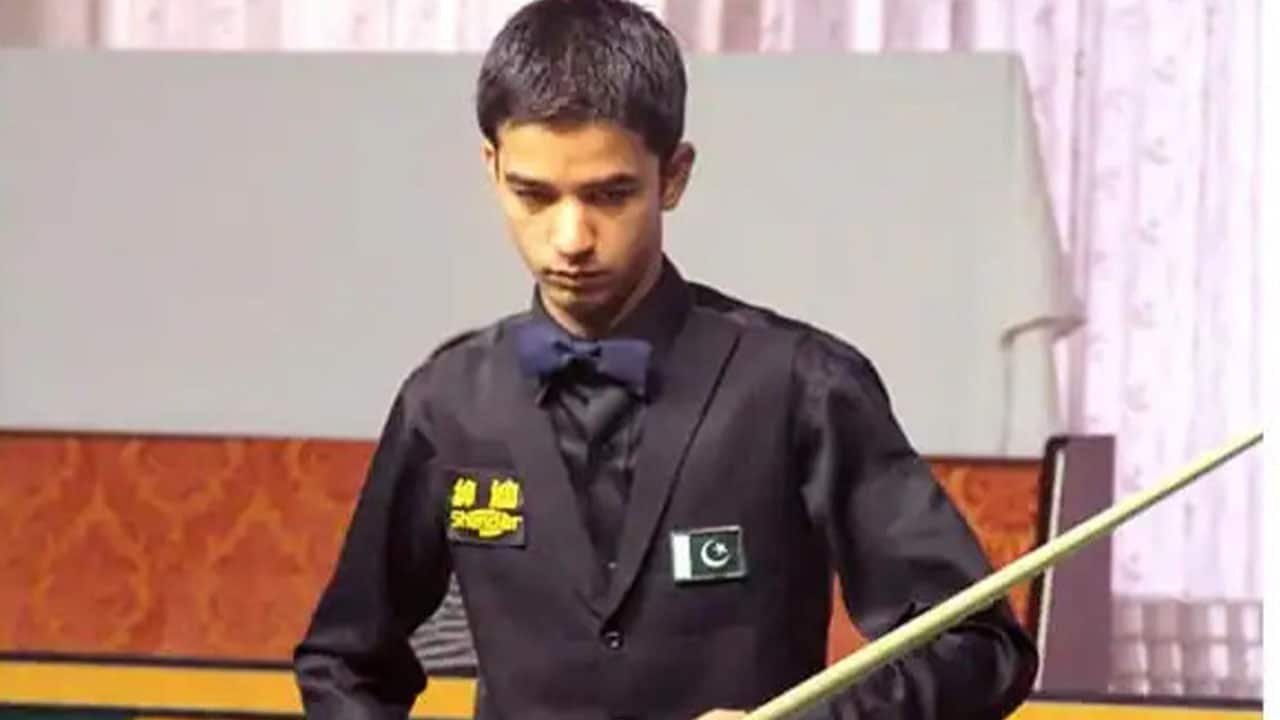
Renowned snooker player Mohammad Majid Ali, a silver medalist in the Asian U21 championship, sadly took his own life on Thursday, the first day of Eid-ul-Azha. Family sources have confirmed that Majid had been battling with depression for several years.
Alamgir Sheikh, Chairman of the Pakistan Billiards and Snooker Association (PBSA), conveyed the distressing news to fellow players and members of the sports organization via a text message. This unfortunate event marks the second loss within a month for the Pakistani snooker community, as they had recently mourned the passing of Mohammad Bilal.
The circumstances surrounding Majid’s death are both shocking and distressing. Majid’s brother, Umar, has confirmed that it was indeed a case of suicide. Majid tragically ended his life making use of a wood-cutting machine in his hometown of Samundri, near Faisalabad.
Umar further confirmed that Majid had been enduring depression for the past few years, although the specific reasons remain unknown. Financial difficulties were ruled out as a contributing factor.
Expressing his deep shock, the PBSA Chairman, in an interview with Geo, highlighted Majid’s exceptional talent, acknowledging that although his ranking had recently declined, he had always exhibited immense potential. He expressed profound sorrow at the loss of such a promising talent within the Pakistani snooker community.
“We are profoundly saddened by the news of his passing. This is an immense loss for the Pakistani snooker community,” he concluded.
US Surgeon General Dr Vivek Murthy issued an advisory on Tuesday, warning about the consequences social media usage has for women and children. He said that it is imperative now more than ever that tech companies, policymakers and parents take immediate action to ensure that children are protected.
“For every family, it may not be feasible to stop your child from using social media or there may be benefits,” he told the Associated Press, “But drawing boundaries around the use of social media in your child’s life so there are times and spaces that are protected, that are tech-free, that can be really helpful.”
According to The Guardian, Murthy revealed that it was terrifying that not enough research has been done to understand the harm social media has over children:
“The bottom line is we do not have enough evidence to conclude that social media is, in fact, sufficiently safe for our kids. And that’s really important for parents to know.”
The advisory is a part of Dr Murthy’s ongoing investigation in to the mental health crisis of American youth. The report pointed out that more than 95% of American teenagers between the ages of 13 to 17 years old are active on social media platforms, while a third said they use these apps constantly. The report also pointed out that there has been a noticeable rise of children and adults dealing with anxiety and depression due to social media usage.
This report has arrived in the wake of Facebook whistleblower Frances Haugen revealing in 2021 that according to research conducted by Facebook, 13.5% of teen girls say Instagram makes thoughts of suicide worse, and 17% of teen girls say Instagram makes eating disorders worse.
“And what’s super tragic is Facebook’s own research says as these young women begin to consume this eating disorder content, they get more and more depressed. It actually makes them use the app more,” Haugen revealed. “They end up in this feedback cycle where they hate their bodies more and more.”
Nawazuddin Siddiqui gave an interview to Mashable India, where his comments about mental illness have triggered a debate on social media. According to Indian Express, the actor was quoted as saying that mental illnesses like depression and anxiety only happened to privileged people because they tend to glorify their emotions.
The ‘Sacred Games’ actor revealed that while growing up, he would never have been able to tell his father that he was depressed or he would have been slapped:
“I come from a place where, if I would tell my father that I am feeling depressed, he would give me one tight slap… Depression waha nahi tha, kisi ko bhi nahi hota waha depression, sab khush hai. But I learnt about anxiety, depression, bipolar after coming to the city.”
“Ye shehro mein aake hoti hai, yaha pe har aadmi apne chhote emotions ko bhi bohot glorify karta hai.”
The actor, who faced a recent controversy after his ex-wife accused him of kicking her and their children out of their house, went on to say that it was working class people who never get depressed because they work hard and make the most out of their conditions, unlike rich people.
“If you ask a labourer, or someone who is sleeping on the footpath, what is depression. When it rains, they dance even then, usko gh***a depression nahi pata hota. Jab aapke paas paise aajate hai toh iss tareeke ki beemariya aati jaati hai.”
Bollywood actor Alia Bhatt made it to the cover of Vogue India’s May-June 2023 issue. In the accompanying interiew, the star opened up about rumors surrounding her dramatic weight loss, and addressed pressure to snap back in to shape after giving birth.
The ‘Brahamastra’ actor announced the birth of her and Ranbhir Kapoor’s daughter, Raha, in 2022. Bhatt talked to Vogue about the pressures society places over mothers to revert back to their old bodies after giving birth:
“I wasn’t hard on myself because I was so proud of what my body had done when I delivered Raha. I know everyone believes that I lost weight unnaturally but the truth is that I can’t even get my wisdom tooth extracted at the moment since I’m breastfeeding and can’t be given anaesthesia. Many folks are under the impression that individuals who work in the visual medium do unnatural things to their bodies to get back in shape post-delivery. That’s why I felt like it was important to document parts of my fitness journey on Instagram. I didn’t put any pressure on myself. The doctors advised me to only push harder in my workouts post 12 weeks, and I did that.”
In December 2022, the ‘Darlings’ actress shared a picture of herself performing yoga, urging mothers to keep listening to their bodies and to never be hard on themselves after what their bodies had gone through:
To my fellow mamas, listening to your body post delivery is key. Do NOT do anything your gut tells you not to. For the first week or two during my workouts, all I did was breathe… walk… find my stability and balance again (& I still have a long way to go). Take your time – appreciate what your body has done. After what my body did this year I have taken a vow to never be hard on myself again. Childbirth is a miracle in every way, and giving your body that love and support that it gave you is the least we can do.”
Describing herself as a healthy person to Vogue, Bhatt said that she worked out six days a week, but during post-partum recovery, she refused to check her weight to avoid getting pressurized by unrealistic expectations.
“I avoided checking my weight every day like many people do when they work out religiously. I would step on the scale maybe once in two weeks. You need to be consistent and let change happen at its own pace. My mother-in-law even made me those gond ke laddus which I ate for six weeks. People need to understand that putting on weight during pregnancy is not a result of eating too much; it’s because you’re making life inside you and that life needs that extra weight. It has to be in sync with your BMI, of course, and you should consult a professional if you have questions but you’re supposed to put on a certain amount of weight. It’s completely okay!”
Along with taking care of her own mental health and well being, Bhatt revealed that she ensured her newborn’s mental well-being was her biggest priority, a process that included diswoing the stereotype that a crying baby is an unhappy baby:
“As a new mom, you don’t want your baby to even frown; you just want them to be happy all the time. But I’m very clear about not having anyone tell Raha that she shouldn’t cry. Nobody should pacify her by saying, ‘Don’t cry, you’re a good girl’. I get very upset about that. Just because she’s crying, doesn’t mean she’s a bad child. Her tears help me understand whether something is wrong. Crying is good. Crying is communication. And sadly, that goes away with time because the minute you start talking, crying becomes something to be embarrassed by. Even as adults, crying is your body’s way of saying that something is up and you need to deal with it.”
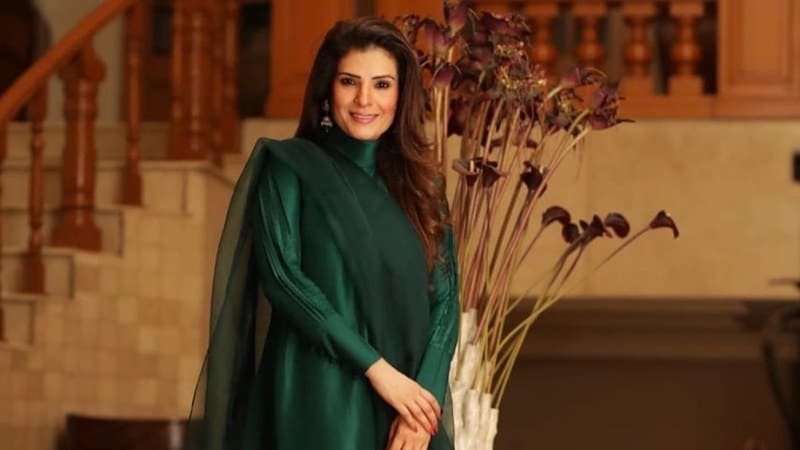
In a recent interview on PTV Home, veteran actor Resham claimed that depression “does not exist”, which is an incredibly insensitive and illogical statement for a person in her position to say. Depression is not trivial; it is a genuine health condition. And it very much exists in Pakistan — more than most countries in the world.
In 2022, public health experts and intellectuals pointed out that around 75 per cent of the population, especially youngsters, are experiencing stress, anxiety or depression in Pakistan. We have one of the highest rates of mental ill-health in the world; according to one estimate, around 50 million people in Pakistan suffer from debilitating issues such as depression, abuse, alcoholism, post-traumatic disorder, eating disorders, manic depressive psychosis, and schizophrenia. What is even more alarming is that according to the World Health Organisation (WHO), there are only 0.19 psychiatrists in Pakistan per 100,000 inhabitants, one of the lowest numbers in the world. The absence of trained mental health professionals in the country has created a major treatment gap, leaving more than 90 per cent with mental health issues untreated. More than 20 million Pakistanis (10 per cent of the country’s population) suffer from some form of mental health condition.
With a deteriorating economy, unemployment, an all time high inflation, and low salaries, survival seems nearly impossible in Pakistan right now. People are getting killed in stampedes just to get free ration for themselves.
Last year, WHO and the International Labour Organisation (ILO) called for concrete actions to address mental health concerns in the working population, saying that an estimated 12 billion workdays are lost annually due to depression and anxiety, costing the global economy nearly $1 trillion.
The struggles and torment some people are facing in Pakistan are truly heart-wrenching, the reasons why the country is wrapped in depression. Conditions are so palpable and scary that last month we witnessed a Grade 17 officer of the Inland Revenue Service (IRS) in Pakistan’s Federal Board of Revenue (FBR) who allegedly wrote a letter to Prime Minister Shehbaz Sharif requesting permission to start engaging in corrupt activities from April 1. The officer claimed that he faced difficulties in meeting his expenses due to his low salary and the current high inflation in the country. In the letter, the officer said that he had been working with the FBR for the last four years and has never committed a single rupee of corruption, despite offers to earn below-the-table money on several occasions. However, now he was not left with any option but to look for illicit means to make ends meet, and seeks permission from the prime minister to engage in corruption. The officer also shared his salary, which is Rs122,922, and his general expenses, which amount to Rs110,500, not including petty expenses as a husband and father.
In these desperate times how would one not be scared, anxious, worried and in depression? We can only hope that people take mental health seriously. Times are tough and only the right help and guidance will help us get through. And we hope that people acknowledge and understand the reality of these conditions and not disregard that we are very much, in fact, a depressed nation.
A strong misconception about celebrities is that they lead a life laced with glitz and glamour so they are always happy and in high spirits, which isn’t true. It is important to realize that mental illnesses do not have any fixed causes or reasons behind them. The manifestations of them, likewise, take various forms. Lately, with an increased awareness surrounding mental health in Pakistan, a number of celebrities, both national and international, have come out with their struggle with depression.
Hina Altaf
When Hina Altaf talked about her fight with depression, she was one of the first celebrities to talk about this issue in detail. She shared the symptoms she had and everything she did which helped her on Samina Pirzada’s show. She also talked about how the environment in her house affected her mental condition. Hina also gave credit to the doctor who totally turned her life around. Hina Altaf also talked about schizophrenia, another mental disorder that people do not know much about. She made it a point that she talked about her fight with depression in every talk show because according to her that is what her therapist recommended. Hina’s interviews definitely helped people understand depression and they went viral. She used her fame for this constructive purpose and while doing so, Altaf also healed herself.
Mawra Hocane
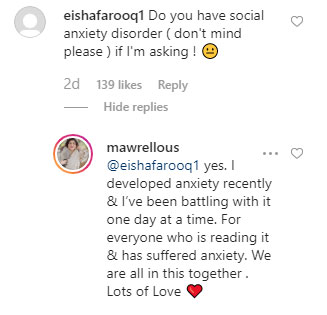
Mawra Hocane along with her sister Urwa talked about depression rather casually when they were invited as guests in Nida Yasir’s morning show. They were criticized and made fun of after they remarked that the kind of food they eat causes depression and food can also cure depression. They were criticized for their ill-informed opinions and that is when both sisters decided to talk about their own struggles with depression and anxiety. While replying to someone on Instagram, Mawra Hocane shared that she had been battling with anxiety and she also showed her support for all those people who were fighting with the disorder. This was Mawra’s way of telling the world that she was not ill-informed but she too was going through the same turmoil. She also cited different sources which supported her claim that processed food adds to depression. People however continued to mock her. Mawra did not let the criticism stop her from sharing how she fought with anxiety and once again through social media shared her journey and hoped to spread awareness about anxiety.
Mahira Khan
Superstar Mahira Khan spoke with Sara-Jane Mee about the importance of mental health awareness and her new role as an ambassador for the British and Asian Trust. The Bin Roye star Two years back when a fan asked her on Twitter whether there is any cure for depression, the Raees diva shared a piece of advice to those who are suffering from mental illnesses, urging them not to be afraid to speak up about depression. “Don’t be afraid of getting help. Talk about it. Ask questions. Read. Reach out to people,” she responded. “There is no shame in reaching out for help. Sometimes talking therapy helps. Other times meds do. But it’s important to go to the right people who can guide you through it,” added Mahira.
Momina Mustehsan
In 2018 when model Anam Tanoli took her own life after fighting depression, Momina Mustehsan spoke about her own struggle with depression through an Instagram post. She posted her picture and wrote, “I was going through turmoil not very long ago. It happens to the best of us. Mental health is just as important as physical health, and we all hit points in our lives sometimes when all seems to be falling out of our control.” This was not the first time that Momina talked about her struggle with depression. She made several videos in which she talked about her struggles in detail and she also had a special message for the trolls. Momina’s struggle basically showed that celebrities too sometimes find it really hard to cope with the demands of their work and they of course are under severe scrutiny continuously which adds to the deterioration of their mental health. Momina Mustehsan came under severe criticism for ‘photographing’ herself while she was depressed. Earlier in a video post, Momina talked about her struggle with depression and tried to make people understand the disorder.
Usman Mukhtar
Usman Mukhtar talked about the impact childhood experiences have on a person’s mental health. He talked about being an overly anxious adult to the extent that it impacted his eating habits and as a result of that he gained a lot of weight. He shared that he was sent to a boarding school when he was really young and the bullying there coupled with the pressure of coping on his own impacted his mental health. He stayed in the boarding school for 5 years and feels that it shaped his personality in such a way that he finds it difficult to cope with many situations.
Imran Abbas
Following model Anam Tanoli’s tragic incident, Imran Abbas shared a post on his Instagram explaining how mental illnesses are not a joke and how there is a collective need for introspection, as a society.
To put it in Abbas’ words, “Please don’t look down to people suffering from depression, mental ailment, stress, and anxiety. Before judging anyone or making fun of someone (specially who is deceased and who can’t explain/ clarify her/himself) we must look around and try to be nice to people who are suffering from the circumstances which can lead a person to suicide (which certainly is one of the most forbidden acts in our religion).”
Further down in his post, he said, “In our society, it’s so convenient to slut-shame an actress and model, scoff at anyone for any rhyme or reason. Making jokes about people who’ve committed suicide does not make you a comedian. It is not dark humor, it is condemnable humor.”
Imran had previously also opened up his depression, in an interview with Times of India. He mentioned how not being able to do Aashiqui 2 put him in a depressive phase. Even hearing somebody sing “Tum Hi Ho” triggered him.
Hira Mani
Hira Mani’s interview with Samina Peerzada has been a memorable one for many reasons. The Kashf star talked about depression and that she was going to a therapist to cure her depression. She stated that when she entered showbiz, she became too competitive and materialistic. Because of this, she went into depression, she was constantly trying to own things that other popular actresses had. Then a moment of realization changed everything for her. She realized that the reason for her depression was that she was trying to find happiness where there was none. Hira cried while talking about this phase of her life and had an important message for her listeners as well.
Nausheen Shah
Nausheen Shah revealed on Ahsan Khan’s show that she was struggling with depression and anxiety when she was shooting for Deewar-e-Shab been fighting depression for almost 7 years and although she went to see the doctor, she did not get the kind of help she was expecting to get. The doctor gave her a relaxant and Nausheen Shah started abusing the drug because it brought short-term relief. One day she completely broke down in front of her co-actor Shahroz Sabzwari and he pointed her in the right direction. Shah is still fighting depression but with the help of medicine and experts to guide her. Nausheen talked about her struggle with depression in Ahsan Khan’s talk show. She has also been part of seminars that help spread awareness about depression.
Juggan Kazim
Juggan Kazim often talks about mental health because she has gone through a really difficult period of her life when she was in an abusive marriage. Juggan got really depressed and had low self-esteem. When her son was born, her life got meaning but the abusive marriage left her broken. She often talks about the importance of therapy and how important it is to seek help in such situations.
Other Artists
Yashma Gill
Actor Yashma Gill shared in multiple interviews that she came from a broken family which impacted her mental health. She was depressed and anxious. She started avoiding her family and was over-dependent on friends. At the age of 19, she was diagnosed with clinical depression. She worked hard in order to come out of this mental state and eventually found solace in the family. She also moved to Australia for further studies and the change in environment helped.
Senior actor Salma Hassan opened up about how therapy helped her over the years. She is also one of those few celebrities who talked openly about post-partum depression; a topic that is often considered taboo even in this day and age. She discussed the issue in detail and talked about the stigma attached to therapy. She shared how she was on medication for depression and later on turned to therapy when she felt that her daughter was getting affected due to her mental condition.
Actor Babar Khan also talked about the extreme depression he went through after his beloved wife Sana Khan passed away in a tragic incident. Babar Khan made a television appearance after many years and talked about how depressed he got and also attempted to take his own life. Babar Khan’s struggle with depression has been a long fight that finally ended when he had his first daughter and he felt that his life had meaning now. Even now Babar Khan hardly ever gives interviews and struggles with staying happy.
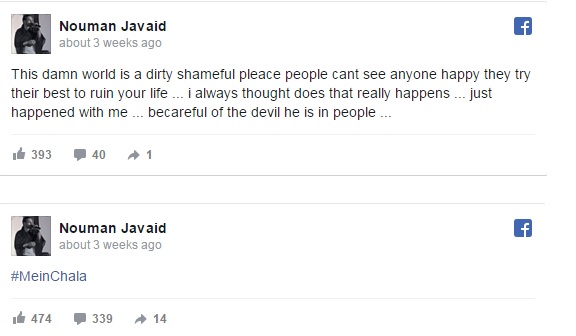
Singer Nouman Javaid was so depressed that he tried to kill himself. His suicide attempt was initially termed as an accident but later on, Nouman talked openly about how difficult it was for him to fight depression. While talking about the tough times he had been going through Nouman said in an interview, “I was in depression for quite some time before finally attempting suicide. I was facing issues in life but I wish to make it clear that Fariha was not the only reason behind my depression; there were a number of other things involved.” Nouman Javaid’s marriage with Fariha ended weeks after his suicide attempt. Before attempting suicide, Nouman also posted a status saying “mein chala” (I am going). In a recent interview, Nouman said that he was focusing on namaz and his work to help him deal with heartbreak and now he was content with his life.