Tag: digital media

  • ‘It’s not possible’; Reporting in internet-challenged Pakistan

    ‘It’s not possible’; Reporting in internet-challenged Pakistan

    With the primary shift from newspapers to television channels and now to digital media applications, the dissemination of information has become increasingly competitive for newsrooms, with the latest updates just a click away.

    “Delays can be managed with newspapers, but today everything is in your hands—specifically, mobile phones,” says Raees Ansari, Bureau Chief of Geo News in Lahore.

    “Every single second is crucial in reporting now; some footage needs to be sent and put on air instantly. But due to poor network conditions and slow WhatsApp, content is not being sent on time, which is affecting our professional activities,” he reveals.

    Over the past week, internet users across Pakistan have reported network disruptions, with WhatsApp, Facebook, and Instagram experiencing slowdowns, hindering online activities. The Pakistan Telecommunication Authority (PTA) has denied any connection between these issues and the alleged firewall installation.

    Since the ban on X (formerly Twitter) on February 17, 2024, many have turned to Virtual Private Networks (VPNs). The ongoing disturbances, however, have complicated internet usage, which is crucial for a number of professions.

    Sumaira Raja, an investigative reporter, who is mostly found out on the field, complains of encountering issues with not only the internet but also phone signals which often prevents her from conveying news on time.

    “I also experience delays with receiving beepers, as head office frequently reports that the number is not available due to poor signals. This situation makes it very difficult to do my job. I’ve tried using a VPN, but it hasn’t worked,” Raja says.

    Sports journalist Faizan Lakhani recalls when javelin champion Arshad Nadeem returned to Pakistan on August 17 after winning the gold medal at the Paris Olympics, all the visuals sent through WhatsApp by reporters were delayed, and they struggled to download them unless they used a VPN.

    “This situation is very challenging and affects our workflow. When reporters are working on a story or covering an event, they need to stay connected with the desk. We usually rely on voice notes to pass instructions, but since we started encountering this issue, we are struggling with that method too,” he says.

    “We have been told that the network disruption is because of the firewall installation. While things are becoming easier around the world, it has been getting harder for us. Everything is happening with the help of technology and the current situation is a major challenge.” says Ansari.

    What’s happening?

    A highly placed source in the IT industry identifies that filtering of content delivery networks (CDNs) through Firewall is causing content to be routed via internet backbone rather than CDNs.

    “This means that around 4 TBs of internet traffic previously served through CDNs, hosted in Pakistan, is becoming ineffective. When all traffic goes on backbone bypassing CDNs, it’s causing massive slowdown at many western destinations that’s happening now,” he explains.

    Recently, Fiverr, an online marketplace for freelance services, warned clients that Pakistani freelancers may experience delays due to internet issues and the use of VPNs to change their locations.

    “Brace for impact. God save the internet in Pakistan”, says the IT expert.

    Background

    It all started on February 17, 2024, about a week into the new government, when X (formerly Twitter) was banned.

    Initially, amid the uproar, the government remained silent on the matter while the Pakistan Telecommunication Authority (PTA) seemed aloof until the High Courts of Sindh and Islamabad intervened. The PTA eventually admitted that the ban on X was imposed on the orders of the Ministry of Interior based on reports from intelligence agencies.

    The government eventually justified the ban by attributing it to national security concerns, citing ‘digital terrorism‘ and online propaganda as among the threats.

    Earlier in August, Provincial Information Minister Azma Bokhari stated that the government is not against social media but wants to focus on rules and regulations, which, if enforced, could lead to the removal of the ban on X.

    The disruption has now extended beyond X, affecting other widely used apps along with the internet.

    Ironically, since the February 2024 election, the new government has emphasised the need to grow the tech industry in Pakistan.

    In March, Lahore Knowledge Park (a science park) was handed over to the Punjab Central Business District Development Authority with the approval of Chief Minister Punjab Maryam Nawaz, with the goal of establishing Pakistan’s largest IT city.

    In June, Prime Minister Shehbaz Sharif visited Shenzhen— the tech hub in China— in hopes of future collaboration. Ironically, he posted on X (Twitter), expressing how “impressed” he was by the “city’s skyline and development that symbolizes modern-day China.”

    Given the lack of proper infrastructure in the country amid burgeoning surveillance, how will Pakistan evolve in the rapidly transforming digital world? It remains to be seen – but likely we won’t be able to download it.

  • New initiatives to protect sensitive information, prevent cyber attacks

    New initiatives to protect sensitive information, prevent cyber attacks

    The federal government has formed the National Computer Emergency Response Team to protect sensitive information and prevent cyber attacks.

    NCERT will protect digital assets, sensitive information and critical infrastructure.

    According to a notification of the Ministry of IT, NCERT has been formed as per PECA and CERT rules. The Cyber Security for Digital Pakistan project was declared a National CERT, which had been running for several years.

    The NCERT will play a role in detecting and preventing cyber attacks. For this, along with the appointment of experts, the purchase of necessary software and hardware has already been done.

    NCERT will work on creating awareness, research and development related to cyber attacks while a separate website for National Cert has also been launched.

    The Cyber Security for Digital Pakistan project has been running for several years, and it was run by the National Telecommunication and Information Security Board.

  • Why did Aurat March hold a Feminist Press Conference?

    Why did Aurat March hold a Feminist Press Conference?

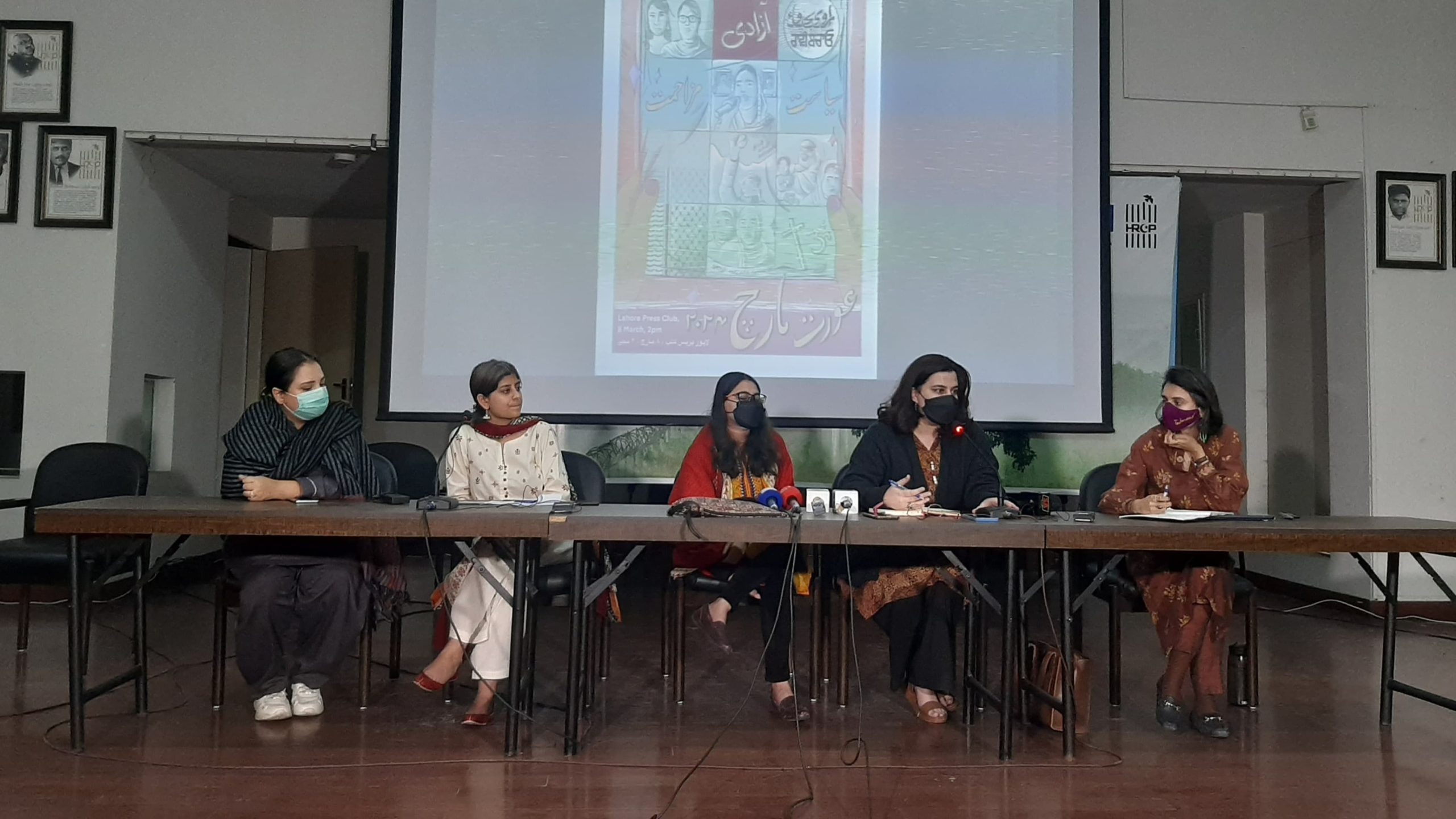
    This Friday, on March 8, as the world will celebrate Women’s Day, Aurat March will take to the streets in Lahore, Karachi, Islamabad and Multan.

    The Current attended this year’s Aurat March press conference and got details about how this year is different from the ones before.

    Every year, the press conference is dominated by men from media platforms, leaving little or no room for women and transgender journalists to interact with Aurat March members.

    Moreover, coming with preconceived notions and biases, male journalists reportedly have been condescending and aggressive towards Aurat March members who conduct the conference with the aim to explain their manifesto and charter of demands prior to the big day.

    To counter this issue, this year Aurat March decided to hold a Feminist Press Conference.

    The purpose of a Feminist Press Conference was to provide a space to women, transgender, and minorities where they can get a fair chance to not just raise questions in respect to the March, but meaningfully engage with members.

    “This year’s press conference, in comparison to previous ones, was definitely much better,” said one of the representatives (who requested to remain anonymous).

    “Today, we were able to talk about our manifesto, we took questions from the reporters, and the interaction was respectful.”

    The member further denoted that this has never happened before. She explained that in the past, no reporter would come having read Aurat March’s charter of demands and the manifesto and instead, would resort to stereotypical questions.

    “When we would try to counter their queries, they wouldn’t listen to us because they wanted to hear the preconceptions they came with.

    “In fact, we are happy that this year, because the conference was conducted peacefully, we even got suggestions from journalists – which will, of course, help us as well”, she added.

    On Youtubers

    Last year, Youtubers disrupted the press conference, and media journalists stated that they do not consider YouTubers as journalists. “I am glad this year, we talked about [YouTuber disruption] as well”, the members highlighted.

    “The journalist community should think through ways to distance themselves from or critique YouTubers who are badmouthing their profession.”

    Some YouTubers, who attend the March as independent journalists, are known for their alleged misconduct at Aurat March. They have also been called out for spreading disinformation about performances and placards at the marches, and also harassing marchers with irrelevant and demeaning questions.

    This poses a threat to Aurat March members as well as attendees, and above all, the propaganda hinders socio-political awareness that the March intends to raise.

    The irony of today’s feminist press conference was when a YouTuber reached out to Aurat March members, upset for not getting a chance to ask his questions during the session. Well, I hope he realized how women feel when men take up their rightful space.

  • The Current ko kis tarhan ka hona chahiye?

    The Current ko kis tarhan ka hona chahiye?

    Please fill out this survey and let us know what you want from out website.

  • X considers monthly fee for all users as a countermeasure against fake accounts 

    X considers monthly fee for all users as a countermeasure against fake accounts 

    Renowned technology billionaire Elon Musk hinted on Tuesday that users of the social media platform X, formerly known as Twitter, may face a monthly fee. Musk stated, “We’re moving to having a small monthly payment for use of the system,” during a conversation with Israeli Prime Minister Benjamin Netanyahu. 

    Musk’s proposal is driven by the need to combat the issue of bots and fake accounts on social media, with the idea of charging for verification. However, it remains unclear whether this was a spontaneous comment or a signal of more concrete plans. 

    The new owner of the social media giant X, who assumed control last year, is encouraging users to subscribe to X Premium, which offers paid subscribers additional features like longer posts and increased visibility. Currently, users can still access X for free. 

    While Musk insists that the primary objective is to combat bots, it is apparent that there is a financial interest for the company in charging users, according to the BBC. Musk explained, “A bot costs a fraction of a penny to make. But if somebody even has to pay a few dollars or something, some minor amount, the effective cost to bots is very high.” 

    Read more: iOS 17 update is here: Try these fun features today

    The world’s richest person is also exploring options for lower pricing tiers for X Premium, which currently costs $8 (£6.50) per month in the US, with variations depending on the subscriber’s location. He stated, “We’re actually going to come up with lower-tier pricing. So we just want it to be a small amount of money.” 

    Musk emphasised, “This is a longer discussion, but in my view, this is actually the only defence against vast armies of bots.” 

    However, there is a concern that placing X behind a paywall could result in a significant loss of users, potentially affecting the company’s primary source of income, advertising revenue. 

  • Nobel laureate Maria Ressa acquitted in Philippines tax evasion case

    Nobel laureate Maria Ressa acquitted in Philippines tax evasion case

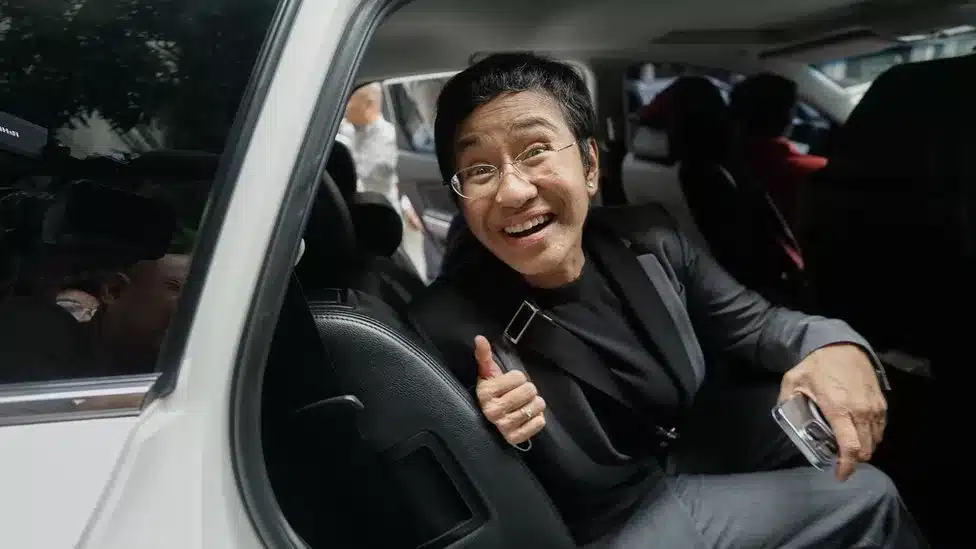
    Maria Ressa, Nobel prize winner and co-founder of the online news platform Rappler, has been acquitted of a tax evasion charge in the Philippines on Monday.

    This is another feat in her legal fight against a number of charges that were filed under the government of former president Rodrigo Duterte.

    “You gotta have faith,” she said outside the court.

    Ressa and Rappler have been hindered by five government charges of tax evasion after the sale of Philippine depositary receipts in 2015 — a route for companies to raise money from foreign investors.

    In January, they were acquitted on the other four charges.

    However, Maria Ressa and Rappler have two more court cases to fight.

    Ressa and Rey Santos Jr, a former colleague, have appealed for a cyber-libel conviction that carries a nearly seven-year jail sentence.

    Similarly, Rappler is challenging a Philippine Securities and Exchange Commission order to close for allegedly violating a ban on foreign ownership in media. Under the country’s constitution, investment in the media is reserved for Philippine citizens or entities controlled by citizens.

    “It shows that the court system works and we hope to see the remaining charges dismissed,” she said.
    Ressa won the Nobel Peace Prize in 2021 alongside Russian journalist Dmitry Muratov in recognition of their efforts to “safeguard freedom of expression“.

    Ressa is also an American national but has remained in the Philippines and is currently on bail pending the appeal against the cyber-libel conviction.

    Maria Ressa was awarded the 2021 Nobel Peace Prize along with Dmitry Muratov for “their efforts to safeguard freedom of expression, which is a precondition for democracy and lasting peace.”

  • WhatsApp now lets users share videos in HD resolution

    WhatsApp now lets users share videos in HD resolution

    Shortly after introducing support for high-definition photos, Meta’s messaging app, WhatsApp, has now incorporated the capability for users to send videos in high-definition resolution as well. This enhancement has been made available to both iOS and Android users.

    Much like the previously launched high-definition photos feature, the inclusion of high-definition videos empowers users with the option to share videos in superior quality through WhatsApp. 

    Prior to this update, videos of high-definition quality would undergo compression, limiting them to 480p resolution. With the recent update, users are now afforded the choice to transmit videos in high-definition, although this is restricted to a maximum resolution of 720p.

    The process for sharing high-definition videos mirrors that of sharing high-definition photos. Upon selecting the desired video or videos for sharing, users will encounter a newly integrated HD button positioned atop the screen. Subsequently, a dialogue box will emerge, affording the user the decision to opt for Standard Quality or HD Quality. This dialogue box also provides insight into the associated file sizes. The sharing procedure is then finalized by selecting the “send” option, consistent with standard sharing practices.

    It is noteworthy that all images and videos exchanged on WhatsApp remain safeguarded through the company’s robust end-to-end encryption protocols. 

    According to Meta, this feature is currently being rolled out, indicating that users who have yet to access it will likely do so in the coming days.

  • X fixes ‘glitch’ causing disappearance of pre-2014 images and media

    X fixes ‘glitch’ causing disappearance of pre-2014 images and media

    The social media giant X, previously known as Twitter, has acknowledged a significant glitch that led to the disappearance of images and other media links dating back to before 2014. The company has confirmed that the bug has been rectified, and the issue is expected to be completely resolved in the upcoming days.

    In a recent communication, X Support stated, “During the weekend, we encountered a bug that prevented the display of images from the period preceding 2014. It’s important to note that no images or data were permanently lost due to this issue. We have successfully addressed the bug, and its full resolution is anticipated shortly.”

    While no official confirmation has been provided, there is speculation that the bug could be attributed to the transition of domains from Twitter.com to X.com.

    The glitch on the X platform also had an impact on one of the most iconic tweets shared on the platform by Ellen DeGeneres, the host of the 2014 Oscars. This particular tweet, captured after the Oscars, featured a star-studded selfie including personalities like Bradley Cooper, Jennifer Lawrence, Brad Pitt, and Meryl Streep, among others. The comedian accompanied the 2014 Oscars selfie with the caption, “If only Bradley’s arm was longer. Best photo ever.”

    Interestingly, amid the ‘bug’ issue, one of the few posts that remained unaffected was the well-known tweet by Barack Obama following his victory in the 2012 election. The post featured an image of Obama and his wife Michelle, accompanied by the caption, “Four more years.”

    Initial reports suggest that the glitch appears to be linked to tweets posted after December 2014. This timing coincides with changes made by the social media platform in 2016, when it introduced ‘enhanced URL enrichment’ to enable previews for linked websites and native attachments, a feature that extended beyond the platform’s original 140-character limit.

  • Imran Khan’s upcoming alleged audio leak: PTI says if it happens, they will not sit quietly

    Imran Khan’s upcoming alleged audio leak: PTI says if it happens, they will not sit quietly

    Pakistan Tehreek-e-Insaf (PTI) Chairman Imran Khan’s conversation with his former Principal Secretary Azam Khan at the time when he was Prime Minister of Pakistan (PM) can be leaked, writes journalist Ansar Abbasi for Daily Jang.

    Following this, Focal Person on Digital Media to Khan Dr Arslan Khalid took to Twitter and said, “Recording thousands of calls, editing voices, making custom phone calls and then spreading them through your envelopes, is all that’s left now.”

    PTI’s Babar Awan termed this act as treason and said, “First Bushra Imran’s fake audio and now Imran Khan’s. Is it a joke that someone can tap the call of the PM of a nuclear country or use it for media trial by tampering and editing?”

    Journalist Mansoor Ali Khan shared an old interview of Khan when he was in power. In the video clip, Khan can be heard defending Inter-Services Intelligence (ISI) for recording calls.

    According to Khan, ISI knows who is he talking to over the telephone. He further said that they should know because they are responsible for the security of the PM.

    Addressing a press conference, both former federal ministers and PTI leaders Shireen Mazari and Fawad Chaudhry condemned Khan’s and Bushra Bibi’s leaked audios.

    Talking about Khan’s audio, Mazari said phone tapping of a PM’s secure line is illegal as only an intelligence agency can do that. She urged that Supreme Court (SC) take suo moto of the situation as it is a violation of SC order.

    In the verdict issued in the late 1990s, the top court had said that an individual’s privacy under Article 14 was not just restricted to physical boundaries of home or work but also extended to public places.

    Taking Ansar Abbasi’s name, she further said it is a clear violation of the Constitution. Mazari said that if such audio is leaked, it will be a violation of the Official Secrets Act as the conversation between a PM and his principal secretary.

    “If a journalist leaks this, they are not only violating Article 14, they will also be in violation of the Official Secrets Act. Beware, we will not sit quietly if this happens,” she added.

    Commenting upon the leaked audio of Bushra Bibi, the former minister said that “no substantial” conversation was there and “the actual problem here is of phone tapping”.

    “One wonders how much did the US help in tapping the phones?” Mazari posed a question. She said that the “neutrals and the government” could not find evidence of corruption against Khan that’s why they are leaking audios. She further claimed that they are diverting the public from real problems such as inflation, loadshedding, etc.

    Meanwhile, speaking on Geo News’ programme ‘Naya Pakistan’, Defence Minister Khawaja Asif said that if PTI claims that Bushra Bibi’s audio leak is fake, they can get its forensics done from a third party.

    On Saturday, an alleged audio of Imran Khan’s wife Bushra Bibi was leaked in which she is instructing Arslan Khalid to make a statement against Khan’s opponents and run a campaign to ‘prove them, traitors’.

  • Digital Media Wing Report: misleading and not at all ‘Deep Analytics’

    Digital Media Wing Report: misleading and not at all ‘Deep Analytics’

    A report released by the Digital Media Wing (DMW) of the Ministry of Information and Broadcasting titled, ‘Anti-State Trends: Deep Analytics Report’ is deeply misleading and based on assumptions instead of facts, The Current has discovered after analysing the report.

    Glaring errors and almost comical additions, the report makes a correlation between analysing hashtags on Twitter to determine if someone is anti-state and is responsible for starting trends against Pakistan.

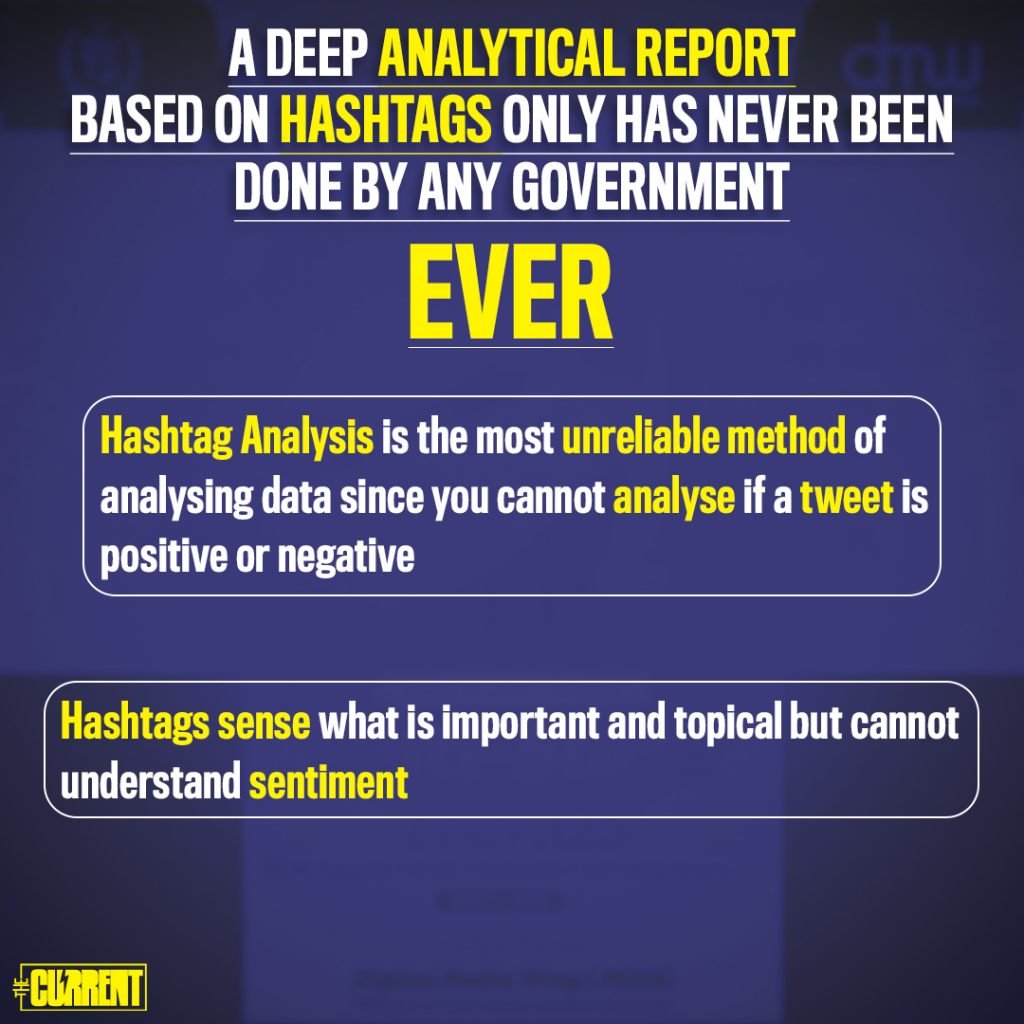
    Before analysing the report, The Current researched and spoke with analysts who are well-versed with digital analysis. There is no record of any report on hashtag analysis to determine trends at a government level in any country at any time. Pakistan is the only country that has created a report based on hashtag analysis. Worldwide, hashtag analysis is considered to be deeply unreliable since it cannot understand what is written in the tweet – it is just able to see what is being discussed.

    WHAT IS THE REPORT?

    The report is a compilation of hashtags that created trends that the government deems anti-state. The report shows information collected about hashtag trends and then lists pages of screenshots that show different Twitter handles sharing tweets that have the ‘anti-state’ hashtag. They do not differentiate between users and also label ‘influencers’ – people with a following who have tweeted or retweeted/replied to the hashtag.

    In effect, the report seems to declare all the users in the report as anti-state, until one prominent journalist got them to add a disclaimer last night.

    HOW WAS THE INFORMATION COLLECTED?

    Since the whole report is based on hashtag analysis, it will be considered to be unreliable data collection and cannot be considering as a legitimate report in any institution.

    When The Current reached out to General Manager of the Digital Media Wing (DMW), Imran Ghazali, he responded to the question of faulty analysis of hashtags by saying, “The purpose of this report was to ascertain factual data and to analyze social media trends that were anti-state, Data was collected after analysing Pakistan Twitter Panel from June 2019- August 2021. Those hashtags were marked for data collection where the content of tweets were planned and propagated through a network to spread anti-state trends.”

    According to a source in the government, the information used is public. “Publicly released data is accurate. It’s no rocket science, anybody with a credit card can get this data. Hence made public.”

    From The Current’s analysis, the data was collected by using a web application called, ‘Tweeps Map’, which is open to the public.

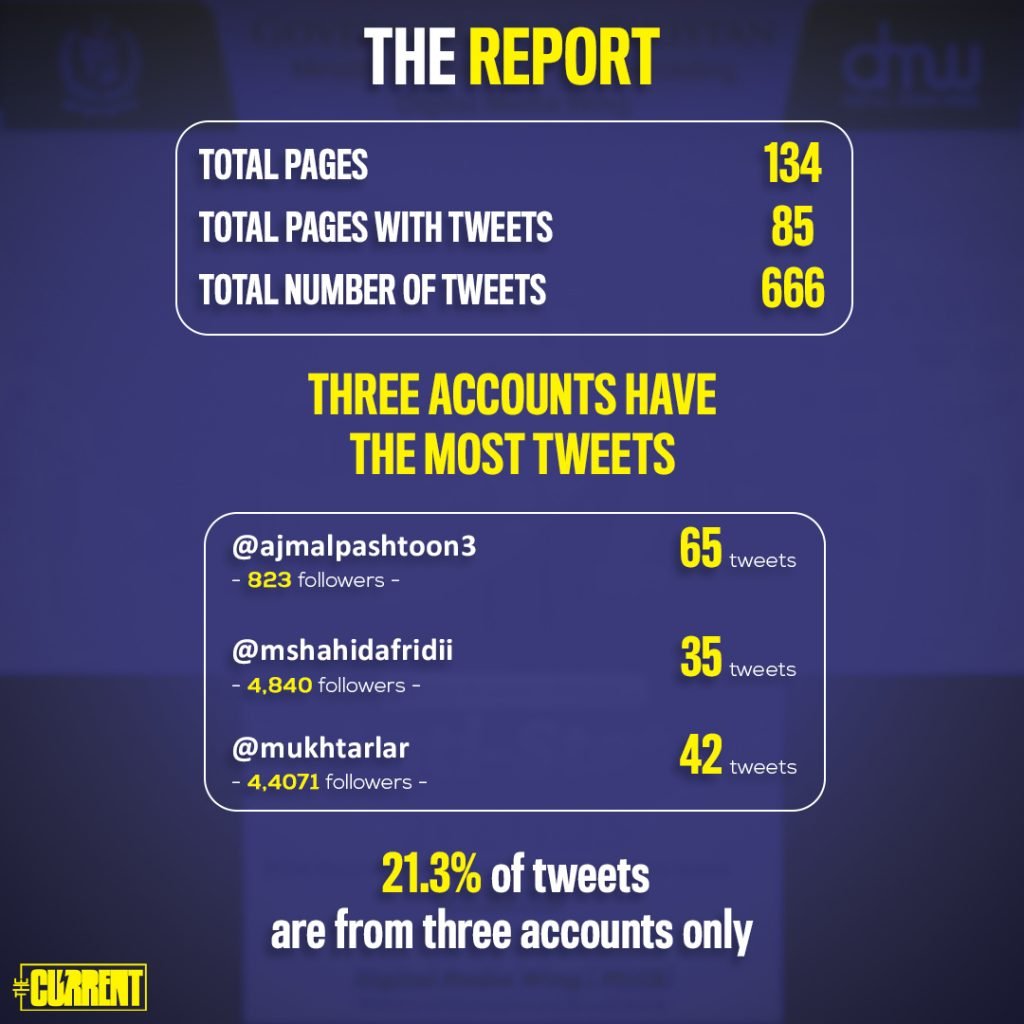
    From our findings, the 134-page report has 85 pages that have screenshots of tweets, which means that 63.4 per cent of the report is based on screenshots of people who are using a certain hashtag that the government has identified as being anti-state. The number of tweets that are in these 85 pages amount to 666 tweets out of which 142 tweets are from three accounts, which means that 21.3 per cent of the tweets used in this study came from three people.

    After further analysis of the three accounts, The Current discovered that all three accounts had a combined following of less than 11,000.

    TheCurrent Analysis on report of  Anti State Tweets as per the Digital Media Wing of the Ministry of Information

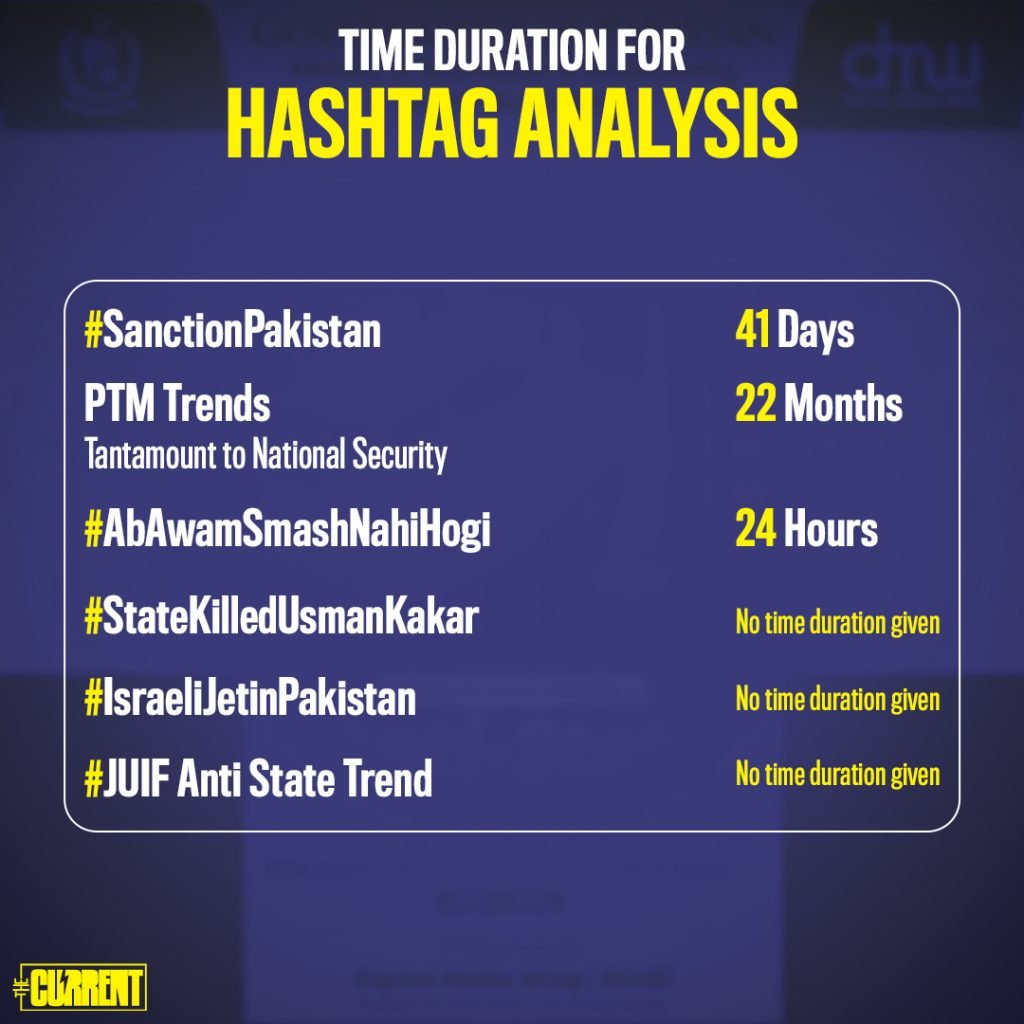
    We discovered that the hashtag #SanctionPakistan was ‘analysed’ for 41 days, Pakhtun Tahafuz Movement (PTM) hashtags were clubbed together as “PTM Trends Tantamount to National Security” (the report doesn’t list which hashtags were used within this topic) and were ‘analysed’ for 22 months, #AbAwamSmashNahiHogi was ‘analysed’ for one day, and #StateKilledUsmanKakar, #IsraeliJetinPakistan, ‘JUIF Anti State Trend’, was ‘analysed’ but no time duration is given.

    TheCurrent Analysis on report of  Anti State Tweets as per the Digital Media Wing of the Ministry of Information

    WHY AND WHEN WAS THE ‘DISCLAIMER’ ADDED?

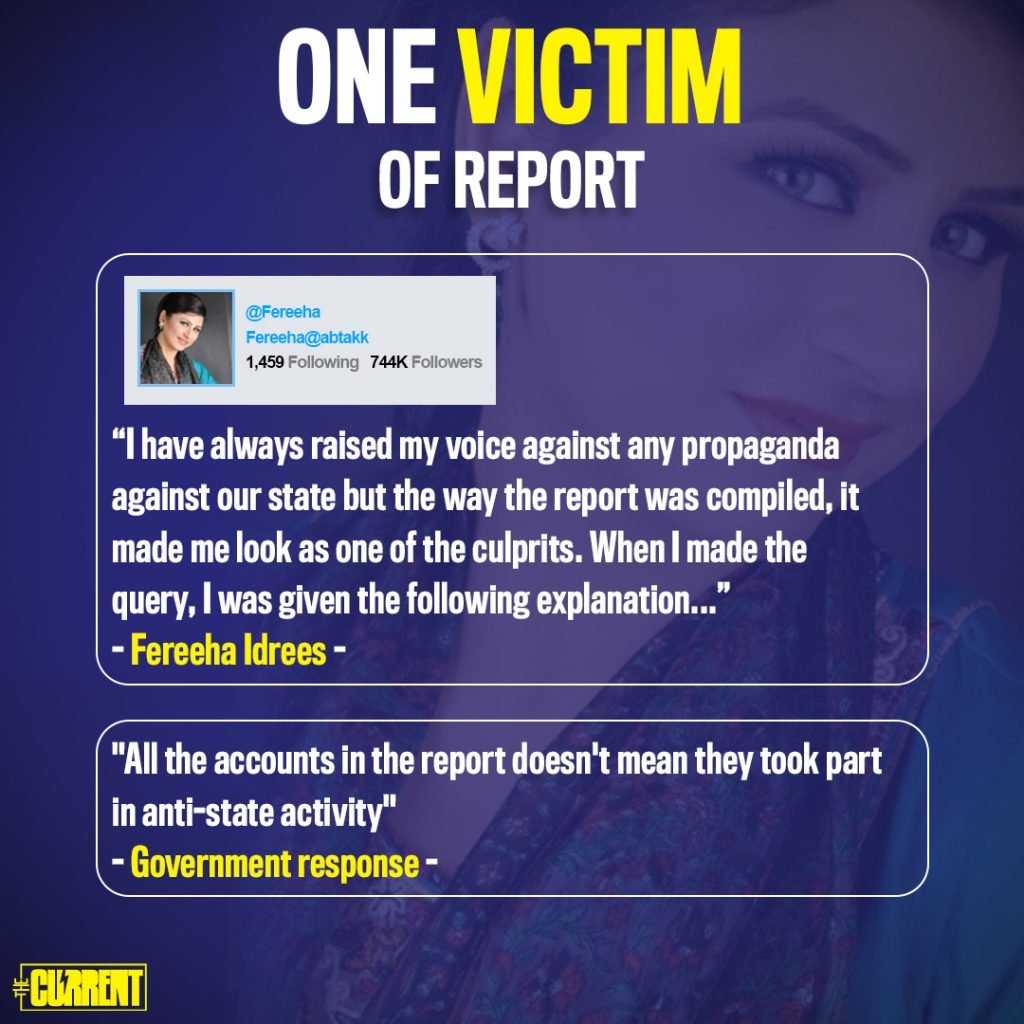
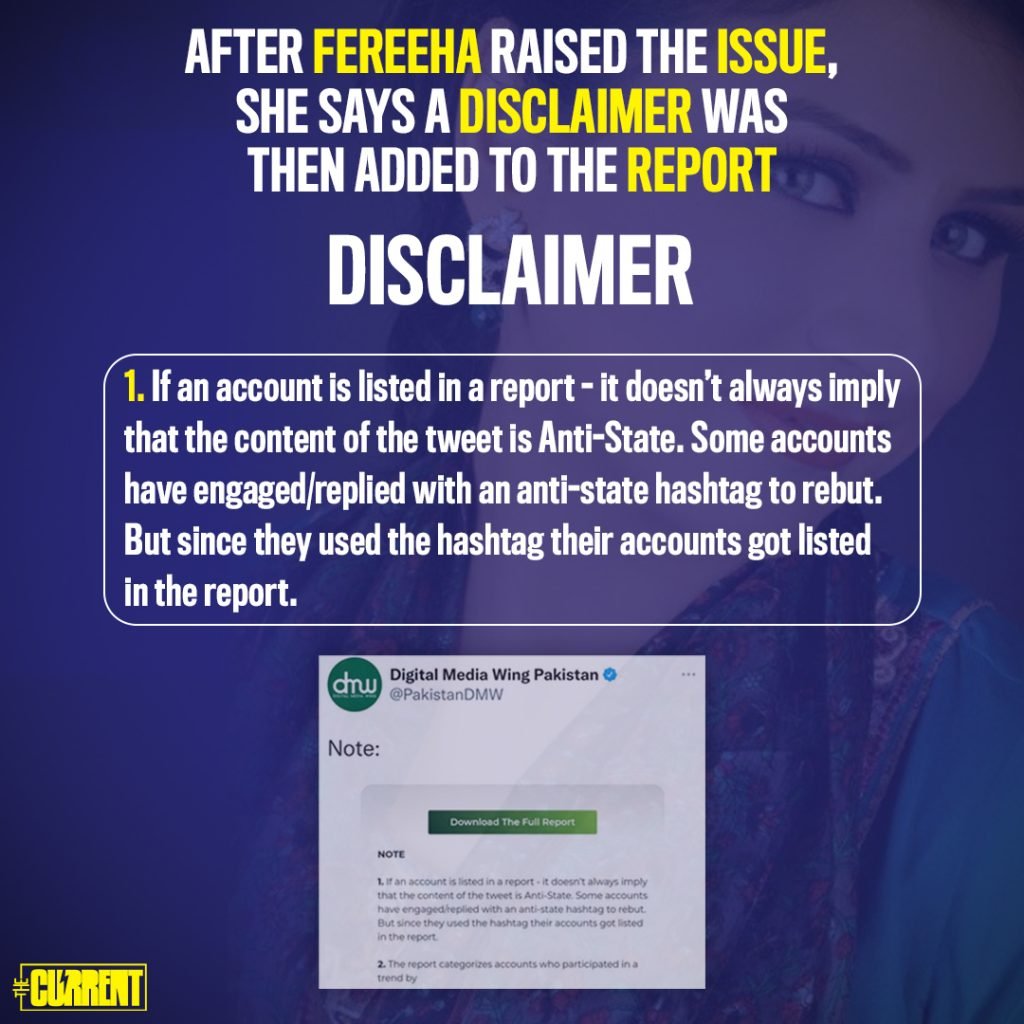
    The report was released Wednesday evening around 5:30PM and a few hours later a disclaimer was added to the report. According to journalist Fereeha Idrees, the disclaimer was added after she raised the issue with the DMW for being highlighted in the report as a ‘replies with the most followers’ account.

    “I have always raised my voice against any propaganda against our state but the way the report was compiled, it made me look as one of the culprits and suddenly social media was rife with messages calling me anti-state,” Fereeha told The Current, “When I made the query, I was given the following explanation.”

    TheCurrent Analysis on report of  Anti State Tweets as per the Digital Media Wing of the Ministry of Information

    The explanation given to Fereeha by the DMW stated, “All the accounts in the report doesn’t mean they took part in the anti-state activity…It shows the whole journey of the trends/hashtags, so in this case Fareeha Idrees replied/rebutted on the Israeli related trend and that’s why it mentions ‘Replies with most mentions’ in the report.”

    After the DMW response, Fereeha demanded that they add a disclaimer to the report. A disclaimer was added which stated, “If an account is listed in a report – it doesn’t always imply that the content of the tweet is Anti-State. Some accounts have engaged/replied with an anti-state hashtag to rebut. But since they used the hashtag their accounts got listed in the report.”

    Digital Media Wing of the Ministry of Information - Anti State Tweets

    Imran Ghazali admitted to adding the disclaimer after Fereeha raised an objection about the fairness of the report.

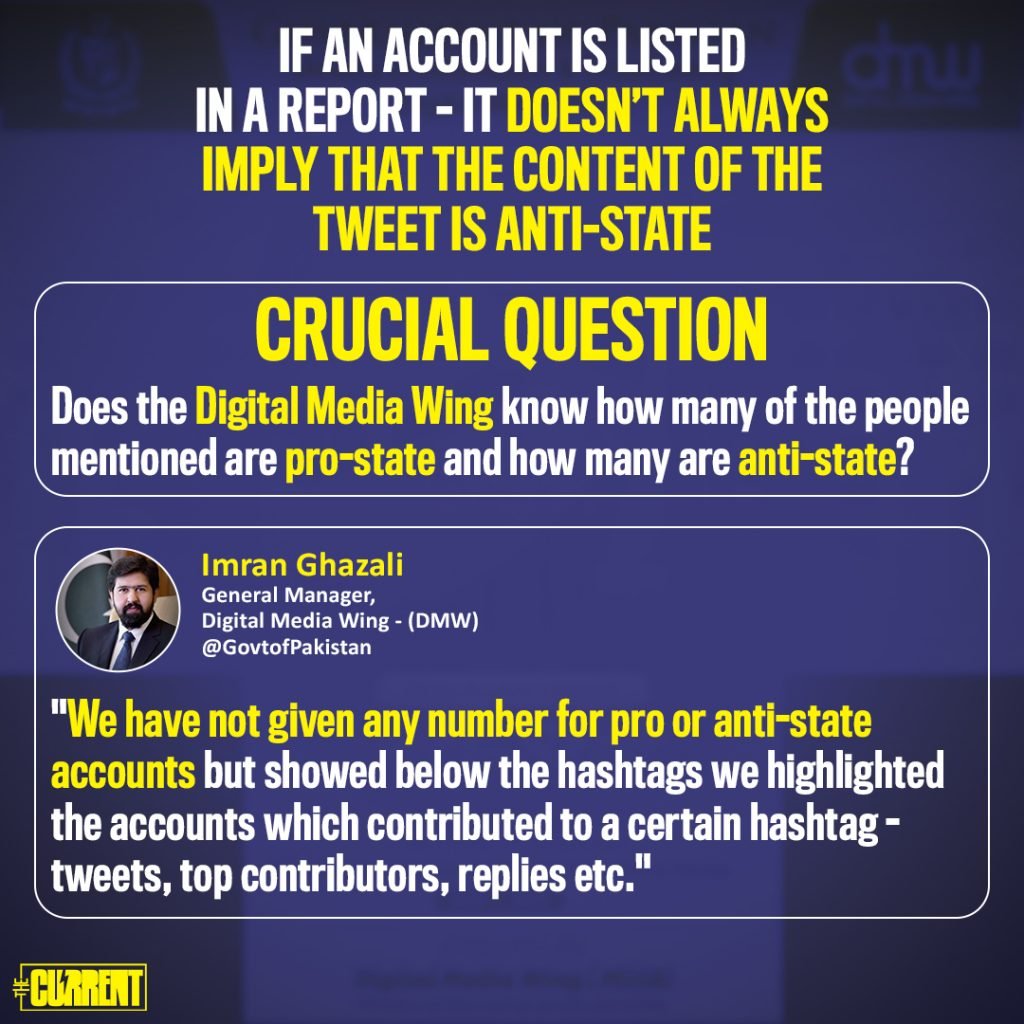
    The Current asked Ghazali about how they have divided the report to show which people mentioned were anti-state and which ones were considered pro-state. Ghazali refused to directly answer the question and stated, “We have not given any number for pro-state or anti-state accounts but showed below the hashtags we highlighted the accounts which contributed to a certain hashtag – tweets, top contributors, replies etc.”

    When we pressed him to answer the question about how the people selected were separated into anti-state and pro-state, he said, “If an account is listed in a report – it doesn’t always imply that the content of the tweet is Anti-State. Some accounts have engaged/replied with an anti-state hashtag to rebut. But since they used the hashtag their accounts got listed in the report.”

    The implication of his answers show that the report does not – and cannot- differentiate people’s points of view on a tweet, which means that someone who has posted a ‘pro-state’ tweet condemning the hashtag will also be added into the list of someone who is considered anti-state.

    WAS THE GOVERNMENT ALLOWED TO USE THE APP ‘TWEEPSMAP’?

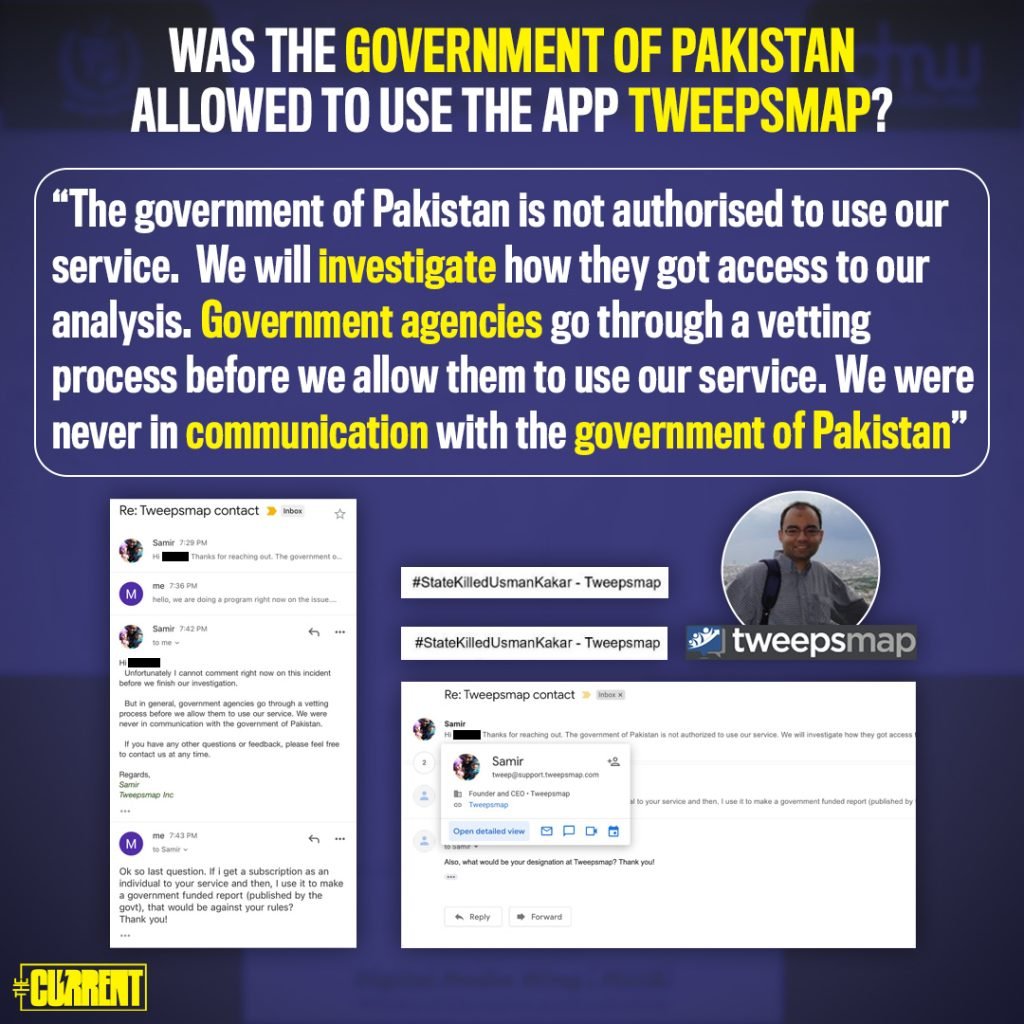
    The Current reached out to TweepsMap, which was the primary analysis app used by the government for this report. The maps and information all have the Tweepsmap link on the maps and all charts in the report. We asked the CEO of TweepsMap Samir Al-Battran if they considered the analysis of the report to be authentic since it used their app service. Samir told us, “The government of Pakistan is not authorised to use our service.  ​We will investigate how they got access to our analysis and get back to you on this.”

    Digital Media Wing of the Ministry of Information - Anti State Tweets

    We asked him for further details, asking if an individual used their service for analysis for a government funded report, would that be against their rules, to which Samir replied and said, “…Government agencies go through a vetting process before we allow them to use our service. ​We were never in communication with the government of Pakistan…Yes, [using the app without informing us what it is for] would be a misrepresentation and is definitely against our rules.”

    The Current asked Ghazali if they used the application and if they had authorisation to which he said, “We used different tools/APIs including our internal tools to analyse data”. We asked him since TweepsMap is the only one that is being listed in the report, if they had gotten a subscription for the government of Pakistan to which we got no response.

    WHAT ELSE IS IN THE REPORT?

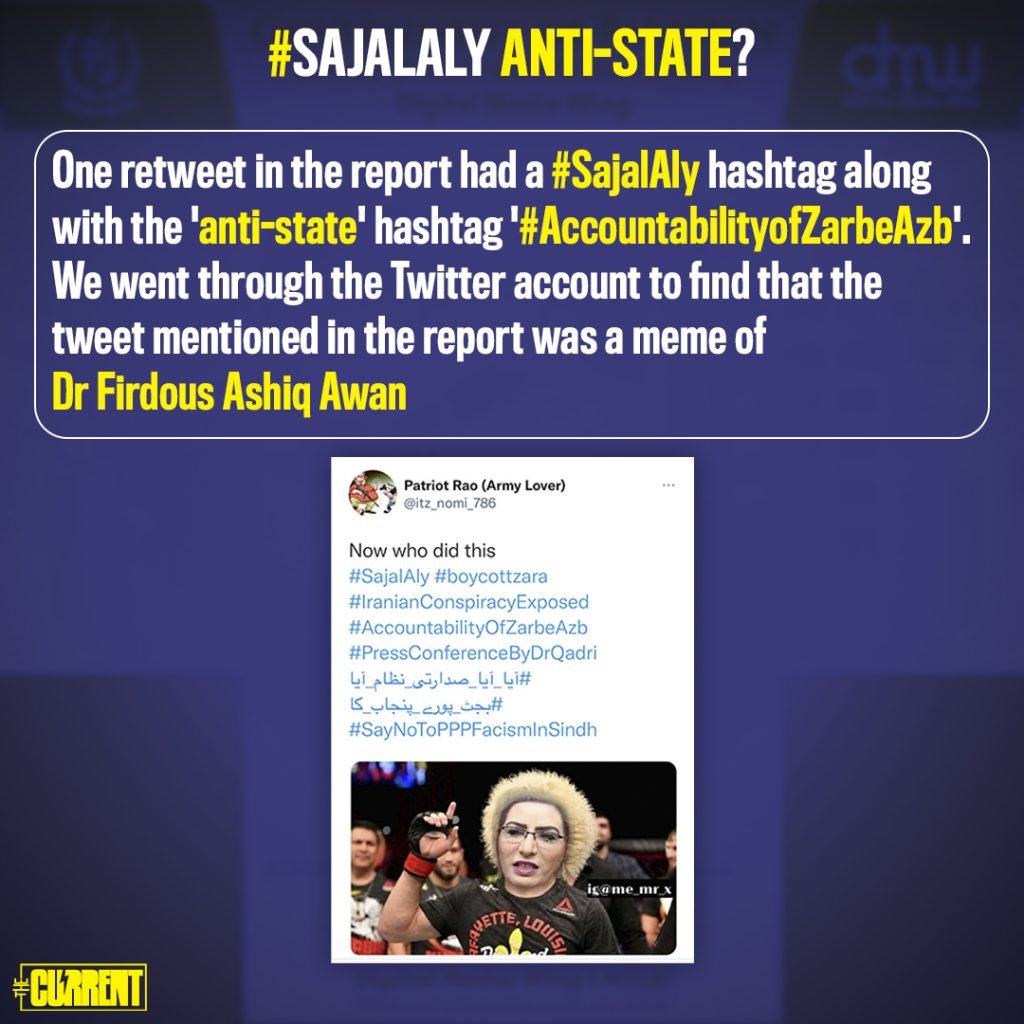
    We analysed the tweets used in the 85 screenshots present in the report and found some comical discrepancies. One retweet had the #SajalAly hashtag along with the ‘anti-state’ hashtag ‘#AccountabilityofZarbeAzb’. We went through the Twitter account to find that the tweet mentioned in the report was a meme of Dr Firdous Ashiq Awan.

    Digital Media Wing of the Ministry of Information

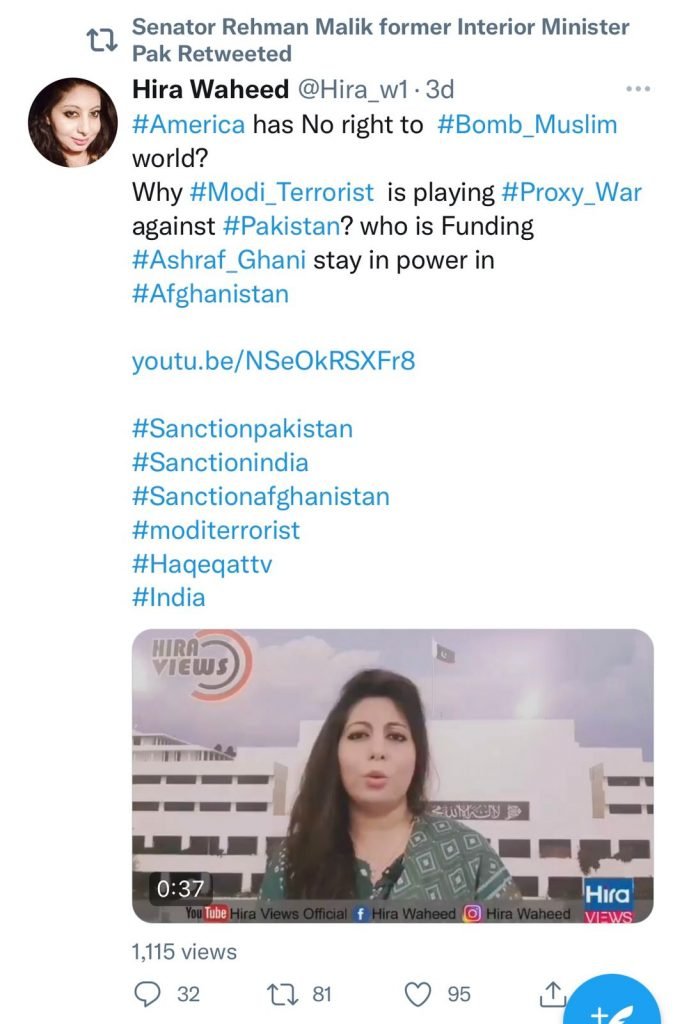
    A tweet by former Interior Minister Rehman Malik is included in the #SanctionPakistan list in which he is criticising Indian Prime Minister Narendra Modi and the US.

    The tweet Rehman Malik retweeted

    The report also includes references to “a group of Wikipedia Admins most of whom are based in India,” giving state level credibility to an online encyclopedia that can be edited by anyone. With glaring spelling mistakes and analysis based on unauthorised data, the summary of the Digital Media Wing Deep Analysis report has been summed up by one senior data analyst based in Singapore, “That just goes to show… they don’t understand how it works.”