Tag: digital rights

  • Federal government begins consultations for establishment of social media regulatory authority

    Federal government begins consultations for establishment of social media regulatory authority

    The federal government has begun consultations for the establishment of a social media regulatory authority.

    According to sources, the proposed social media regulatory authority (PECA) Amendment Bill 2024 is to be tabled soon in the Parliament.

    Media houses and other stakeholders have also been invited for consultation to establish the authority of the committee.

    Prime Minister Shehbaz Sharif reportedly formed a cabinet committee on this matter whose task is to consult the social media regulatory authority and give suggestions to the government on issues related to digital rights.

    The authority will ensure responsible use of the internet and compliance with regulations in addition to considering the issue of regulating online content and procedures for investigating violations of law on social media.

    The issue of summoning witnesses and violators of social media laws will also be considered in the consultation.

    The bill is intended to protect the private life of citizens from threats posed by social media.

  • Who Banned X (former Twitter) in Pakistan? We finally have an answer

    Who Banned X (former Twitter) in Pakistan? We finally have an answer

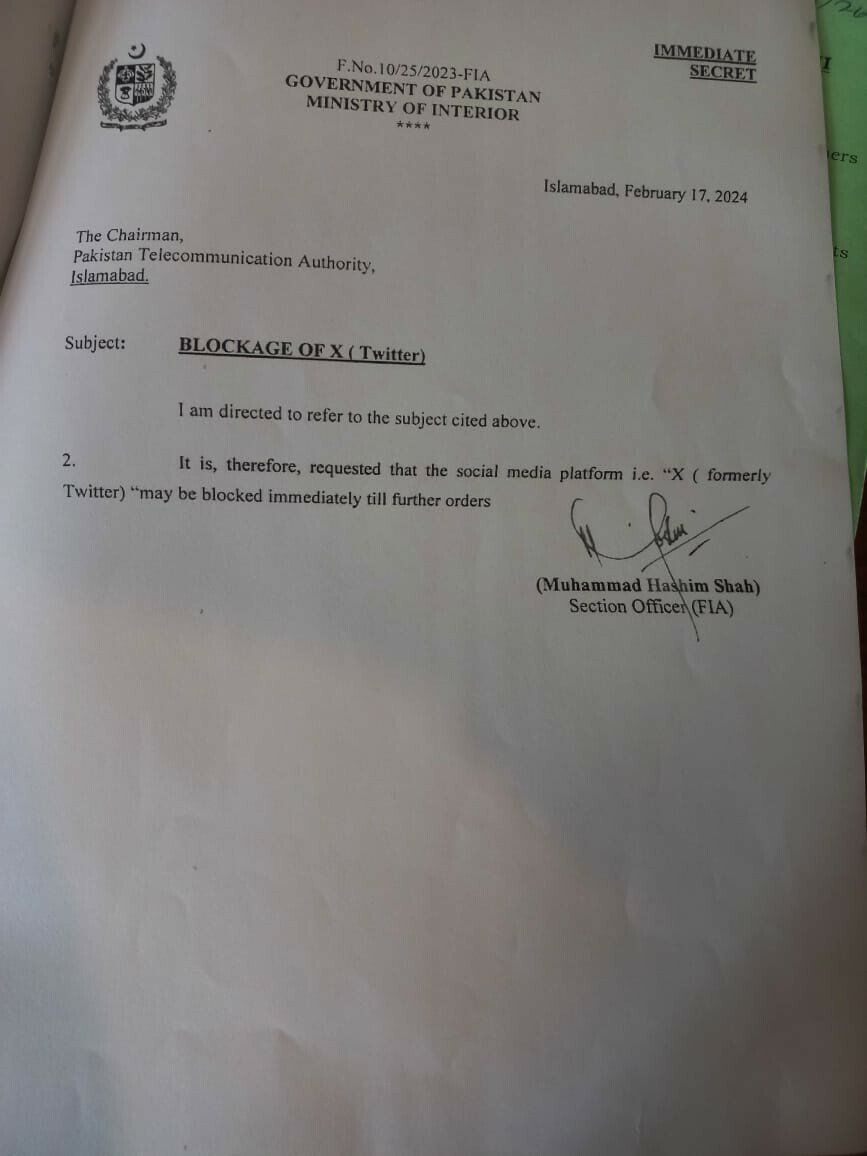
    Pakistan Telecommunication Authority (PTA) disclosed to the Sindh High Court (SHC) that the nationwide ban on the social media platform X, implemented on February 17, was executed upon directives from the Ministry of Interior, citing intelligence agency reports.

    Since February 17, the X website and application have remained predominantly offline, with sporadic service restorations, primarily occurring following statements made by former Rawalpindi commissioner Liaquat Ali Chatta alleging election irregularities.

    PTA Chairman Hafeezur Rehman announced his intention to address the disruption of X with the interior ministry during a telephonic conversation with Dawn.com.

    Rehman emphasized the need for clarity or accountability regarding the platform’s closure, highlighting that such actions are typically directed by the Interior Ministry.

    During a hearing, a two-member SHC bench, comprising Chief Justice Aqeel Ahmad Abbasi and Justice Abdul Mubeen Lakho, consolidated four petitions filed by lawyer Jibran Nasir, journalist Zarrar Khurho, and others concerning internet disruptions at various instances.

    In court, the PTA presented a copy of a letter dated February 17 from the Ministry of Interior instructing the telecommunication authority to block social media platform X.

    The letter sent by Muhammad Hashim Shah, section officer FIA, to The Chairman PTA stated, “It is, therefore, social media platform i.e. X (formerly Twitter) may be blocked immediately till further orders.”

    The PTA further revealed that these orders stemmed from intelligence agency reports.

    Expressing dissatisfaction over the interior ministry’s failure to provide a written response, Chief Justice Aqeel Ahmad Abbasi urged Deputy Attorney General Khaleeq Ahmed to submit a “serious response,” prompting the latter to later present a written reply on behalf of the interior ministry. The response stated that services were disrupted on May 9, following orders from all provincial governments, citing concerns for state and citizen security. However, it refrained from commenting on other aspects of the case.

    Following the inclusion of the ministry’s response in the case record, the bench adjourned the hearing until April 17, awaiting further proceedings.

  • Information Minister admits X still restricted in Pakistan

    Information Minister admits X still restricted in Pakistan

    Following earlier assertions that social media giant X, formerly known as Twitter, was accessible to online users, Information Minister Atta Tarar has now conceded that the popular social networking app remains suspended in the country.

    During an interview with a local news channel on Monday, Tarar acknowledged, “Twitter was already banned when we assumed power, and there is no official notification regarding its status.” Emphasising the necessity for a charter delineating “do’s and don’ts,” the information minister advocated for discussions among political parties to establish “red lines” that should not be crossed on the platform.

    Expressing his dismay over allegations against women, abuses, misconduct, and smear campaigns targeting the sacrifices of martyrs on social media, Tarar highlighted the need for accountability.

    It is noteworthy that Tarar dismissed inquiries about X’s suspension in Pakistan on March 13, stating, “Twitter [X] is operational. Tweets continue to be posted on Twitter as well. If there is an official notification mandating its closure, then it should be presented for discussion.”

    The continued unavailability of X, a vital source of information, to millions of users in Pakistan for over a month now, since its suspension preceding the February 8 general election, raises concerns. Despite various court orders urging the restoration of uninterrupted access, users have faced sporadic disruptions and obstacles.

    Furthermore, on March 13, human rights activists and civil society organisations issued a joint statement expressing deep concern over the escalating instances of internet shutdowns and social media platform blocks, advocating for the immediate reinstatement of X.

  • Meta issues apology for labelling pro-Palestinian users as terrorists on Instagram 

    Meta issues apology for labelling pro-Palestinian users as terrorists on Instagram 

    Meta, the parent company of Instagram, has issued an apology for an incident where the term “terrorist” was added to the profile bios of certain Instagram users identifying themselves as Palestinian.

    The issue arose when the word “Palestinian” was written in English on their profiles, along with the Palestinian flag emoji and the Arabic phrase “Alhamdulillah” (which translates to “Praise be to God”). 

    Upon auto-translation to English, the phrase read: “Praise be to God, Palestinian terrorists are fighting for their freedom.”

    “We fixed a problem that briefly caused inappropriate Arabic translations in some of our products. We sincerely apologise that this happened,” a Meta spokesperson said.

    This translation error was pointed out by a TikTok user, khanman1996, who tested various combinations and found that they all translated to “terrorist.” It’s worth noting that @khanman1996, although not Palestinian himself, discovered this issue after being informed by a Palestinian friend. 

    Meta has acknowledged and rectified the problem, stating that it was a technical error rather than an intentional action. Additionally, the platform has faced accusations of suppressing content expressing support for Palestinians, particularly during the Israel-Gaza conflict.

    Some users reported being “shadow banned,” a practice where posts are intentionally made less visible to others, allegedly due to their pro-Palestinian content. 

    Meta responded to these accusations, clarifying that a bug affecting Stories (a feature on Instagram) occurred, reducing the reach of posts, but insisted that it was unrelated to the content’s subject matter.

    The company stated that new measures have been implemented to tackle harmful content on their platforms, particularly during times of conflict, and denied deliberately suppressing anyone’s voice.

    This follows previous accusations of Instagram suppressing pro-Palestinian content, raising concerns about social media platforms’ handling of sensitive political topics. 

  • New laws to fight cybercrime in Pakistan: Cabinet passes e-safety and data protection bills

    New laws to fight cybercrime in Pakistan: Cabinet passes e-safety and data protection bills

    In a significant development, the federal cabinet of Pakistan granted principle approval to two crucial pieces of legislation on Wednesday, which are expected to have a far-reaching impact on digital rights, e-commerce, and the digital economy of the country.

    The first bill, named the E-Safety Bill 2023, aims to tackle and prevent online crimes such as cyberbullying, online harassment, and blackmailing. To enforce the provisions of this bill, the cabinet also greenlit the establishment of a regulatory authority known as ‘The E-Safety Authority.’ This authority will be responsible for registering and monitoring websites, web channels, YouTube channels, and existing media houses’ websites. The main objective behind this initiative is to safeguard the rights of citizens, businesses, as well as public and private institutions from online harassment and blackmail.

    Presently, the Pakistan Telecommunication Authority (PTA) has the authority to monitor content and enforce relevant laws online, while the Federal Investigation Agency (FIA) handles cybercrime-related cases. However, the proposed E-Safety Authority will take charge of the front-end monitoring of all websites, promptly addressing violations and imposing penalties. This measure is deemed necessary due to the rapid pace at which cybercrime incidents occur, often exceeding the FIA’s investigative capacity, while the PTA’s role is primarily limited to regulatory functions for internet and telecom service providers.

    According to Dawn, the second bill, titled the Personal Data Protection Bill 2023, focuses on protecting user data and preventing the unauthorised use of information systems. The bill will apply to all types of online services, including online shopping platforms, various companies, and social networking websites operating in Pakistan. It aims to safeguard consumers’ data and ensure that it is not misused or illegally accessed.

    As per the official statement, “personal data” under the proposed legislation refers to any information directly or indirectly related to an identifiable individual, encompassing sensitive or critical personal data. The bill mandates all entities collecting or maintaining data, digitally or non-digitally operational in Pakistan, to register themselves locally and appoint a data protection officer. The National Commission for Personal Data Protection (NCPDP) will oversee the registration process and will establish sub-offices in provincial capitals and other necessary locations within six months of the bill’s passage.

    However, the approval of the Personal Data Protection Bill 2023 has raised concerns among international bodies representing internet-based platforms. The Asia Internet Coalition (AIC), through its Managing Director Jeff Paine, highlighted that the bill’s current form falls short of international data protection standards and imposes unnecessary complexities that may increase the cost of doing business and hinder foreign investment. The requirement for “critical” data to be stored locally and the restriction on cross-border transfer of other personal data could potentially limit access to global digital services for Pakistanis.

    In response to these concerns, the AIC has called for more transparent stakeholder consultations by the government. Digital rights campaigner and Meta board member, Nighat Dad, expressed similar sentiments, stating that while the bill addresses important issues, the lack of consultations is undemocratic.

    Despite concerns from international bodies, an official from the IT ministry defended the legislation, emphasising that the government’s primary responsibility is to protect Pakistan’s interests and its citizens. He asserted that commercial entities’ apprehensions are primarily driven by their business concerns.

    The approval of these significant bills marks a crucial step towards enhancing digital rights and data protection in Pakistan. As the nation progresses into a more digitally interconnected era, finding a balanced approach that addresses concerns from both local and international stakeholders will be crucial for the country’s digital economy and growth.


  • Rights groups denounce PEMRA’s efforts to regulate web content

    Rights groups denounce PEMRA’s efforts to regulate web content

    Digital rights activists on Tuesday rejected the proposal of the Pakistan Electronic Media Regulatory Authority (PEMRA) to regulate digital content and Over the Top TV (OTT).

    According to the details, PEMRA on Tuesday released a document titled “Consultation on Regulating the Web TV & OTT Content Services” on its website, seeking comments on the matter by February 14, which drew strong reactions.

    The document proposes a number of regulatory guidelines, including licensing, inspection, content regulation and putting a complaint handling mechanism in place for web TV and OTT platforms.

    In response to the document, the participants were of the view that any such measures would cause regression in Pakistan’s digital growth. Furthermore, that the measures would curb freedom of expression, increase censorship and diminish digital rights for Pakistanis.

    A press release in this regard said that the draft regulations “are thinly disguised as draconian attempts to discourage new media journalism, including YouTube/website channels being run by Pakistani journalists who have been forced out from mainstream media over the past two years by the authorities to curtail their professional and/or entrepreneurial work or dozens of entrepreneurial and non-legacy current affairs news and current affairs websites that are filling the gaps in information from legacy media and providing useful local community information”.