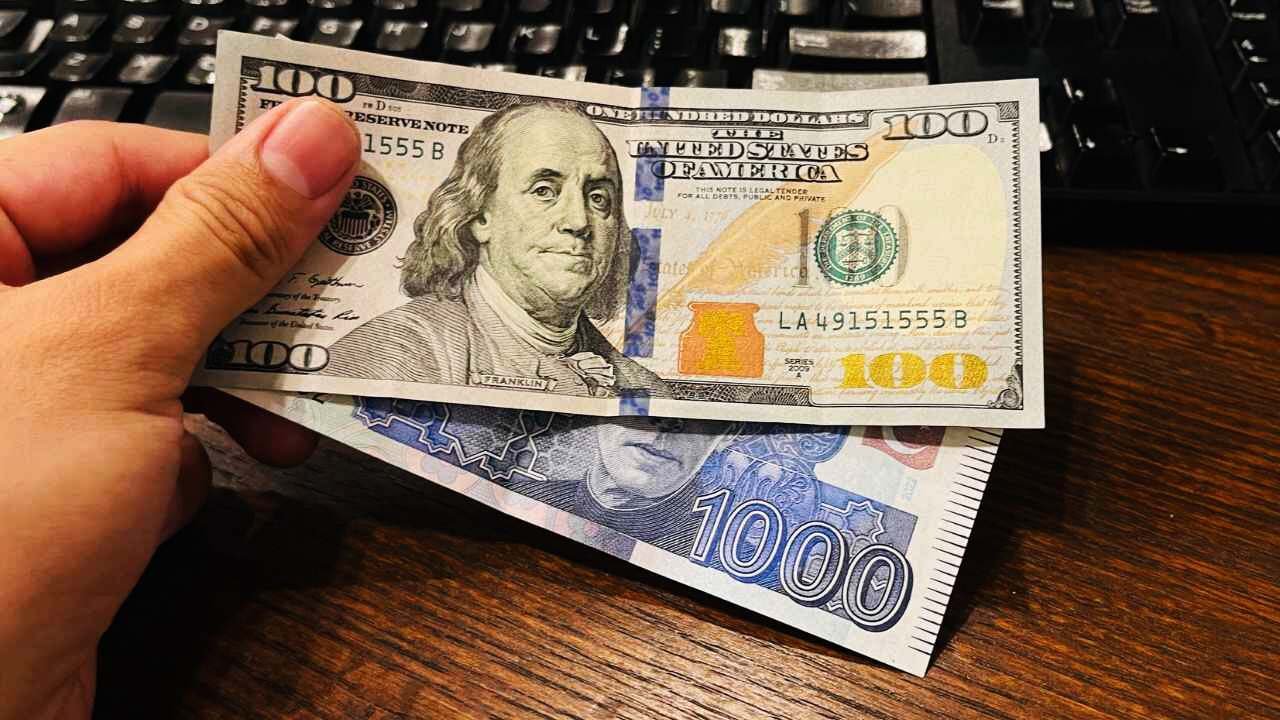
Tag: Dollar to PKR

  • Exchange rates: PKR closes at Rs277.64 against US dollar, Rs368.97 versus Pound

    Exchange rates: PKR closes at Rs277.64 against US dollar, Rs368.97 versus Pound

    The Pakistani rupee (PKR), on the third trading day of the week, gained almost five paisa versus the US dollar (USD).

    PKR ended the session at Rs277.64 against the USD.

    The latest exchange rate released by the State Bank of Pakistan (SBP) shows PKR about 0.2 per cent up as compared to the last closing of Rs277.69, which was reported on Tuesday.

    During the trading session, the home unit remained stable as it saw an intraday high of Rs277.7 with the lowest level reported at Rs277.6.

    Exchange companies in the country were buying USD for Rs278.5 and selling for Rs280.

    Here is how the PKR performed against other foreign currencies:

    Currency Previous rate Today’s rate Difference
    British Pound 370.39 368.97 1.43 rupees
    UAE Dirham 75.59 75.60 1.35 paisa
    Euro 308.64 307.32 1.32 rupees
    Swiss Franc 327.56 328.35 79.37 paisa
    Chinese Yuan 39.57 39.56 0.71 paisa
    Saudi Riyal 74.02 73.97 4.18 paisa
    Japanese Yen 1.926 1.9277 0.17 paisa
    Exchange rates

    The Saudi Riyal closed today at Rs73.97 losing more than four paisas from its previous rate of Rs74.02.

    The British Pound decreased by Rs1.43, clocking in at Rs368.97, compared to Rs370.39 from a day ago.

    The rupee surged Rs1.32 versus Euro, ending at Rs307.32 as opposed to the Tuesday’s rate of Rs308.64.

    The UAE Dirham declined by only 1.35 paisa from Rs75.59 to Rs75.6.  

    The Chinese Yuan also witnessed very minor loss of 0.71 paisa, closing at Rs39.56 against Rs39.57.

    Swiss franc climbed 79.37 paisa, closing Wednesday at Rs328.35 compared to its last close of Rs327.56.

    Against the Japanese Yen, rupee shed 0.17 paisa, closing at Rs1.927 versus Rs1.926.

    Interestingly, Pakistani currency has remained stable for months against the US dollar as it has gained only 70.38 paisa or 0.25 per cent in the ongoing fiscal year.   

    The calendar year has also seen minimal changes USD to PKR rates as the home unit has appreciated by only Rs4.22. 
  • Pakistani rupee gains only Rs1.16 against US dollar throughout March

    Pakistani rupee gains only Rs1.16 against US dollar throughout March

    In March, the Pakistani rupee (PKR) demonstrated resilience, maintaining stability against the US dollar (USD) while marking slight gains.

    Throughout the month, the PKR experienced marginal fluctuations, witnessing minor increments and decrements in value.

    Despite this, the overall trajectory showcased a modest uptick, with the local currency gaining 1.16 rupees against the USD, concluding the month at Rs277.95 per USD.

    In Friday’s trading session alone, the PKR exhibited a noteworthy appreciation, strengthening by 8.61 paisa against the greenback.

    During today’s trading activities, the currency displayed a range, reaching an intraday high bid of 278.45 and a low ask of 280.41.

    Notably, throughout the current financial year, the PKR has displayed resilience, appreciating by 8.04 rupees against the Dollar, reflecting a 2.89 per cent increase. Similarly, within the scope of the current calendar year, the PKR has witnessed a gain of 3.91 rupees, equating to a 1.41 per cent appreciation.

    In parallel, the State Bank of Pakistan (SBP) undertook strategic financial operations, including a reverse repo and Shariah Compliant Modarabah-based Open Market Operation (OMO) today.

    Through these interventions, the SBP injected a cumulative total of Rs2.71 trillion into the market, underscoring efforts to maintain liquidity and stability within the financial landscape.

  • Pakistani rupee shows marginal improvement, gains 0.03% against US dollar

    Pakistani rupee shows marginal improvement, gains 0.03% against US dollar

    The Pakistani rupee (PKR) experienced a slight improvement, appreciating by 0.03 per cent against the US dollar (USD) in the inter-bank market on Friday. 

    Closing at Rs279.41 after a gain of Re0.07 against the USD, as reported by the State Bank of Pakistan (SBP). On Thursday, the rupee had a marginal increase, settling at Rs279.48 against the USD, according to the SBP.

    The government is reportedly scheduled to hold a session with the International Monetary Fund (IMF) in the next day or two, focusing on tariff rationalisation to reduce industry tariffs from 14 cents per unit to 11.75 cents per unit through a subsidy-neutral proposal.

    Globally, the US dollar experienced a broad decline on Friday, influenced by positive risk sentiment following upbeat big tech earnings on Wall Street. Traders are anticipating US job data later in the day to assess the potential timing for the Federal Reserve to initiate rate easing.

    Comparatively, against major currencies, the PKR depreciated by 2.71 rupees against the Euro, closing at 304.1 compared to the previous value of 301.39. 

    The British Pound strengthened, becoming costlier by 2.93 rupees and closing at 356.46 compared to 353.52 from the previous day. 

    The Swiss franc saw gains of 2.6 rupees, closing at 325.94, compared to 323.34 in the previous session. Against the Japanese yen, PKR lost 0.06 paisa, closing at 1.906 versus 1.906 a day ago. 

    The Chinese Yuan gained 1.57 paisa, closing at 38.9171 against 38.9014 from the previous session.

  • Pakistani rupee appreciates by 9.32 paisa against US dollar

    Pakistani rupee appreciates by 9.32 paisa against US dollar

    In the latest interbank session on Tuesday, the Pakistani rupee (PKR) displayed resilience, appreciating by 9.32 paisa against the US dollar. The closing rate settled at PKR 279.55, marking a positive shift from the previous day’s closing at PKR 279.64 per USD.

    During the trading day, the local currency experienced an intraday high (bid) of Rs279.66 and a low (ask) of Rs279.6. In the open market, exchange companies quoted the dollar at Rs278.71 for buying and Rs280.86 for selling.

    In a significant development, the central bank opted to maintain the policy rate at 22 per cent, a decision unchanged for the fifth consecutive meeting. This decision is amidst the Pakistani rupee’s consistent upward momentum, celebrating its eleventh consecutive weekly victory against the US dollar.

    Against other major currencies, the PKR demonstrated strength. It gained 29.66 paisa against the euro, closing at 302.68 compared to the previous value of 302.98. The British Pound became more affordable by 53.78 paisa, closing at 354.86 compared to 355.4 from the previous day.

    The Swiss Franc witnessed gains of 45.64 paisa, closing at 324.6 compared to 324.15 from the previous session.

    However, against the Japanese yen, the PKR experienced a marginal loss of 0.6 paisa, closing at 1.898 versus 1.892 a day ago. The Chinese Yuan, on the other hand, gained 0.5 paisa, closing at 38.9514 against 38.9464 from the previous session.

    The Saudi Riyal closed at 74.54 with a loss of 2.58 paisa from its value of 74.57 a day ago, while the U.A.E. Dirham decreased in value by 2.54 paisa from 76.136 a day ago to 76.111.

    Reflecting on the broader financial landscape, during the current financial year, the PKR has appreciated against the dollar by 6.44 rupees, or 2.3 per cent. Meanwhile, the current calendar year has witnessed the PKR appreciate by 2.31 rupees, or 0.83 per cent.

    In the money market, the benchmark 6-month Karachi Interbank bid and offer rates experienced a modest increase of 13 basis points, reaching 20.58 per cent and 20.83 per cent, respectively.

  • Pakistani rupee sees marginal dip against US dollar 

    Pakistani rupee sees marginal dip against US dollar 

    In Monday’s trading session, the Pakistani rupee experienced a slight decline of 0.02 per cent against the US dollar in the inter-bank market, closing at Ra279.64, reflecting a decrease of Re0.05, according to the State Bank of Pakistan (SBP).

    The previous week saw the rupee’s 11th consecutive week of appreciation, gaining Re0.31, or 0.11 per cent, to settle at Rs279.59 against the US dollar. 

    This consistent uptrend was attributed to the approval of the second tranche of $705.6 million in the $3 billion Stand-by Arrangement (SBA) from the International Monetary Fund (IMF).

    The positive impact of the IMF inflow was evident in the foreign exchange reserves held by the SBP. 

    Meanwhile, Caretaker Prime Minister Anwaar-ul-Haq Kakar instructed the Ministry of Energy to develop a comprehensive plan, in consultation with the Finance Ministry, to address and reduce the circular debt in the power and gas sectors.

    In a significant move, the SBP announced plans to revamp the foreign exchange trading system by introducing a centralised foreign exchange (FX) trading platform named “FX Matching” for the interbank FX market.

    On the global front, the US dollar maintained a stable position as investors assessed US economic data ahead of the Federal Reserve policy meeting scheduled for the week. 

    Geopolitical tensions in the Middle East contributed to a cautious risk sentiment among investors.

  • Pakistani rupee remains stable at Rs279.67 against US dollar

    Pakistani rupee remains stable at Rs279.67 against US dollar

    In the inter-bank market on Thursday, the Pakistani rupee maintained its stability against the US dollar, closing at Rs279.67, according to the State Bank of Pakistan (SBP).

    This follows a positive trend observed on Wednesday when the rupee gained ground, settling at the same rate of Rs279.67 against the US dollar, as reported by the SBP.

    Caretaker Prime Minister Anwaar-ul-Haq Kakar has taken a significant step by directing the Ministry of Energy to collaborate with the Finance Ministry. 

    The goal is to formulate and present a comprehensive and sustainable plan aimed at reducing the circular debt plaguing the power and gas sectors.

    On the global front, the US dollar exhibited stability, maintaining a six-week high on Thursday. Investors are keenly awaiting key data releases, including GDP figures, to gain insights into the direction of US interest rates. 

    Concurrently, the euro softened in anticipation of the European Central Bank’s policy meeting later in the day.

    Recent data revealed an uptick in US business activity for January, coupled with a noticeable easing of inflation. 

    The measure of prices charged by companies for their products recorded a decline to the lowest level in over 3-1/2 years.

    The dollar index, gauging the US currency against six major rivals, experienced a marginal rise of 0.06 per cent, reaching 103.33. 

    This follows a 0.2 per cent drop on Tuesday as traders consolidated positions ahead of the upcoming Federal Reserve policy meeting next week.

  • Pakistani rupee closes week strong at Rs282.53 against US dollar

    Pakistani rupee closes week strong at Rs282.53 against US dollar

    In a trend marking its ninth consecutive session, the Pakistani rupee (PKR) demonstrated resilience against the US dollar (USD) by registering a 0.09 per cent appreciation in the inter-bank market on Friday.

    Closing the week at Rs282.53, the currency saw an increase of Rs0.26, according to the State Bank of Pakistan (SBP).

    This positive momentum follows a marginal gain on Thursday, settling at Rs282.79 against the US dollar.

    Simultaneously, the foreign exchange reserves held by the State Bank of Pakistan experienced a decline, falling below the $7 billion mark.

    A notable decrease of $136 million, attributed to debt repayments during the week ending December 15, 2023, brought the reserves to $6.904 billion.

    On the international front, the US dollar found itself near a more than four-month low on Friday, anticipating a key US inflation gauge reading scheduled for later in the day.

    This data is expected to provide clarity on the Federal Reserve’s room to manoeuvre in terms of interest rate cuts in the coming year.

    Early Asia trade witnessed the greenback hitting a five-month trough against the New Zealand dollar and a three-week low against the euro.

    This decline resumed after a sudden risk-aversion episode in New York hours on Wednesday triggered a sell-off in US stocks, leading to a rise in the dollar.

    Against a basket of currencies, the greenback hovered around 101.76, remaining close to the previous session’s more than four-month low of 101.72.

     The dollar index seemed poised for a weekly loss of about 0.8 per cent, extending the previous week’s 1.3 per cent decline.

    The Federal Reserve’s decision to leave the door open to potential rate cuts in the next year, as indicated in its last policy meeting for 2023, contributed to the ongoing downward pressure on the US dollar.

    This market movement has implications for various currency pairs, including the Pakistani rupee to US dollar exchange rate, which continues to be of interest to investors tracking global economic trends.

  • PKR records eighth consecutive gain, closes at Rs282.79 vs dollar

    PKR records eighth consecutive gain, closes at Rs282.79 vs dollar

    In a notable financial trend, the Pakistani rupee (PKR) sustained its positive trajectory against the US dollar (USD) for the eighth consecutive session, witnessing a 0.04 per cent appreciation in the interbank market on Thursday.

    According to the State Bank of Pakistan (SBP), the rupee concluded at Rs282.79 after experiencing a rise of Re0.11.

    The preceding day saw a slight uptick in the PKR’s value, settling at Rs282.9 against the US dollar. 

    A significant development unfolded as the government successfully secured a historic amount of Rs397 billion ($1.4 billion) in Wednesday’s local currency bond auction. 

    This achievement surpassed expectations, marking the highest borrowing in years within a single auction, showcasing sustained market interest even as December draws to a close.

    The substantial participation of investors underscores their confidence in long-term bonds, fueled by the anticipation of an early 2024 rate cut. 

    The government strategically opted for long-term borrowing in response, effectively mitigating rollover risks and minimisingreliance on short-term funding in the future.

    On the global front, the US dollar regained strength on Thursday, prompted by a sudden end to a robust rally for US stocks, compelling investors to seek safety. 

    In the final hour of equities trade on Wall Street, heavy selling induced a ripple of risk aversion through markets, lifting the previously under-pressure greenback from lows.

    As of early Asia trade on Thursday, the dollar index, which is down 1 per cent for the year so far, remained steady at 102.37. 

    In a comparison with major currencies, the Pakistani currency strengthened by 69.15 paisa against the Euro, concluding at Rs309.57 as opposed to the previous rate of Rs310.26. 

    The British Pound saw a reduction in value of 79.58 paisa, settling at Rs357.41 in comparison to the previous day’s Rs358.21.

    However, PKR experienced a slight decline of 0.38 paisa against the Japanese yen, closing at Rs1.974 as compared to the previous day’s rate of Rs1.97. 

    The Saudi Riyal concluded at Rs75.38, registering a decrease of 1.15 paisa from its value of Rs75.39 a day ago. 

    Similarly, the UAE Dirham witnessed a decrease in value of 2.81 paisa, shifting from Rs77.027 the previous day to Rs76.999.

    Meanwhile, oil prices, a crucial indicator of currency parity, experienced a decline on Thursday due to concerns over low demand following an unexpected US crude inventory build, outweighing apprehensions about global trade disruptions linked to tensions in the Middle East. 

    Brent crude futures dropped by 3 cents to $79.67 a barrel, while US West Texas Intermediate crude stood at $74.16 a barrel, reflecting a 6-cent decrease.

  • Interbank closing: Pakistani rupee gains 10 paisa against US dollar

    Interbank closing: Pakistani rupee gains 10 paisa against US dollar

    The Pakistani rupee (PKR) demonstrated resilience for the third consecutive session against the US dollar (USD), marking a 0.04 per cent appreciation in the interbank market on Thursday, according to the State Bank of Pakistan (SBP).

    The PKR settled at Rs283.51 after an increase of Rs0.10. This positive trend follows Wednesday’s marginal gain, where the rupee settled at Rs283.61 against the USD.

    In contrast to major currencies, the local currency experienced a loss of Rs2.64 against the Euro, closing at Rs308.49 compared to the previous value of Rs305.85.

    The British Pound strengthened by Rs2.91, concluding at Rs357.96 in comparison to Rs355.05 from the preceding day.

    The Swiss franc also witnessed gain of Rs1.46, closing at 325.35 compared to Rs323.89 in the previous session.

    Against the Japanese yen, PKR lost 5.23 paisa, settling at Rs1.9972 versus Rs1.9449 a day ago.

    In the ongoing financial year, the PKR has appreciated against the dollar by Rs2.48, or 0.87 per cent.

    However, in the current calendar year, it has depreciated by Rs57.08, or 20.13 per cent.

    In a related development, the Asian Development Bank (ADB), in its latest report, Asian Development Outlook (ADO), highlighted that Pakistan’s overall recovery is still constrained by moderate confidence and high inflation eroding purchasing power.

    The ADB noted that Pakistan’s inflation rate averaged 28.5 per cent over July–October but is expected to ease amid fiscal consolidation, monetary tightening, and improved availability of food and key imported inputs.

  • Pakistani rupee declines to new historic low of Rs299 per US dollar

    Pakistani rupee declines to new historic low of Rs299 per US dollar

    The Pakistani rupee continued its downward trend on Tuesday, closing at an all-time low of Rs299.0070 against the US dollar. This represents a decline of 0.63 per cent or Rs1.873.

    On Monday, the rupee continued to struggle against the US dollar, closing at Rs297.13. This drop in value is due to several reasons. One is the country’s current account deficit, which has widened because it’s now easier to open letters of credit. This change has affected the availability of foreign exchange, putting pressure on the rupee’s value in the local market.

    Another factor is the lack of foreign exchange coming into the country. This shortage has also contributed to the rupee’s decline.

    Experts say that the increase in import payments is tied to the International Monetary Fund’s (IMF) demand to remove import restrictions. This has led to a higher demand for the US dollar.

    Political uncertainty is also playing a role in the rupee’s decline. There are concerns that the general elections might be delayed. This delay could also mean a hold-up in fulfilling promises made to the IMF and other international lenders. With a caretaker government in place, questions arise about who will invest in and lend money to the country.

    To add to these challenges, there’s a need to bridge the gap between the rates in the inter-bank and open markets, which has been getting wider lately.