Tag: domestic violence

  • Two women allegedly gang-raped, paraded naked in India

    Two women allegedly gang-raped, paraded naked in India

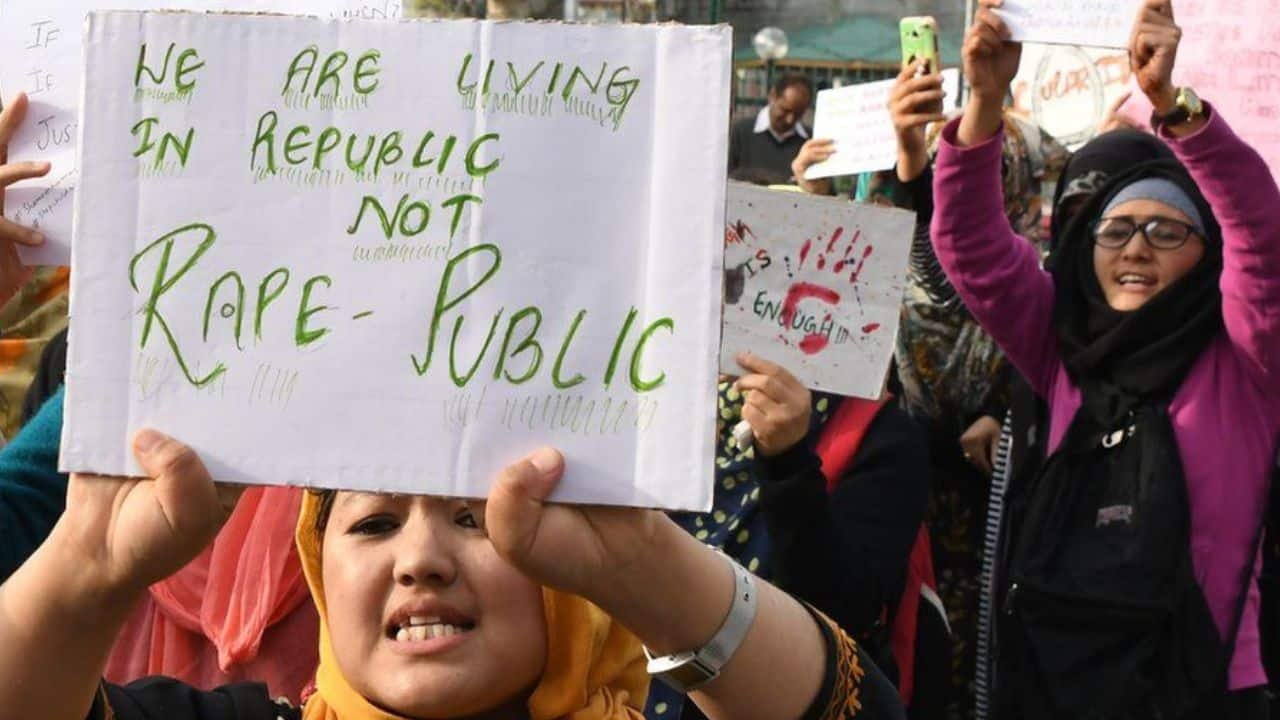
    In a shocking sequence of events, a viral video from May 4 shows two women from Kangpoki district, Manipur, being paraded on the streets naked after being gang-raped in a field. According to the statement posted by the Indigenous Tribal Leaders’ Forum (ITLF):

    “…The despicable scene, which happened on May 4 in Kangpokpi district, shows the men constantly molesting the helpless women, who cry and plead with their captors.”

    “The horrifying ordeal suffered by these innocent women is amplified by the perpetrators’ decision to share the video, which shows the identity of the victims, on social media,” ITLF further wrote, appealing to the National Commission For Women and the National Comission for Scheduled Tribes to intervene and arrest the aggressors.

    According to The Wire, the incident happened after tribal clashes between the Meitei and Kuki community in Manipur on May 3. The violence began when tribal groups held a solidarity march against the demand to grant Scheduled Tribe status to the Meitei community. A mob burned down houses and accosted five people who were trying to flee the violence. Two men in the group were murdered, and the other women were forced to strip.

    The Union Women and Child Development Minister Smriti Irani had condemned the incident on her Twitter account yesterday and revealed that she had spoken with Chief Minister N Biren Singh to order the police and investigate this crime to take speedy action against the perpetuators.

    According to Outlook, the Indian government has issued an order to social media websites like Twitter to take down the video

  • TW: Brother confesses to murder of three young sisters by decapitation, says did it because of mental stress

    TW: Brother confesses to murder of three young sisters by decapitation, says did it because of mental stress

    On Monday, three young girls were found dead in their house in Muzaffargarh district, Punjab. They were first reported missing when during the evening 11-year-old Areesha went out to search for her sisters, Fatima, 7, and Zahrah, 8, after they didn’t come back home. Areesha then didn’t return herself.
    The family reported the missing girls to the police, who found the girls’ decapitated bodies in a deserted government quarter located in the same colony.

    Punjab Inspector General of Police, Dr Usman Anwar, announced that the police was taking immediate action to arrest the ones responsible.

    According to the District Police Officer Hasnain Haider, the police have arrested the three elder brothers of the slain sisters for being the perpetuators of the crime. One of the brothers, Basit, has confessed to the killing, saying that he had taken the girls to an empty house where he slaughtered them.

    Basit cited his mental health as the motivation behind the grisly murders, as Haider revealed to the media that the killer was under stress to repay loans that he had taken from some people.

    According to news sources, the police revealed they had recovered the murder weapon, a long knife, from the killer.

    The DPO further told a news channel that police were interrogating the entire family.

  • TW: mentally challenged girl gang-raped by six men in Kasur

    TW: mentally challenged girl gang-raped by six men in Kasur

    On Wednesday, the police in Kasur arrested six men for the brutal gang rape of a mentally challenged teenaged girl found unconscious by her mother in the basement of a private restaurant.

    In the case filed at the Kot Radha Kishan police station, the mother revealed that her daughter had gone out of the house, however, she was later found unconscious, and was rushed to Tehsil Headquarters hospital. After the girl was denied medical treatment, she was taken to Jinnah Hospital, where again she was denied healthcare. Then, the survivor was taken to Services Hospital, where after a medical examination, it was determined that she had been gang raped.

    After the mother questioned locals, it was revealed that two men Sahil and Khalil along with three to four other unidentified men, had taken the girl with them to the basement of a private restaurant where they had gang-raped her.

    After the case was filed, the DPO took speedy action to file a case against main accused Sahil, and arrested him.

    On Wednesday, the police arrested six men for the brutal gang rape of a mentally challenged teenage girl in the basement of a private restaurant and was found unconscious by her mother, according to Express Tribune.

    In the case filed at the Kot Radha Kishan polcie station, the mother revealed that her daughter had gone out and was later found unconscious, and was immediately taken to THQ hospital, where after she was denied medical treatment, was taken to Jinnah Hospital, where again she was denied medical treatment. Then, the survivor was taken to Services Hospital, where after a medical examination it was that she had been gang raped.

    After the mother had questioned the locals, it was revealed that the men Sahil, Khalil and three to four other unidentified men had taken the girl with them to the basement of a private hospital where they had gang-raped her.

    After the case was filed, the DPO took speedy action the main accused Sahil.

  • Pakistani family arrested for torturing daughter-in-law, forcing her to drink engine oil

    Pakistani family arrested for torturing daughter-in-law, forcing her to drink engine oil

    A Pakistani man and four of his family members in Britain have been sentenced to years in prison after forcing his wife to become a house slave, subjecting her to cruelty and torture from October 2017 to April 2019.

    The husband, Mohammed-Shuaib Arshid, brought his wife from Pakistan to the UK, after an arranged marriage, to their house in Hillingdon, West London, where he lived with his mother Nabila Shaheen, father Arshid Sadiq, brother Aqeel Arshid, and sister Zaib Arshid.

    According to court details, the woman was forbidden from leaving the house or attending college, and could not contact her family members back in Pakistan. Her personal identity documents were taken from her, leading her to begging her husband for purchasing basic toileteries as she had no cash of her own.

    The woman was subjected to torturous behavior by being forced to cook and clean around the house all day, and on one occasion was even forced to drink engine oil by the family. She was threatened with death by family members.

    The court said that during these two years, the woman was subjected to both mental and physical abuse at the hands of the five family members, leaving her with long term psychological trauma.

    According to Paul Jenkins, a senior district crown prosecutor for the CPS: “The victim believed that they were moving into a safe family home with a loving husband, but the subsequent actions of [the family] proved that this was not the case.

    “The victim was subject to regular abuse whilst under their care, resulting in serious physical and psychological harm.”

    A CPS spokesman spoke of the survivor’s plight: “Being the victim of violence or sexual assault is undoubtedly a harrowing experience – but when this abuse is ‘honour-based’, the challenges can often feel impossible to overcome.

    “If someone is seen to have dishonoured or brought shame on a family or community, they can be ‘punished’ through threatening behaviour, rape, kidnap, false imprisonment, female genital mutilation, forced marriage and even murder – also known as honour killings.”

    The husband Mohammed-Shuaib Arshid was jailed for 11 years; father Arshid Sadiq to seven years; mother Nabila Shaheen to four years; the siblings Aqeel and Zaib to 21 months each.

  • Want to know how to talk about domestic violence? Tere Bin has nothing on 1990’s Aahat

    Want to know how to talk about domestic violence? Tere Bin has nothing on 1990’s Aahat

    In a triggering scene, a house helper is seen violently beaten, dragged across the floor by her hair as her husband screams at her to give him more money. The woman keeps refusing, since the man is a drunkard who steals all their money to gamble it away. When the house help begins crying for help, another woman steps outside from her apartment and stands between them to protect her. The drunkard orders her to leave, as its a personal matter between a husband and his wife. But the woman refuses to do so, threatening to call the police. She takes the beaten woman inside her house.

    Did this scene come from a recent hit drama like ‘Tere Bin’, or from a forgotten, classical drama from the 90’s which talked about post- partum depression, pressure to give birth to sons and struggles of a working class family to make a living for their three daughters? Haseena Moin’s ‘Aahat’ was decades ahead of its time when it came to discussing sensitive topics, giving women the catharsis they need that decades later, ‘Tere Bin’ glorified with toxic relationships.

    In several ways, Aahat was ahead of its time when it pulled back the curtain to reveal the struggles Pakistani women underwent, talking about the things that today’s television dramas would have been called ‘vulgar’. It explores the struggles of Rabiya, who gave birth to a fourth daughter, and is being pressurised by her mother-in-law to give her a son, or her husband must marry another woman. Rabiya’s pain is nothing new for Pakistani women, who bear the brunt of family problems, and the drama never shies away from being blunt about the pain: like a scene where Rabiya is made to isolate herself from her children in a room until she is able to give birth to a healthy son, under the orders of a peerni. Or the taunts for only giving birth to daughters which puts pressure on her health as she toils around the house, regardless of the warnings of her doctor and friend.

    But most importantly, what makes ‘Aahat’ the exemplary drama that proved Haseena Moin knew what Pakistani women yearned for, better than the writers today, was how she crafted female friendships that rose from the pains women shared with each other. Rabiya’s friendship with the brilliant and witty Naheed (played by Talat Naseer) is what guides her to take a stand for herself and eventually for her children. Naheed’s boldness and selfless love for Rabiya rescues her in moments when her post-partum depression make the worst of her, like in the first episode, she immediately begins working around the house after undergoing a critical surgery, because her mother-in-law refuses to take care of her three daughters, calling them a burden. Or the humiliation Rabiya endures because of the limited money her husband makes, that eventually push her into making shocking decisions. It was Naheed who offered her safety, and eventually proved that the drama was a love letter to the magic of female friendships.

    In an episode when Rabiya has to make a critical decision, Naheed reminds her that she will never be granted a place on the table, but she needs to keep raising her voice to make it happen.

    “Hum aurtoon kay pass koi jagah nahi hoti’ she urges. “Mein isliee har dafa chala rahi hoti hoon kyun kay mujhay pata hai kay istarhaan meri awaaz koi sunay ga. Islie apni awaaz uthaya karo ta ke log tumhein sunien.”

    Would this message remain evergreen in the years ahead ? Tere Bin, currently rated as a critical hit drama on Pakistani screens, proved that the enduring message of friendships and female empowerment has been lost forever. For 58 episodes, the drama stomped out any effort Moin made to give Pakistani women the space they needed to find their voice; instead glorifying the opposite with a clueless storyline featuring two toxic characters, and an even toxic slutty savitri who plotted to break them apart. From the first five episodes, Meerub was slapped for refusing to marry Murtasim, lead a toxic storyline of stalking, abuse, harassment, and even marital rape to a point. What was once a space crafted by the gentle and clever writing of Haseena, is now bombarded with 45 minutes of Haya plotting to make sure Murtasim catches Meerab in a scene that makes him slap her and then divorce her so Haya could become his wife.

    The wound left behind by the passing of Haseena bleeds anew when we come to realise that what television dramas show on our screens is what even female drama writers today staunchly believe is what the audience needs. When the writer of Tere Bin Nooran Mahkdoom, had been questioned about the controversial marital rape episode, she defended it as ‘a demand of a serial’, a complete 180 from the time when a decades old drama written in the times of Zia had not only condemned domestic abuse and rape, but even made sure that the message that abusers should be punished is given to the audience.

    The problem never was just about Tere Bin, but the complete decline in the quality of our dramas, pushed by an industry that now considers that any show featuring one of out the following: domestic violence, wailing women, a satti savitri desperately wanting a man’s attention. Pick one of them and you have a hit on your hands, even get a Pride of Pakistan award ready. Take a stand and make a drama like ‘Udaari’ that talks about child abuse and sexual assault, PEMRA is at your doorstep ready to call you a traitor for going against the Islamic Republic of Pakistan.

    In a time even Pakistani women can’t find a place to be still, with the economy ravaging, human rights violations growing even worse by the day, public spots becoming hunting grounds for rapists and harassers, the grief we carry in our bodies is understood by no one better than Haseena Moin, and the prevailing message that becomes relevant as currently a hit drama featuring two cousins falling in love features a scene accusing women for falsifying rape accusations for the sake of attention. It’s no surprise that more women are turning to classical dramas because the gentleness and sharp writing of Moin will keep outshining whatever dumpster bin dramas we’re fed in the name of ‘hit dramas’.
  • Somy Ali slams ‘King of Bollywood’ for calling Salman Khan, her abuser, a ‘good human’

    Somy Ali slams ‘King of Bollywood’ for calling Salman Khan, her abuser, a ‘good human’

    Pakistani-American actress and former model Somy Ali, once Salman Khan’s girlfriend, has been vocal about the abuse she was subjected to in a now deleted Instagram post, calling it the “worst years” of her life.

    “In addition to tons of affairs and flings he would constantly belittle me by calling me ugly, stupid and dumb. Not a day went by that he wouldn’t make me feel worthless and small. He would not acknowledge me as his girlfriend in public for years and when he finally did he would insult me in front of his friends and berate me nonstop,” she wrote.

    In a Instagram post put up three days ago, the actress revealed that an actor, regarded as the ‘King Of Bollywood’, refused to hold her abuser accountable because of the power he held to make or break their career. Instead he called Salman a “pyaara insaan”. She also made a pointed remark that this man has a lot of respect for women, but when it comes to holding her abuser accountable, “he’s in a bind.”

    “Might I add a very good human being, the king of Bollywood stated that this abuser is a very “pyara insaan” which translates as “a very good human being.” Remember I am quoting a huge actor whom I have the utmost respect for, but I also know that he’s in a bind. Nonetheless it’s sad and ironic that the amount of respect this superstar has for women yet would even look in this abuser’s way baffles me. I wouldn’t let any roadblocks hinder my ability to take a stand more so when he himself has a daughter. Hey, I took many stands publicly for his son when he was accused of drug usage. But I guess to each their own.”

    Social media users believe the post refers to Shah Rukh Khan, who is father to a daughter and whose son was publicly accused of drug usage in what was seen as a witch hunt by the BJP government to target the Muslim superstar.

  • South Asian men becoming more violent with climate change, scientists claim

    South Asian men becoming more violent with climate change, scientists claim

    According to a study published by JAMA Psychiatry on Wednesday, the rising temperatures in South Asia caused by climate change has led to a rise in domestic violence inflicted upon women and girls.

    Researchers completed the study by gathering data of physical, emotional and sexual abuse from 194,871 girls and women between the ages of 15 to 49 from countries like India, Pakistan and Nepal between the years 2010 and 2018.

    Their results have shown that with every one degree rise in temperature, there was an eight per cent hike in physical violence, a 7.3 per cent rise in sexual violence, and a 4.9% increase in domestic violence.

    The study has warned that domestic violence is likely to rise by 21 per cent by the end of the century because of the “unlimited emissions scenario”, with India likely to see a 23.5 per cent increase, 14.8 per cent in Nepal and 5.9 per cent in Pakistan.

    A report by Amnesty International has called for global leaders to take action against rising heatwaves in Pakistan, stating that the country was on the “frontlines of the climate crisis” despite producing less than one per cent of planet-warming gases.

    “Despite their small contribution to climate change, its people face disproportionately severe consequences which are often life threatening. Tackling a climate crisis of this scale requires global attention and action. Wealthier countries must make no mistake about the important role they play,” said Dinushika Dissanayake, Amnesty’s deputy regional director in South Asia.

    The report revealed that after speaking to 45 people in the summers of 2021 and 2022 from Lahore and Jacobabad, where temperatures had reached 52C, the human rights organisation revealed that people complained about heatstroke, shortness of breathe and dizziness, with some needing hospital care.

    People who were interviewed for the study belonged to professions at a higher risk of exposure to heat, such as working in agriculture, brick kilns, factories or delivery men.

    The organisation also shared that 40 million Pakistanis suffer from constant power outrages, while others receive erratic power supplies due to lengthy outrages.

    “People living in poverty do not have access to, or are unable to afford, electricity for fans or air conditioning units and neither can they afford to buy solar panels,” the report said.

  • Survey resurfaces: 40 per cent Pakistani men believe beating wife justified five years ago

    Survey resurfaces: 40 per cent Pakistani men believe beating wife justified five years ago

    According to a resurfaced Demographic and Health survey taken in 2018 by the National Institute of Population Studies (NIPS), around 40 per cent men agreed that a husband is justified in beating his wife.

    However, the reasons for beating were as follows: If she burns his food, goes out without his permission, neglects his children or refuses to have sex with him. Surprisingly, 42 per cent women had also agreed with the statement. Around 34 per cent women, the report reveals, had experienced spousal violence, whether it was physical, sexual or emotional.

    The report states that 28 per cent married women had experienced physical violence since the age of 15, and 15 per cent women had experienced violence in the past year.

    Up to seven per cent married women admitted that they experienced violence during their pregnancy.

    On experiencing sexual violence, six per cent married women had experienced sexual violence and the most common perpetuator was revealed to be the husband, while 14 per cent women who were divorced, seperated or widowed had experienced sexual violence.

    Moving on to financial stability and empowerment, the survey reported that only 19 per cent married women had been working in the past 12 months, compared to 98 per cent married men.

    Half of the married women who are employed and earned an income, made independent decisions on how to spend their earnings, while 41 per cent made joint decisions with their husband. 76 per cent of working women reported making less money than their husband.

    The survey also found that only three per cent of ever-married women owned a house, alone or jointly, compared to 72 per cent ever-married men.

    The survey sampled from all four provinces including Punjab, Sindh, Khyber Pakhtunkhwa, Balochistan, including Azad Jammu Kashmir and FATA. A total of 12,364 women between the ages of 15-49 and 3,145 men had participated in the survey.

  • ‘Stop’: Twitter in no mood to accept Kanwal Aftab’s justifications of domestic violence statement

    ‘Stop’: Twitter in no mood to accept Kanwal Aftab’s justifications of domestic violence statement

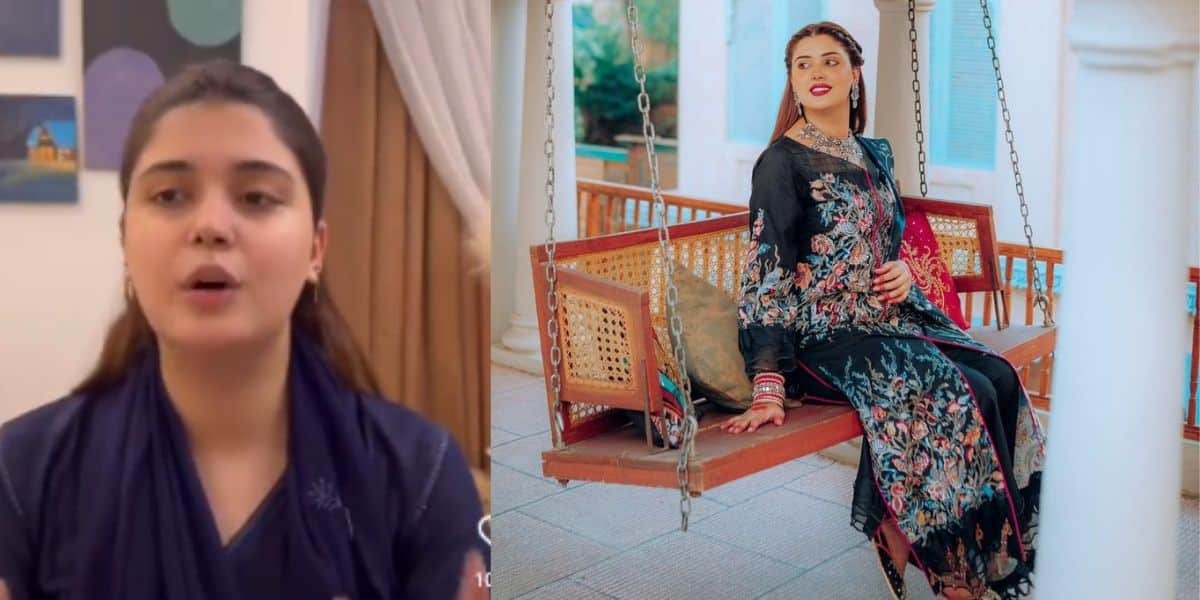
    Tiktoker and Instagram influencer Kanwal Aftab was slammed by social media yesterday when during a Q & A on Instagram, the social media star was asked about advice regarding women coping with domestic violence, to which she had responded by saying more women should try to save their marriages and console their husbands rather than seek divorce.

    Founder of Soul Sisters, Kanwal Ahmed, criticised Aftab for encouraging women to fix their abusive husbands by laying the blame of a broken marriage on them.

    After backlash to her statement, Aftab had now uploaded a video where she explained that she was not trying to tell women to endure domestic violence, but was encouraging them to try and work through anger rather than begin demanding divorces.

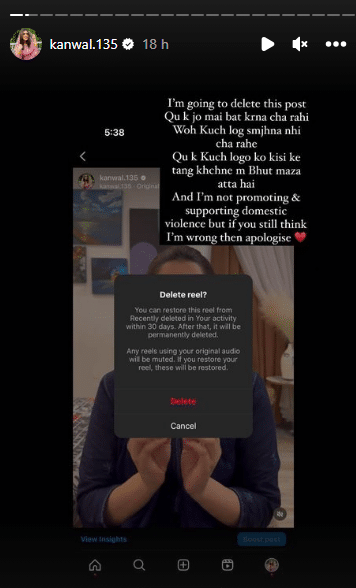
    After this video, Aftab wrote in an Instagram story that she was deleting the reel, stating she was not promoting or supporting domestic violence.

    Twitter users shared the video on the platform, and criticised the Tiktok star for not understanding the difference between an argument and domestic violence. Couples can have small arguments, and it is perfectly okay to encourage people to work through misunderstandings to overcome them. But domestic violence is a completely different issue, and no woman needs to stick around to endure it to keep her marriage inta

    ‘There is a huge, huge difference between domestic violence and badtameezi,” one user pointed out.

  • Tiktoker Kanwal Aftab slammed for telling 2.8 million followers that women should fix abusive husbands

    Tiktoker Kanwal Aftab slammed for telling 2.8 million followers that women should fix abusive husbands

    Tiktoker and Instagram influencer Kanwal Aftab has been slammed by the internet for telling a fan that women should “support” abusive husbands.

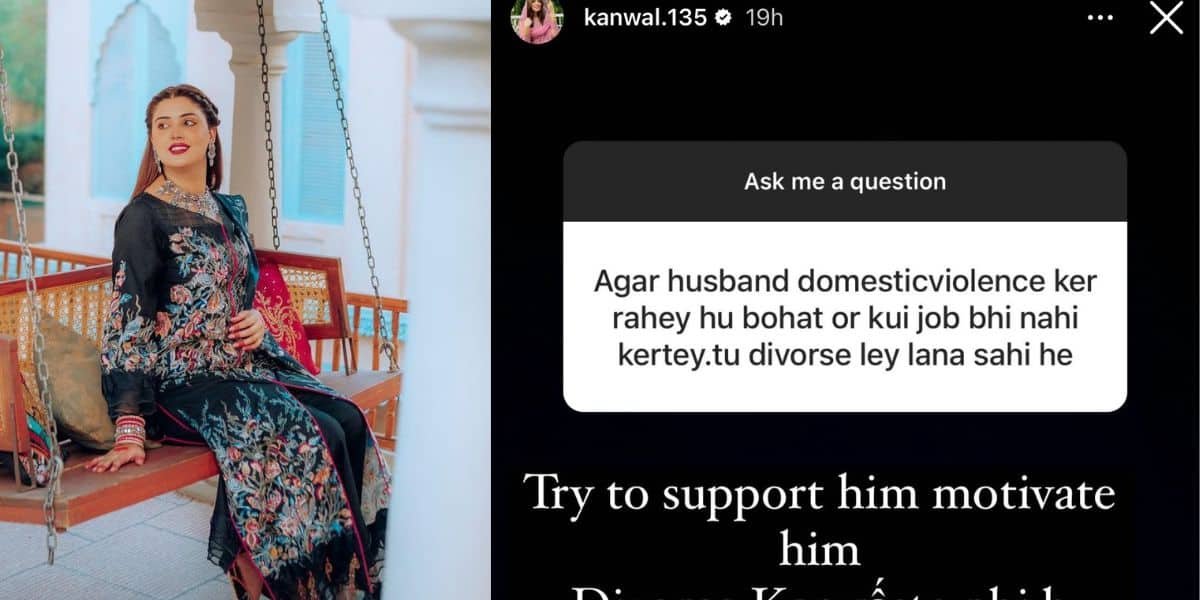
    During a question and answer session on Instagram, Aftab, who has over 2.8 million followers, was asked by a fan how a woman could cope with an abusive husband when she can’t find a good job.

    The influencer responded:

    “Try to support him. Motivate him. Divorce koi rasta nahi hai.”

    This harmful advice was slammed by social media users, especially the Founder of Soul Sisters Pakistan, Kanwal Ahmed, who shared a screenshot of Aftab’s answer and schooled the Tiktoker:

    “Tiktoker Kanwal Aftab with 18.4 MILLION followers wants women to “support” and “motivate” husbands who abuse them. Struggling to understand if that means cheering them on as they punch her? Or leaving a reminder to do it again when they’re done?”

    She also shared another response by Aftab where the user had been asked if she truly meant that women should support husbands while suffering under domestic violence, the Instagram influencer had responded: “Bhain support karien us kay halat ko behtar karne m. Usko sahi karne mein.”

    “Women don’t get married to “fix” abusive men. Or to support and validate their violent behaviour,” Ahmed tweeted.

    Social media users condemned the display of misogyny and schooled the Tiktoker for making irresponsible statements on a public platform.

    https://twitter.com/amnachaudhry03/status/1671206978356404224?s=20

    Why does the burden of fixing the marriage always fall on the woman? Many users had to ask Aftab this

    “Why the “sahi karna” burden always fall on women in marriage. Men are grown up individuals! It’s high we need to understand, if a human doesn’t want to be corrected no one can! And there should be a boundary in marriage! And domestic violence is way far from that boundary line!”

    It is never the woman’s responsibility to endure something as heinous as domestic violence, and we are also shocked at how our celebrities have no issue in turning a blind eye towards abusive marriages, and consistently tell women to endure rather than leave.