Tag: Economic stability

  • ‘No need to panic’: PM Shehbaz hopes Pakistan and IMF will sign deal this month

    ‘No need to panic’: PM Shehbaz hopes Pakistan and IMF will sign deal this month

    Prime Minister Shehbaz Sharif reiterated on Sunday that Pakistan has successfully fulfilled all the prerequisites set by the International Monetary Fund (IMF) to revive the halted bailout program. He expressed confidence that no obstacles remain in finalising a staff-level agreement between the nation and the IMF, emphasising that Pakistan is committed to resolving its financial challenges.

    During the inauguration of the Sabzazar Sports Complex in Lahore, Prime Minister Shehbaz hinted at a contingency plan, stating, “If there are further delays in reaching an agreement with the IMF, I will address the situation.” He urged the public not to panic, assuring them that Pakistan will be safeguarded by the divine will of Allah. He expressed hope that the government and the IMF will achieve a staff-level agreement within the current month.

    Highlighting the significance of political stability, the Prime Minister emphasised its crucial role in ensuring economic stability. He pledged to bring about economic prosperity in the country under the leadership of PML-N supremo Nawaz Sharif.

    In strong criticism of the former ruling party, Prime Minister Shehbaz held deposed Prime Minister Imran Khan responsible for the events of May 9 and vowed to bring all those involved in the violent protests and attacks on civil and military installations to justice.

  • PM Shehbaz confident of positive outcome in IMF loan talks

    PM Shehbaz confident of positive outcome in IMF loan talks

    Pakistan and the International Monetary Fund (IMF) are on the verge of finalising a long-awaited loan deal, according to Prime Minister Shehbaz Sharif. In an interview with Turkish news agency, the premier expressed hope that the ninth review by the IMF would align with all the terms and conditions, leading to positive news this month.

    Prime Minister Shehbaz Sharif said that Pakistan has diligently fulfilled each and every requirement set by the IMF as prior actions. The country’s commitment to meeting these obligations demonstrates its determination to address economic challenges head-on.

    However, in the event of the IMF talks falling through, the prime minister assured the nation that Pakistan possesses the resilience and fortitude to overcome any obstacles. He drew attention to the fact that the people of Pakistan have faced and triumphed over numerous challenges in the past. If necessary, they are prepared to tighten their belts and rise once again. Shehbaz Sharif credited the government’s ability to navigate these difficulties to the unwavering support of the Pakistani people and the assistance of brotherly and friendly nations.

    Highlighting the close bilateral relations between Pakistan and Turkiye, the prime minister described them as “one soul, two hearts that beat together.” He took the opportunity to congratulate the people of Turkiye on President Erdogan’s re-election, considering it a “wonderful development.” The deep bond between the two nations sets the stage for enhanced cooperation in the near future.

    PM Shehbaz Sharif outlined plans for Pakistan and Turkiye to strengthen their collaboration, particularly in the areas of biogas, solar energy, and hydropower. By focusing on these sectors, both countries aim to bolster trade and achieve mutual growth. The emphasis on renewable energy sources aligns with the global trend towards sustainable development and underscores the commitment of Pakistan and Turkiye to fostering a greener future.

    As Pakistan and the IMF move closer to finalising the loan deal, there is renewed hope for the country’s economic stability and growth. The government’s determination to meet the IMF’s requirements and the unwavering support of the Pakistani people serve as strong foundations for overcoming challenges and securing a brighter future. Furthermore, the prospects for increased cooperation with Turkiye in key sectors pave the way for mutually beneficial partnerships and contribute to regional progress.

    With anticipation building, all eyes are now on the impending announcement that will mark a significant milestone in Pakistan’s economic journey. The successful conclusion of the loan deal will not only provide much-needed financial assistance but also serve as a testament to Pakistan’s commitment to reform and progress.

  • Pakistan is making desperate efforts to revive IMF programme before deadline

    Pakistan is making desperate efforts to revive IMF programme before deadline

    Pakistan is facing a critical situation as it seeks to revive its stalled Extended Fund Facility (EFF) programme with the International Monetary Fund (IMF). The $6.5 billion programme is set to expire on June 30, and negotiations for the ninth review, due last November, have not been successful.

    Efforts to reach a Staff Level Agreement (SLA) with the IMF have been ongoing, but disagreements persist regarding the conditions set by the Fund. The SLA must be signed before Pakistan unveils its 2023-24 budget on June 9, or the current programme will fail.

    According to The News, two options are being considered. The first involves signing the SLA immediately, requesting approval from the IMF Executive Board for the next $1 billion tranche, and extending the EFF programme for a few months to complete the 10th and 11th reviews. The second option is to combine the 9th and 10th reviews, share budgetary figures with the IMF, and sign the SLA after the budget announcement. If approved by parliament, the IMF’s Executive Board could then grant an extension for the completion of the 11th Review by July or August 2023.

    However, finding a solution is proving challenging. Maintaining the status quo will not lead to any breakthroughs, and consensus must be reached between Pakistan and the IMF. Political uncertainty, inadequate economic management, and the inability to secure sufficient external financing have hindered progress.

    Without an IMF programme, Pakistan’s options are limited. The risk of default would increase, and reserves would remain weak. Although there are options available, such as striking the SLA in the next few days or combining reviews, they are becoming increasingly difficult. Life without the IMF would require seeking financing from other sources at higher costs.

    It is crucial for Pakistan to resolve its differences with the IMF and secure the continuation of the EFF programme. Failure to do so would have severe consequences for economic stability and future financing prospects.

  • Fitch warns of further depreciation of Pakistani rupee due to $6.7 billion debt payment

    Fitch warns of further depreciation of Pakistani rupee due to $6.7 billion debt payment

    Fitch, the world’s leading credit rating agency based in Hong Kong, said on Friday that Pakistan must pay a total of $6.7 billion in debt payments for the ongoing fiscal year of 2022-23.

    Of this amount, $3.7 billion must be paid by Islamabad this month, with another $3 billion due in June. Krisjanis Krustins, Fitch’s director, warned that these payments could cause the Pakistani rupee to depreciate further, exerting greater pressure on the country’s currency.

    Krustins also revealed that Pakistan expects a rollover of $2.4 billion from China to address its economic needs. However, he emphasised the need for Pakistan to revive its International Monetary Fund (IMF) loan programme.

    Pakistan has been working to restart the stalled loan programme with the IMF. Earlier this year, Saudi Arabia and the United Arab Emirates pledged external funds, but the IMF has demanded that Pakistan “do more” to unlock the loan programme.

    Finance Secretary Hamid Yakoob recently met with the IMF in the US, but the meeting remained unfruitful. The international lender has proposed that Pakistan arrange $1 billion from commercial banks to unlock the loan programme.

  • US expresses confidence in Pakistan’s economic policies and offers support for bilateral relations

    US expresses confidence in Pakistan’s economic policies and offers support for bilateral relations

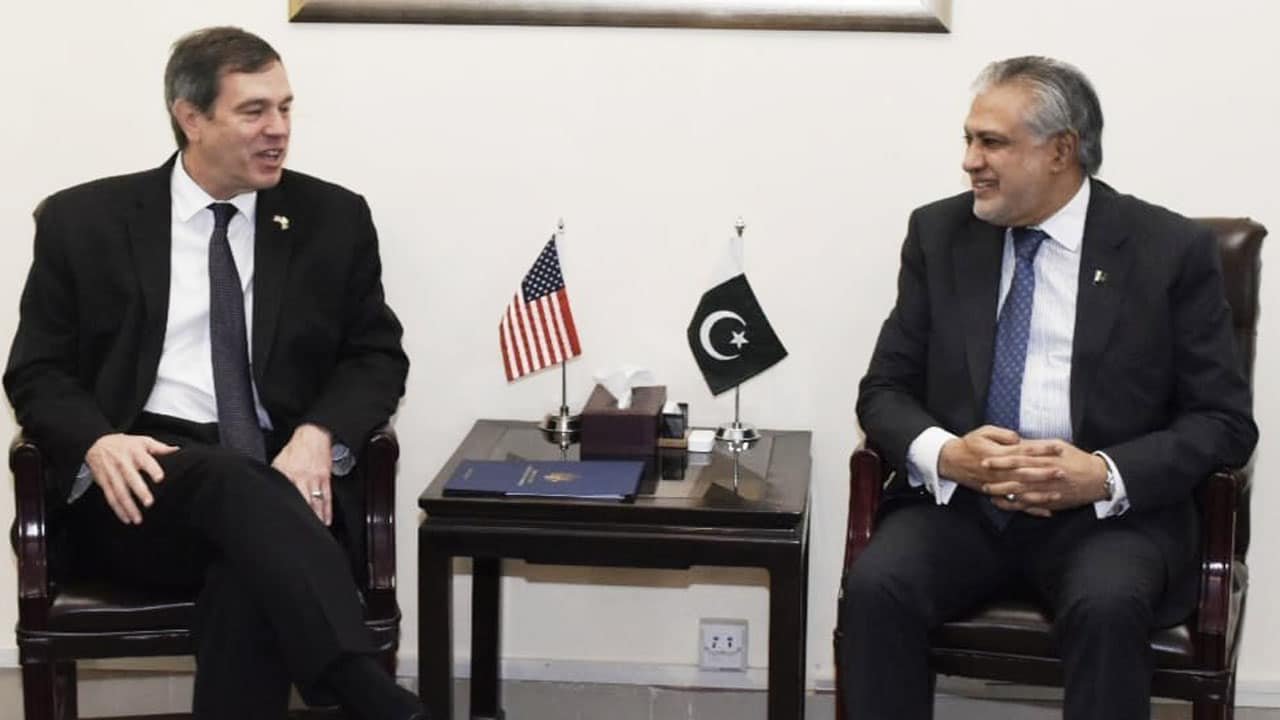
    On Wednesday, Finance Minister Senator Ishaq Dar reaffirmed the federal government’s commitment to the International Monetary Fund (IMF) programme during a meeting with US Embassy Charge’d Affaires Andrew Schofer at the Finance Division.

    Dar informed Schofer about the ongoing programme and assured him that the government was dedicated to completing it. Schofer expressed his confidence in Pakistan’s economic policies and programs and offered his support to strengthen economic and trade relations between the two nations.

    The finance minister also discussed the current economic challenges and policy decisions taken by the government to stabilize and promote sustainable and inclusive growth. Both parties exchanged their views on the notable bilateral relations between the US and Pakistan.

    Dar thanked the US Charge’d Affaires and reiterated the government’s desire to expand bilateral trade and investment ties. The meeting followed a report published by The News that stated the IMF and Pakistani authorities were holding each other responsible for the delay in reviving the stalled programme.

    It is still uncertain how Pakistan will proceed to accomplish the current IMF programme, which expires on June 30, 2023.

  • IMF seeks further assurances from Pakistan despite Saudi Arabia and UAE confirmation

    IMF seeks further assurances from Pakistan despite Saudi Arabia and UAE confirmation

    The International Monetary Fund (IMF) is seeking further assurances from Pakistan, despite confirmation of financial assistance from Saudi Arabia and the United Arab Emirates (UAE), to ensure that Pakistan has met the condition of arranging $6 billion financing in order to reach a staff-level agreement.

    Nathan Porter, the IMF’s Mission Chief to Pakistan, welcomed the announcement of financial assistance from the two “key” friendly countries, stating that the IMF supports the efforts of the Pakistani authorities. A Pakistani delegation is currently in Washington attending the Spring meetings of the IMF to discuss the revival of the loan programme. Pakistan’s Finance Minister Ishaq Dar was unable to attend due to domestic issues.

    Pakistan had been asked to arrange $6 billion in external financing, which it needed from now until June to avoid default. Saudi Arabia has pledged $2 billion, while the UAE has committed $1 billion, thus reducing the now-required amount to $3 billion. Pakistan’s foreign exchange reserves have fallen to cover barely a month of imports after the IMF funding stalled in November, hit by snags over fiscal policy adjustments after officials of the lender visited Islamabad in February for talks. The IMF programme will disburse another tranche of over $1 billion to Pakistan before it concludes in June.

    IMF’s Director of the Middle East and Central Asia Department, Jihad Azour, during a press conference, briefed the media about the current status of the $6.5 billion programme with Pakistan, saying that Pakistan is at a critical juncture and decisive actions are required to stabilise the economy. Azour emphasized the need for Pakistan to address inflation, reduce the constraints on trade and export, and maintain macroeconomic stability. He also stated that financing is required, and the financing needs are about what is currently in the programme, and the IMF is working with the authorities and bilateral supporters of Pakistan to ensure that the financing needs for the programme and beyond are assured.

    Central bank governor Jameel Ahmad told investors in Washington at the spring meetings of the lender and the World Bank that programme loans from other multilateral agencies await completion of the IMF review. Pakistan is at a critical juncture, and decisive actions are required to stabilise the economy.

  • Gold price increases to Rs208,300 per tola as investors adopt cautious approach amid uncertainties

    Gold price increases to Rs208,300 per tola as investors adopt cautious approach amid uncertainties

    The price of gold in Pakistan soared by 2 per cent on Saturday, according to data from the All-Pakistan Sarafa Gems and Jewellers Association. The political unrest in the country has left investors uncertain about the economy, prompting them to seek safe-haven assets such as gold.

    The price of gold (24 carats) increased by Rs4,100 per tola and Rs3,516 per 10 grammes, reaching Rs208,300 and Rs178,584, respectively. In the week ending March 18, gold gained Rs9,600 per tola, or 4.8 per cent, as it rose during all six trading sessions, despite the little appreciation of the Pakistani rupee against the US dollar.

    The precious metal is expected to remain attractive to investors as they adopt a cautious approach.

    The price of silver also rose by Rs100 per tola and Rs85.73 per 10 grammes to settle at Rs2,250 per tola and Rs1,929 per 10 grammes, respectively. Meanwhile, in the international market, gold prices surged by over 2 per cent due to banking crises shaking global markets, putting bullion on track for its biggest weekly rise in three years. The price per ounce settled at $1,989 after an increase of $53. This rise in gold prices was also driven by bets for a less aggressive Federal Reserve in its fight against inflation.

    Gold is currently Rs11,500 per tola “undercost” in Pakistan compared to the Dubai market, making it cheaper for investors to buy. According to experts, gold is surging on fears that more bad banking news could appear over the weekend and hopes that the FED will pause its rate hikes next week.

    With political and economic uncertainties looming in Pakistan, gold is likely to shine as investors seek a low-risk profile.

  • PM Shehbaz calls for ‘political stability’ as Khan gears up to dissolve assemblies

    PM Shehbaz calls for ‘political stability’ as Khan gears up to dissolve assemblies

    Prime Minister (PM) Shehbaz Sharif on Saturday called for political stability in the country and the slammed the Opposition for “spreading anarchy”.

    In a statement issued by the Prime Minister’s Office (PMO) the premier said, “It is required for the sake of loyalty to Pakistan and allegiance that there must be economic stability.”

    PM Shehbaz said that only political stability and an economic charter could “strengthen Pakistan’s national solidarity”.

    “The people who had laid land mines in the economic foundations of the country, are out to do the same in the political foundations of the country,” Shehbaz stated.

    He said that it was “someone’s” desire that Pakistan should be pushed into (financial) default, however, he stressed that that scenario would never happen.

    “The people who had hurt public confidence are now out to dissolve assemblies,” he stressed, claiming that their objective was to create political instability.

    “There is no doubt that economic havoc was brought under an agenda and political instability is a continuity of that action,” he opined.

    “The political miscreants wanted to force the world to not invest in Pakistan by spreading anarchy, besides hampering the efforts for rehabilitation of the flood-affected people,” Shehbaz said.

    His remarks come on the same day as Pakistan Tehreek-e-Insaf (PTI) gears up to announce the dissolution of Punjab and Khyber-Pakhtunkhwa assemblies. Party chairman Imran Khan is expected to announce his final decision on Saturday evening in Lahore.

  • IMF programme will only revive if Govt hikes fuel, electricity prices

    IMF programme will only revive if Govt hikes fuel, electricity prices

    The International Monetary Fund (IMF) has stated unequivocally that the loan programme under the Extended Fund Facility (EFF) will not be revived unless oil and electricity prices are increased. The Pakistani delegation, on the other hand, has asked for more time to withdraw the subsidy.

    The delegation would meet with Prime Minister (PM) Shehbaz Sharif to discuss it. Both parties have agreed to continue discussions. Apart from the withdrawal of the subsidy, officials claim that all other issues have been resolved.

    Pakistan was unable to persuade the IMF despite a week of discussions in Doha, Qatar, from May 18 to May 25.

    IMF postponed the rollback of Pakistan’s stalled $6 billion External Financing Facility (EFF) programme late Wednesday as the government hoped that the revival would bring stability to the financial markets, the rapid weakening of the local currency with depleting foreign exchange reserves.

    In a statement, the Fund underlined the elimination of petroleum and energy subsidies, among other conditions, as a prerequisite for the program’s restoration. Following the conclusion of the talks, Nathan Porter, the IMF Mission Chief for Pakistan, stated that the Fund held meaningful talks with Pakistani representatives.

    “The Mission has engaged in highly constructive discussions with Pakistani authorities in order to reach an agreement on policies and reforms that will lead to the completion of the awaiting seventh evaluation of the authorities’ reform programme, which is backed by an IMF Extended Fund Facility arrangement”.

    As per Porter, significant progress was made during the mission, including the need to continue addressing massive inflation and rising fiscal and current account shortfalls, whereas ensuring sufficient protection for the weakest.

    The Fund also lauded the State Bank of Pakistan’s (SBP) decision to raise the policy rate from 12.25 per cent to 13.75 per cent in order to combat rising inflation. However, the mission chief noted that there were fiscal deviations from the policies agreed upon in the previous review, reflecting in part the fuel and power subsidies announced by the authorities in February.

    The PTI-led government initially concurred to increasing the prices of energy and petroleum products, but Imran Khan announced a subsidy on both commodities later in March, and the present government is proceeding with the same arrangement.

    As per Porter, the IMF team highlighted the importance of tangible policy actions, including the removal of fuel and energy subsidies and the FY2023 budget, to achieve programme objectives. He went on to say that the IMF team is looking forward to proceeding with its discussion and close engagement with the Pakistani government on policies to ensure price stability for the benefit of all Pakistanis.