Tag: Economic Trends

  • Annual inflation increases by 29.65% in Pakistan, driven by rising gas prices 

    Annual inflation increases by 29.65% in Pakistan, driven by rising gas prices 

    According to the Pakistan Bureau of Statistics (PBS) report released on Friday, the weekly inflation, as measured by the Sensitive Price Indicator (SPI), exhibited a decline of 0.33 per cent during the week ending on October 19. 

    The Combined Index, as reported by PBS, stood at 277.11, down from 278.04 on October 19, 2023, with a notable contrast to the index of 213.74 recorded on October 27, 2022, a year ago.

    Among the 51 items monitored, the analysis indicates that the average prices of 14 items experienced an increase, 17 items saw a decrease, and 20 items remained stable. 

    Significant reductions were observed in the prices of chicken (10.19 per cent), onions (4.4 per cent), rice IRRI-6/9 (3.84 per cent), bananas (3.64 per cent), gur (3.4 per cent), pulse masoor (2.36 per cent), sugar (2.22 per cent), and mustard oil (2.17 per cent). 

    Conversely, notable price increases were recorded for tomatoes (20.81 per cent), potatoes (3.33 per cent), eggs (1.63 per cent), salt powdered (0.91 per cent), garlic (0.77 per cent), tea prepared (0.67 per cent), bread plain (0.56 per cent), and mutton (0.28 per cent).

    In a year-on-year comparison, the trend reveals an increase of 29.65 per cent in overall inflation, with substantial hikes in gas charges for Q1 (108.38 per cent), cigarettes (94.46 per cent), chilies powder (84.11 per cent), rice basmati broken (78.51 per cent), wheat flour (77.49 per cent), sugar (63.22 per cent), rice irri-6/9 (62.83 per cent), gents sponge chappal (58.05 per cent), gur (57.73 per cent), and salt powdered (54.84 per cent). 

    In contrast, price decreases are observed in tomatoes (31.90 per cent), onions (24.88 per cent), pulse gramme (5.82 per cent), mustard oil (4.16 per cent), and vegetable ghee (1 1 kg) (0.92 per cent).

  • Pakistani rupee declines by 48 paisa, closing at Rs280.57 against US dollar

    Pakistani rupee declines by 48 paisa, closing at Rs280.57 against US dollar

    In the financial markets this week, the Pakistani rupee (PKR) experienced a depreciation of 1.78 rupees against the US dollar (USD), closing the week’s trade at PKR 280.57.

    This marks a significant shift from the previous week’s closing rate of PKR 278.8 per USD.

    During today’s trading session, the local currency saw a decline of 48.1 paisa. The intraday high (bid) was recorded at Rs280.5, while the low (ask) reached Rs280.15 against the US dollar.

    In the open market, exchange companies quoted the US dollar at Rs279.5 for buying and Rs292.8 for selling, indicating a loss of 50 paisa compared to the previous closing rates of Rs279 for buying and Rs282 for selling.

    This decline against the US dollar signifies the second consecutive weekly decrease for the Pakistani rupee. In comparison to other major currencies, the PKR experienced fluctuations as well.

    Against the Euro, the PKR depreciated by 64.78 paisa, closing at Rs296.17 compared to the previous value of Rs295.53.

    The British Pound became more expensive by 1.21 rupees, closing at Rs339.94 in contrast to Rs338.73 from the previous day.

    PKR lost 0.69 paisa against the Japanese yen, closing at Rs1.869 versus Rs1.862 the previous day.

    The UAE dirham also increased in value by 12.89 paisa from Rs76.257 to Rs76.386.

    It’s noteworthy that during the current financial year, the PKR has appreciated against the dollar by Rs5.42, or 1.93 per cent.

    However, in the current calendar year, PKR has depreciated by 54.14 rupees, or 19.3 per cent.

    This dynamic market movement reflects the ongoing economic fluctuations in the country.

  • Here are the latest prices of all Honda cars in Pakistan after reduction

    Here are the latest prices of all Honda cars in Pakistan after reduction

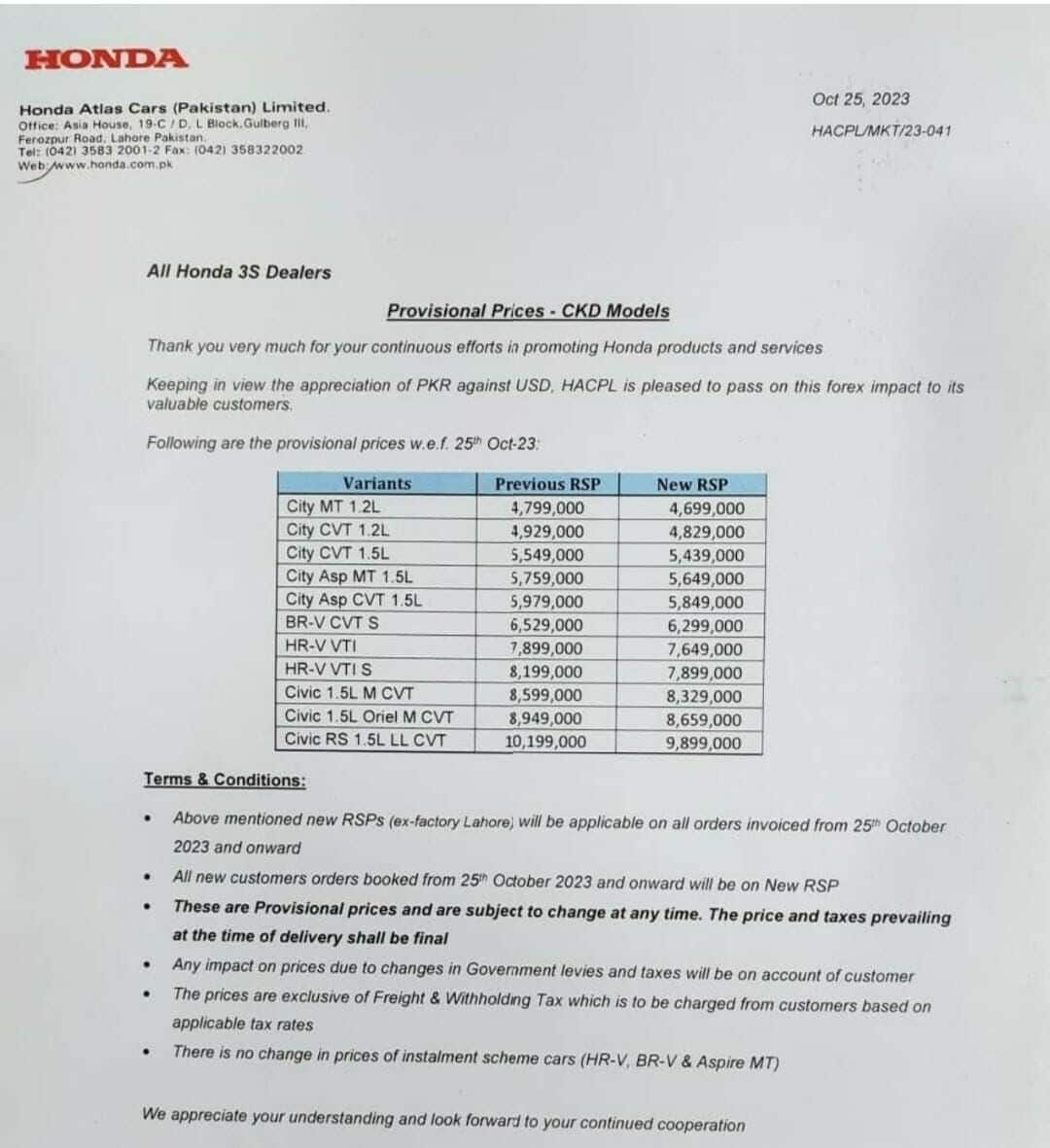
    In a move similar to what Toyota did earlier, Honda Atlas Cars (Pakistan) Limited announced on Wednesday that it is reducing the prices of its vehicles, especially the popular Honda City lineup.

    This decision was made due to the significant strengthening of the Pakistani rupee (PKR) against the US dollar.

    Through an official circular, Honda Pakistan disclosed the updated ex-factory prices for all its car models, reflecting reductions of up to PKR 300,000.

    This substantial price drop is expected to make Honda vehicles more affordable for a broader consumer base.

    After these adjustments, the price of the most budget-friendly Honda car in Pakistan, the City MT 1.2L, now stands at Rs4.699 million following a reduction of Rs100,000.

    Moreover, the top variant, the Aspire CVT 1.5L, is now available for Rs5.849 million after a cut of Rs130,000.

    The most significant price changes have been applied to the popular Honda City lineup, generating excitement among potential buyers.

    Here are the new prices for all Honda cars:

  • Knitwear tops the list: Pakistan’s exports surge by 25.54%

    In the fiscal year 2023–24, Pakistan’s exports, denominated in rupees, experienced a notable 25.54 per cent increase during the first quarter (Q1) compared to the previous year, as per the Pakistan Bureau of Statistics (PBS).

    Between July and September 2023, exports amounted to Rs2,013,533 million, marking a 25.54 per cent boost from the same period in the previous year, according to PBS’s provisional data.

    Looking at year-on-year figures, September 2023’s exports surged by 31.27 per cent, totaling Rs737,295 million, compared to Rs561,643 million in September 2022.

    On a month-to-month basis, exports grew by 6.06 per cent, reaching Rs737,295 million in August 2023.

    Key export categories in August 2023 included knitwear (Rs103,029 million), readymade garments (Rs74,608 million), bed wear (Rs69,234 million), cotton cloth (Rs51,891 million), oil seeds, nuts, and kernels (Rs46,571 million), cotton yarn (Rs33,815 million), rice and others (Rs32,324 million), towels (Rs25,116 million), rice basmati (Rs19,008 million), and miscellaneous articles, excluding towels and bed wear (Rs16,922 million).

    On the other hand, imports during July to September 2023 (FY2023-24) totaled Rs3,560,763 million, showing a decrease of 2.45 per cent compared to the same period in the previous year.

    In a year-on-year comparison, imports into Pakistan during September 2023 amounted to Rs1,189,167 million, a 2.52 per cent decline from September 2022.

    Month-on-month data indicated a 10.62 per cent increase in imports in September 2023 compared to August 2023.

    Key imported commodities in September 2023 included petroleum products (Rs162,087 million), petroleum crude (Rs146,179 million), liquefied natural gas (Rs75,331 million), palm oil (Rs61,388 million), plastic materials (Rs49,628 million), electric machinery and apparatus (Rs44,699 million), iron and steel (Rs44,191 million), mobile phones (Rs37,093 million), iron and steel scrap (Rs27,299 million), and pulses/leguminous vegetables (Rs22,208 million).

  • Gold price increases by Rs6,400 to Rs206,500 per tola

    Gold price increases by Rs6,400 to Rs206,500 per tola

    Gold prices in Pakistan are once again on an upward trajectory, with the per tola price recently surging by Rs6,400 in the domestic market.

    This increase was observed as the price of this precious metal climbed by Rs6,500 per tola, reaching Rs206,500, according to statements made by the chairman of the All Pakistan Jewellers Manufacturers Association.

    Simultaneously, the price for 10 grammes of gold also rose, now trading at Rs107,740 after a substantial increase of Rs5,487.

    In the international arena, the price of gold saw an uptick of $46, settling at $1,938 per ounce. Conversely, the US dollar strengthened against the Pakistani rupee in interbank trading on Wednesday morning, ending a streak of losses for the Pakistani currency.

    Furthermore, the value of the US dollar also rose by one rupee in the open market, where it now trades at Rs278, up from its previous rate of Rs277. Just last week, the US dollar had depreciated by Rs5.07 against the Pakistani rupee in interbank trading.

  • Eggs and tomatoes lead weekly price hikes in latest SPI inflation report 

    Eggs and tomatoes lead weekly price hikes in latest SPI inflation report 

    The latest data from the Pakistan Bureau of Statistics (PBS) reveals that, for the week ending on October 12, the Sensitive Price Indicator (SPI) reflected a notable weekly inflation uptick of 0.30 per cent.

    During this period, the SPI for this particular category surged to 282.86 points, marking a distinct rise from the preceding week’s 282.00 points.  

    Among the 51 items tracked, the price dynamics exhibited a balanced distribution, with 17 items experiencing upward price movements, 17 witnessing price declines, and 17 remaining stable throughout the week. 

    Some of the commodities that observed a decline in prices encompassed sugar (4.47 per cent), pulse gramme (2.75 per cent), bananas (2.47 per cent), pulse moong (2.44 per cent), gur (1.93 per cent), chicken (1.69 per cent), rice irri-6/9 (1.46 per cent), and pulse masoor (1.26 per cent). 

    Conversely, there was a noticeable surge in the prices of several items during the same week, including tomatoes (6.28 per cent), eggs (3.48 per cent), salt powdered (2.75 per cent), cooked beef (1.06 per cent), garlic (1.04 per cent), tea prepared (0.73 per cent), beef (0.39 per cent), potatoes (0.35 per cent), electricity charges for Q1 (8.59 per cent), energy server (0.55 per cent), shirting (0.47 per cent), and LPG (0.31 per cent). 

    For a broader perspective, when evaluating these price changes on a year-on-year basis, it becomes evident that certain commodities have shown significant variations.  

    For instance, tomatoes witnessed a substantial year-on-year decline of 43.53 per cent, while onions experienced a decrease of 16.67 per cent.  

    Furthermore, pulse gramme recorded a drop of 4.01 per cent, and mustard oil saw a more modest decline of 1.19 per cent. These statistics provide valuable insights into the evolving economic landscape and the relative stability of various consumer goods. 

  • US dollar hits six-month low against Pakistani currency 

    US dollar hits six-month low against Pakistani currency 

    The Pakistani rupee (PKR) has been on an upward trajectory, with the US dollar (USD) experiencing its lowest value in six months.

    This development follows a concerted effort to combat dollar smuggling, resulting in a decrease of Rs5.50 in interbank trading this week. The greenback concluded the week at Rs282.69.  

    In the open market, the US dollar saw a significant drop of 6.50 rupees, closing at Rs281.50, down from Rs288.

    This decline has been a consistent trend in recent weeks, starting from the beginning of September, when the US currency has been steadily losing ground against the Pakistani rupee.  

    Notably, other foreign currencies have also seen a decrease in their value within the currency market. Over the past week, the Euro fell by 8 rupees, going from Rs306 to Rs298. Similarly, the British Pound Sterling lost Rs5, reaching a rate of Rs248 from its previous Rs253.

    The Saudi Riyal experienced a modest decrease of one rupee, moving from Rs76.20 to Rs75.20, while the Emirates dirham shed Rs2.60 to settle at Rs77.20, down from its previous rate of Rs79.80 over the weekend.  

    This strengthening of the Pakistani rupee against the US dollar in the open market has occurred while maintaining a narrow gap with the interbank market, aligning with the limits stipulated by the International Monetary Fund (IMF).  

    This positive trend in the rupee’s value against the dollar can be attributed to a nationwide crackdown on illegal currency operations carried out by law enforcement agencies. 

  • Pakistan’s imports drop sharply, leading to 42% reduction in trade deficit

    Pakistan’s imports drop sharply, leading to 42% reduction in trade deficit

    Pakistan’s trade deficit for the first three months of the fiscal year 2023–24 has notably contracted by 42.25 per cent to reach $5.29 billion. This remarkable reduction is primarily attributed to a significant decrease in imports, a direct consequence of carefully administered measures.

    Data released by the Pakistan Bureau of Statistics (PBS) reveals that the trade balance, which represents the difference between exports and imports, stood at a deficit of $5.29 billion for the period spanning July to September 2023–24. This is in stark contrast to the $9.16 billion deficit recorded during the same period in the preceding year.

    Both exports and imports experienced declines in this timeframe, with imports showing a more substantial decrease compared to exports, effectively narrowing the trade deficit. During these three months of 2023–24, Pakistan’s exports contracted by 3.8 per cent to $6.9 billion, despite facing significant currency depreciation when compared to the corresponding period in the previous year.

    Conversely, imports registered a notable decline of 25.4 per cent, totaling $12.19 billion in the July–September period, down from the $16.33 billion recorded in the same period of the previous fiscal year.

    For a more granular view, the PBS reported that in September 2023, Pakistan’s trade deficit further shrank by nearly 48 per cent to $1.489 billion, compared to $2.856 billion during the same month in the previous year. 

    Exports experienced a slight improvement of 1.1 per cent, reaching $2.47 billion in September 2023 compared to $2.44 billion in the same month the previous year, while imports significantly decreased by 25.5 per cent to $3.95 billion from $5.29 billion in the corresponding month last year.

    From a monthly perspective, the trade deficit contracted by 31.5 per cent compared to August 2023, with exports increasing by 4.2 per cent to $2.47 billion in September from $2.37 billion in the preceding month of August. Simultaneously, imports decreased by 12.9 per cent, amounting to $3.95 billion from $4.53 billion in the last month.