Tag: economy

  • COVID-19 & industry: Current situation and the way forward

    In the previous two years, Pakistan had started to pick its pace at a slightly high point and the economy had started to improve.  Both the current account along with the non-oil current account had continued to improve after exchange rate reforms while sectors with the highest forward linkages i.e cement, iron and steel, had started to show an upward spike in production.

    The fiscal side also seemed to strengthen over a period of time while growth in revenue collections at all levels, especially direct taxes, was also witnessed.

    However, with the ongoing coronavirus pandemic raising its ugly head, the meager growth achieved is now threatened.

    According to a World Bank (WB) assessment, the global impact of COVID-19 can reach $347 billion (0.4 per cent of Global GDP). Nearly all regions suffer a double-digit decline in trade volumes in 2020, with exports from North America and Asia hitting the hardest. But it is important to note that this hit was majorly experienced by countries with sizable exports due to trade problems while Pakistan has a low global value chains (GVC) exposure to the world, especially to People’s Republic of China (PRC), which means it has suffered lesser trade disruptions so far.

    Trades have fallen steeper in sectors with complex value chains, particularly electronics and automotive products.

    According to Urban Unit’s spatial industrial data, currently, 18 per cent of the industries in Pakistan are operational. These include the fertilizer industry, agriculture, agriculture spare parts and export industry, all of which are operating under conditions of following certain standard operating procedures (SOPs) developed by the Punjab government. However, strict monitoring from the government will also be required as an exemplary practice of these SOPs which will further encourage the authorities to open up other capital-intensive sectors.

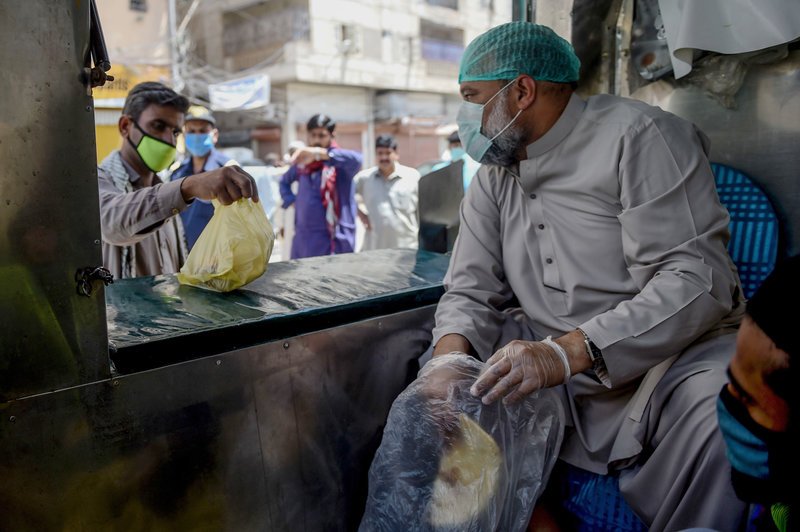
    On the monetary side, there are several efforts made by the government. Under a federal package, a Rs100 billion relief package has been provided to small and medium-sized enterprises (SMEs) and the agriculture sector along with concessional loans. Money is allocated to lower the input cost for farmers along with a Rs12,000 monthly package with facilities of panagahs [shelter homes] and langar centers [soup kitchens].

    The Punjab government has also implemented tax reductions as all forms of GST have been removed from online platforms, businesses and services related to HR; deferment of tax has been implied for properties and CVT & stamp duties have been reduced to 2 per cent on property transactions, construction industries, hospitals and medical consultants. In addition to these, the State Bank of Pakistan (SBP) has provided relaxation in export schemes (EFS & LTFF) and has enhanced liquidity for exporters while providing extensions in the time period to ship and import goods against advance payment.

    The central bank has also reduced its interest rate from 13.5 per cent to 9 per cent.

    However, there are some further actions that the government can take in order to improve the current economic situation. A regulatory framework can be adopted keeping in view some of the best international practices from where many risk management practices can be learnt to determine the best price discovery (for example, the United States has dropped the interest rate to 0 per cent).

    Secondly, allowing ease of entry for institutional capital in order to broaden the depth of the market i.e. attracting FDIs in newly established special economic zones in Faisalabad, Bhalwal, Vehari and Rahim Yar Khan by simplifying provincial and federal procedures. Thirdly, the role of aggregators, producers and organisations can be improved for better price negotiations for SME’s.

    Fourth, access to foreign capital should be made easier and distortions should be minimised by developing linkages with the international markets. That means ease of doing business index, logistic performance index and reduced lead time for exports should be commenced. Lastly, e-markets should be developed where participants can access both international and domestic markets. An e-commerce policy at the provincial level must be put in place with incentives to increase documentation of economy and online trade at B2B B2C and C2C levels.

    It is to be noted that Pakistan is not alone in this economic downfall. It is vital to have a positive outlook on the situation and prepare for the future with better resilience. Effective policies and active preparedness can give impetus to the post-pandemic industrial revival.
  • Historic first: No cars sold in Pakistan in a month

    Historic first: No cars sold in Pakistan in a month

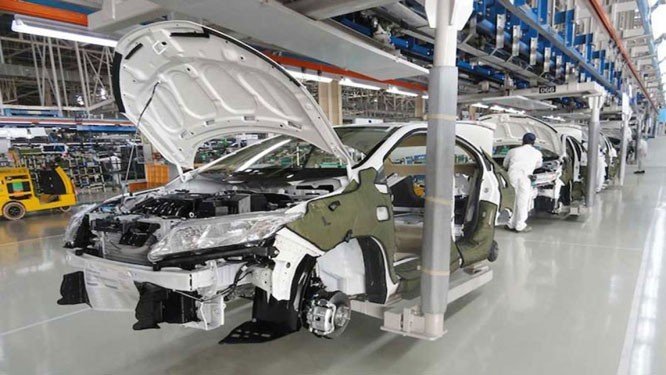
    In a historic first, not even a single car was sold in Pakistan during April 2020 as countrywide lockdowns due to the coronavirus continued to take a toll on the economy, and consequently, the automobile sector, SAMAA quoted analysts as saying.

    According to data from Pakistan Automotive Manufacturers Association, the lockdowns resulted in the closure of plant operations along with car dealerships across the country. Car sales in the last 10 months ending April dropped by 52% compared to the same period of the preceding financial year, Topline Securities said in a report, adding that motorcycle sales were also affected.

    “The auto industry sold 39 units in April, which only included trucks and buses,” Inter Market Securities (IMS) said in a separate report, noting there were no passenger car sales due to the lockdown that came into force on March 24.

    Tractor sales were down 30% in April compared to the same month of 2019. “The decline in [tractor] sales was probably because of a partial lockdown, which was later eased for the tractor industry given its links to the agriculture sector amid harvesting season,” it said.

    READ MORE: Coronavirus may never go away, WHO says

    “With the easing of lockdowns in the country effective May 11, we expect sales to resume for the last two weeks of May,” IMS said. It, however, added the sales are expected to pick up in the first half of 2021. This is because Indus Motor Company, the makers of Toyota in Pakistan, and Honda Car Pakistan Limited increased prices recently and Pak Suzuki Motor Company is likely to follow suit. But analysts at IMS also said the reduction of more than 4% in interest rates may help auto-financing pick up earlier than expected.

    Similar situations have been reported across the globe as COVID-19 continues to affect global economy and spell misery for consumers.

    According to BBC, the United Kingdom’s (UK) motor industry has been in suspended animation for weeks. Showrooms have been closed while vast factories, which normally produce hundreds of cars every day for sale here and abroad, have been standing idle.

  • Inflation: Armed forces demand 20 per cent increase in salaries

    Inflation: Armed forces demand 20 per cent increase in salaries

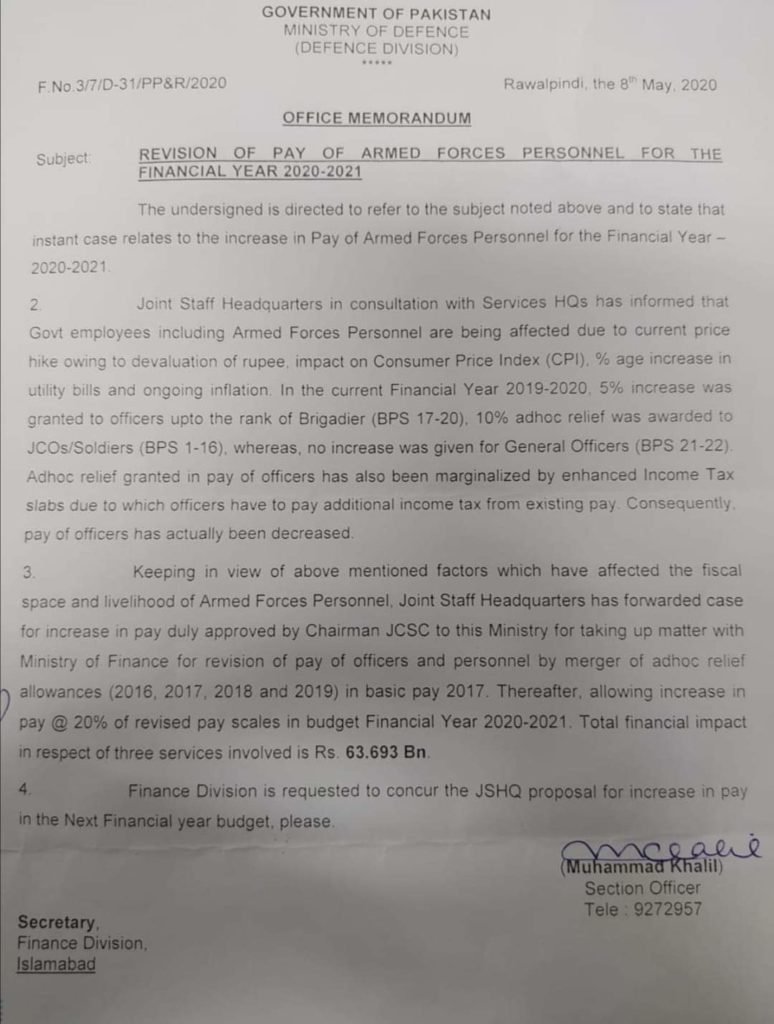
    The armed forces of the country have sought a 20 per cent increase in the salaries of their personnel for the financial year 2020-2021, which will cost an estimated Rs63.67 billion.

    According to a letter forwarded by the Defence Ministry to the Finance Division, a copy of which is available with The Current, the joint staff headquarters, in consultation with the services headquarters, has sought an increase in the salaries of armed forces personnel for being affected due to the current price hike owing to the impact of the devaluation of rupee on consumer price index (CPI), increase in utility bills and the persisting wave of inflation.

    In the current financial year 2019-2020, a five per cent increase was granted to the officers up to the rank of brigadier (BPS 17-20) and 10 per cent ad hoc relief was awarded to JCOs/soldiers (BPS 1-16), whereas no increase was given to general officers (BPS 21-22).

    Ad hoc relief granted in the pay of the officers has also been marginalised by enhanced income tax slabs due to which officers have to pay additional income tax from existing pay.

    Consequently, the pay of officers has actually decreased during the current financial year, the document maintained.

    Keeping in view the above mentioned factors, which have affected the fiscal space and livelihood of the armed forces personnel, joint staff headquarters have forwarded a case for the increase in pay duely approved by the chairman joint chief of staff committee to the Defence Ministry for taking up the matter with the Finance Ministry for the revision of pay of armed forces personnel.

    The Defence Ministry had also sought that the adhoc relief allowance for the year 2016, 2017, 2018 and 2019 be merged in the basic pay scale, and proposed a 20 per cent increase in the revised pay scale in the upcoming budget 2020-2021.

    Meanwhile, according to a Defence Ministry official, if the proposal of merging of four ad hoc allowances into revised pay scale is allowed along with a 20 per cent raise in salaries and pension of all employees, including civilians and armed forces, it will require Rs150 to Rs200 billion in the next budget.

  • Pakistan to lose Rs628,000,000,000 by June

    Pakistan to lose Rs628,000,000,000 by June

    A report prepared by the sub-committee of the National Coordination Committee (NCC) for coronavirus has said that the country, due to an adverse impact of COVID-19 on the economy, will record a loss of over Rs628 billion by the end of the current financial year.

    The report ‘COVID-19: Preliminary Macroeconomic and Socioeconomic Assessment’ said almost all the departments of the country were going in a loss due to lack of human activity in the wake of the pandemic that has killed over 200,000 people worldwide.

    Giving a breakdown of the losses, the report said the Aviation Division will face an estimated financial loss of Rs13.6bn; the Pakistan Stock Exchange Rs250bn; Petroleum Division Rs 87bn; Ministry of Energy (Power Division) Rs136bn; Pakistan Railways over Rs7 bn; National Food Security Rs 55bn; Overseas Pakistanis over Rs 76bn; Ministry of Information Technology Rs1-5bn under the head of withholding tax; and Maritime Affairs will report a loss of Rs30 million.

    It further said that the Federal Board of Revenue will face a total estimated revenue shortfall of Rs600bn in the last three months of the current financial year.

    The report also suggested the way forward to deal with losses, saying some measures have already been taken.

  • Rethinking a post-COVID-19 future

    Rethinking a post-COVID-19 future

    “We should not go back to the old ways.”

    We are living through a global pandemic and life as we knew it will perhaps never be the same again, That’s the hope anyway. Because there are a lot of things about the way life was before that need rethinking — and COVID-19 has given us an opportunity to do this.

    In the 21st century, there was life before the virus, there is now lockdown and life during the virus and, at some point, there will be life after the virus — but will the latter be the same as our old way of living? There is much discussion now of ‘getting the economy going’ again, of getting things back to ‘normal’ again but is our plan just to restore the same economic model and the same old systems?

    Or is now the time to rethink the way we live?

    Several falsehoods about our lives have been exposed by the lockdown. Key among these is the myth that the old way of working and studying was the only way: fixed hours of attendance at sites you had to physically travel to. It turns out that this ‘hazri’ culture is not actually essential, and many of these ways of working were just constructs whose aim was to strengthen a type of corporate or darbari culture. Not allowing people to work from home stemmed perhaps from a reluctance to lose control of staff. The institutions that would hire expensive consultants to help them ‘save money’ and work efficiently told us that it was too expensive to have individual desks for staff and subjected them to the horrors of hotdesking. This apparently ‘saved’ some money yet these same organisations would be reluctant to allow staff to work from home routinely even though that would have saved even more money. The permission for ‘working from home’ was given not as the norm, but as some kind of great favour or concession which involved HR, applications and a degree of workplace politics.

    Well now nearly everybody’s working from home and we realise this has actually been possible for many, many years and that perhaps the workplace would have caught up with technology long ago if there weren’t so many dubious management practices and vested interests involved. Apart from the workplace, there is the question of the classroom and what it is — is it a physical reality or an intellectual one? In Britain, university education was once state-funded and all about education rather than businesses.

    “We’ll have to rethink education completely — especially university education.”

    But in the last decade universities have been turned into businesses which are less about education and more about profits. The students are called ‘clients’ and since university fees are now more than three times what they were ten years ago, they are saddled with crippling student debt (student loans are given by a private profit-seeking company). Students invest so much that they are afraid to challenge intellectual views of question anything professors say because they know that they need to get good grades because of their investment. Instead of concentrating on the wellbeing of their students, universities seem to have become more focused on marketing their brand in order to attract a maximum number of ‘customers’ or ‘clients’. But even when the riches poured in, it never seemed to be the academic staff who’d benefit but rather the ‘managers.’

    We’ll have to rethink education completely — especially university education. In Argentina, most young people get their first degree while working full time. Work by day and take evening classes. It might take longer but it definitely seems to be a more productive way to live. Oh, and state universities are free.  Of course, education can not all be virtually based but perhaps a large part of it does need to be.

    Then there’s the question of how society values work. Of how bankers are more highly paid and valued than ‘unskilled’ workers. How financial managers are much better paid than medical professionals. Now we realise who are the professionals that society really needs when in times of trouble: they are the medical professionals, the cleaners, the garbage collectors, the bus drivers, the police, the fire brigade, the people who run food shops and stack shelves. These are essential, these are the people we should value, these are the jobs we need to pay people well to do.

    We need to think of new businesses too. Instead of having an endless number of restaurants and coffee shops to ‘provide employment’ perhaps we should have more businesses whose goal is to contribute to community welfare employing people. We need more cooperative models of working and more localised businesses. Instead of manufacturing fast fashion and throwaway clothes which encourage frivolous spending and whose plastic fibres are clogging up the oceans and rivers, we perhaps should concentrate on businesses that produce food.

    “And guess who governments need to fund now? Not bigshot entrepreneurs and investment bankers, they need to support medical professionals, health workers and research scientists.”

    The virus and subsequent lockdown exposed a number of vulnerabilities in life as we were living it, and one of these was the matter of food production and supply. Perhaps now we need to have a national policy of localised production: local dairy farming, local livestock, locally grown fruit and vegetables. Apart from the fact that this will avoid the issue of complicated supply chains, many people in the health, economic and development sectors have long argued that this is a healthier and more sustainable way to live. This way food production would be organic and fresh – not shipped from the other side of the world. And in terms of food, we need to unlearn the mantra that endless choice is good. The illusion that the more choice you have in choosing, for example, a brand of chocolate shows how ‘free’ you are as people needs to be dispelled. And we need to move back to the idea of quality not quantity in the way we live.

    And new initiatives need to be set up to care for the environment. The enforced detox brought on by the lockdown has shown us bluer skies, clearer air and cleaner waters. We need to have a policy of setting up local initiatives to support this which are goal-oriented and not just motivated by a profit motive.

    And guess who governments need to fund now? Not bigshot entrepreneurs and investment bankers, they need to support medical professionals, health workers and research scientists. And they need to provide free broadband and digital access to all citizens because when push comes to shove this is something that will benefit the whole of society. We need more government spending, new frameworks and new initiatives based on a clear vision of what our priorities are now.

    People and governments need to come together and come up with a new way to live and a new model of economics, We can make a whole new sort of world; a world minus dodgy ‘outsourcing’, privatisation, unsound financial instruments, economic disparity and unbridled greed. But what’s needed is a lot of imaginative ideas and a bold new way of thinking. We need to be creative.

  • Naya Pakistan: Govt starts paying unemployed people to plant trees

    Naya Pakistan: Govt starts paying unemployed people to plant trees

    When construction worker Abdul Rahman lost his job to Pakistan’s coronavirus lockdown, his choices looked stark – resort to begging on the streets or let his family go hungry.

    But the government has now given him a better option: Join tens of thousands of other out-of-work labourers in planting billions of trees across the country to deal with climate change threats, Reuters reported.

    Since Pakistan locked down starting March 23 to try to stem the spread of COVID-19, unemployed day labourers have been given new jobs as “jungle workers”, planting saplings as part of the country’s 10 Billion Tree Tsunami programme.

    Such “green stimulus” efforts are an example of how funds that aim to help families and keep the economy running during pandemic shutdowns could also help nations prepare for the next big threat: climate change.

    WATCH VIDEO:

    “Due to coronavirus, all the cities have shut down and there is no work. Most of us daily wagers couldn’t earn a living,” Rahman, a resident of Rawalpindi district in Punjab province, told the Thomson Reuters Foundation.

    He now makes 500 rupees ($3) per day planting trees – about half of what he might have made on a good day, but enough to get by.

    “All of us now have a way of earning daily wages again to feed our families,” he said.

    The ambitious five-year tree-planting programme, which Prime Minister (PM) Imran Khan launched in 2018, aims to counter the rising temperatures, flooding, droughts and other extreme weather in the country that scientists link to climate change.

  • Resting the food panic amid COVID-19

    Resting the food panic amid COVID-19

    The global coronavirus pandemic has resulted in either a partial or full closure of most industries, wreaking havoc on the country’s economy. Though food scarcity is not a problem yet, during Ramzan, the closures can spell misery for people despite the government’s assurance of consistent supply. In order to simmer down the current food panic and hoarding of goods, it is to be ensured that the production and availability of essential goods are not halted by the arrival of COVID-19 in Pakistan.

    There are two sources of concern in this situation.

    First, despite growth in livestock, which contributes to almost 2/3 of the agricultural output in Pakistan and accelerated slightly to 4.0% in fiscal year (FY) 2019; agricultural production as a whole expanded by only 0.8%. Second, with COVID-19 escalating, Pakistan has recently suspended its trade and closed its borders, leaving many distressed and worrying about the shortage of essential Iftar items.

    In order to address the first concern, it is imperative to note that an overall decline in all sectors was already being witnessed before COVID-19. The slowdown in the agriculture industry was exacerbated by weaker demand and higher costs until the disease arrived. As for the shortage of essentials food items, Punjab alone is a mass producer of many food essentials that will be easily available during Ramzan. An analysis by the Urban Unit states the availability of most essential items from April to June 2020:

    • Tomatoes: Punjab’s production was recorded 1,38,397 tons during 2018-19
    • Potatoes: Punjab has 96.94% share in the total domestic production of potato and the total arrival in local wholesale markets was recorded at 510 to 515 trucks/day on an average
    • Garlic: Domestic production was recorded at 72,598 tons in 2018/2019.
    • Chilies: Production of chilies in Punjab is 11,698 tons
    • Onions: 20% in total domestic production
    • In addition to these, all forms of meat and dairy will be available as 3.7 million litres of milk are supplied per day and the daily supply of beef and mutton is 518,861 tonnes and 130,000 tonnes per day, respectively.

    Under essential items, rice is the only commodity that is expected to suffer a blow by the pandemic, but it is harvested in September. All vegetables and fruits such as capsicum, cabbage, cauliflower, bittergourd, cucumber, turnip, guava, melons and strawberries will be available in an abundant amount.

    While no serious panic has been witnessed in consumer behavior in Pakistan unlike in Europe or the United States (US), the government must exercise extreme vigilance on supply-demand trends during Ramzan. There should be no hoarding, and a robust price control mechanism must be put in place at the grass-root level by respective provincial and district administrations.

    For example, the Food Department of the Punjab government has taken effective and strict measures and warned of a crackdown on unnecessary stock holdings.

    So far, collective efforts by the Food Department along with the Deputy Commissioner’s Office and the Industries Department have led to the collection of fines worth Rs2,883.71 million from accumulators of food items, out of which Rs882.03 million was collected within just 40 days i.e. from March 1 to April 9.

    In an attempt to reduce the current wheat prices, the department is further identifying and disqualifying ghost mills from the official quota and borders are also being sealed, barring wheat transportation outside the province and ensuring food security.

  • At least 1,300,000 people in KP to lose jobs in 45 days?

    At least 1.3 million people could lose their jobs if a 45-day lockdown is put in place, a report prepared by Khyber Pakhtunkhwa (KP) government’s Planning and Development Department revealed on Sunday.

    The report warns at least 460,000 people working as daily wagers and street vendors are set to lose their employment with “immediate effect”.

    The report, released on Sunday, highlighted the effect of the COVID-19 pandemic on the province’s economy.

    Estimating layoffs caused due to the lockdown in place to stop the spread of the pandemic, the report noted that “daily wage workers, paid worker by piece rate or work performed, paid non-family apprentice and street vendors” were highly vulnerable to the economic impact of coronavirus.

    The report also predicted that the growth of KP’s economy would drop from 3.73 per cent in 2019 to 2.9pc this year, while the gross domestic product (GDP) would go down from Rs13,35,942 million to Rs13,16,160m.

    The report also predicted that overall, some 1.3 million jobs could be lost during a 45-day lockdown. The highest losses would be seen in the transportation and storage sectors with a predicted loss of some 359,393 jobs while construction, manufacturing and wholesale sectors would also be highly affected with job losses of some 295,594, 258,664 and 216,252 respectively.

    The number of jobs lost could increase even more if the lockdown was extended, the report warned, estimating that some 2.7m jobs would be lost if the lockdown was extended to a six-month period while some 4.2m jobs would be lost if the lockdown remained in place for a year.

    However, the report observed that there would be “minimal impact” on the province’s agricultural sector.

    REPORT LAYS DOWN MECHANISM TO MITIGATE IMPACT:

    The report titled Coping Strategy: Mitigating Adverse Impact of COVID-19 on the Economy and Job Market in Khyber Pakhtunkhwa also laid out the provincial government’s mechanism to deal with the impact.

    According to the report, some 1.5 million families in the province will benefit from the federal government’s Ehsaas Cash Disbursement Programme through which they would get Rs12,000 every month.

    The report voiced apprehension that the COVID-19 pandemic would also “render vulnerable” those people who do not fall under the federal government’s cash distribution programme criteria.

    The government would therefore form a committee at the Village Council level that would identify vulnerable families who would receive Rs6,000 from the government.

    Certain sectors would also be exempted from tax payments, the report said. Construction, wholesale, retail and transport sectors would be eligible to benefit from these tax exemptions.

    The government would also adopt a moratorium on loan payments for three months to “allow business higher liquidity to the most affected small and medium enterprises” while “mark-up due for the quarter ending 31 March would have to be paid by 15 June instead of 15 April”.

    The government would also pay advance salaries to officers from grade 1 to 17 to “sustain demand” if needed.

    The government would also consider deferral of payment of utility bills for three months to help support small businesses and shopkeepers, the report further added.

  • Around 10,000 Pakistanis lose jobs in UAE amid coronavirus outbreak

    Around 10,000 Pakistanis lose jobs in UAE amid coronavirus outbreak

    Due to the coronavirus outbreak in United Arab Emirates (UAE), 10,000 plus Pakistanis have lost their jobs, The News reported.

    Moreover, around 35,000 Pakistanis have registered with the consulate in Dubai in a bid to return Pakistan, Consul General Ahmed Amjad Ali Said.

    The officials informed that preparations are underway to bring back the stranded Pakistanis.

    Besides, “Tourists, unemployed and the elderly will be given preference,” as per evacuation policy.

    The screening measures have been completed at the Dubai airport but bringing Pakistanis back in such large number in very challenging for the authorities.

    According to Pakistani diplomats, Pakistan is a big labour supplier to the UAE — more than a million Pakistanis — who are living and working in UAE.

    In March, Special Assistant to the Prime Minister on National Security Division Moeed W Yusuf had assured the nation that the government was in touch with the authorities of those countries where Pakistani passengers are stuck in transit.