Tag: education

  • Cambridge grading system under fire after outrage from Pakistani students

    Cambridge grading system under fire after outrage from Pakistani students

    Pakistani students have slammed Cambridge International Examinations (CIE) after results for 2023 examinations came to light.

    Cambridge exams were disrupted in Pakistan due to riots on May 9 and 12. However, instead of rescheduling the affected papers, Cambridge allegedly opted to allocate average marks.
    The announcement of the results, on August 10, has stirred frustration among students across Pakistan, as only a small number managed to attain A and B grades. More than 45,000 students appeared in the exams.

    In response, students expressed their intent to stage peaceful protests in Karachi, Islamabad, and Lahore, to highlight what they perceive as an injustice done by Cambridge.

    Outraged students have turned to social media, urging a rescheduling of the exams to provide them with a fair opportunity to showcase their capabilities and receive grades reflective of their performance.

    Students took to X (formerly known as Twitter) to run an online campaign and raise their concerns regarding the issue.

    X user, Muhammad Awais Sial mentioned that Cambridge graded them on components where scoring marks are inevitable.
    https://twitter.com/MASial34789939/status/1690045360998322176?s=20

    https://twitter.com/MASial34789939/status/1690045360998322176?s=20

    Senior Vice President of Pakistan Muslim League (N), Maryam Nawaz, also expressed concerns, stating that numerous students have reached out to her. She urged the CIE to consider the conditions in which students sat during these exams while reviewing the results on fairgrounds.

    Chief organiser of President Punjab PML(N), Mohammad Sarwar mentioned that he has been contacted by students who are disheartened after receiving E grades. The former chief minister of Punjab stated that he has reached out to a member of the House of Lords, Wajid Khan, for support in urging CIE to review their grading process.

    Activist and lawyer Jibran Nasir explained the issue in detail while demanding that “Cambridge Assessment International Education and British Council Pakistan needs to provide details and transparency in the mechanism adopted this year and it must ensure that students of Pakistan did not suffer in particular due to some discriminatory or flawed policy.”

    Addressing the concerned Cambridge students, Uzma Yousuf, the Country Director for CAIE Pakistan, stated, “Cancelling the exams on 10, 11 and 12 May has been a difficult decision for the British Council. Your safety and well-being come first, and that’s why this decision was taken.”

    She further added, “Our team is continuously monitoring the situation, and we will keep you updated as we have more information. We are completely committed to providing a safe and secure environment for you to sit for your exams.”


  • Swift approval of 24 universities without proper discussion sparks debate

    Swift approval of 24 universities without proper discussion sparks debate

    In an unusual move that contradicts customary legislative protocol, the National Assembly of Pakistan has sanctioned the establishment of twenty-four new universities across various cities within a single session. These approvals, though hailed as a massive boost to the nation’s educational infrastructure, have ignited debates over the abruptness of the process.

    The approval of the bills occurred in an unusually sparse session, without the traditional discourse within respective Standing Committees, raising questions about the abrupt nature of the process.

    Critics are questioning the urgency that bypassed the usual deliberations associated with such significant decisions.

    The newly approved institutions include Metropolitan International Institute of Science and Technology, Askari Institute of Higher Education, Federal Ziauddin University, The Indus University of Science and Technology, The Institute of Management and Technology, and Pak China Gwadar University.

    Other notable approvals were for Lahore, University of Shaheed Benazir Bhutto, Institute of Health and Professional Studies, Sheikhupura Institute of Advanced Studies, Cosmic Institute of Science and Technologies, Balhe Shah International University, The Ravi Institute, and The International Islamic Institute for Peace.

    Also given the green light were Shah Bano Institute Jardanwala, International Memon University, Umm Abiha Institute of Health Sciences, Mufti Azam Islamic University, Islamabad International University, Islamabad Institute of Modern Sciences, Al Biruni International University, National University of Health Emerging Sciences and Technologies, National Institute of Technology, Pakistan Institute of Management Sciences and Technology, and The Horizon University.

    As the debate continues, it remains to be seen how these newly approved universities will contribute to the country’s higher education landscape.

  • ‘I was not targeting anyone particularly’: Kajol provides clarification on ‘educated political leaders’ comment

    ‘I was not targeting anyone particularly’: Kajol provides clarification on ‘educated political leaders’ comment

    Bollywood actress Kajol recently said in an interview to The Quint that people are steeped in traditions, and politicians are uneducated which is why there isn’t a clear viewpoint on how to move forward in India:

    “You have political leaders who do not have an educational system background. I’m sorry but I’m going to go out and say that. I’m being ruled by leaders, so many of them, who do not have that viewpoint, which I think education does give you, at least the chance to look out for a different viewpoint.” 

    While some applauded the DDLJ actress for making a strong case for why its important to have educated leaders, some Twitter users were enraged by her comments and pointed out that Kajol herself was a school dropout.

    Kajol took to Twitter to post a clarification, saying that she was emphasising the importance of education, and was not targeting any politician.

    “I was merely making a point about education and its importance. My intention was not to demean any political leaders, we have some great leaders who are guiding the country on the right path.”

  • Govt allocates only Rs97 billion for education affairs and services in budget 2023-24

    Govt allocates only Rs97 billion for education affairs and services in budget 2023-24

    The federal government has designated a budget of only Rs97.098 billion for education affairs and services in the fiscal year 2023-24. This allocation reflects a 5.5 per cent increase compared to the revised allocation of Rs91.777 billion for the current fiscal year.

    Pakistan’s public expenditure on education, as a per centage of GDP, is estimated to be 1.7 per cent in the fiscal year 2022-23, a slight increase from 1.4 per cent in the previous year. However, this figure remains the lowest in the region.

    Of the total allocation, the bulk of expenditure amounting to Rs76.589 billion has been allocated for Tertiary Education Affairs and Services in the budget for 2023-24, accounting for 79 per cent of the total allocation under this category.

    Furthermore, the government has designated Rs4.468 billion for pre-primary and primary education affairs in the upcoming fiscal year, compared to Rs3.786 billion in 2022-23. Additionally, Rs10.778 billion has been earmarked for Secondary Education Affairs and Services in 2023-24, as opposed to Rs8.863 billion in the previous year.

    The budget for administration has also increased, with Rs3.698 billion allocated compared to the revised figure of Rs2.010 billion for 2022-23, which was later revised to Rs2.430 billion.

    Since the implementation of the 18th Constitutional Amendment, education has been devolved to the provinces, making the federal government primarily responsible for financing higher education.

    According to budget documents, the Higher Education Commission (HEC) has been allocated Rs59.71 billion under the Public Sector Development Programme (PSDP) for 2023-24, a significant increase from the previous year’s allocation of Rs44.718 billion.

  • How to use familiar language with children to tell them about good and bad touch

    How to use familiar language with children to tell them about good and bad touch

    It seems that instances of child molestation and sexual abuse will never end.

    An 8 year girl in Islamabad was sexually assaulted in Shahzad Town area on Friday. The rapist managed to escape from the crime scene, in the presence of area residents.

    This should worry us all. As parents, as guardians, as relatives and as friends of people who have baby girls, who we dote on, we should all be alarmed.
    When discussing the topic of good touch and bad touch with your minor kids, it’s important to approach the conversation in a gentle and age-appropriate manner. Here are some suggestions on how to have a soft and conversational discussion:

    Choose an appropriate time and setting

    Find a calm and comfortable environment where your children feel at ease and can focus on the conversation without distractions.

    Use simple and understandable language:

    Adapt your language to the age of your children. Use words and phrases that they can easily understand and relate to. Avoid using complex or scary terms.

    Start with positive touches:

    Begin the conversation by talking about different types of touches that are generally considered good or positive. For example, you can mention hugs from family members, holding hands with friends, or receiving a pat on the back.

    Define personal boundaries

    Explain to your children that their bodies are their own and that they have the right to decide who can touch them and how. Teach them to recognize and trust their instincts when they feel uncomfortable with a touch or a situation.

    Introduce the concept of bad touches

    In a calm and reassuring manner, explain that there are certain touches that are not appropriate or safe. Emphasize that no one should touch their private parts (parts covered by a swimsuit) except for medical reasons and only in the presence of a trusted adult, like a doctor or parent.

    Encourage open communication

    Let your children know that they can always come to you or another trusted adult to talk about any uncomfortable experiences or if they have any questions. Assure them that they won’t get in trouble for speaking up and that you are there to support and protect them.

    Role-play and practice scenarios

    Engage in role-playing activities where you and your children can practice different scenarios. Teach them to say “no” assertively and to seek help from a trusted adult if they encounter an uncomfortable touch.

    Reinforce the message over time

    Remember that this conversation is not a one-time event. As your children grow and develop, it’s important to reinforce the message regularly and adapt the conversation to their increasing understanding.

    Use age-appropriate resources

    Consider using age-appropriate books, videos, or online resources that discuss the topic of good touch and bad touch in a child-friendly manner. These resources can complement your conversation and help reinforce the concepts.

    Remember, the goal is to create a safe and open space for your children to ask questions and understand the importance of boundaries and consent.

  • ‘They don’t like being told what to do’: Imran Khan holds back from criticising Taliban ban on girls’ education

    Pakistan Tehreek-e-Insaf (PTI) Chairman Imran Khan, in an interview with Matt Frei for Channel 4, talked about the rigid ban imposed by Afghanistan Taliban on girls’ education.

    When asked whether he will tell them to let the girls go to school, he responded by saying that he knows Afghan character much more than anyone else in the West. “They dont like being told what to do,” Imran Khan said.

    He then urged the world to engage with the Taliban, stressing that only then the group will listen to them.

    He said, “If the West wants to influence them, they must mainstream them. I kept telling them to engage. If you isolate them, what influence are you going to have on them.”

    “My advice is to get them involved, give them a stake in the international community so when you tell them to educate girls, they will listen to you.”

    According to him, right now they react when the world questions their policy toward women.

    We are heading toward martial law: Imran Khan

    In the interview, the deposed prime minister said that the postponement of elections by the Election Commission of Pakistan (ECP) is a violation of the constitution.

    He said that five judges of the Supreme Court categorically said that elections should be held on April 30.

    “The worry right now is that we are heading towards martial law”, said Khan.

  • Lahori students to get free rides on Orange, Metro line

    In a bid to provide easier access to transportation, public train systems Orange Line and Metro Line in Lahore will provide free transportation facilities to students in school uniforms, Samma has reported.

    The decision was announced by the Caretaker CM Punjab Syed Mohsin Raza Naqvi on Sunday, in order to help students attend their schools punctually and also lessen the financial burden of travelling costs on their families.

    Students will only need to be dressed in school uniforms in order to receive a free ride.

  • Man behind viral Aurat March poster shares inspiring story about his mother

    Man behind viral Aurat March poster shares inspiring story about his mother

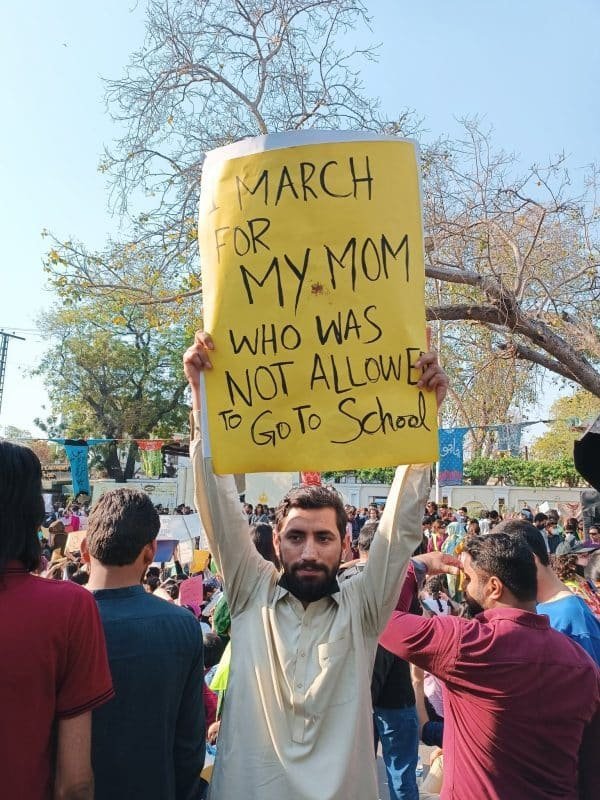
    ‘I march for my mom who was not allowed to go to school’; so stated a placard at the Aurat March, pictures of which went viral on Twitter.

    Now Ehtesham Hassan, the man behind the poster, has taken to Twitter to share the inspiring story of his mother.

    Hassan revealed that since the age of 10, his mother was fond of reading and writing and had wanted to go to school like her brothers did.

    When his mother expressed her desire to her grandmother, she purchased a takhti for her because of which the mother was able to go two school for two days. Hassan revealed that every night, his mother would clean the takhti with mud so that she could use it again the next day.

    However, Hassan said it was Maulana Fazal Rehman heard about his mother going to school and forbade her family from sending her because this way the girl would write letters to the men and violate the honor of her family.

    Hassan narrated that his mother was restricted from going to school, a fact that she is sorrowful about to this day. Hassan said that being deprived of her fundamental right to receive an education, and not being supported by her family is the reason why he choose to march today so that no other woman would be treated this way.

    Since the story was posted yesterday, women on Twitter have praised Hassan for pasionately defending the right of women to receive education, calling his thread a moving tribute to his mother.

    Many women said they had witnessed the same in their families.

    “This is the story of both my maternal & paternal grandmothers. They were both not allowed to go to school after 8th grade. They made sure their daughters were highly educated – they advocated for them against hell or high water,” this user wrote.

    Another user wrote: “Mother’s carried the burden of thier broken dreams and planted seeds of hope for future generations. She might not have gone to school but her son’s daughter would! Women have been forebearers of a silent revolution for generations.”

    We hope that more men out there step out of their bubble and follow the lead of Hassan to empower the women of their lives to never stop reaching for their dreams.

  • Sampling campaign to monitor drug addiction among students launched in Lahore

    Sampling campaign to monitor drug addiction among students launched in Lahore

    The District Administration has initiated a campaign of random sampling in the provincial metropolis to monitor drug addiction among students. According to Deputy Commissioner Rafia Haider, a total of 215 samples were collected from public and private schools and sent to the health department for analysis.

    The samples were taken from various educational institutions, with 50 from Tehsil City, 50 from Shalimar, 50 from Raiwind, 52 from Model Town, and 13 from Cantt.

    Haider has directed ADC (G) Zeeshan Ranjha to ensure strict monitoring and better coordination. She also informed that an awareness lecture was conducted during the sampling process, and drug dealers were under surveillance, apart from random sampling. In addition, monitoring of shops around educational institutions was being carried out, and any suspicious activity should be reported immediately.

    DC Lahore expressed that the young generation is the future and should be safeguarded from drug addiction, which poses a threat to both life and the country’s future. Meanwhile, the District Administration Lahore was actively preparing for the seventh digital census in the city. The DC chaired a meeting where it was reported that thousands of tablets were being distributed for the census, with 1271 tablets already distributed in Tehsil City, 168 in Cantt, 253 in Cantonment, 808 in Tehsil Model Town, 725 in Shalimar, and 382 in Raiwind.

    The DC was informed that tablet distribution was completed 100 per cent in Lahore Cantonment, 92 per cent in Raiwind Tehsil, 86 per cent in City, 85 per cent in Walton Cantonment, 71 per cent in Model Town, and 75 per cent in Lahore Cantt and Shalimar, respectively. All necessary steps were being taken to ensure a 100 per cent success rate for the online census, with officers evaluating performance in the field themselves. The concerned officers were directed to speed up the delivery of the remaining modern tablets.

  • Govt launches paid internship programme to support 30,000 unemployed graduates

    Govt launches paid internship programme to support 30,000 unemployed graduates

    Federal Minister for Planning and Development Ahsan Iqbal announced on Thursday that the government is initiating the “Talented Youth Internship Program” for 30,000 graduate students who are unemployed.

    The minister announced the internship would last six months and pay a monthly stipend of Rs25,000 to the youngsters while presiding over a meeting of representatives from the private sector.

    He claimed that because two-thirds of Pakistan’s population is under the age of 30, the future of the nation hinges on the youth acquiring meaningful education and skills.

    According to Ahsan Iqbal, the Ministry of Planning’s primary responsibility is to prepare for the youth’s future, and he said that the private sector and the youth’s active participation are essential for Pakistan’s growth.

    He claimed that with this scheme, 30,000 young people would have the chance to work in the industry.

    The minister emphasised the necessity of putting aside differences and cooperating to end the country’s economic problems.

    He said, “When there is a fire in the house, the first thing to do is to extinguish the fire. The economy of a country with a population of 220 million does not sink in 8 months.”

    Every Pakistani, according to him, should contribute to the effort to end the nation’s economic predicament. “Every Pakistani citizen must support the Turnaround Pakistan Campaign.”