Tag: Election Commission of Pakistan

  • ECP invites international observers, media ahead of January elections

    ECP invites international observers, media ahead of January elections

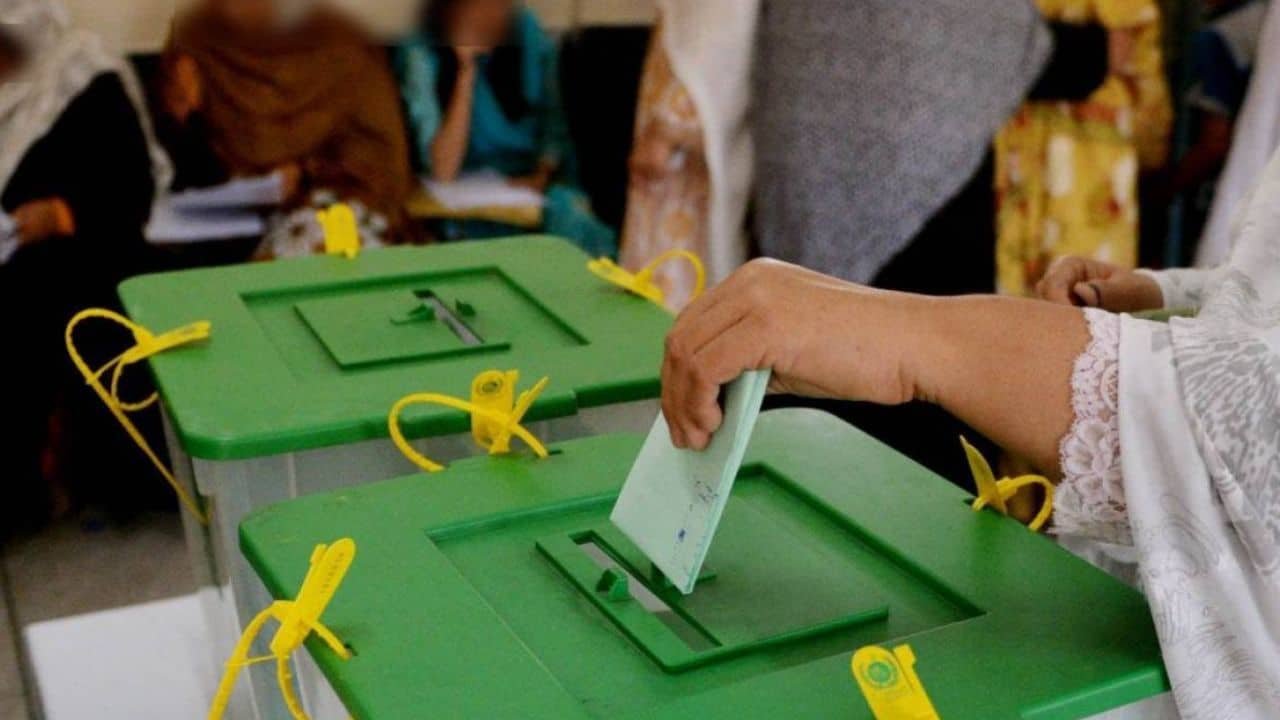
    In a bid to ensure transparency and fairness in the upcoming electoral process, the Election Commission of Pakistan (ECP) extended invitations to international observers and media, signaling its intention to conduct nationwide polls tentatively scheduled for the last week of January 2024, as reported by Nausheen Yusuf for Geo.

    In a two-page invite, sent under Section 238 of the Elections Act, 2017, the ECP explained the process for international observers and media to avail accreditation cards and visas to enter the country for the nationwide polls.

    “The Election Commission has announced General Election is tentatively scheduled in the last week of January 2024. The Election Commission of Pakistan, has an Open Door Policy for accreditation of any national and international Observer subject to the fulfillment of codal formalities (Section 238 of the Elections Act 2017),” said the ECP.

    The commission laid out a detailed procedure for obtaining necessary visas, directing interested parties to the Pakistan Online Portal of the Ministry of Foreign Affairs. Alongside the visa application, applicants were instructed to submit the accreditation application form accessible on the ECP’s official website.

    For the visa process, the ECP has explained that it may be obtained via the Ministry of Foreign Affairs’ “Pakistan Online Portal”. Along with the visa application, those wishing to come to the country for the polls will also need to attach the “accreditation application form” that is available on the ECP’s website.

    “After completion of codal formalities as per law, ECP will issue accreditation cards to security cleared international observers/media and arrange briefings for observers in ECP Secretariat,” added the commission. It also advised them to follow the advisories of the Foreign Office and the interior ministry.

    “We believe that the presence of international observers will add a valuable dimension to the electoral process, ensuring its transparency and impartiality while lending credibility to our electoral process. In this connection, all necessary arrangements will be made available for international observers to carry out their duties effectively and independently,” said the ECP.

    Pakistan has been embroiled in a state of political flux since the removal of the Imran Khan government through a no-confidence motion in April 2022. Subsequently, the coalition government that took over, dissolved the National Assembly on August 9, leading to the necessity of holding elections within 90 days, as per constitutional requirements.

    However, the ECP faced obstacles in meeting the deadline due to the need to establish new electoral boundaries following the approval of the census by the Council of Common Interest (CCI). Notably, the major political parties, including the Pakistan Tehreek-e-Insaf (PTI) and the Pakistan Peoples Party (PPP), had urged the ECP to expedite the electoral process to quell the prevailing political uncertainty in the country.
  • Vote register karwaayein October 28 tak

    Vote register karwaayein October 28 tak

    The Election Commission of Pakistan (ECP) on Tuesday extended the deadline for the voter registration and information update from October 25 to October 28 (Saturday).

    The decision was made during a meeting chaired by Chief Election Commissioner (CEC) Sikandar Sultan Raja.

    CEC Raja called upon the general public to utilise this final opportunity to ensure their registration, transfers, exclusions, and vote accuracy by October 28.

    How to register your vote:

    You can submit your application along with a copy of CNIC to the District Election Commissioner (DEC) or Registration Officer or Assistant Registration Officer of the district where you want to get your name enrolled.

    The prescribed Form (Enrolment / Transfer of Vote) is available online at the ECP website or it can be obtained free of cost from the office of the District Election Commissioner or Registration Officer or Assistant Registration Officer or Display Centre Incharge.

    How to check the details of your vote registration:

    Please type your CNIC without Hyphen (-) and spaces on your mobile and send it to 8300.

    After sending an SMS to 8300, an automated response will be generated, furnishing information such as the name of the electoral area, block code, and serial number.

    Each registered voter has the option to verify their details by visiting the District Election Commissioner’s (DEC) office in their respective area, where the complete electoral roll is accessible.

    How to transfer your vote

    There are two ways to transfer your vote:

    1. Visit the NADRA office and renew or modify your CNIC and ensure that the option to transfer your vote either at a temporary or permanent address is marked properly.
    2. Visit the office of the DEC Concerned and submit Form-21 (Click here to download Form-21). You can also submit the same form to the Form Submission Centers at the tehsil level. (Click here to check the list of Form Submission Centres).

    Eligibility to be a voter:

    A person shall be entitled to be enrolled as a voter in an electoral area if he—

    (a) is a citizen of Pakistan;

    (b) is not less than 18 years of age;

    (c) possesses a National Identity Card issued by the National Database and Registration Authority (NADRA) at any time till the last day fixed for inviting claims, objections and applications for preparation, revision or correction of electoral rolls;

    (d) is not declared by a competent court to be of unsound mind; and

    (e) is or is deemed under section 27 to be resident in the electoral area.

    Explanation: The National Identity Card issued by the National Database and Registration Authority (NADRA) shall be deemed to be valid for the purpose of registration as a voter or for casting vote in an election, notwithstanding the expiry of its validity period.

  • ‘If the Ministry of Interior cannot provide security to one person, how will it conduct elections’: Election Commission

    ‘If the Ministry of Interior cannot provide security to one person, how will it conduct elections’: Election Commission

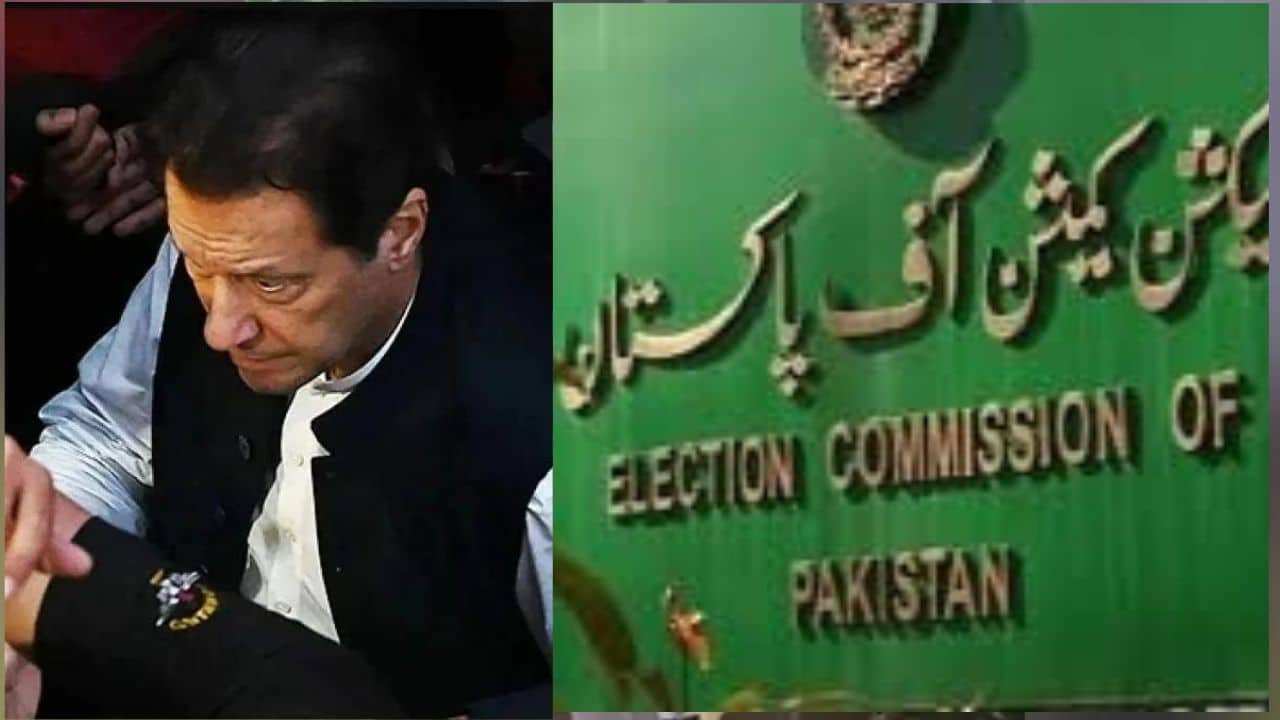
    The Election Commission of Pakistan (ECP) faced a setback on Tuesday as PTI Chairman Imran Khan couldn’t make it to a hearing due to security concerns. The Interior Ministry and Islamabad police were worried about the risks involved in bringing him to the commission, as he’s currently in jail for cipher case.

    Although the commission had earlier ordered that Imran Khan’s appear in person, the police and the ministry raised serious concerns about the safety of such a move.

    The commission was hearing a defamation case against the PTI chief, Asad Umar, and Fawad Chaudhry. A four-member commission headed by Nisar Durrani adjourned the hearing till November 13.

    Fawad Chaudhry and Asad Umar appeared before the commission, while Imran Khan was not brought to the election commission from Adiala Jail.

    PTI lawyer Shoaib Shaheen said the real insult to the election commission has taken place today.

    The operations assistant inspector general of police (AIG) submitted a report regarding Imran Khan, stating that Rawalpindi was a densely populated area, which is not without dangers.

    PTI Chairman Imran Khan has himself said there are threats to his life, the report stated.

    ECP’s member from Sindh, Nisar Durrani, asked the AIG if he believed whatever Imran Khan said was true.

    The Interior Ministry suggested that the election commission go to Adiala Jail to conduct the hearing to which the commission questioned how the ministry ordered them, ordering the interior secretary to appear before the commission.

    The commission asked the ministry to get it in writing from Imran Khan that he was sorry.

    “If the Ministry of Interior cannot provide security to one person, how will it conduct elections?” the commission questioned.

    ECP’s production order stated, “Since the respondent is in Adiala Jail […] and his personal appearance is mandatory to proceed further with the matter. In such view of the matter, there is no alternate except to issue production order of respondent namely Imran Ahmed Khan Niazi.”

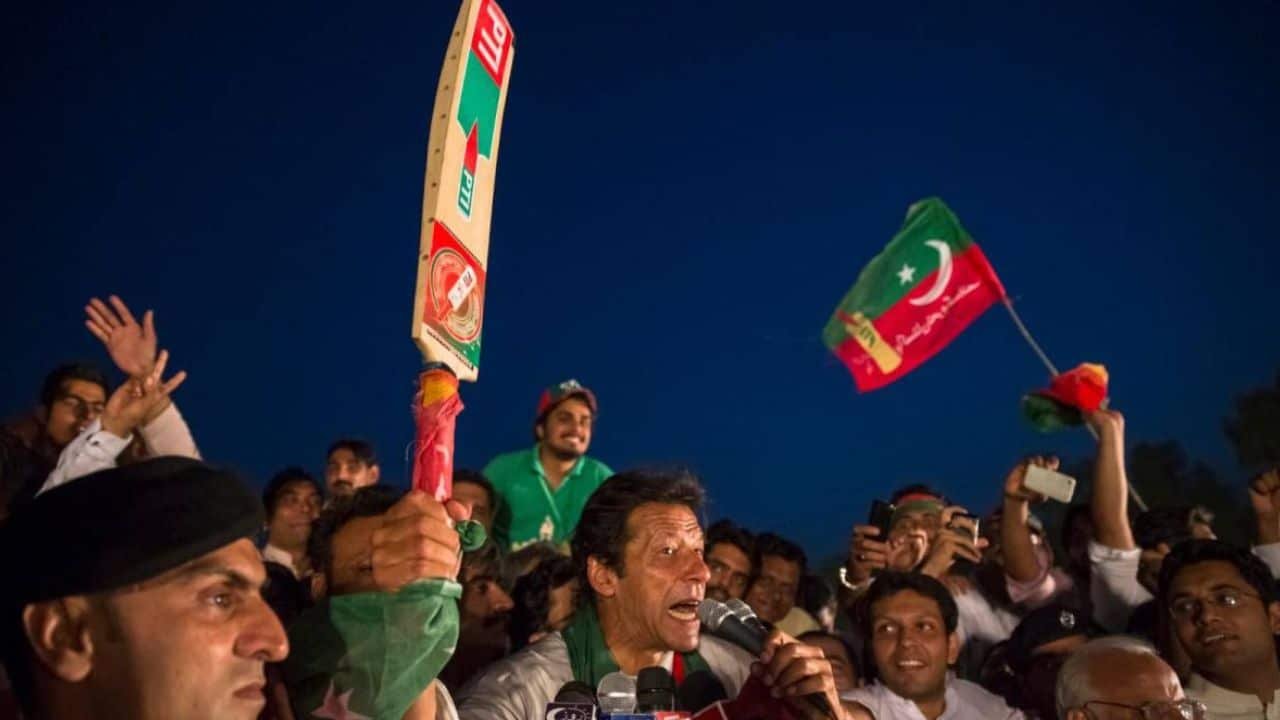
  • PTI ko chahiye sirf ‘ballay’ ka nishan

    PTI ko chahiye sirf ‘ballay’ ka nishan

    Pakistan Tehreek-e-Insaf (PTI) has asked the Election Commission of Pakistan (ECP) to promptly release a detailed written order regarding the issuance of the party’s election symbol.

    Highlighting the importance of justice and fairness, Senator Barrister Syed Ali Zafar, the party’s counsel, submitted an application on Wednesday to the Commission, emphasizing the necessity of a comprehensive decision in the interest of transparency.

    Senator Zafar underscored that the Election Commission’s earlier notice to the PTI, rejecting the allocation of the cricket bat symbol due to purported intra-party election discrepancies, was a misstep. He contended that the PTI had indeed conducted intra-party elections on June 9, 2022, in accordance with its constitution.

    According to Senator Zafar, the Election Commission’s subsequent decision on August 30, 2023, had validated the PTI’s stance on the legitimacy of the intra-party elections and had signaled the allocation of the bat symbol.

    However, despite the Commission’s initial commitment to issue a detailed decision following the verbal announcement, the order had not been provided even after 41 days.

    “PTI is the largest political party in the country, which is contesting the upcoming elections. Not issuing a detailed decision even after 41 days is a clear violation of fundamental rights, including articles 4, 9, 10A, 15, 16, 17 and 26 of the Constitution,” he said.

    Ali Zafar insisted that according to the Constitution, ECP was bound to hold free, fair, impartial, and transparent elections, while avoiding detailed decisions was a deviation from this constitutional mandate.

    He further added that under the Constitution of Pakistan, the ECP was bound to organize and conduct the election in a manner that was honest, just, fair, and in accordance with the law, but the non-issuance of the detailed written order was contrary to this.

    “The entire world is watching the proceedings of the ECP and the delay in the decision is unnecessarily creating contrary false rumors as if the decision orally announced on Aug 30, 2023, is going to be varied,” he said.

  • ‘Election and democracy halted for one person’s return’: Bilawal takes swipe at Nawaz

    ‘Election and democracy halted for one person’s return’: Bilawal takes swipe at Nawaz

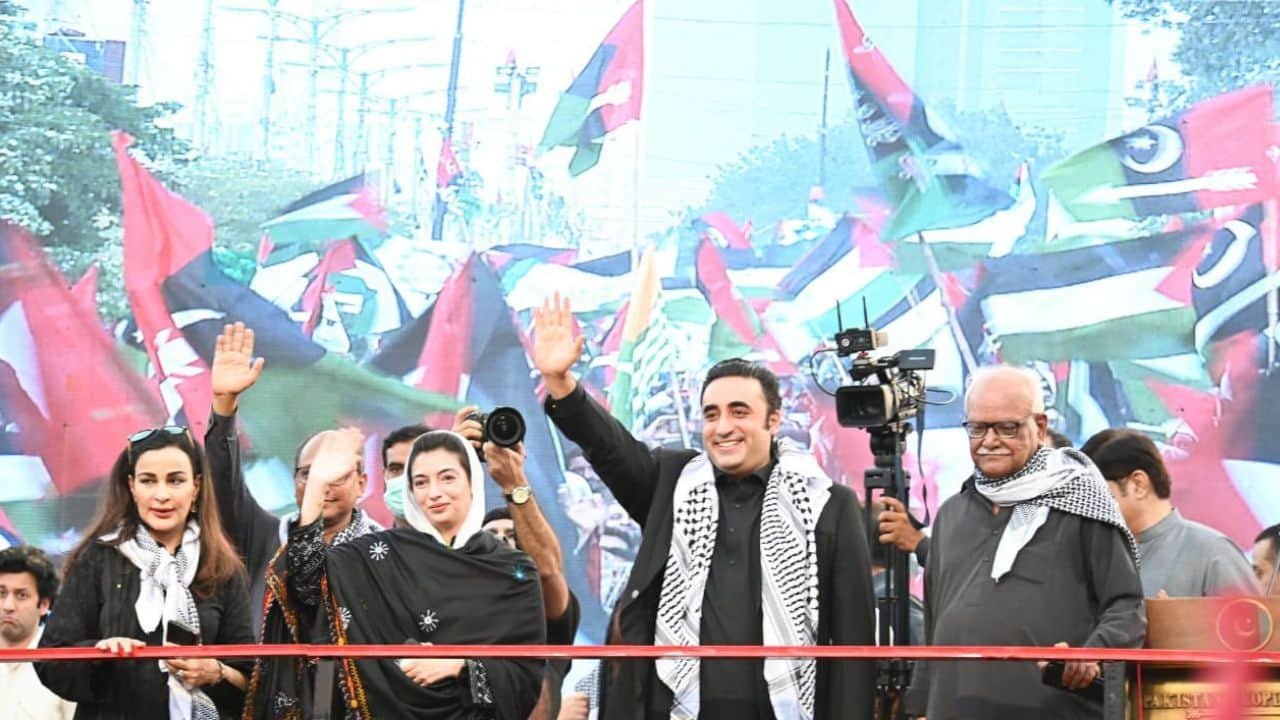
    Pakistan Peoples Party (PPP) Chairman Bilawal Bhutto-Zardari made thinly veiled references to PML-N supremo Nawaz Sharif while addressing a public gathering held in connection with the 16th anniversary of the Karsaz tragedy, outside Bilawal House in Karachi.

    He said on Wednesday that the country’s constitution, election, and democracy were halted for “one person’s return.”

    Despite being partners in the last government and demanding the former three-time prime minister’s return, the PPP has kept raising concerns that Nawaz might get “special relief”.

    Nawaz will return to Pakistan on Saturday (October 21) and has been granted protective bail till October 24 in Avenfield and Al-Azizia case. Arrest warrants in Toshakhana case have also been suspended till October 24.

    “Our previous allies will have to acknowledge that delaying elections will not ‘give respect to vote’, rather disrespect it,” Bilawal said during a public rally in Karachi, hitting out at the PML-N, whose slogan has been “vote ko izzt do (give respect to the sanctity of vote)”.

    The PPP chairman also said that he wants to end the politics of divide and abuse, adding that if politicos keep fighting amongst themselves, the country will not progress.

    “We can swallow the ‘bitter pill’ [of holding elections] in more than 90 days only when the election commission announces a date for the polls,” he said.

    He called for holding elections, saying only people had the right to choose their leaders and make decisions for their future.

    “We have to leave politics of abuses and divide behind. We need new leadership… a leadership that is not stuck in the past but thinks about the future. We don’t want 90s’ Pakistan or 2017’s Pakistan. We want today’s Pakistan… Pakistan of 2023… a modern Pakistan,” he added.

    “The tenure of [coalition] government of the last 16 months taught us that Pakistan cannot be run from London,” he said.

    In view of the skyrocketing inflation and depleting economic reserves, the PPP leader demanded that relief should be given to the common man instead of the elite.

  • Major changes in Punjab’s National and Provincial Assembly seats

    Major changes in Punjab’s National and Provincial Assembly seats

    Five newly created districts in Punjab are set to receive a total of 13 national and provincial assembly seats as part of the preliminary delimitation, marking a notable shift in the political landscape.

    The districts in question are Kot Addu, Taunsa, Wazirabad, Talagang, and Murree. Among these, Kot Addu district in southern Punjab stands out, securing two National Assembly seats, NA-179 and NA-180, along with three provincial assembly constituencies: PP-276, PP-277, and PP-278.

    Wazirabad and Taunsa districts are also set to gain representation, with Wazirabad obtaining NA-66, PP-35, and PP-36, while Taunsa secures NA-183, PP-284, and PP-285.

    Talagang, which was carved out of Chakwal, will now share a National Assembly seat, NA-59, with Chakwal itself. This arrangement leads to Chakwal having one independent NA seat, and Talagang securing one provincial assembly seat, PP-23. PP-22 will be referred to as Chakwal-cum-Talagang.

    Similarly, Murree will not have an independent NA seat but will be included in NA-51, referred to as Rawalpindi-cum-Murree. Nonetheless, Murree will have representation in the provincial assembly with PP-06.

    These changes also entail a reduction in the number of national and provincial assembly seats for some districts. Dera Ghazi Khan, for instance, will see a decrease from four to three NA seats and a reduction from eight to six provincial assembly seats. Muzaffargarh, too, will experience a decrease, with two fewer NA seats, resulting in a drop from six to four NA seats, and a reduction in provincial assembly seats from 12 to eight.

    Gujranwala and Hafizabad, despite Gujranwala’s sizable population of 5.95 million, will collectively have only five seats, despite the potential for an additional independent seat. Dera Ghazi Khan is also set to lose one NA seat and two provincial assembly seats.

    These changes in seat allocations underscore the evolving political landscape in Punjab, reflecting efforts to ensure fair and equitable representation for all regions within the province.

  • Release political opponents, urges Maulana

    Release political opponents, urges Maulana

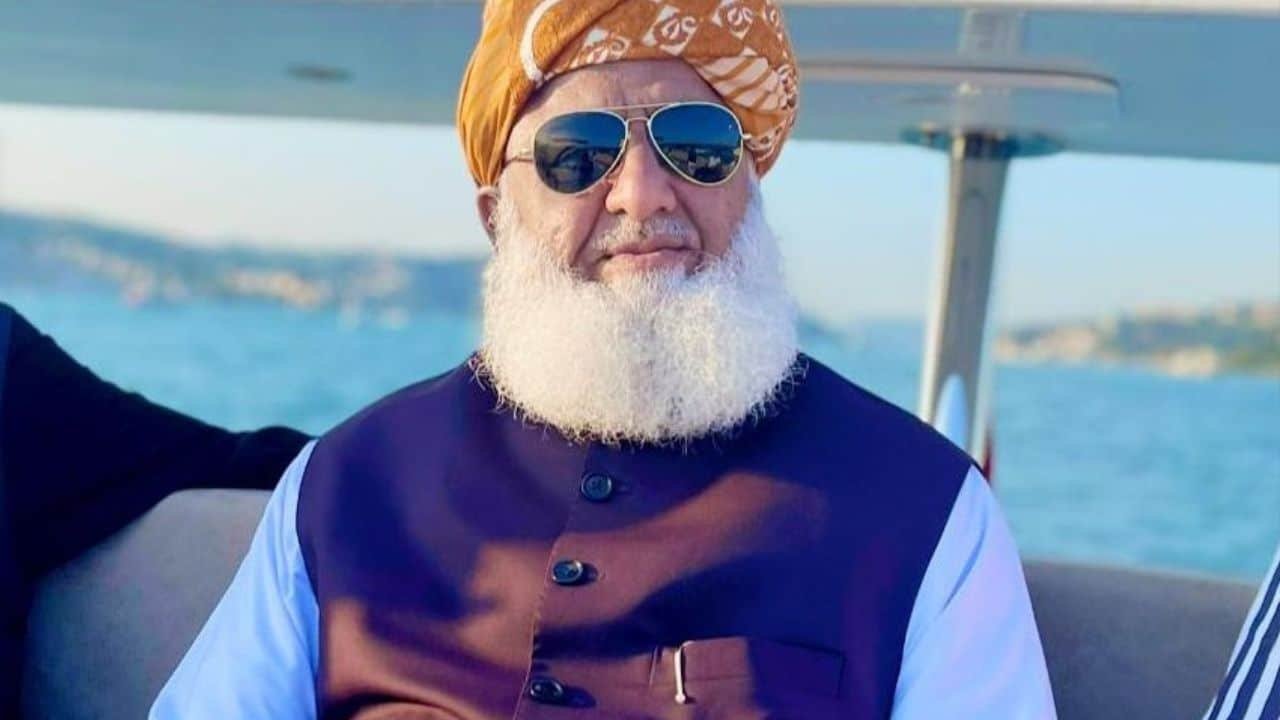
    In a recent address at the Jamiat Ulema-e-Islam Fazal (JUI-F) social media convention in Peshawar, Maulana Fazlur Rehman, the head of JUI-F, conveyed his desire to see imprisoned politicians released from incarceration.

    He emphasized that political parties need to direct their attention towards internal and external challenges faced by Pakistan.

    Maulana Fazlur Rehman expressed his reluctance to organize public gatherings against his incarcerated political opponents, stating that such actions do not befit the current circumstances.

    Addressing the return of Pakistan Muslim League-N (PML-N) supremo Nawaz Sharif to Pakistan, Maulana Fazlur Rehman encouraged the nation to welcome him.

    He criticized the Pakistan Tehreek-e-Insaf (PTI) chief, asserting that his governance had led the country into an economic crisis. He also pointed out that the pending court cases against the PTI leader could result in his disqualification, preventing him from participating in future elections.

    Maulana Fazlur Rehman further highlighted the Election Commission of Pakistan’s (ECP) announcement of elections in January, asserting that holding elections is a constitutional right.

  • What is Form 45 and why is it important in elections?

    What is Form 45 and why is it important in elections?

    The Election Commission of Pakistan (ECP) has recently made changes to Form 45, a document used for counting results.

    According to the ECP, from now on, date and time will also be entered into Form 45. The Commission said that objections to the amendment can be submitted till October 20.

    What is Form 45

    Form 45, commonly known as the “Result of the Count” form, is a significant record in the Pakistani electoral process. It plays a pivotal role in documenting and revealing voting outcomes at specific polling stations. Here, we delve into the importance of Form 45 and its role in Pakistan’s electoral process:

    Purpose: Form 45 is a cornerstone of transparency and accountability in Pakistan’s elections. Its primary goal is to create an official record of voting outcomes at specific polling stations. This documentation is indispensable for compiling and verifying results at the constituency level.

    Contents: Form 45 includes details like the polling station number, constituency name, the total number of registered voters at that station, the total votes cast, and a comprehensive breakdown of votes garnered by each candidate.

    Signatures: Form 45 is signed by the Presiding Officer responsible for overseeing the voting process. Additionally, representatives of candidates present at the polling station also sign the form as witnesses. These signatures are crucial for confirming the accuracy of recorded results.

    Transparency and Verification: Form 45 is instrumental in maintaining transparency throughout the voting process. It empowers candidates and their representatives to independently validate results recorded at the polling station and cross-reference them with the final results. This robust verification process minimizes the potential for irregularities or manipulation in election outcomes.

    Compilation and Reporting: After polling concludes, the Presiding Officer completes Form 45 and promptly submits it to the Returning Officer overseeing the respective constituency. The Returning Officer’s role is pivotal, as they collect and consolidate Form 45 from all polling stations within the constituency to determine final election results.

    Public Accessibility: In a dedicated effort to promote transparency, the Election Commission of Pakistan (ECP) mandates Presiding Officers to prominently display Form 45 outside polling stations for public scrutiny. This transparency measure enables voters, candidates, and their representatives to openly observe, verify, and validate election results, fostering confidence in the electoral process.

  • Election Commission takes notice of violations in Sindh

    Election Commission takes notice of violations in Sindh

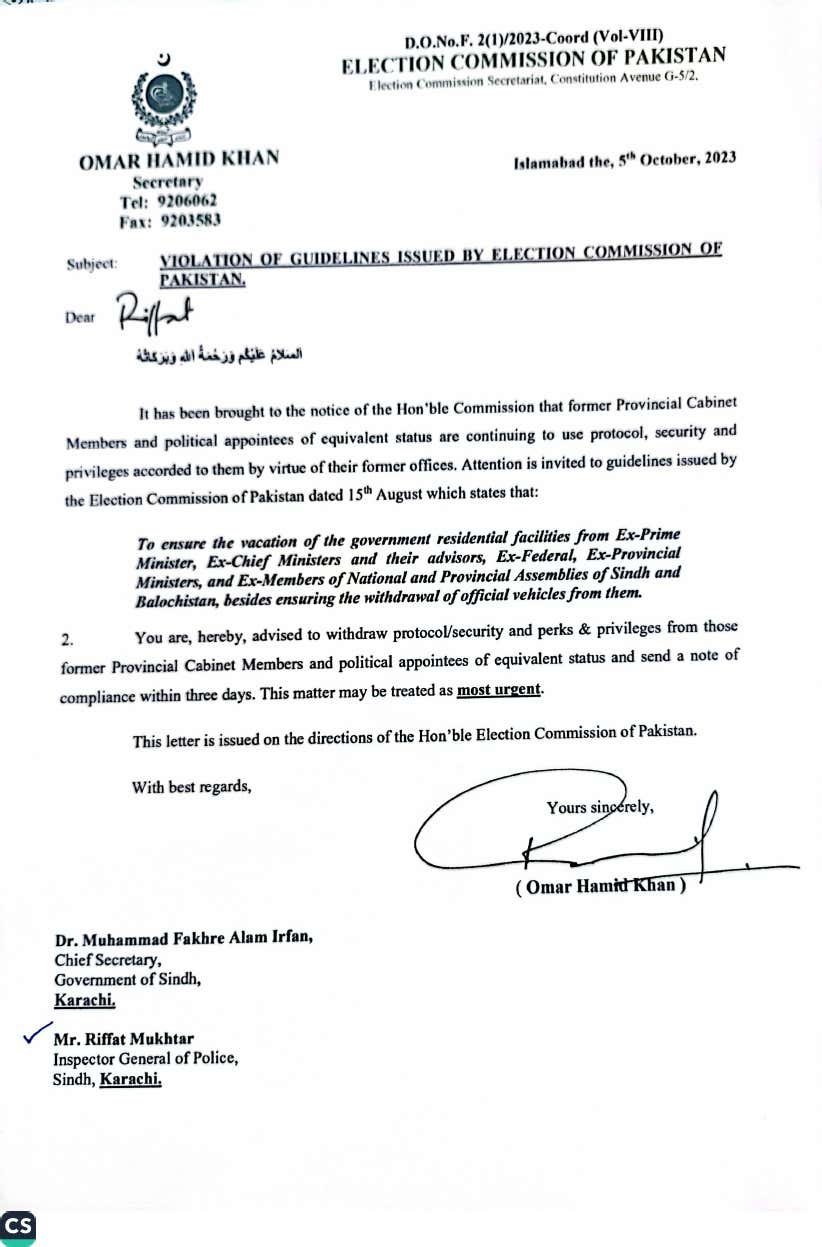
    The Election Commission of Pakistan (ECP) has issued a directive instructing the Chief Secretary of Sindh to immediately withdraw security, privileges and protocols from former members of the provincial cabinet and government officials. The decision follows the conclusion of the provincial government’s tenure and the upcoming general elections scheduled for the beginning of next year, after the delimitation process.

    In a letter addressed to the provincial secretary and inspector general, Election Commission Secretary Omar Hamid highlighted that former officials and cabinet members were still benefiting from the perks and privileges associated with their former positions.

    The letter stated, “You are, hereby, advised to withdraw protocol/security and perks and privileges from those former provincial cabinet members and political appointees of equivalent status and send a note of compliance within three days. This matter may be treated as most urgent.”

    The ECP had earlier on August 15 sent a letter to provincial authorities for withdrawal of the official protocol of the then members of former Chief Minister Murad Ali Shah-led cabinet and government officials.

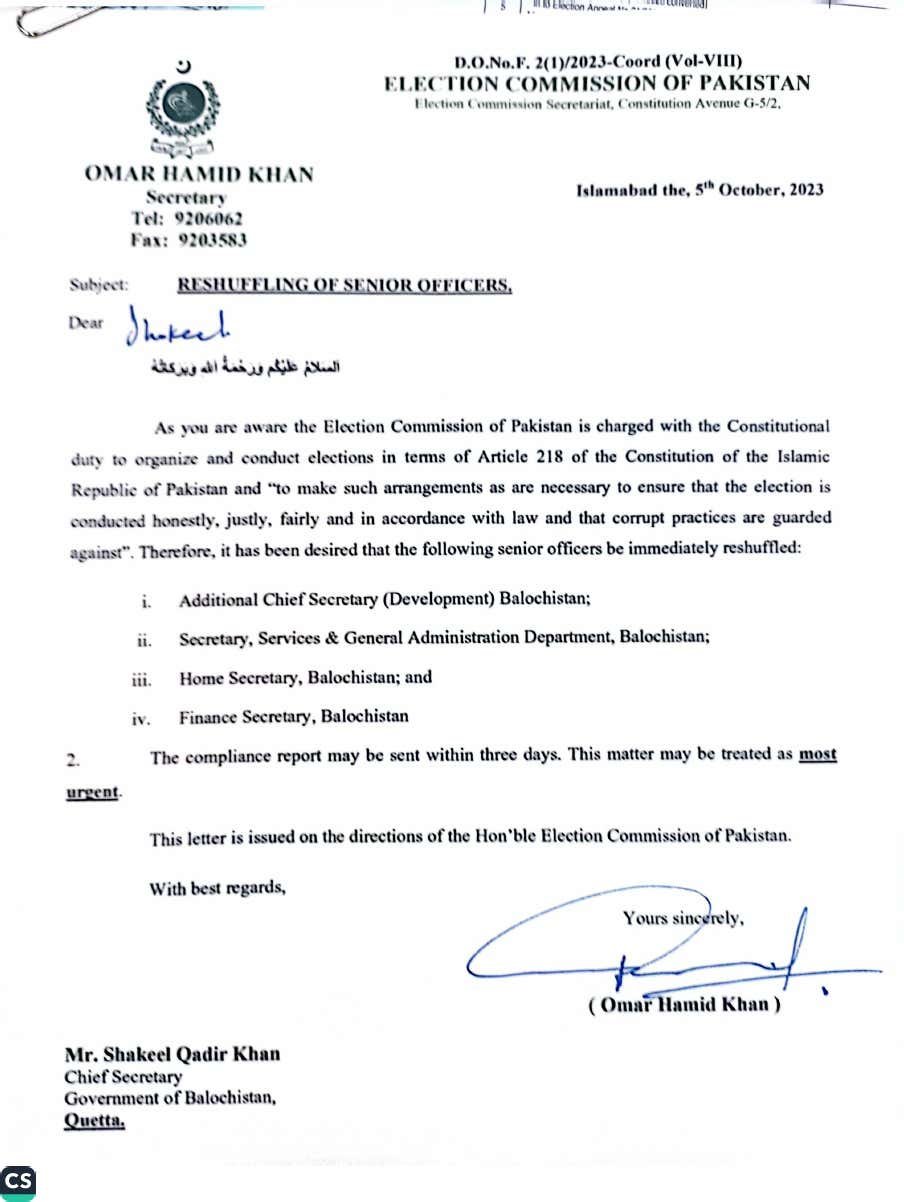
    Additionally, in a separate communication to the Balochistan chief secretary, the Election Commission directed the immediate replacement of existing officials with new appointees for specific positions.

    The letter states, “As you are aware the Election Commission of Pakistan is charged with the Constitutional duty to organize and conduct elections in terms of Article 218 of the Constitution of the Islamic Republic of Pakistan and “to make such arrangements as are necessary to ensure that the election is conducted honestly, justly, fairly and in accordance with law and that corrupt practices are guarded against. Therefore, it has been desired that the following senior officers be immediately reshuffled:

    1. Additional Chief Secretary (Development) Balochistan
    2. Secretary, Services & General Administration Department, Balochistan
    3. Home Secretary, Balochistan
    4. Finance Secretary, Balochistan”

    The ECP has requested a compliance report from the concerned authorities within three days.

  • ‘Remove Imran’s name’; petition filed in Election Commission

    ‘Remove Imran’s name’; petition filed in Election Commission

    Election Commission of Pakistan (ECP) will be hearing three separate petitions filed against PTI on October 10 by Khalid Mehmood Khan and Mohammad Awn Saqlain, as per Geo News.

    The petitions seek the removal of former prime minister Imran Khan’s name as Pakistan Tehreek-e-Insaf (PTI) chairman and declare the party ineligible for obtaining electoral symbol.

    Khalid Mehmood Khan has also asked for the electoral body to take action against PTI in one of his petitions, alleging that the party is still receiving “prohibited funds from foreign entities”.

    Meanwhile, another application filed by Mohammad Awn Saqlain seeks PTI to be declared ineligible for electoral symbols under Section 215(4) of the Election Rules 2017.

    The rule states, “Where a political party or combination of political parties, severally or collectively, fails to comply with the provision of section 209 or section 210, the Commission shall issue to such political party or parties a notice to show cause as to why it or they may not be declared ineligible to obtain an election symbol.”

    The ECP will also hear a case against PTI’s former leader Fawad Chaudhry for making “contemptuous” remarks and “intemperate” language against the electoral body and its officials.

    It is pertinent to know that at present, PTI Chairman and former prime minister Imran Khan is imprisoned in Adiala jail in the cipher case after the Federal Investigation Agency — in August — booked the PTI chief under the Official Secrets Act for allegedly misplacing and misusing the classified document for vested political interests.