Tag: Election Commission

  • Raja Riaz, Rana Sanaullah ki prediction sach sabit hui

    Raja Riaz, Rana Sanaullah ki prediction sach sabit hui

    A three-member bench, headed by Chief Justice Qazi Faez Isa and comprising Justice Aminuddin Khan and Justice Athar Minallah, was hearing petitions filed by the Supreme Court Bar Association (SBCA) and others seeking directives to hold general elections within 90 days as stipulated by the Constitution.

    During the hearing, Election Commission of Pakistan (ECP) lawyer, Sharjeel Sawati, said that elections will be held on February 11, as per Geo News.

    Former leader of the opposition in National Assembly (NA) Raja Riaz had said on August 12 this year that the upcoming general elections would be held in February 2024 – three months later than the constitutionally allowed limit of 90 days.

    Talking to Maria Memon on Sawal ye Hai on ARY News, the Pakistan Tehreek-e-Insaf (PTI) dissident leader said, “Elections will be held 4 to 5 days before or after February 15.”

    While talking to Kashif Abbasi on his program, Off the Record, on Tuesday, August 15, he said, “The ‘elders’ have decided that the general elections will be held in February.”

    PML-N leader Rana Sanaullah said on Tuesday, August 15, that his party’s supremo, Nawaz Sharif, was confident that general elections would be held in the country in February next year.

    “He (Nawaz) is sure that elections will take place in February. Delimitation of constituencies has to be completed before then, and it will be completed by December,” Sanaullah said while responding to a question about Nawaz’s expected return to Pakistan during an appearance on Geo News show ‘Aaj Shahzeb Khanzada Kay Saath’.

    READ MORE: Finally, ECP gives date for general elections

  • Finally, ECP gives date for general elections

    Finally, ECP gives date for general elections

    A three-member bench, headed by Chief Justice Qazi Faez Isa and comprising Justice Aminuddin Khan and Justice Athar Minallah, is hearing petitions filed by the Supreme Court Bar Association (SBCA) and others seeking directives to hold general elections within 90 days as stipulated by the Constitution.

    During the hearing, Election Commission of Pakistan (ECP) lawyer, Sharjeel Sawati, said that elections will be held on February 11, as per Geo News.

    After being questioned about wether they have consulted with the president of Pakistan on the date or not, the lawyer was instructed to consult with Arif Alvi today.

    Chief Justice of Pakistan (CJP) Qazi Faez Isa on Thursday remarked that President Arif Alvi violated the Constitution by not giving a date for general elections.

    At the outset of the hearing, Pakistan Peoples Party (PPP) counsel Farooq Naek told the court that his party had submitted the request to become a party in the case.

    After this, PTI’s lawyer Ali Zafar started his arguments by saying that the party has limited its petition to only seeking timely elections.

    “Elections must be held within 90 days after the dissolution of assemblies as per the Constitution,” he stressed. At this, CJP Isa said that the plea seeking polls within 90 days has then become ineffective.

    “The court was told that it was impossible to hold polls within 90 days in the previous hearing,” he remarked.

    Zafar then said that PTI only wants elections.

    He further said that there won’t be any parliament and law if elections are not conducted.

    “Giving a date and schedule of elections are two different things. President Dr Arif Alvi had written a letter to hold consultations with the ECP,” he remarked.

    The CJP observed that the president had written in his letter that the court should look into the matter of elections.
    “Is the president saying that court should take notice of the issue about elections,” he questioned.

    At this, Zafar replied that the president had said that the court can also review the matter.

    CJP Isa then said that the president did not give any date for elections in his letter. “Did the president not fulfil his constitutional duty,” he asked.

    Zafar said that the president fulfilled his responsibility by consulting on the elections.

    On this point, Justice Minallah asked why the president wrote the letter in September and not on August 15 after the assemblies were dissolved on August 9.

    “Did the president only ask the Supreme Court verbally to take notice of the matter,” asked CJP. He further said that the head of state wrote the letter to the ECP and not to SC.

    CJP Isa then questioned whether the apex court had the authority to give a date for polls. “Is it necessary for the president to consult the prime minister to give a date,” he inquired.

    Zafar replied that consultations are not necessary as the president has his own constitutional duty to give a date.

    During the last hearing, the SC had issued notices to the Election Commission of Pakistan (ECP) and the federal government for their input on polls within 90 days.

    The ECP had earlier set the date for elections in Punjab on April 30, but then postponed them to October 8 — in Punjab as well as KPK.

    PTI filed a plea in the top court against this decision.

    On April 4, the SC had ordered the government and the ECP to hold elections for Punjab assembly on May 14 but both institutions said this would not be possible due to shortage of resources, including funds and manpower.

    On September 21, the ECP announced that general elections will be held in the last week of January 2024. However, it did not issue a specific date.

    The commission also published the preliminary constituency lists.
    According to the ECP, objections to the preliminary constituency lists will be entertained until October 26, with hearings on these objections slated to run until November 25.

    The final electoral rolls are scheduled for release by November 30, and within 54 days following this publication, the election commission has outlined the election timetable.

  • General Elections ki date aa gaee?

    General Elections ki date aa gaee?

    The Election Commission of Pakistan (ECP) is getting ready for the next big elections.

    The commission is thinking of setting January 28 as the day for the General Elections in 2024, as per Waqar Satti of Geo News.

    ECP is set to apprise the Supreme Court (SC) after it sought the commission’s response in a case pertaining to timely elections.

    Chief Justice of Pakistan (CJP) Qazi Faez Isa, earlier this week, during the apex court’s hearing on the issue of timely elections, observed that it was “not possible” to meet the 90-day deadline for holding elections and lamented the lack of preparations of the petitioners.

    The CJP’s remarks came as he is leading a three-member bench comprising himself, Justice Athar Minallah, and Justice Amin-Ud-Din Khan to hear petitions filed by the Supreme Court Bar Association (SCBA), Pakistan Tehreek-e-Insaf (PTI), and others, seeking elections within the 90-day constitutional limit.

    During the hearing, the SCBA lawyer apprised the court that the “90-day period will complete on November 3″.

    To this, CJP Isa inquired whether it would even be possible to hold the polls within 90 days, to which the lawyer conceded that even if the top court gives the order even then it will not be possible to hold the elections within 90 days.

    The National Assembly, as well as the Sindh and Balochistan assemblies, were dissolved by the Shehbaz Sharif-led government on August 9.

    This was done so the ECP could have enough time to organize the elections within the 90-day limit.

    However, the ECP had to wait a bit longer to get everything sorted because they needed to consider the new population census approved by the Council of Common Interest (CCI). This meant they had to do some fresh planning and organization.

    The ECP later announced that the new elections would happen in the last week of January 2024. But before they made this announcement, some people had filed petitions in the Supreme Court, asking them to make sure the elections happen within the 90-day limit.

    These petitions were filed a while back but weren’t looked at during the tenure of former Chief Justice Umar Ata Bandial.

  • ECP invites international observers, media ahead of January elections

    ECP invites international observers, media ahead of January elections

    In a bid to ensure transparency and fairness in the upcoming electoral process, the Election Commission of Pakistan (ECP) extended invitations to international observers and media, signaling its intention to conduct nationwide polls tentatively scheduled for the last week of January 2024, as reported by Nausheen Yusuf for Geo.

    In a two-page invite, sent under Section 238 of the Elections Act, 2017, the ECP explained the process for international observers and media to avail accreditation cards and visas to enter the country for the nationwide polls.

    “The Election Commission has announced General Election is tentatively scheduled in the last week of January 2024. The Election Commission of Pakistan, has an Open Door Policy for accreditation of any national and international Observer subject to the fulfillment of codal formalities (Section 238 of the Elections Act 2017),” said the ECP.

    The commission laid out a detailed procedure for obtaining necessary visas, directing interested parties to the Pakistan Online Portal of the Ministry of Foreign Affairs. Alongside the visa application, applicants were instructed to submit the accreditation application form accessible on the ECP’s official website.

    For the visa process, the ECP has explained that it may be obtained via the Ministry of Foreign Affairs’ “Pakistan Online Portal”. Along with the visa application, those wishing to come to the country for the polls will also need to attach the “accreditation application form” that is available on the ECP’s website.

    “After completion of codal formalities as per law, ECP will issue accreditation cards to security cleared international observers/media and arrange briefings for observers in ECP Secretariat,” added the commission. It also advised them to follow the advisories of the Foreign Office and the interior ministry.

    “We believe that the presence of international observers will add a valuable dimension to the electoral process, ensuring its transparency and impartiality while lending credibility to our electoral process. In this connection, all necessary arrangements will be made available for international observers to carry out their duties effectively and independently,” said the ECP.

    Pakistan has been embroiled in a state of political flux since the removal of the Imran Khan government through a no-confidence motion in April 2022. Subsequently, the coalition government that took over, dissolved the National Assembly on August 9, leading to the necessity of holding elections within 90 days, as per constitutional requirements.

    However, the ECP faced obstacles in meeting the deadline due to the need to establish new electoral boundaries following the approval of the census by the Council of Common Interest (CCI). Notably, the major political parties, including the Pakistan Tehreek-e-Insaf (PTI) and the Pakistan Peoples Party (PPP), had urged the ECP to expedite the electoral process to quell the prevailing political uncertainty in the country.

  • What is Form 45 and why is it important in elections?

    What is Form 45 and why is it important in elections?

    The Election Commission of Pakistan (ECP) has recently made changes to Form 45, a document used for counting results.

    According to the ECP, from now on, date and time will also be entered into Form 45. The Commission said that objections to the amendment can be submitted till October 20.

    What is Form 45

    Form 45, commonly known as the “Result of the Count” form, is a significant record in the Pakistani electoral process. It plays a pivotal role in documenting and revealing voting outcomes at specific polling stations. Here, we delve into the importance of Form 45 and its role in Pakistan’s electoral process:

    Purpose: Form 45 is a cornerstone of transparency and accountability in Pakistan’s elections. Its primary goal is to create an official record of voting outcomes at specific polling stations. This documentation is indispensable for compiling and verifying results at the constituency level.

    Contents: Form 45 includes details like the polling station number, constituency name, the total number of registered voters at that station, the total votes cast, and a comprehensive breakdown of votes garnered by each candidate.

    Signatures: Form 45 is signed by the Presiding Officer responsible for overseeing the voting process. Additionally, representatives of candidates present at the polling station also sign the form as witnesses. These signatures are crucial for confirming the accuracy of recorded results.

    Transparency and Verification: Form 45 is instrumental in maintaining transparency throughout the voting process. It empowers candidates and their representatives to independently validate results recorded at the polling station and cross-reference them with the final results. This robust verification process minimizes the potential for irregularities or manipulation in election outcomes.

    Compilation and Reporting: After polling concludes, the Presiding Officer completes Form 45 and promptly submits it to the Returning Officer overseeing the respective constituency. The Returning Officer’s role is pivotal, as they collect and consolidate Form 45 from all polling stations within the constituency to determine final election results.

    Public Accessibility: In a dedicated effort to promote transparency, the Election Commission of Pakistan (ECP) mandates Presiding Officers to prominently display Form 45 outside polling stations for public scrutiny. This transparency measure enables voters, candidates, and their representatives to openly observe, verify, and validate election results, fostering confidence in the electoral process.

  • Election Commission takes notice of violations in Sindh

    Election Commission takes notice of violations in Sindh

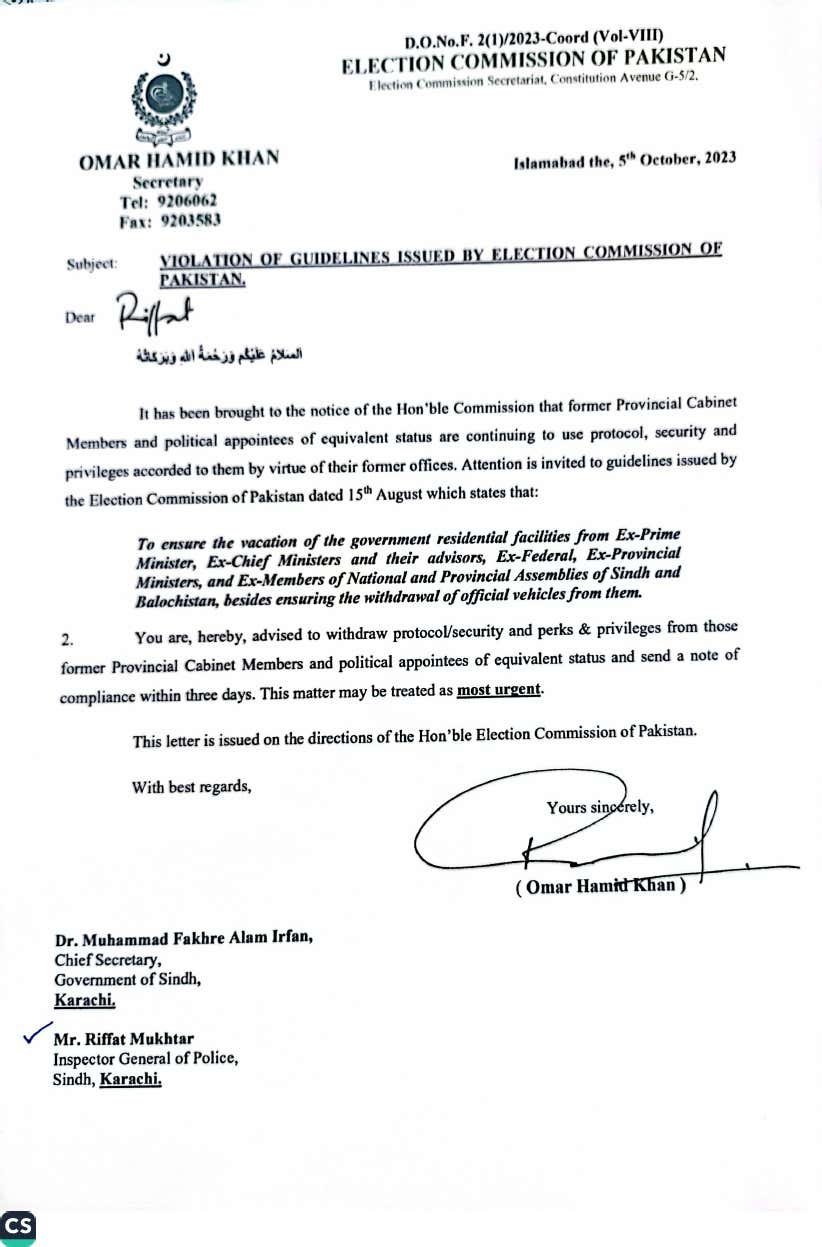
    The Election Commission of Pakistan (ECP) has issued a directive instructing the Chief Secretary of Sindh to immediately withdraw security, privileges and protocols from former members of the provincial cabinet and government officials. The decision follows the conclusion of the provincial government’s tenure and the upcoming general elections scheduled for the beginning of next year, after the delimitation process.

    In a letter addressed to the provincial secretary and inspector general, Election Commission Secretary Omar Hamid highlighted that former officials and cabinet members were still benefiting from the perks and privileges associated with their former positions.

    The letter stated, “You are, hereby, advised to withdraw protocol/security and perks and privileges from those former provincial cabinet members and political appointees of equivalent status and send a note of compliance within three days. This matter may be treated as most urgent.”

    The ECP had earlier on August 15 sent a letter to provincial authorities for withdrawal of the official protocol of the then members of former Chief Minister Murad Ali Shah-led cabinet and government officials.

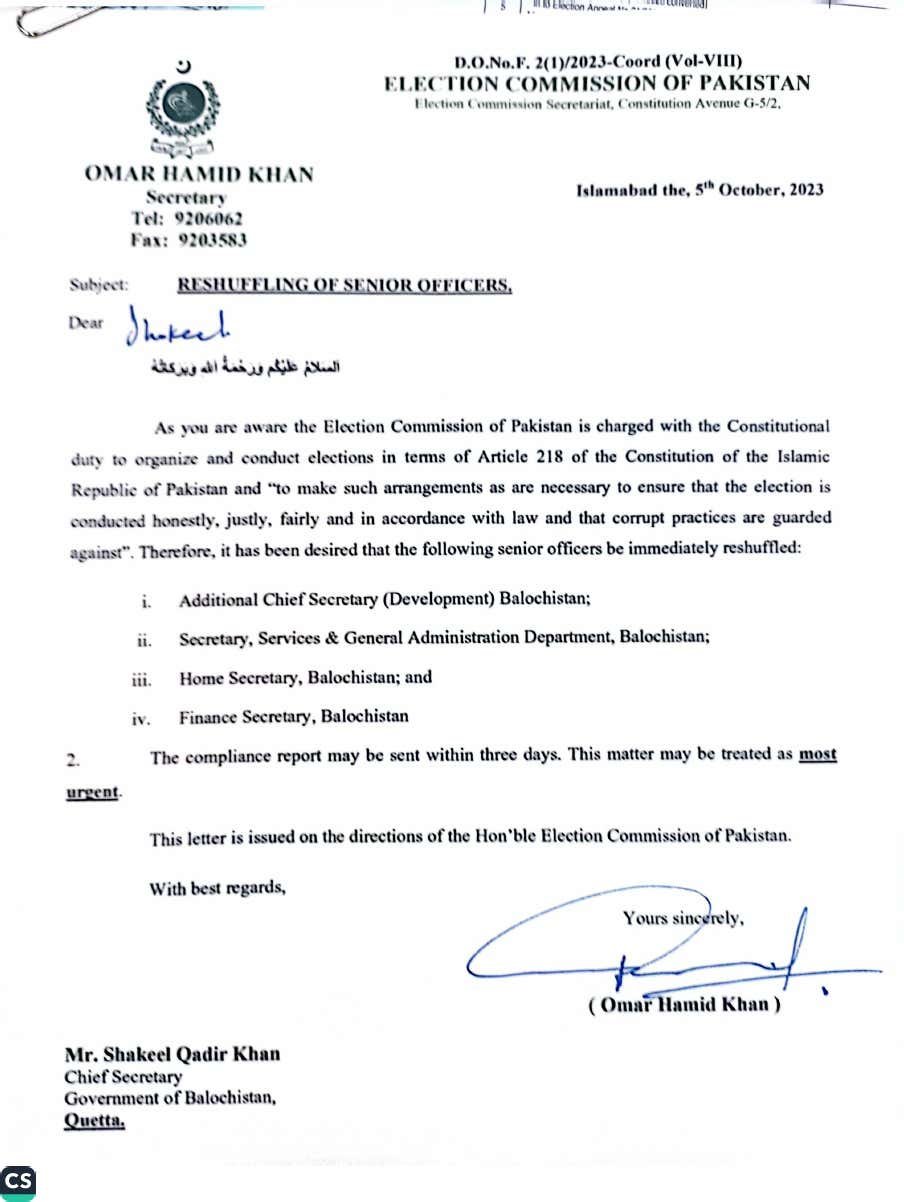
    Additionally, in a separate communication to the Balochistan chief secretary, the Election Commission directed the immediate replacement of existing officials with new appointees for specific positions.

    The letter states, “As you are aware the Election Commission of Pakistan is charged with the Constitutional duty to organize and conduct elections in terms of Article 218 of the Constitution of the Islamic Republic of Pakistan and “to make such arrangements as are necessary to ensure that the election is conducted honestly, justly, fairly and in accordance with law and that corrupt practices are guarded against. Therefore, it has been desired that the following senior officers be immediately reshuffled:

    1. Additional Chief Secretary (Development) Balochistan
    2. Secretary, Services & General Administration Department, Balochistan
    3. Home Secretary, Balochistan
    4. Finance Secretary, Balochistan”

    The ECP has requested a compliance report from the concerned authorities within three days.

  • Elections in Jan ‘24: How you can register to vote in Pakistan

    Elections in Jan ‘24: How you can register to vote in Pakistan

    The Election Commission of Pakistan (ECP) has set a new date for the general election in January, which is about three months later than originally planned. This decision was made to clear up confusion about when the election would happen and to help the struggling economy. 

    In this article, we will explain how you can sign up to vote in the upcoming election. 

    To register to vote, you need to send in an application along with a copy of your Computerised National Identity Card (CNIC) to the District Election Commissioner (DEC), Registration Officer, or Assistant Registration Officer in the district where you want to vote.

    You can find the necessary forms online on the ECP website or get them for free at the offices of the District Election Commissioner, Registration Officer, Assistant Registration Officer, or Display Centre Incharge. 

    To be eligible to vote, you must meet these criteria: 

    (a) You must be a citizen of Pakistan.  

    (b) You must be at least eighteen years old.  

    (c) You need to have a CNIC issued by the National Database and Registration Authority (NADRA) up until the last day for submitting claims, objections, and applications for updating the voter list.  

    (d) You must not have been declared legally unfit (unsound mind) by a court.  

    (e) You must either live in the area where you want to vote or be considered a resident under section 27. 

    Even if your NADRA ID has expired, it’s still valid for registering to vote or casting your vote in an election. 

  • Election Commission adamant about ensuring timely elections

    Election Commission adamant about ensuring timely elections

    After completing consultations with political parties, the Election Commission of Pakistan (ECP) on Friday announced that the delimitation process will be finalised by November 30. 

    A statement issued by the electoral body said the purpose of reducing the duration of the delimitation process is to ensure elections are held as early as possible.

    The ECP also said that a date for the elections will also be announced keeping in view the schedule for the delimitation process, adding that the date was announced after deliberation with the parties. 

    A day earlier, the Election Commission said that polls would be held by mid-February at the most or by January end if the delimitation of constituencies is completed earlier. 

    The Election Commission has held consultations with political parties including Pakistan Muslim League Nawaz (PML-N), Pakistan Peoples Party (PPP), Pakistan Tehreek-e-Insaf (PTI), Jamaat-e-Islami (JI), Muttahida Qoumi Movement-Pakistan (MQM-P) Jamiat Ulema Islam-Faiz (JUI-F) and others regarding the road map to general elections. 

    On August 17, the ECP announced the schedule of new delimitations to be carried out as per the new census approved by the Council of Common Interest (CCI) last month. 

    According to the schedule, the new delimitation of the constituencies was expected to be completed in December. However, the date has now been shortened to November. 

    Earlier, the ECP schedule had shown that the fresh delimitation would take nearly four months. 

    Last month, the CCI meeting chaired by then-prime minister Shehbaz Sharif approved the final results of the 7th Population and Housing Census 2023 reporting the country’s population at 241.49 million with a growth rate of 2.55%.

    The CCI approval made it constitutionally mandatory for the ECP to hold elections following fresh delimitations in the light of the results of the 7th census.

    According to Article 51 (5) of the Constitution, the seats of the National Assembly to each province and the federal capital shall be allocated on the basis of population in accordance with the last preceding census officially published.

  • Hamza contacts Elahi over appointment of caretaker CM in Punjab

    Hamza contacts Elahi over appointment of caretaker CM in Punjab

    Leader of the Opposition in the Punjab Assembly, Hamza Shehbaz, has instructed Pakistan Muslim League-Nawaz (PML-N) leader Malik Ahmed Khan to consult and contact Chief Minister (CM) Pervaiz Elahi over the appointment of a caretaker setup in Punjab.

    Governor Punjab Baligh Ur Rehman while forwarding the names sent by Pervez Elahi to Hamza Shehbaz tweeted, “I have received three names from Chief Minister Pervaiz Elahi, which are being forwarded to Opposition Leader Hamza Shehbaz Sharif. I would like to see both of the leaders jointly agree on any name within the stipulated period.”

    One of Elahi’s nominees, former civil servant Nasir Mehmood Khosa, when contacted by the PML-N, excused himself from accepting the post of caretaker CM.

    Defence Minister Khawaja Asif took to Twitter and confirmed that Nasir Khosa excused himself from the offer and declined to take the chair.

    It is pertinent to mention that if both Elahi and Hamza CM fail to reach a consensus, then the Punjab Assembly speaker would constitute a parliamentary committee, finalising the name within three days.

    If the committee also fails to reach an accord then the Election Commission will decide the name for the interim CM from the names forwarded by the government and Opposition.

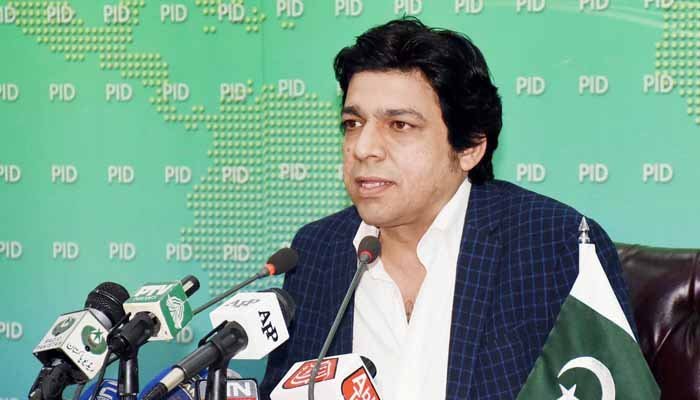
  • Court asks Faisal Vawda why he is afraid of Election Commission investigation

    Court asks Faisal Vawda why he is afraid of Election Commission investigation

    Pakistan Tehreek-e-Insaf (PTI) Senator Faisal Vawda filed a petition at the Islamabad High Court (IHC) seeking a stay against the proceedings of the Election Commission of Pakistan (ECP) in his disqualification case, reports Geo Urdu.

    Chief Justice IHC Athar Minallah dismissed the case and rejected Vawda’s petition.

    Vawda had adopted the stance that the case against him in the ECP had become invalid as the body could not make a decision within the time limit. The ECP was bound to decide the complaints within 60 days after he was elected. He requested the court to turn down the ECP decision dated October 12 and declare the case against him null and void.

    Justice Athar Minallah questioned, “Why are you afraid of being investigated by the ECP? Your application is inadmissble, it is rejected.”