Tag: Employment Trends

  • Pakistan’s Business Confidence Index increases in May 2024

    Pakistan’s Business Confidence Index increases in May 2024

    The overall Business Confidence Index (BCI) in Pakistan rose to 54.6 in May 2024, according to the 48th wave of the Business Confidence Survey conducted by the State Bank of Pakistan (SBP) and the Institute of Business Administration (IBA).

    This increase was driven by improvements in both the Industry and Services sectors, with the Industry BCI rising by 2.2 points to 52.1 and the Services BCI by 0.7 points to 55.4.

    The headline index, “Overall Business Confidence,” consists of the Current Business Confidence Index (CBCI) and the Expected Business Confidence Index (EBCI). The CBCI, reflecting economic conditions over the past six months, increased by 1.1 points to 51.2 in May 2024.

    Specifically, the Industry CBCI climbed by 2.8 points to 48.3, while the Services CBCI edged up by 0.5 points to 52.1, indicating more positive and neutral views and fewer negative perceptions.

    Looking ahead, the EBCI saw a 1.1-point increase to 58, driven by rises in both sectors. The Industry EBCI grew by 1.6 points to 55.9, and the Services EBCI by 0.9 points to 58.7, with a corresponding shift towards more positive and neutral expectations.

    However, the Purchasing Managers Index (PMI) fell by 0.6 points to 49.3, continuing to stay below the positive zone last seen in June 2022. Four of the five PMI components decreased: total orders by 1.5 points, business activities by 1.0 point, supplier delivery times by 0.6 points, and employment by 0.3 points. Only the quantity of raw material purchases slightly improved by 0.1 points.

    On inflation, expectations significantly dropped by 10.1 points to 56.0, with the Industry and Services sectors both showing decreases of 10.2 and 9.8 points, respectively.

    Employment trends were mixed. The Current Employment Index rose by 1.1 points to 51.2, primarily due to a 1.6-point increase in the Services sector, despite a slight 0.3-point decrease in the Industry sector.

    Conversely, the Expected Employment Index fell by 0.8 points to 55.1, driven by a 1.0-point decline in the Services sector, while the Industry sector showed a marginal increase of 0.1 points.

    Additionally, the Average Current Capacity Utilization (ACCU) in the Manufacturing sector within the Industry sector increased by 4.1 per cent to 67.7 per cent in May 2024.

  • IMF analysis reveals AI’s potential to disrupt 40% of jobs globally

    IMF analysis reveals AI’s potential to disrupt 40% of jobs globally

    In a recent comprehensive analysis, the International Monetary Fund (IMF) sheds light on the extensive impact of artificial intelligence (AI), unveiling its potential to disrupt nearly 40 per cent of all jobs worldwide.

    Kristalina Georgieva, the Managing Director of the IMF, expresses deep concerns about the consequences of widespread AI adoption, emphasising the likelihood of exacerbating existing inequalities.

    Georgieva underlines the urgency for policymakers to address this alarming trend, cautioning that unchecked deployment of AI could further widen social disparities and intensify tensions.

    The analysis indicates that the influence of AI on employment is expected to be particularly pronounced in advanced economies, with an estimated impact on approximately 60 per cent of jobs.

    While in about half of these cases, employees are poised to benefit from AI integration by enhancing their productivity and work capabilities, in other instances, AI may assume critical roles traditionally performed by humans.

    This shift in labour dynamics could lead to reduced demand for human workers, potentially affecting wages and, in some cases, resulting in job displacement.

    Contrary to the more significant impact projected for advanced economies, the IMF’s projections suggest that low-income countries may experience a comparatively lower impact, with AI affecting only around 26 per cent of jobs in these regions.

    Ms. Georgieva points out that many of these nations lack the necessary infrastructure or skilled workforces to harness the benefits of AI, raising concerns that the technology could exacerbate inequality among nations over time.

    This analysis aligns with a 2023 report by Goldman Sachs, estimating that AI has the potential to replace the equivalent of 300 million full-time jobs.

    However, the report also highlights the possibility of new job opportunities emerging along with a substantial increase in productivity.

    As the rapid proliferation of AI continues to spark intense debate, the global community faces the critical challenge of balancing the benefits and risks associated with this transformative technology.

  • Young Pakistanis in the UK lead in unemployment, govt stats confirm 

    Young Pakistanis in the UK lead in unemployment, govt stats confirm 

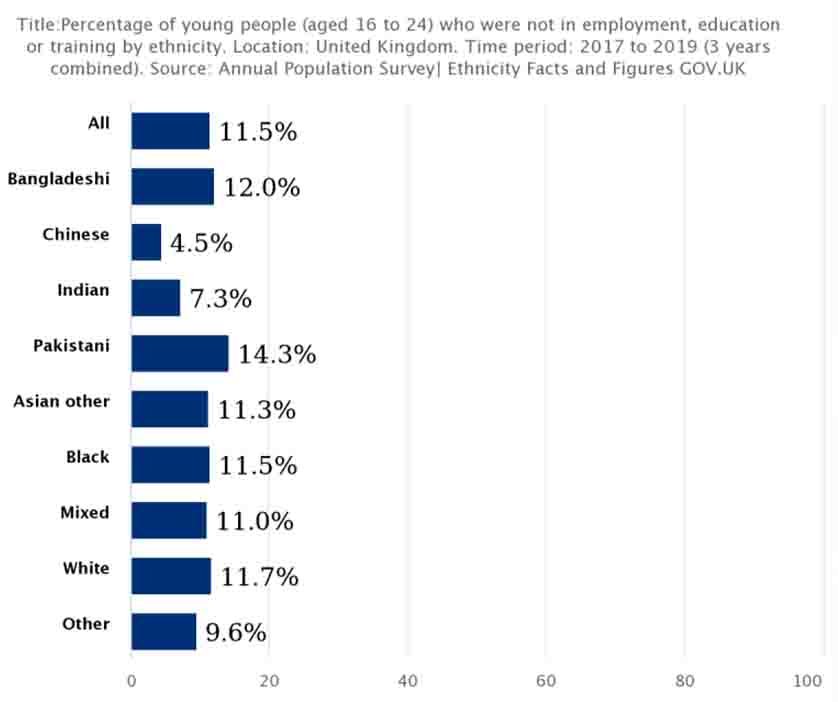
    Official data from the United Kingdom’s government shows that among different ethnic groups in the country, young Pakistanis are the least active in terms of work and education. 

    The dataset in question is categorised as “unemployment,” encompassing individuals aged 16 to 24 who are neither employed nor engaged in any form of training or educational pursuits. This data was systematically collected over a three-year period spanning from 2017 to 2019. 

    Notably, within the spectrum of ethnic backgrounds in the UK, individuals of Pakistani origin stand out with the highest unemployment rate at 14.3 per cent, surpassing their counterparts from nine other nations. The next highest rate pertains to individuals of Bangladeshi descent at 12 per cent, while young individuals of Indian heritage exhibit a comparatively lower inactivity rate of 7.3 per cent, as indicated by the data. 

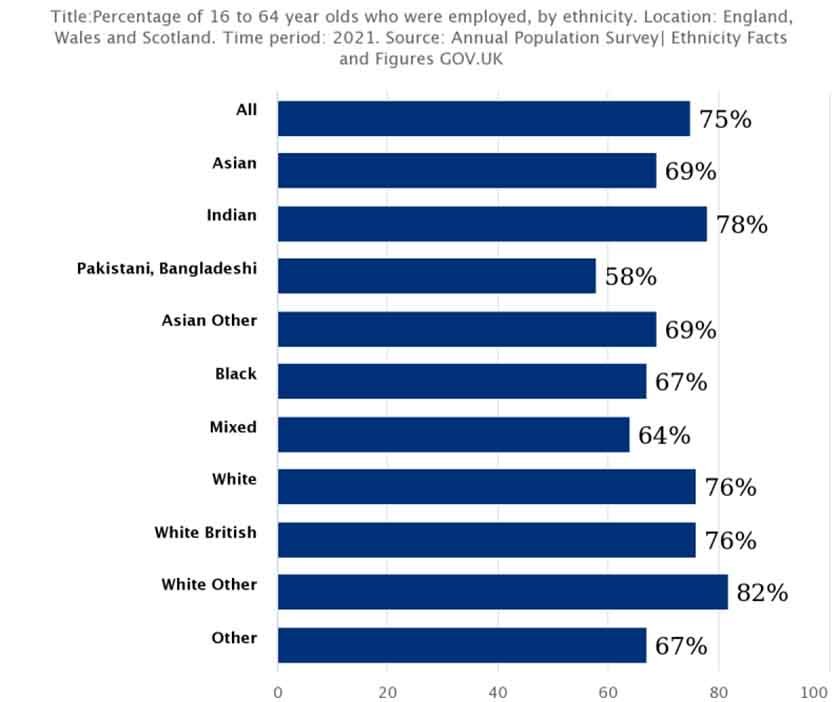
    A similar pattern is discernible when examining the overall employment data for the country, which encompasses individuals aged 16 to 64. In this context, Pakistani and Bangladeshi individuals are grouped together and collectively exhibit the lowest employment rate, standing at a mere 58 per cent, the lowest among ten defined categories. In contrast, individuals of Indian descent display a more favourable employment rate at 78 per cent, trailing only those of non-British white origin, of whom 82 per cent are gainfully employed. 

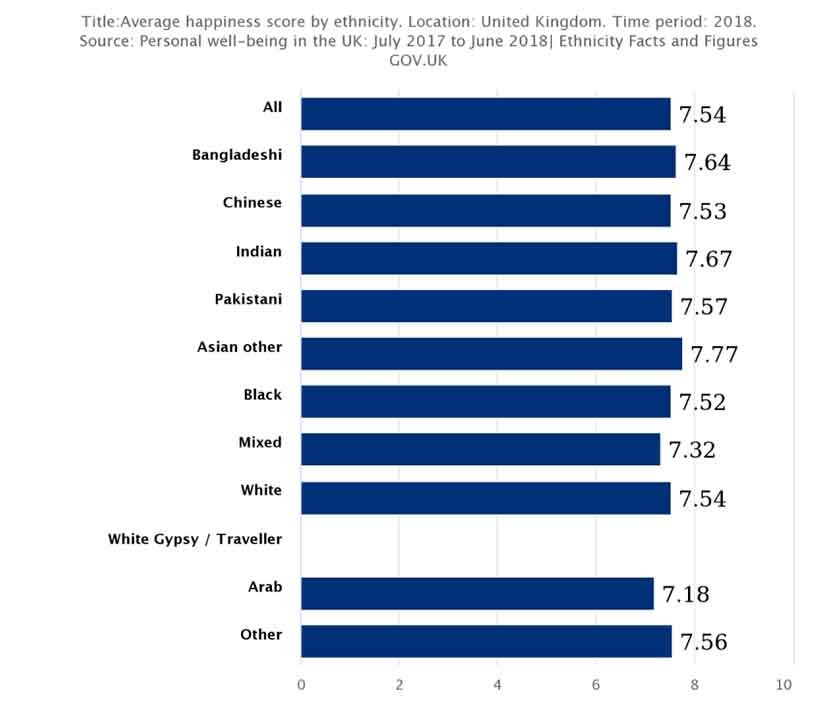
    It is worth noting, however, that the observed trends in employment and unemployment figures do not appear to have a conclusive impact on the overall happiness score, as the data does not differentiate by age and represents the broader community. The happiness index assigns a score on a scale of 10, and according to the data, individuals of Pakistani descent in the UK have a happiness score of 7.57, ranking as the fourth highest among the ten surveyed ethnic groups. 

    While individuals of Indian, Bangladeshi, and other ethnic backgrounds report higher levels of happiness than those of Pakistani origin, individuals of Arab, black, Chinese, and even white ethnicities exhibit lower happiness scores in comparison. 

  • Future of Jobs Report: 83 million jobs to be eliminated globally by 2027

    Future of Jobs Report: 83 million jobs to be eliminated globally by 2027

    The World Economic Forum (WEF) has published its Future of Jobs Report 2023, which examines how global trends and technologies may impact the job market, including in Pakistan. The report predicts that artificial intelligence (AI) and big data will be vital for companies’ skills strategies worldwide. The report also warns that 83 million jobs may disappear in the next five years across the world, with some jobs becoming obsolete.

    The report indicates that 23 per cent of jobs are expected to change by 2027, with 69 million new jobs created and 83 million eliminated. The green transition and localisation of supply chains are expected to generate a net increase in jobs. Cognitive skills, such as analytical and creative thinking, will be the most crucial skills for workers in the next five years, with companies focusing on AI and big data in particular.

    The study provides a comprehensive evaluation of Pakistan’s performance related to the Future of Jobs in 2023 and predicts how the job market will unfold in the next 5-7 years. Pakistan has the most negative outlook globally, with a lower skill stability than the global average. The report identifies several global trends and technologies that will affect Pakistan’s job market, such as digital platforms and apps, big-data analytics, and education and workforce development technologies. These trends and technologies will play a crucial role in creating new employment opportunities and driving industry transformation.

    WEF’s report suggests that while reskilling and upskilling towards green skills is growing, it is not keeping pace with climate targets. The working-age population in Pakistan is 85.78 million, indicating a vast pool of potential talent. The country’s labor force participation rate is 57 per cent, with 55 per cent of the workforce in vulnerable employment. However, the unemployment rate remains relatively low at 5 per cent. It also highlights that 82 per cent of companies plan to adopt education and workforce development technologies in the next five years.

    Mishal Pakistan, the Country Partner Institute of the Center for New Economy and Societies Platform, World Economic Forum, has announced plans to develop a comprehensive report on the Future of Jobs for Pakistan in the third quarter of 2023.

    Amir Jahangir, Chief Executive Officer of Mishal Pakistan, believes that by strengthening the education system, investing in vocational and technical training, and fostering a culture of innovation, Pakistan can better equip its population to excel in the global job market. Saadia Zahidi, Managing Director of the World Economic Forum, emphasises that investing in education, reskilling, and social support structures will ensure individuals are at the heart of the future of work.