Tag: energy

  • Pakistan moves closer to finalising oil deal with Russia as team arrives in Karachi

    Pakistan has taken a step forward in its efforts to secure a loan deal with Russia, as a delegation has arrived in Karachi to finalise a crude oil deal with Pakistan State Oil (PSO). However, the Energy Ministry has not yet revealed the payment method or the discount rate for the crude oil prices, keeping it confidential for now.

    Technical teams from the Operational Services Centre held talks with the PSO team last month, but progress was not made on the constitution of a Special Purpose Vehicle responsible for importing crude and making payments. The Russian delegation is now in Pakistan to finalise the government-to-government agreement, including the mode of payment. Pakistan wants to pay in rupee, while Russia is asking for payment in China’s Yuan or Ruble. Once the deal is done, Pakistan will place an order with Russia for crude oil purchase.

    According to sources, the Russian ship will arrive in mid-May, and the current Brent price in the international market is $85.16 per barrel, while Russian oil is available at $47-48 per barrel. The State Bank of Pakistan (SBP) is asking local banks to open letters of credit for importing Russian oil, but they are hesitant to do so mainly because of the G7 countries’ regulations of following the price cap of $60 per barrel or below it and making payments under Society for Worldwide Interbank Financial Telecommunications (SWIFT) arrangement.

    PSO has never imported crude oil before, and refineries have been importing crude under long-term agreements from ADNOC and Saudi Aramco. However, in the case of Russian crude, refineries will not be involved in the import, but it will be an SPV with representatives from PSO and PSC. Pakistan may get Russian crude price with a discount close to $50 per barrel, $10 per barrel below the cap price imposed by G7 countries on Russian oil in the wake of the war on Ukraine.

    One of the top officials in the coalition government suggests that the decision to import Russian crude under the government-to-government agreement at a 30 per cent discount may not provide the required relief as shipping and refining costs will erode the maximum discount. Additionally, Pakistan refineries will only be able to extract 10 per cent MS out of Ural crude and 50 per cent furnace oil.

    The government needs to conduct a commercial analysis to determine if importing Russian oil will benefit Pakistan’s economy and to what extent. Industrial sources suggest that the government should evaluate the economic benefits of importing Russian oil carefully.

  • Gas shortage worsens in Pakistan amid rising demand and low reserves

    Gas shortage worsens in Pakistan amid rising demand and low reserves

    Minister of State for Petroleum, Musadik Malik, stated on Wednesday that the general public cannot receive gas 24/7 due to a decline in the commodity’s reserves, which is a significant reason. Pakistan relies heavily on natural gas for energy, and with increasing demand and insufficient supply, load shedding has become a daily occurrence in many areas of the country. This situation worsens during Ramadan when Pakistanis consume more gas for cooking and other purposes, particularly during sehri and iftar timings.

    During a conversation with journalists in Karachi, the minister mentioned that gas load shedding would end during sehar and iftar but did not specify when. “We cannot provide gas for 24 hours as our reserves have decreased,” he stated. Recently, the issue of gas scarcity in Karachi has caught the attention of Prime Minister Shehbaz Sharif, who has directed relevant officials to ensure an uninterrupted supply of the commodity. He has instructed that the supply of gas must be monitored, and no negligence should be tolerated.

    Due to the widening gap between gas supply and demand, the Sui Southern Gas Company (SSGC) has announced its decision to suspend supplies to captive power plants and industries. The gas utility has stated that this decision has been made due to low gas supply, and the volume of gas in pipelines has decreased. In response, the Karachi Chamber of Commerce and Industry (KCCI) has called for immediate government action to address the shortage of gas supply to Karachi’s industries, stating that the industries cannot operate without gas and would be forced to halt production.

    KCCI President Muhammad Tariq Yousuf said, “It is highly unfair to have such an attitude towards Karachi’s business community, which, despite facing so many challenges, contributes around 54 per cent in terms of exports and more than 68 per cent in terms of revenue.”

    While talking to journalists, Malik said that his visit to Karachi was aimed at resolving the gas supply issues faced by the people and urged them to pay their utility bills. “The gas bill of the rich and poor has been separated; rich people will have to pay more now,” he said, adding that the separation of gas bills for the rich and the poor was now in effect.

  • Pakistan’s Petroleum Division eyes discounted Russian crude oil amid high global prices

    Pakistan’s Petroleum Division eyes discounted Russian crude oil amid high global prices

    Petroleum Division is attempting to purchase Russian crude oil for approximately $50/barrel, which is at least $10/barrel below the price ceiling imposed by G7 countries on this valuable commodity originating from Russia because of its conflict with Ukraine. Presently, crude oil is being sold internationally for $82.78/barrel.

    Officials participating in the virtual negotiations with Russia have disclosed that Moscow is primarily focused on fulfilling all prerequisites, such as deciding on the method of payment, shipping costs with premium, and insurance expenses, before entering into an agreement with Pakistan. These officials, who requested anonymity, revealed that Russia will respond regarding the discount on the base price after the prerequisites are finalized. They also stated that shipping the crude oil from Russian ports will take 30 days, resulting in a $10-15/barrel increase due to transportation costs.

    The talks between Moscow and Islamabad are progressing positively, with the expectation that a government-to-government deal on Russian crude oil imports will be finalized by the end of March. When asked, officials stated that the government has decided not to disclose the payment method to Russia for crude oil imports, but authorities are considering using Pakistan National Shipping Corporation (PNSC) ships or Russian tankers for transportation.

    An official cautioned that the landed cost of Russian crude must be considered because the crude vessel will arrive in 30 days, leading to a per barrel shipping cost of $10-15. They added that Moscow has not agreed on the discount yet, and the maximum discount may be offset by the crude oil’s shipping costs.

    State Minister Musadik Malik had previously claimed that Pakistan would receive a 30% discount on Russian crude oil during a press conference. The government plans to import one Russian crude oil ship to test the landed cost compared to the existing cost of crude being imported from Abu Dhabi National Oil Company (ADNOC) of the United Arab Emirates and Saudi Aramco.

    According to Geo, the Petroleum Division secretary is currently in Karachi to further discuss the import of Russian crude oil to process it for finished products with the top management of Pak-Arab Refinery Company Limited (PARCO), Pakistan State Oil (PSO), Pakistan Refinery Limited (PRL), and other refineries. If the test ship’s cost is low enough to bring down the prices of petroleum, oil, and lubricants, Pakistan will approve Russian oil cargos within a month.

    Due to a US dollar liquidity crunch, Pakistan will pay Russia in the currencies of friendly countries such as China, Saudi Arabia, and the UAE. The officials revealed that the ship carrying Russian crude will be insured by the National Insurance Company Limited (NICL) and Pakistan Reinsurance Company Limited (PakRE). The State Bank of Pakistan (SBP), which was previously hesitant about transactions with Russian banks due to G7 restrictions, has now expressed a willingness to communicate with the Russian counterpart bank regarding a payment mechanism for oil imports in three currencies other than dollars.

  • SBP asks banks to prioritise import of certain essential items to help businesses

    SBP asks banks to prioritise import of certain essential items to help businesses

    In order to help businesses, the State Bank of Pakistan (SBP) on Monday removed the necessity for prior import approval and asked banks to give priority to the importation of certain necessities, including food, medicine, and energy.

    The business community, including various trade bodies and chambers of commerce, has drawn attention to the fact that many shipping containers carrying imported goods are stuck at the ports as a result of delays in the release of shipping documents by banks, according to a statement issued by the SBP on Monday.

    “SBP has advised banks to provide one-time facilitation to all those importers who could either extend their payment terms to 180 days (or beyond) or arrange funds from abroad to settle their pending import payments.”

     “Accordingly, till March 31, 2023, banks have been advised to process and release documents of shipments/ goods that have already arrived at a port in Pakistan or have been shipped on or before January 18, 2023,” said the central bank.

    To avoid any future issues, SBP also suggests that clients notify their banks before beginning any import transaction.

    To the dismay of many importers and firms in Pakistan, who cited these constraints as the reason for closing down or curtailing operations, the SBP restricted imports early this year due to low levels of foreign exchange reserves.

    Last week, the business community of the country harshly criticised the SBP’s role in the issue in light of the difficulty in issuing letters of credit.

  • Markets to close at 08:30pm across the country: Khawaja Asif

    The federal government on Tuesday announced its energy saving plan, applicable across the country. Defence Minister Khawaja Asif said that markets in all the province’sr and federal areas will be shut down at 8pm. Furthermore, wedding halls will close at 10pm across the country.

    Asif said that if these timings are implemented then the country will save Rs 62 billion.

    Information Minister Marriyum Aurangzeb and Federal Minister for Climate Change Sherry Rehman, and Federal Minister for Housing and Works Abdul Wasay were also present at the media briefing.

    The minister further elaborated that Prime Minister Shehbaz Sharif has instructed all federal government entities to reduce their energy usage by 30% and to stop using unneeded lighting and other appliances.

    He said that a strategy to save energy provided by the power division had been approved for implementation by the federal cabinet.

  • Iesco issues two-hour load-shedding plan for Rawalpindi, Islamabad

    Iesco issues two-hour load-shedding plan for Rawalpindi, Islamabad

    All areas of Rawalpindi, Islamabad, Jhelum, Chakwal, Azad Kashmir, Murree, Attock, Pindigheb, Kotli Sattiyan, and other circles will face two hours of load-shedding, according to the Islamabad Electric Supply Company (Iesco).

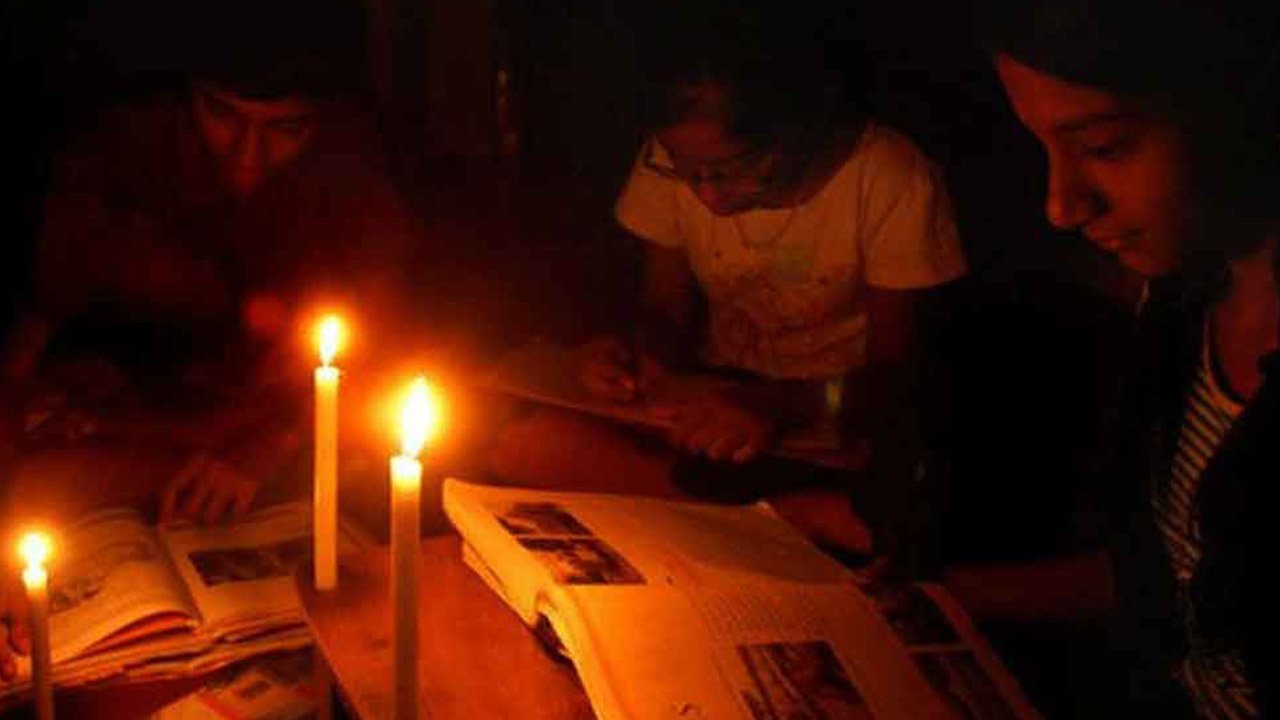
    According to The News, the citizens of these cities have been experiencing regular load-shedding for more than a month that lasts between six and eight hours. Muhammad Tanvir Kiani, who is head of Iesco’s technical division, stated that Iesco has announced a two-hour load-shedding timetable in each of the aforementioned locations.

    He said that the load-shedding schedule would initially last indefinitely until further instruction. Furthermore, he stated that due to an electricity shortage, load-shedding has been implemented in all areas in light of the current situation.

  • SBP to lift import restrictions next week

    SBP to lift import restrictions next week

    The government has lifted import restrictions on commodities intended for vehicle manufacturing, mobile production, solar power equipment, and nuclear reactors for power generation projects commencing in 2023, despite Pakistan’s limited foreign exchange reserves.

    Simultaneously, authorised dealers (ADs – largely commercial banks) have been encouraged to prioritise the import of food and energy products. They should consider enabling the import of non-essential and luxury products after first providing for the necessities.

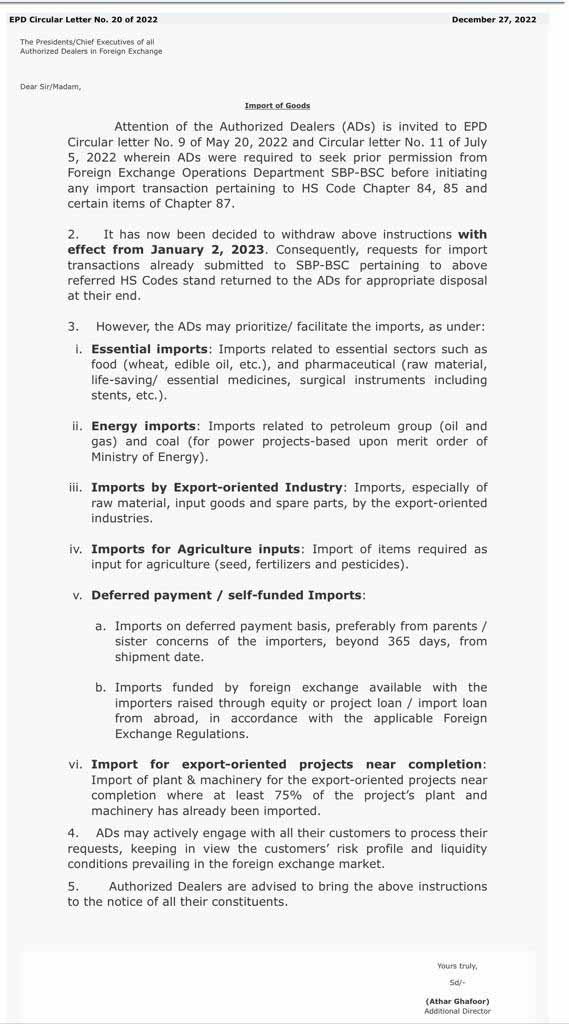
    The State Bank of Pakistan (SBP) reminded ADs on Tuesday that for the past eight months, they had been required to obtain prior permission from the Foreign Exchange Operations Department, SBP-BSC, before initiating any import transaction involving HS Code Chapters 84, 85, and certain items of Chapter 87.

    “It has now been decided to withdraw instructions (of prior permission) with effect from January 2, 2023. Consequently, requests for import transactions already submitted to SBP-BSC pertaining to referred HS codes stand returned to the ADs for appropriate disposal at their end,” the SBP said in the circular.

    Arif Habib Limited (AHL) Head of Research Tahir Abbas said that the import system may “continue to work in its present form. The removal of restrictions will not re-open imports in a full-fledged manner.”

    He stated that due to the country’s short foreign exchange reserves, the government has encouraged banks to first allow the import of necessary items before catering to others.

    The SBP advised ADs (commercial banks) to “prioritise and facilitate the import of essential sectors such as food (wheat and edible oil) and pharmaceuticals (raw material, life-saving or essential medicines, and surgical instruments, including stents).”

    According to Express Tribune, the second priority of ADs is to focus on energy imports “like oil, gas, and coal” (for power projects based on the merit order of the Ministry of Energy).

    Imports for export-oriented businesses should be prioritised as well. They should facilitate “imports, especially of raw materials, input goods, and spare parts, by the export-oriented industries,” stated the SBP. Imports of agri-inputs should be the fourth priority of ADs, as explained by SBP: “import of items required as inputs for agriculture (seed, fertilizers, and pesticides).”

  • Govt announces shut down of markets, restaurants at 8pm to save energy

    Govt announces shut down of markets, restaurants at 8pm to save energy

    The federal government on Tuesday announced a plan to save energy. Defence Minister Khawaja Asif said that all the markets and restaurants across the country will be shut down at 8pm. 

    Information Minister Marriyum Aurangzeb and Advisor to the Prime Minister on Kashmir Affairs and Gilgit Baltistan Qamar Zaman Kaira were also present at the media briefing.

    “If 20% of the workers are sent for work from home on a rotational basis, this will save Rs56 billion,” said the minister.

    Pharmacies have been exempted from these restrictions.

    “The government is also introducing e-bikes, which will phase out the bikes that use petrol. The government is negotiating with companies to phase out the bikes that use petrol and modify the existing bikes,” said Asif.

    A definitive strategy on that, however, is anticipated to be announced on Thursday when the federal government finalises its consultations with all provincial governments.

    “Pakistan’s cabinet decides to take energy conservation measures that will save billions of rupees and burn less fossil fuels. Energy is a huge carbon emitter. Committee will take pathways to the provinces and report back in two days,” tweeted Minister for Climate Change Senator Sherry Rehman.

  • NEPRA okays Rs3.21 per unit hike in power tariff

    NEPRA okays Rs3.21 per unit hike in power tariff

    A quarterly adjustment of Rs3.21 per unit of power for the period of April to June 2022 has been approved by the National Electric Power Regulatory Authority (NEPRA).

    A further burden of Rs93.95 billion will be placed on energy consumers as a result of the most recent price increase. To be effective as of October 1, 2022, the authority transmitted its decision to the federal government.

    According to specifics, the prior adjustments’ time period ended on September 3, 2022. As of October 1, the electricity customers will not receive any respite as the authority implements fresh adjustments immediately following the expiration of the prior adjustment.

    For K-Electric customers, the NEPRA earlier in the day authorised a cut in power rates of Rs4.89 per unit due to a fuel cost adjustment (FCA) for August 2022.

    The notification states that, in contrast to KE’s plea for Rs4.21, the fuel cost adjustment for K-Electric customers would be reduced by Rs4.89 per unit. However, it specified that the tariff cut for July would only be valid for that particular month.

    According to the NEPRA, all consumer categories would be affected by the drop in FCA, with the exception of lifeline consumers, home consumers consuming up to 300 units, agriculture consumers, and EVCS (Electric Vehicle Charging Station).

  • IT sector’s GDP contribution will increase from 2.7% to 13% by 2025: MoITT

    IT sector’s GDP contribution will increase from 2.7% to 13% by 2025: MoITT

    According to estimates from the Ministry of Information Technology and Telecommunication (MoITT), the GDP share of the digital and information technology (IT) sectors would rise to 13 per cent by 2025 as a result of the rapid growth of the digital economy over the next five years.

    MoITT’s offical documents reveal that the size of the digital economy will significantly increase over the next five years as Pakistan’s adoption of digital technology expands. In the upcoming years, the GDP’s share of the digital economy will increase, according to Brecorder.

    While the GDP contribution of the digital and IT sectors will rise from 2.7 per cent to 13 per cent, the GDP contribution of the Information and Communication Technology (ICT) core industry will rise from 1.2 per cent to 8.15 per cent.

    According to the data that is currently available, Pakistan’s digital economy is measured in two ways, i.e. The key industries of ICT, digital technology, and IT. The ICT core industry’s share of the global GDP in 2019 was 1.2 per cent. The IT and telecom industry in Pakistan makes about 2.7 per cent of the country’s GDP.

    Modern ICTs have the ability to accelerate social and economic growth, and this promise will be further realised with the maturation of four enabling technologies: IoT, cloud computing, big data analytics, and AI.

    The cornerstone for nations to build a digital economy and improve their overall economic competitiveness and well-being is ICT infrastructure and services. They can support sustainable cities and communities by lowering poverty and hunger, improving health, generating new jobs, reducing climate change, and enhancing energy efficiency.

    In low- and middle-income nations, mobile remains the main method by which many users access the internet (LMICs). The Information Technology University (ITU) estimates that 87 per cent of broadband connections in developing nations occurred through mobile devices in 2019. Mobile networks and devices are propelling economic growth by connecting consumers and businesses and delivering public and commercial e-services across a range of industries.

    According to the report, Pakistan’s mobile ecosystem is becoming more and more crucial to the country’s economic development due to its direct impact on GDP and the productivity and efficiency benefits it fosters in a variety of economic sectors.

    The majority of nations currently use 4G as the cornerstone of mobile broadband, and this number is continually increasing. The switch from 4G to 5G is happening at the same time all across the world.

    In 2019, 4G connections made up more than 50 per cent of all mobile connections worldwide for the first time, according to the most recent GSMA research. In low and middle-income countries (LMICs), 4G covered 82 per cent of the population compared to 90 per cent for 3G. Compared to 10 years for 3G, LMICs took about seven years to reach more than 80 per cent coverage for 4G.