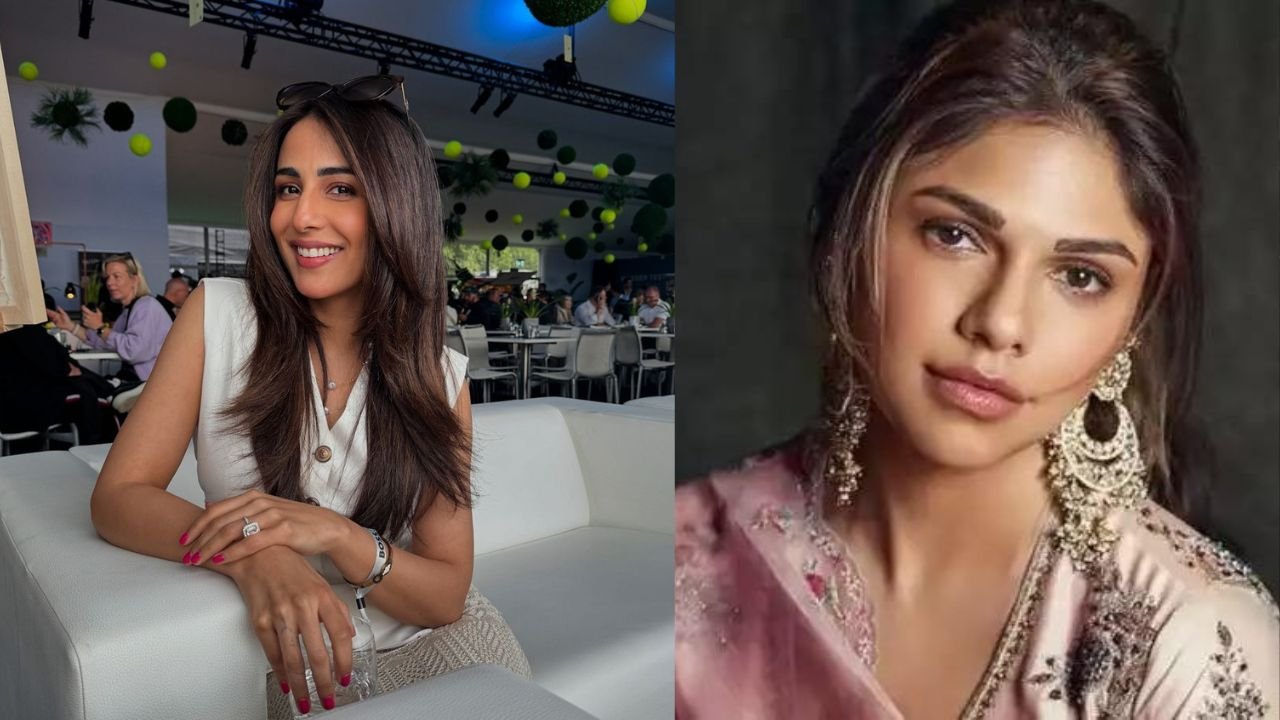
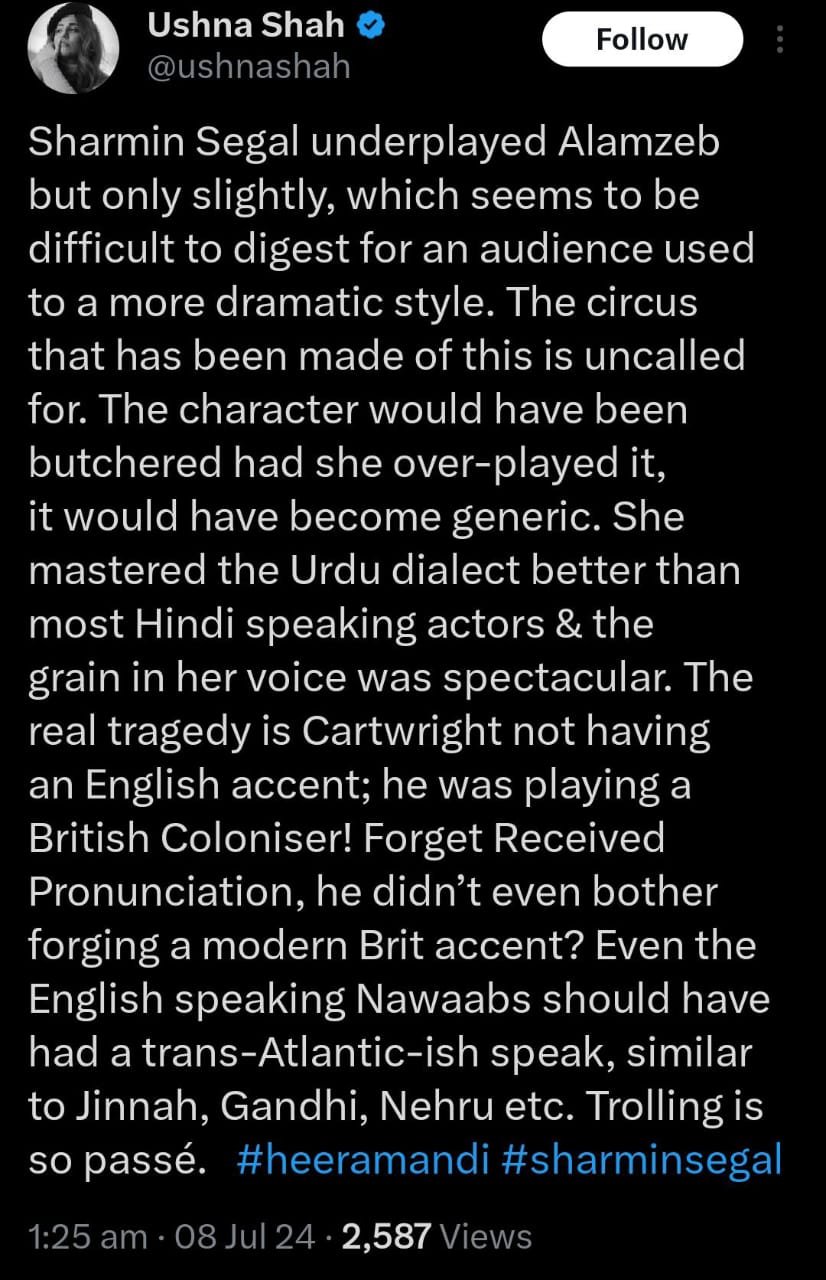
Actress Ushna Shah has come to the defense of Sharmin Segal, who faced criticism for her acting in the web series ‘Heeramandi’. Shah posted a tweet on X (formerly Twitter) writing, “Sharmin Segal underplayed Alamzeb but only slightly, which seems to be difficult to digest for an audience used to be a more dramatic style. The character would have been butchered had she over-played it, it would have become generic.”
“She mastered the Urdu dialect better than most Hindi speaking actors & the grain in her voice was spectacular,” Shah added. Looking at British actor Jason Shah’s performance, who played Alastair Cartwright in the series, Ushna wrote, “The real tragedy is Cartwright not having an English accent; he was playing a British coloniser! Forget Received Pronunciation, he didn’t even bother forging a modern Brit accent? Even the English speaking Nawaabs should have had a trans-Atlantic-ish speak, similar to Jinnah, Gandhi, Nehru etc.” She added the hashtags ‘Heeramandi’ and ‘Sharmin Segal’. Sharmin Segal is Sanjay Leela Bhansali’s niece.
The web series Heeramandi: The Diamond Bazaar, which co-stars Segal alongside Richa Chadha, Aditi Rao Hydari, Manisha Koirala, Sonakshi Sinha, and Sanjeeda Sheikh in major roles, as well as Farida Jalal, Fardeen Khan, Shekhar and Adhyayan Suman, and Taha Shah, is available on Netflix.
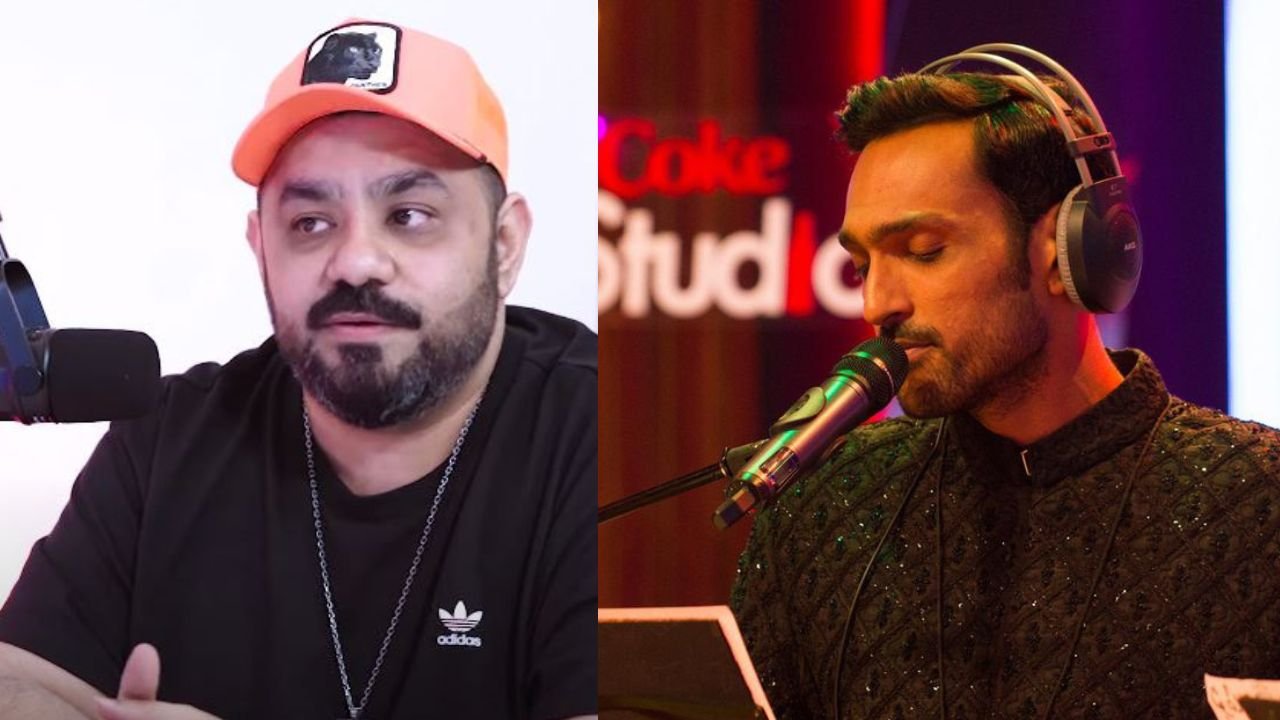
Singer, music director and composer Shani Arshad was recently invited as guest in Ahmed Ali Butt’s podcast. He discussed his musical journey. He also gave advice to Pakistani singers including Ali Sehti, Atif Aslam, Asim Azhar.
While giving advice to Ali Sethi, Shani Arshad said, “Ali Sethi should sing a song in English.” While offering advice to Atif Aslam, Shani said, “He should be more humble and not think too highly of himself.”
He expressed concern about the future of Pakistani singers, saying, “Our music scene is lacking because singers aren’t consistently releasing hit songs. For instance, Kaifi Khalil released a new song after ‘Kahani Suno’, but it didn’t gain popularity, even though it was a great song.”
In the entertainment world, women often get treated unfairly because of their age. Now, model Iffat Omar is speaking out against ageism, posting a video on Instagram wearing a lovely pink saree. In the caption, she wrote, “I’ll do what I want at my age, so you do your thing and stop telling me how to behave.” Known for her independence, she’s showing that it’s perfectly fine to be yourself, no matter your age.
Iffat has also shared her views on feminism and politics in Pakistan, as well as her experiences in the media industry. She has also talked about the culture surrounding Urdu dramas in Pakistan. The ‘Berukhi’ actor mentioned facing criticism in Karachi for her Punjabi accent, limited Urdu skills, and not being fluent in English.
In a surprising statistic, in the three last years at least 54.53 per cent of candidates, who appeared for the Central Superior Services (CSS) Examination failed Pakistan’s national language Urdu subject.
In 2019, 30 per cent of candidates failed in Urdu, while in 2020 and 2021, the rate of failure shot up to 59 per cent and 73 per cent.
Regarding the success rate in English, 35,000 out of 49,500 candidates failed in the subject in 2019 with a rate of failure of 73 per cent, which got better in 2020 when only 39 per cent got failed. However, in 2021, 92 per cent failed the subject.
The details of the candidates were presented in the National Assembly (NA) on Friday.
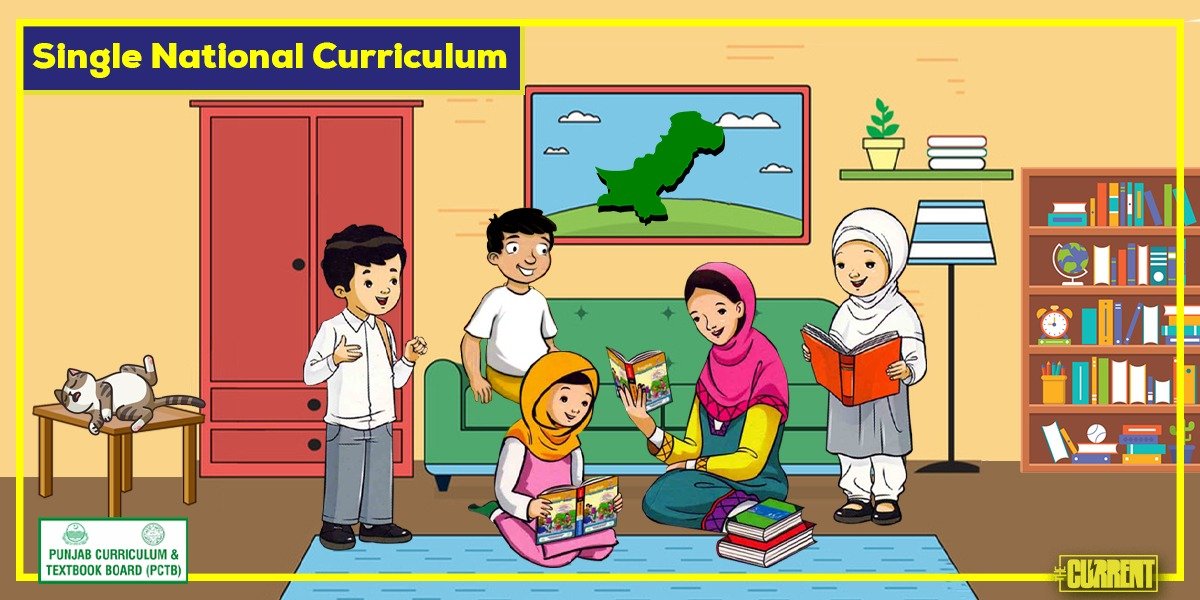
On August 16, 2021, Prime Minister Imran Khan officially launched the Single National Curriculum (SNC). The newly launched curriculum was prepared by the National Curriculum Council (NCC) and the Ministry of Federal Education, in consultation with the provinces. According to PM Khan, “SNC would transform the nation into a unified one.”
What is SNC?
According to the Ministry of Federal Education and Professional Training, the SNC is a ‘uniform’ system of education, which means the same curriculum for everyone. All public schools, private schools, and madrassas were meant to have the same curriculum so that the learning outcomes are similar and without any discrimination in teaching standards. This is not the first time SNC was imposed in Pakistan. It was previously introduced in 2006 by Former President Musharraf. Whereas the previous SNC was a curriculum-based initiative, the one introduced by the PTI government is imposing the use of the textbooks produced by the provincial boards.
Is it being implemented across the country?
No. Sindh has decided not to implement the curriculum since education is a provincial issue. Only Punjab and Khyber Pakhtunkhwa have enforced it so far. However, many schools in both provinces — including the prestigious Aitchison College, Lahore — expressed their concerns over the books in the curriculum. The Director of the National Curriculum Council (NCC), Dr Mariam Chughtai, has also said that madrassas will implement the SNC syllabus in five to six years, which undermines the reason why the government had wanted to introduce the SNC in Pakistan – to bring madrassas into the mainstream so students would be able to get jobs in other professions after they graduated.
Controversies surrounding the SNC
After the SNC syllabus was imposed on schools across Punjab, many controversies surrounding the books and the curriculum came forward. From the disparity in gender representation, the reinforcement of patriarchal gender roles, the lack of female heroes, and religious texts in the non-religious books.
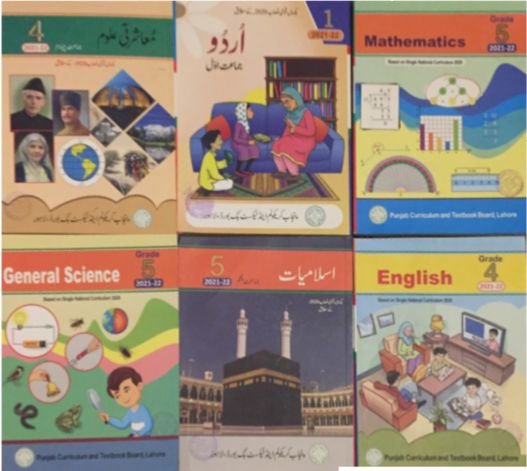
To see if the criticism is valid, The Current analysed the following books published under the Punjab Textbook Board (PTB):
Urdu books from grades 1 to 5, English books from grades 1-5, Mathematics books grades 1, 2, 4, and 5, General Science grades 4-5, Waqfiyat Aama grade 1 and 3, Social Studies 4-5, and Islamiat grade 1- 5.
Two books were not available at the time of research. Grade 3 Math and Waqfiyat Aama grade 2, which have not been included in the study.
The analysis here has been divided into two parts.
Part one comprises the data analysis of all the books included in the SNC by the Punjab Text Book board.
Part two comprises the data analysis of individual subjects being taught to the students.
We studied the total number of male and female representations in the books, a comparison of the eastern and western wear of both genders, the presence of religious (Islam and others) content in non-religious books, and studying the distribution of power roles assigned to both men and women.
Here is the list of most common criticism against the curriculum and the evidence we found:
SUMMARY OF CONTENT IN ALL SNC BOOKS
1- Disparity in Gender Representation:
One of the most debatable points in the entire SNC is the representation of men and women.
After a thorough evaluation, we found that the concerns about the disparity in gender representation are TRUE.
The study reveals that a total of 60.2 percent of the books have images of men, including boys and only 39.4 percent of the books have images of women, including girls.
2-Women represented in hijab vs non-hijab, and women in western clothes:
What the women are wearing became a source of contention in the discussion about the SNC, with critics suggesting that the women should equally represent the country in terms of the hijab, eastern clothes, and the choice to wear western wear.
It is TRUE that there is no equal representation of women’s appearance in the books.
Women’s appearance was divided into three categories.
A) Number of women wearing eastern clothes with hijab.
B) Number of women wearing eastern clothes without hijab.
C) Number of women wearing western clothes.
Our research shows that 41.6% of all women and girls in the SNC books are wearing a hijab, 28.9% are wearing eastern clothes without a hijab, and 29.4% of the images show girls wearing western wear. It is important to note that in the western wear percentage, almost all of the images are of young girls. Older women are not shown wearing western wear.
3-Men represented in eastern vs western clothes:
Since the appearance of women in eastern wear and hijab became controversial, we also studied how many times men appeared in western or eastern wear.
A massive 79.9 percent of men were seen wearing western clothes, in comparison to 20 percent dressed in eastern clothes.
4- More men in ‘power roles’ compared to women:
Another controversy suggested that the books did not show women in positions of ‘power’, and they were mostly listed as helpers or homemakers. While there were many images that showed women in ‘inferior roles’ to men, there were women that were shown in roles of power.
This controversy is TRUE.
We defined power roles shown in the books as doctor, pilot, lawyer, police officer, traffic warden, army sports personality, etc and after analysing all the books, we found that a men are given power roles three times more than women. The results in the graphic below are based on the total number of images shown of men and women in all the SNC Punjab books.
I
5. Religious content in non-religious books
In almost all the books which were studied, we saw the presence of religious references or mentions in non-religious books. Minorities felt their rights were being compromised since books that are not for religious studies should not have references to a specific religion, which may come under the context of ‘preaching’.
In our analysis, we saw a total of 7.77 percent of religious text in all SNC non-religious books, which lends TRUTH to the fact that there is religious content in non-religious books.
Religious content is present in 7.7 percent of English, Math, Social Studies, Urdu, Science, and General Knowledge books.
7.47 percent of books have references to Islam while 0.27 percent mention other religions in all non-religious books.
Dr Mariam Chughtai, while answering a question for The Current about the religious references in non-religious books, did not provide a clear answer but stated that these are model books that require changes.
SNC BOOKS ANALYSIS – SUBJECT ANALYSIS
This section of the report comprises an analysis of individual subjects being taught to students. The subjects under study were, Urdu books from grades 1-5, English books from grades 1-5, Mathematics books grades 1, 2,4, and 5, General Science grades 4- 5, Waqfiyat Aama (General Knowledge) grades 1-3, Muashrati Uloom (Social Studies) grades 4-5.
The graphical representation of the subject-wise evaluation is as follows:
English:
In 668 pages of English books, 58.1 percent have male representation while females have 41.8 percent.
29.7 percent of women are seen with Hijab and 70.2 percent are without Hijab.
There is a total of 9.8 percent presence of religious text in English books. This is based on the total number of pages in English books.
Mathematics:
In 672 pages of the Math books, when gender representation was analysed, 51.1 percent of the books have male representation and 48.8 percent have female representation.
A total of 53.9 percent of females are seen without hijab and 46 percent are seen wearing hijab.
The Math books have a 4.1 percent presence of religious text. This is based on the total number of pages in Math books.
Urdu:
The five Urdu books comprising 791 pages. A total of 59.7 percent presence of males are seen as compared to 40.4 percent of females.
58.5 percent of women/girls are seen wearing hijab and 41.4 percent are seen without hijab.
12.8 percent of religious text is present in Urdu books. This is based on the total number of pages in Urdu books.
General Science:
Out of 310 pages, 76.8 percent have male representation as compared to 23.1 percent female representation.
64 percent of women/girls are seen without hijab and 36 percent of women/girls are seen with hijab.
The General Science books have a 0.96 percent presence of religious content. This is based on the total number of pages in Science books.
Waqfiyat Aama (General Knowledge):
49.5 percent of male images are seen in comparison to 50.15 percent of females.
23.1 percent of females are seen with hijab and 76.8 percent without hijab.
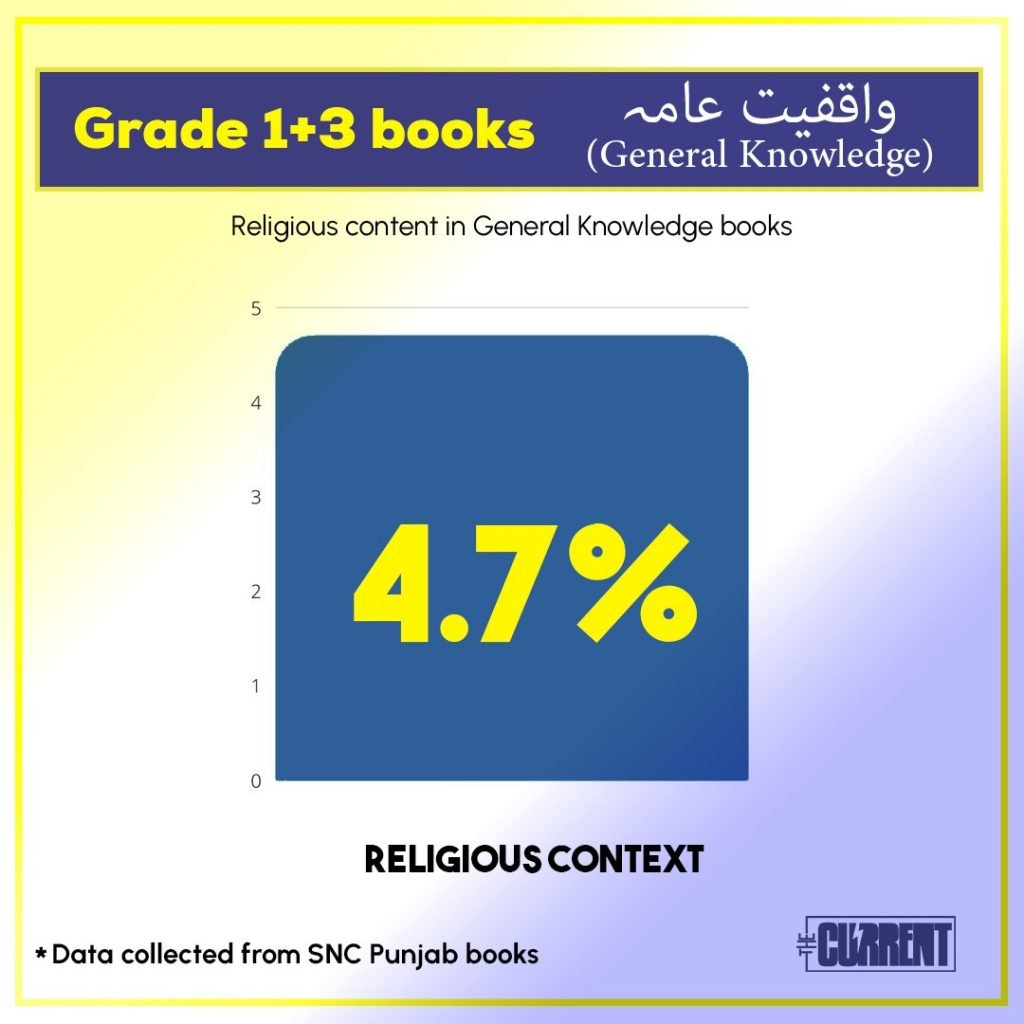
There is a 4.7 percent presence of religious text in the books studied. This is based on the total number of pages in General Knowledge books.
Muasharti Uloom (Social Studies):
From 234 pages analysed, 65.1 percent of men/boys are represented in the books and 34.8 percent of females are shown.
36.8 percent of females are seen without hijab and 63.1 percent are seen with hijab.
10.2 percent of religious content is present in the books. This is based on the total number of pages in Social Studies books.
The last portion of the report highlights the pros and cons, which we have observed in almost all the books. We have provided both positive and negative outcomes deduced from the books after careful analysis.
The positive outcome deduced from the books:
1. The books are locally published and designed. The books are affordable, with a total set for one grade set at Rs. 800 per child according to Dr Chughtai.
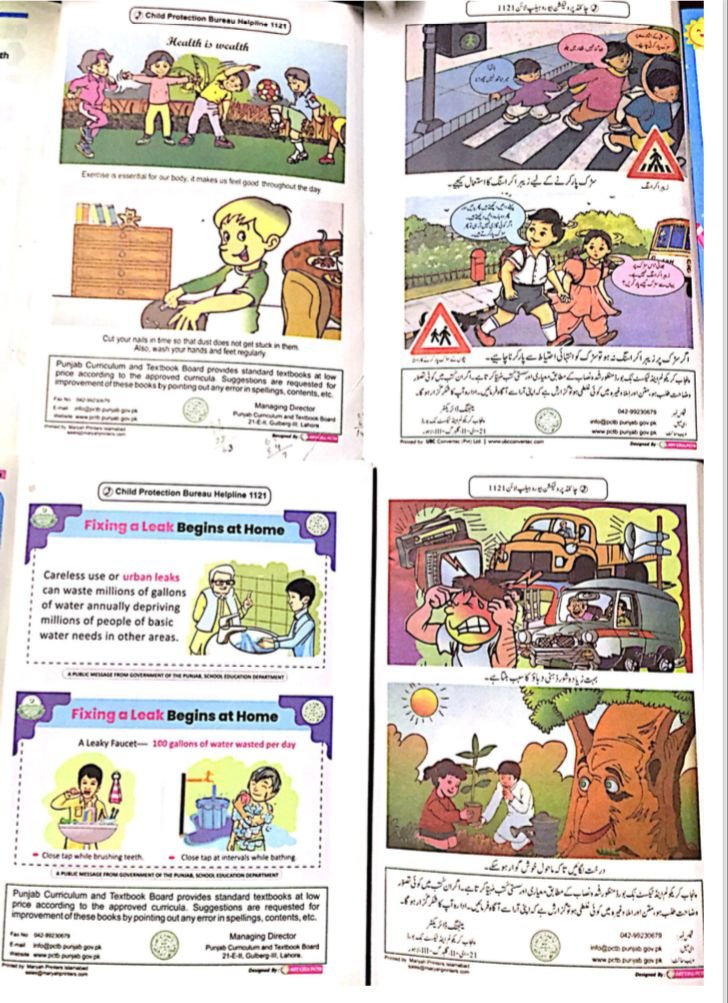
2. There is a public service message printed at the end of each book to raise awareness against talking to strangers, crossing the road, exercising, and even information about fighting dengue.
The possible negative impact of the books
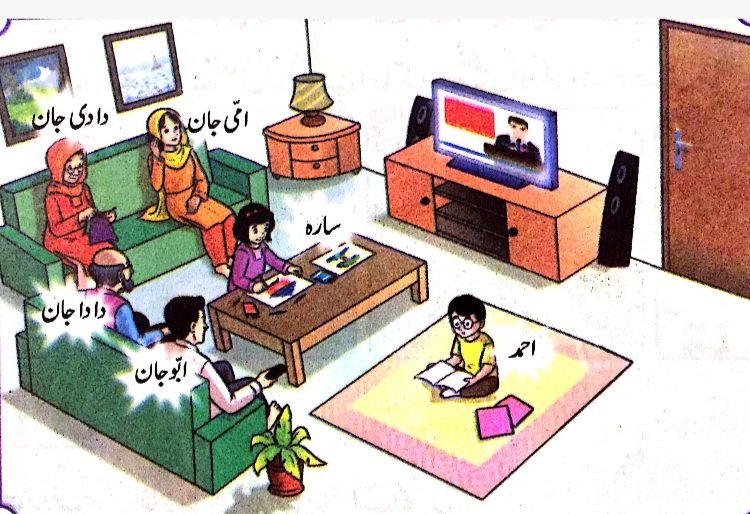
1. After analysing the books, we deduced that mostly nuclear families have been shown in the books. No representation of single parents or children being raised by guardians is seen. Moreover, the presence of both parents is seen as almost essential in all stories in the books.
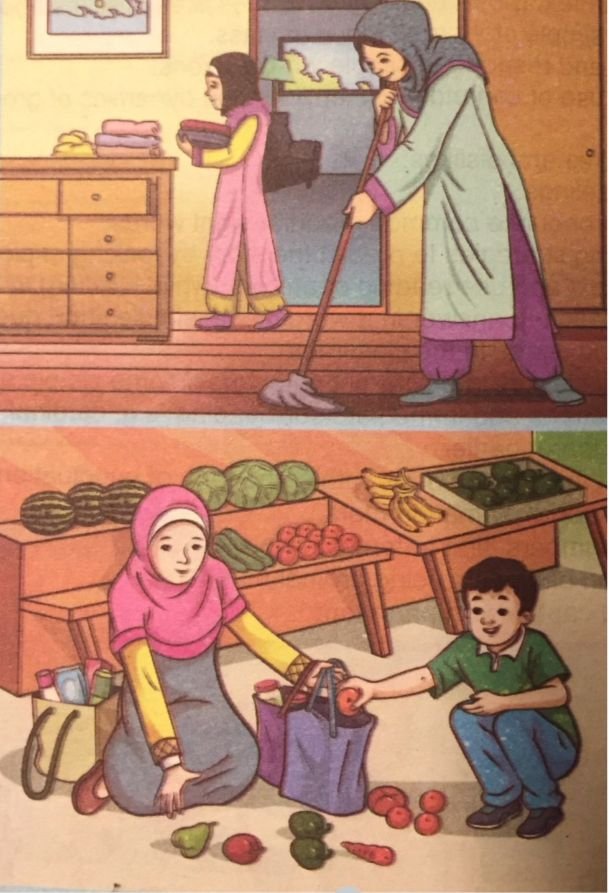
2. Women are mostly shown doing domestic work, taking care of the family, and looking after their children. In stories as well, they seem to come second to their male counterparts.
3. As discussed in detail above, there is the presence of religious text in non-religious books.
4. The stylisation of the books are difficult to understand, fonts and texts are way too clustered. The quality of the pages is not refined, making them unattractive and confusing for students.
CONCLUSION:
According to NCC director, Dr Chughtai, the curriculum is an evolving process and the books can be changed in future publications, based on the response by schools and parents. The biggest hurdle to the books is that the teachers have not been trained in teaching these new books and according to Dr Chughtai, it is up to the school to teach and implement the books. There are no worksheets given with the books and from initial student reactions, students are confused and wary of books that are laid out in a clustered fashion. There is also the subject of a language change. Where students study general knowledge, a precursor to Science, in Urdu, they switch to difficult English in grades 4-5.
While the government should be commended in trying to create a national syllabus, the forced enforcement of the books along with the lack of supplemental information and training will make this very difficult for teachers and students. Moreover, parents should be given a choice as to what they want their children to study. This implementation should be a free choice rather than that of enforcement. What would have been a practical approach is that the government should have improved the structure of the government/public schools, provided better teacher training, spent more on financially improving the conditions rather than lowering the standard for all.
*Graphics credits: Asma Ahmad (Graphic Designer)
How did we collect the data?
The percentage of male characters in the books: Divided the total number of male by the total number of characters. The percentage of female characters in the books: Divided the total number of female by the total number of characters.
The percentage of Islam: Divided the Islamic pictures or references given in the books by the number of total pages of all books. The percentage of other religion: Divided the other religions pictures or reference given in the books by the number of total pages of all books.
The percentage of female power roles: Divided the number of female by the total number of characters (female and male). The percentage of male power roles: Divided the total number of male by the total number of characters (female and male).
The same process/calculation/method was applied to the findings of each book.
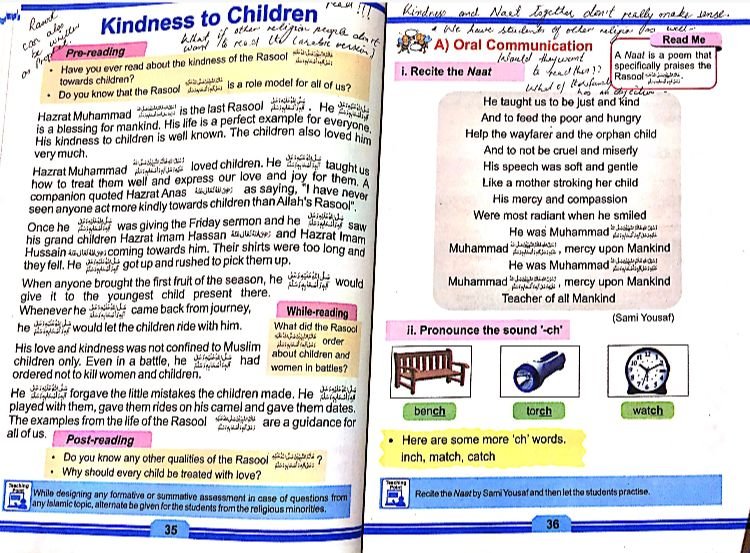
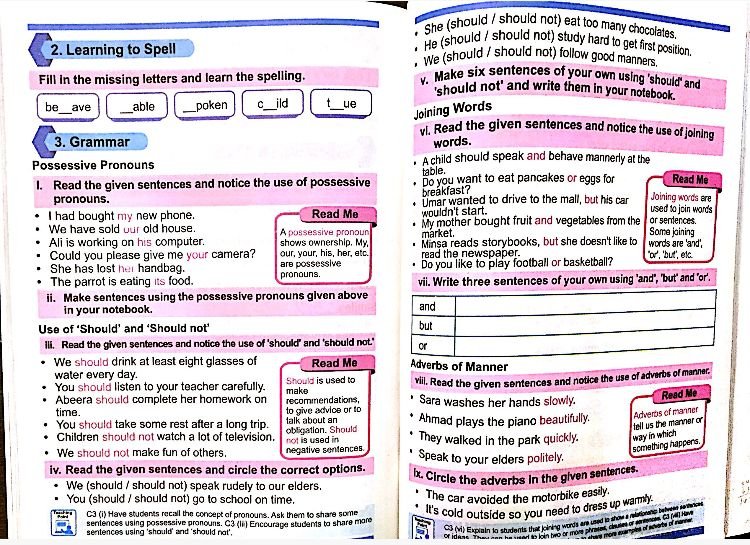
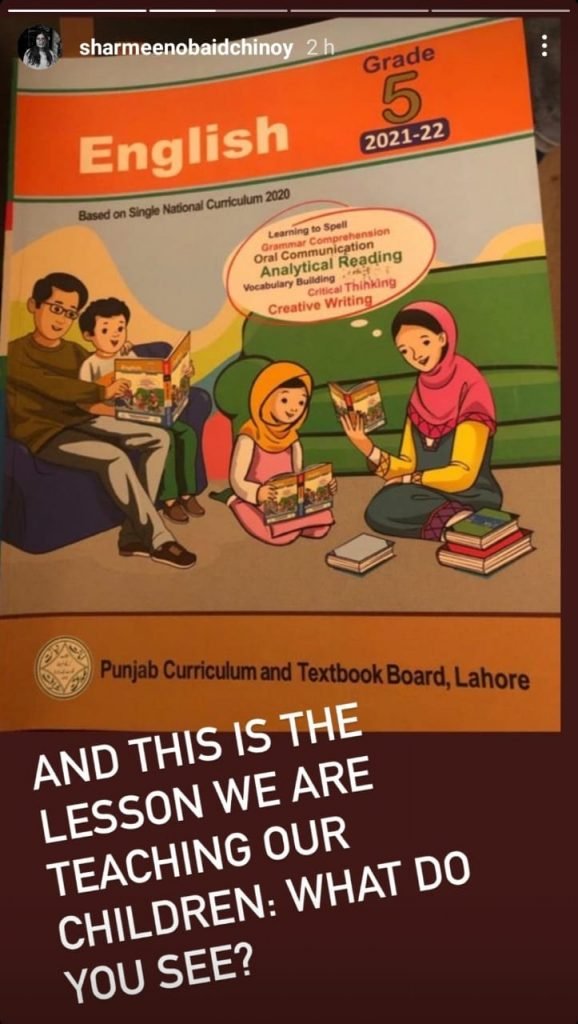
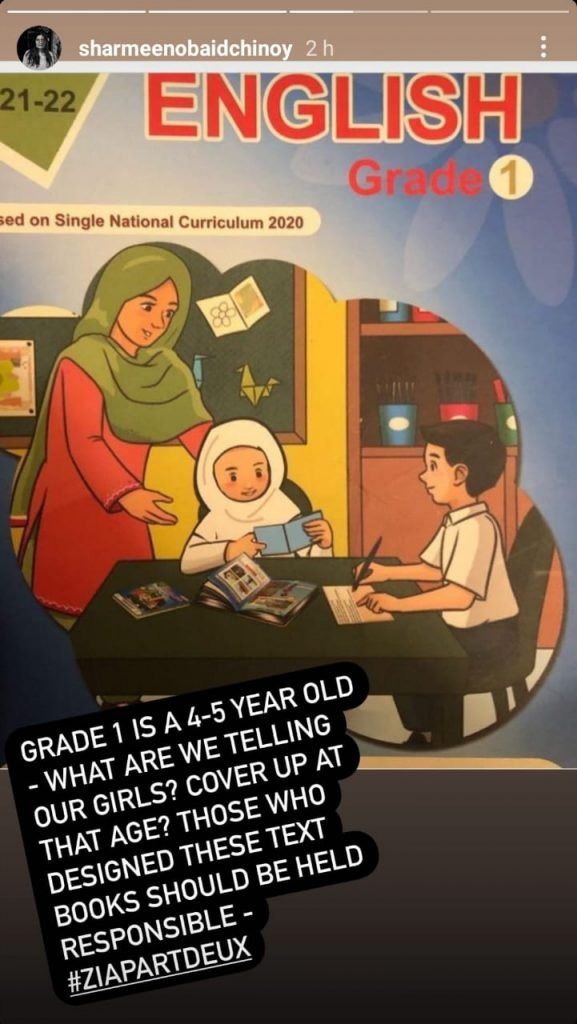
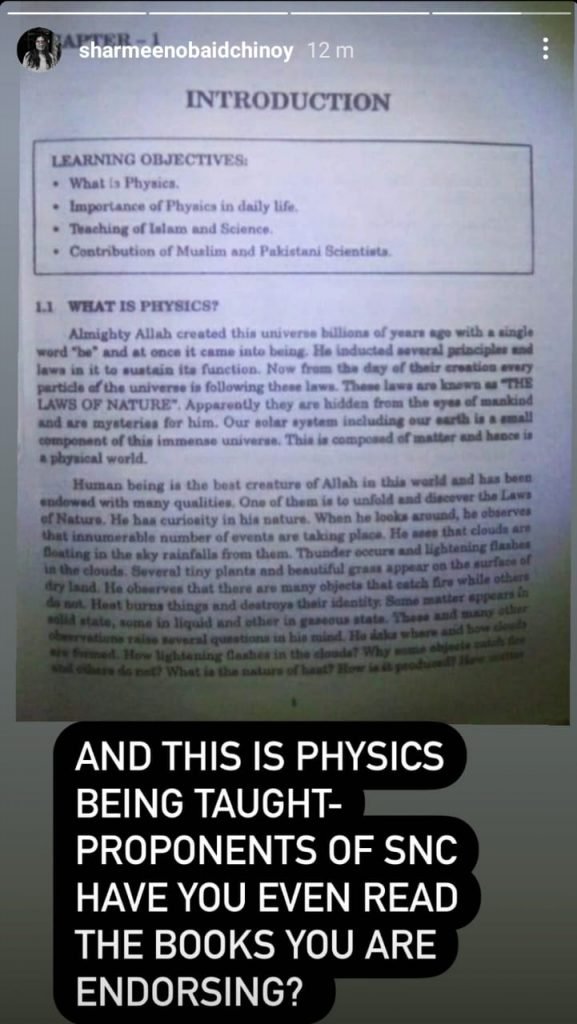
Oscar-winner filmmaker, Sharmeen Obaid Chinoy recently took to social media and criticised the Single National Curriculum (SNC). She shared pictures of English textbooks of grade one and five.
Sharmeen shared a picture of a grade five English textbook on her Instagram stories and wrote, “And this is the lesson we are teaching our children: What do you see?”
Sharing another picture of the English book of grade one, she wrote, “Grade 1 is a 4-5-year-old. What are we telling our girls? Cover up at that age? Those who designed these textbooks should be held responsible. #Ziapartdeux”
“And this is the physics being taught. Proponents of SNC, have you even read the books you are endorsing,” the Oscar winner wrote, posting an image of a page of a physics book.
Single National Curriculum is a ‘uniform’ system of education, which means the same curriculum for everyone. Single National Curriculum has been started to be implemented in madressahs and from grades one to five in both public and private schools in Punjab.
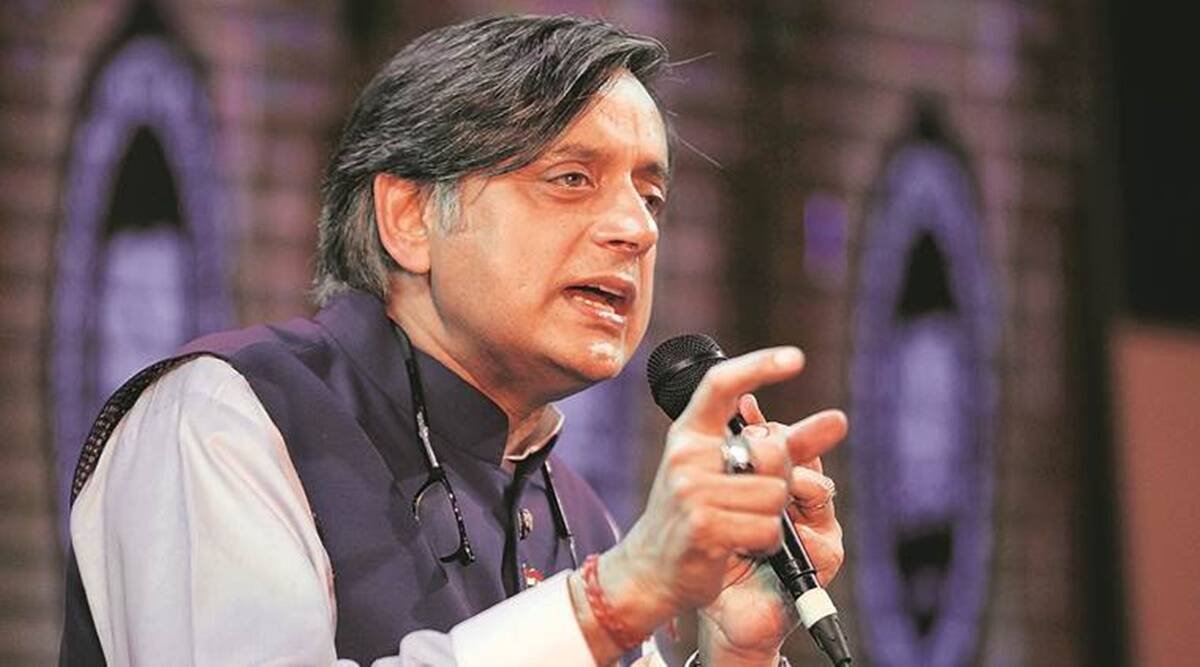
Shashi Tharoor has given a warning to an app that claimed that they could teach users to speak fluent English like him. Tharoor, a member of the Indian National Congress, is known for using extensive English vocabulary during his speeches and interviews.
The politician took to Twitter to clarify that he had no link with the app ‘Blackboard Radio’ and did not endorse it in any way.
“I will take legal action to stop the misuse of my name and image for commercial purposes,” warned Tharoor in the tweet.
This has been drawn to my attention by many unwitting students who were misled by this app. I wish to make it clear that I have NO connection to this app &have NOT endorsed it in any way. I will take legal action to stop the misuse of my name & image for commercial purposes. pic.twitter.com/C2dZhP47dd
A video of two women, who are the owners of Cannoli by Café Soul in Islamabad, mocking the café’s manager for not being fluent in English went viral on the internet this week.
#BoycottCannoli trended online and even Prime Minister Imran Khan weighed in on the issue when he said on Thursday that he doesn’t use English phrases in public because it would be disrespectful to the majority of Pakistani citizens who don’t speak or understand the language.
The elitist and classist owners were criticised on social media as well as mainstream media, but it seems that they remain unfazed by all the backlash. An ‘apology’ was posted by them on the café’s social media pages but it was anything but an apology. It said that this was just a banter with a team member.
“We are not required to prove or defend ourselves as kind employers. Our team has been with us for a decade, that should speak for itself,” it said further. This non-apology led to more outrage and rightly so. There was no remorse in the apology, no acknowledgment that they did anything wrong, no sincerity. The thing that the owners need to realise is that not just their video but their so-called apology reeks of elitism, classism and workplace harassment.
Unfortunately, these two women are not the only ones who are elitist but that as a class-based society, which is very conscious of status, many of us are very much part of the problem. We forget that we have no control over where we are born and being born in a privileged family is just an accident of birth.
We have complexes about speaking in English, how being fluent in the English language opens up a lot of doors for us in the job market as well as society, how a certain accent would show that we come from a privileged background because we went to the ‘right’ schools and colleges.
We all make fun of Meera jee’s English, we criticise our cricketers for not speaking proper English (remember Inzi’s ‘boys did well’?), we don’t treat the English language as just a medium of communication but as a status symbol.
We hope that all of us have learned something from this unfortunate incident, which is to treat our employees with kindness and compassion and also not insult someone for not knowing the English language. Our society needs to break the barriers of class and be more tolerant and less judgmental.
کہنے دیجئے کہ ہمیں بطور قوم انگریزی کا ہیضہ ہو گیا ہے ۔ جی چاہ رہا ہے کہ ملک کے انگریزی سے نابلد عوام کو بتاؤں کہ تم کیا اردو یا کسی اور زبان میں خیالات کی چڑیا اڑاتے رہتے ہو انگریزی زبان کے در پر اپنا ماتھا ٹیک دو گیان وہیں سے ملے گا۔ کینولی والی خواتین کی تحقیر آمیز ہنسی ، مینیجر اویس کی واضح بے چینی معاشرے میں زبان کی بنیاد پر پائی جانے والی ایک نا محسوس لسانی تقسیم کی طرف اشارہ کرتی ہے جو باقاعدہ طبقاتی تقسیم میں ڈھل گئی ہے۔ تقسیم در تقسیم کے شکار معاشرے میں اگر کوئی کمی رہ گئی تھی تو اس پر انگریزی زبان کی بنیاد پر پائے جانے والے احساس کمتری نے چار چاند لگا د ئیے ہیں۔
اس واقعہ نے اور کچھ نہیں کیا سوائے اسکے کہ ہمارے روز مرہ کے معاشرتی رویوں کی ایک جھلک دکھا دی ہے جہاں انگریزی بولنے پر اگلے کے دل میں ویسے ہی ایک رعب پڑ جاتا ہے کئی در تو صرف دو فقرے بولنے سے ہی کھل جاتے ہیں چاہے سامنے والا زیادہ عقلمند اور صاحب علم کیوں نہ ہو اسکی ساری قابلیت انگریزی زبان نہ جاننے کی بنا پر ٹھس ہو جاتی ہے۔ بھائی انگریزی ایک زبان ہے جیسے باقی زبانیں ہوتی ہیں اس میں کون سا سرخاب کے پر لگے ہوئے ہیں ہاں اسے بولنا سیکھنا ایک مہارت یا اہلیت تو گردانا جا سکتا ہے فوقیت نہیں ۔ ہاں اگر انگریزی زبان کی وجہ سے زیادہ ارفع و اعلیٰ خیالات آتے ہوتے تو بات بھی تھی لیکن افسوس سوائے اسکے مجھے تو کوئی ایسی خوبی نظر نہ آئی کہ انگریزی زبان دنیا میں رابطے کی بڑی زبانوں میں سے ایک ہے اور شاید مختلف بولیاں بولنے والوں کے درمیان پل کا کام کرتی ہے۔ اس میں میسر علمی مواد بھی اچھا خاصا ہے لیکن روسی ،چینی ، ہسپانوی اور دیگر زبانوں میں بھی اسی پائے کی چیزیں پائی جاتی ہیں بلکہ بعض زبانوں کے ادب ، فصاحت و بلاغت کے سامنے تو انگریزی زبان پانی بھرتی ہے۔
خلا میں روسی انگریزی زبان جاننے کی بنا پر تو پہلے نہیں پہنچ گئے تھے یا چین کی معاشی ترقی کا راز انگریزی زبان کی وجہ سے تو نہیں ہے بلکہ عظیم چینی رہنما چو این لائی سے منسوب جملے کے بقول ‘ چین گونگا نہیں ہے’۔ صاحب دوسری زبانو ں کو چھوڑئیے اپنی اردو کوہی لیجئے بھلا میر غالب کے پائے کا شاعر اور داستان امیر حمزہ جیسی دیومالا جس زبان کے پاس ہوں اسے تو بڑے چاؤ اور ناز سے رکھنا چاہئے۔ یہ الگ بات ہے کہ ہم نے اسے نصاب کے رٹوں تک محدود کر کے رکھ دیا ہے ۔
خیر بات بھی کہاں سے کہاں نکل گئی دیکھنا یہ ہے کہ اس واقعہ سے حاصل کیا ہو گا؟ سماجی رابطوں کی ویب سائٹس پر ہر ایک نے اپنے دل کی بھڑاس نکال لی، جی بھر کر صلواتیں سنائیں اویس صاحب کو ان لوگوں نے بھی نوکری کی پیشکش کر دی جو اپنے ملازمین کو چھ چھ ماہ تنخواہ کی مد میں لٹکائے رکھتے ہیں ، ہاں جو چیز ہم بھول گئے وہ یہ کہ دو خواتین جو ایک زبان پر پوری طرح سے مہارت نہ رکھنے پر ایک دوسرے انسان کا مذاق اڑا رہیں تھی وہ کوئی اور نہیں میں اور آپ تھے۔ کیا انگریزی زبان نہ جاننے یا اس پر پوری قدرت نہ رکھنے کی بنا پر ہم بھی کیا دوسرے کا مذاق نہیں اڑاتے ؟ کیسا لگا آئینہ میں اپنا اصل روپ دیکھ کر جس پر پتا نہیں کس کس ریا کاری کی پرت چڑھا رکھی ہے اصل میں ہم نے کبھی اس گٹر کے ڈھکن کو اٹھانے کی زحمت ہی نہیں کی جہاں زبان کی بنیاد پر ، رنگ اور شکل کی بنیاد پر اور کسی دوسرے انسان کے رہن سہن کی بنیاد پر اسے اپنے سے نیچا سمجھا جاتا ہے۔
اگرچہ اس واقعہ میں مظلوم اردو بن گئی ہے لیکن کیا یہی معاملہ ہم اپنے ملک کی دیگر زبانوں کے ساتھ نہیں کرتے ؟ پشتو، پنجابی ،سندھی اور بلوچی بولنے والے کو اردو میں بات کرنی پڑ جائے تو اسکا مذاق بن جاتا ہے ۔ اسی لئے مسئلہ اردو انگریزی کا نہیں بلکہ ، عدم برداشت، معاشرتی رویوں اور سماجی آداب کا ہے ہم سب کے اندر چھوٹی چھوٹی کینولی آنٹیاں بستی ہیں ، ان کو صلواتیں سنانے سے پہلے اپنے گریبان میں بھی جھانک لیجئے۔
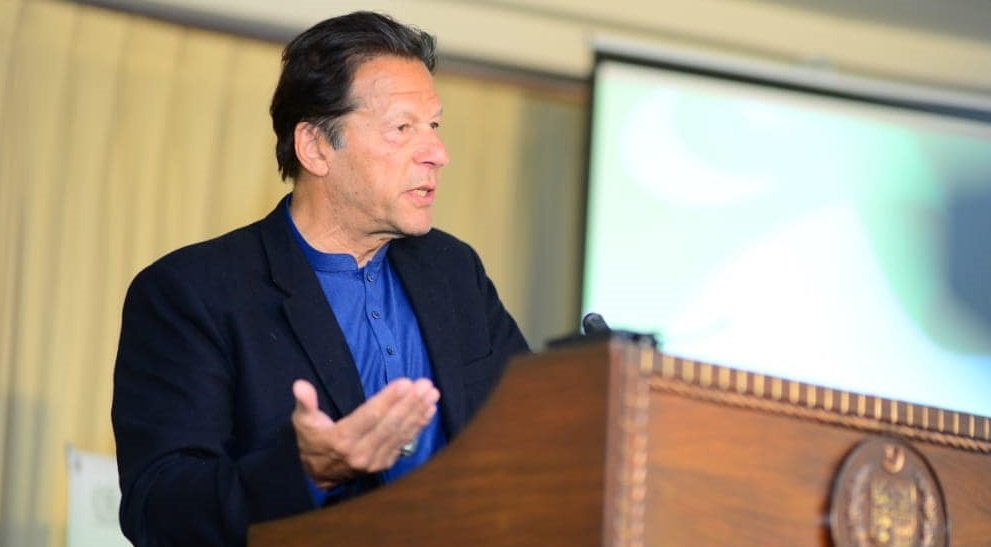
Prime Minister Imran Khan has said that he doesn’t use English phrases in public because it would be disrespectful to the majority of Pakistani citizens who don’t speak or understand the language.
The PM said he has an objection to using English as a language of communication because most people do not speak this language. “I would be fine with addressing events in English if everyone would speak the language,” the PM added.
— Rizwan Ghilzai (Student of Arshad Sharif) (@RizwanGhilzai) January 21, 2021
The remarks by the prime minister came a day after a much controversial video went viral on social media wherein the owners of a posh cafe in Islamabad were seen ridiculing their restaurant manager for his inability to speak English.
Uzma and Diya, who own Cannoli Café Soul in Islamabad, have been at the receiving end of outrage for mocking and ridiculing their restaurant manager for his English speaking skills. In the video, the two women explained how their manager has been working at their café for nine years and has taken three language courses until now.
They then asked him to introduce himself in English and when he struggled with speaking fluent English, they made fun of him by commenting on the manager’s salary. The manager, Owais, was visibly uncomfortable in the video.
Addressing a ceremony in Islamabad on Thursday, the PM announced that inheritance certificates would now be issued within 15 days to make life easier for a common citizen. In past, it would take two years to get this letter issued, but now it will be done in two weeks.
According to Radio Pakistan, the law ministry has devised a mechanism to establish Succession Facilitation Units in collaboration with the National Database and Registration Authority (NADRA) for the issuance of Letters of Administration and Succession Certificates within 15 days of initiation of the application by the legal heirs of the deceased.
The PM also emphasised on reforming the civil procedure court, criminal justice system and ensuring women’s inheritance rights. “People friendly law reforms were being considered crucial by the present government aimed at ensuring justice through people-friendly legislation.