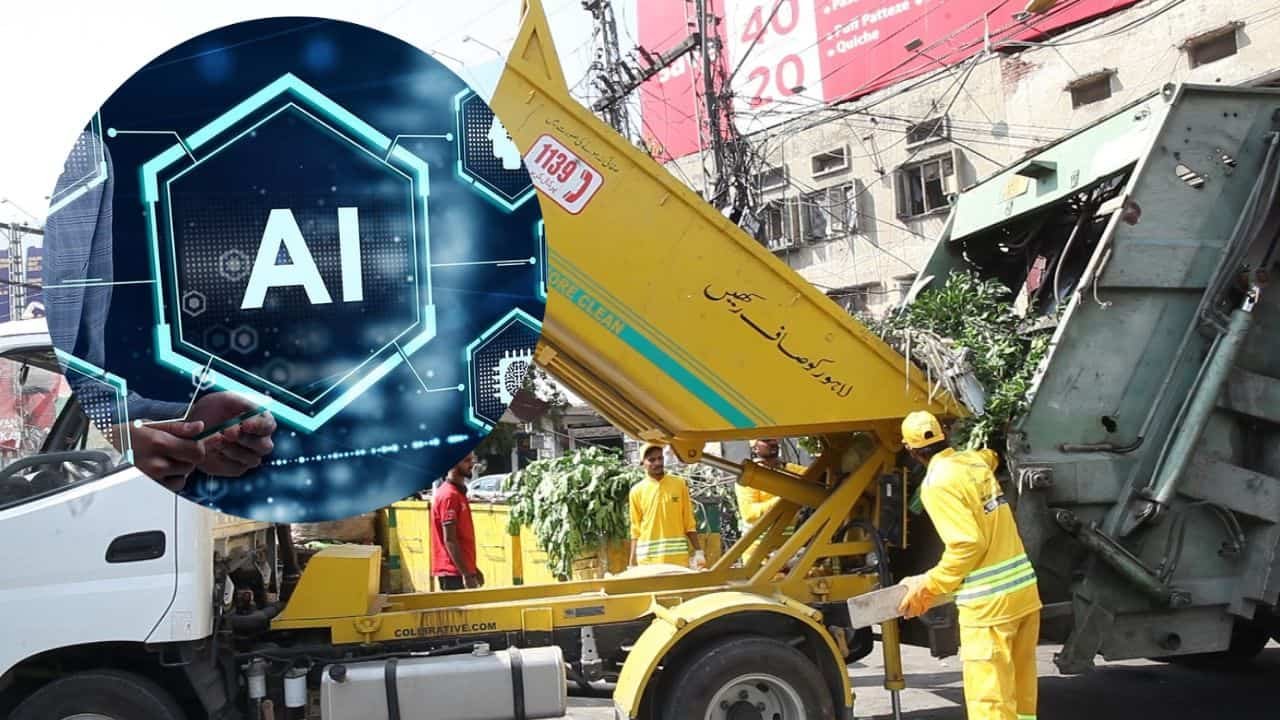
In a significant stride towards modernising waste management operations and addressing the escalating waste challenges within the provincial capital, Lahore Waste Management Company (LWMC) has harnessed the power of artificial intelligence (AI).
According to the recent communication from LWMC, a transformative journey towards digitalization has been set in motion to revamp waste management practices. In its initial phase, AI-driven route optimisation has been deployed in Gulberg Town, yielding remarkable outcomes. Notably, the integration of AI has led to a reduction in both the number of vehicles deployed and the distance covered, resulting in substantial fuel savings.
In addition, the implementation of AI-powered attendance monitoring has not only bolstered the presence of field staff but has also unveiled instances of ghost employees, thereby fortifying operational credibility. The commitment of LWMC to digitalization is further exemplified by its initiatives encompassing GIS-based live mapping of containers and vehicle routes, the introduction of the ‘Hot Spot’ application for real-time container monitoring, and an upcoming Android application tailored for waste-related entity registration.
According to Brecorder, speaking about these innovative measures, Babar Sahib Din, the CEO of LWMC, said that these endeavours underscore the organisation’s dedication to efficiency, ecological sustainability, and revenue enhancement. He underscored that waste management remains a universal challenge for urban centres worldwide, and Lahore, akin to the global arena, faces a mounting waste predicament. To effectively address this challenge, the adoption of digital reforms for comprehensive solid waste management is imperative.
Din stated, “By harnessing the capabilities of artificial intelligence, LWMC has introduced pivotal interventions, including AI-optimised routes, waste segregation via a three-bin system, digital monitoring of field operations, vehicle tracking, and a centralised command center.” This transformative approach has been realised in collaboration with the Centre for Urban Information, Technology, and Policy at LUMS University.”
He further highlighted, “The recent strategic partnerships with Harvard University, the International Growth Centre, and the Centre for Economic Research in Pakistan attest to LWMC’s commitment to evidence-based research, innovation, and digitization for sustainable waste management. As Lahore residents, it was incumbent upon us to support these advancements and maintain a clean city. Through these transformative digital initiatives, we envision a cleaner, more efficient waste management landscape that benefits both the environment and the community.”
Furthermore, LWMC has diversified its revenue streams with the aim of elevating the annual collection rate from the current Rs40 million to an impressive Rs1 billion. This ambitious goal has been realised by extending coverage to encompass a wide spectrum of establishments, including previously untapped revenue sources such as private clinics and industrial units.