Tag: external financing

  • Gold price soars to an all-time high of Rs217,700 per tola amid economic tensions

    Gold price soars to an all-time high of Rs217,700 per tola amid economic tensions

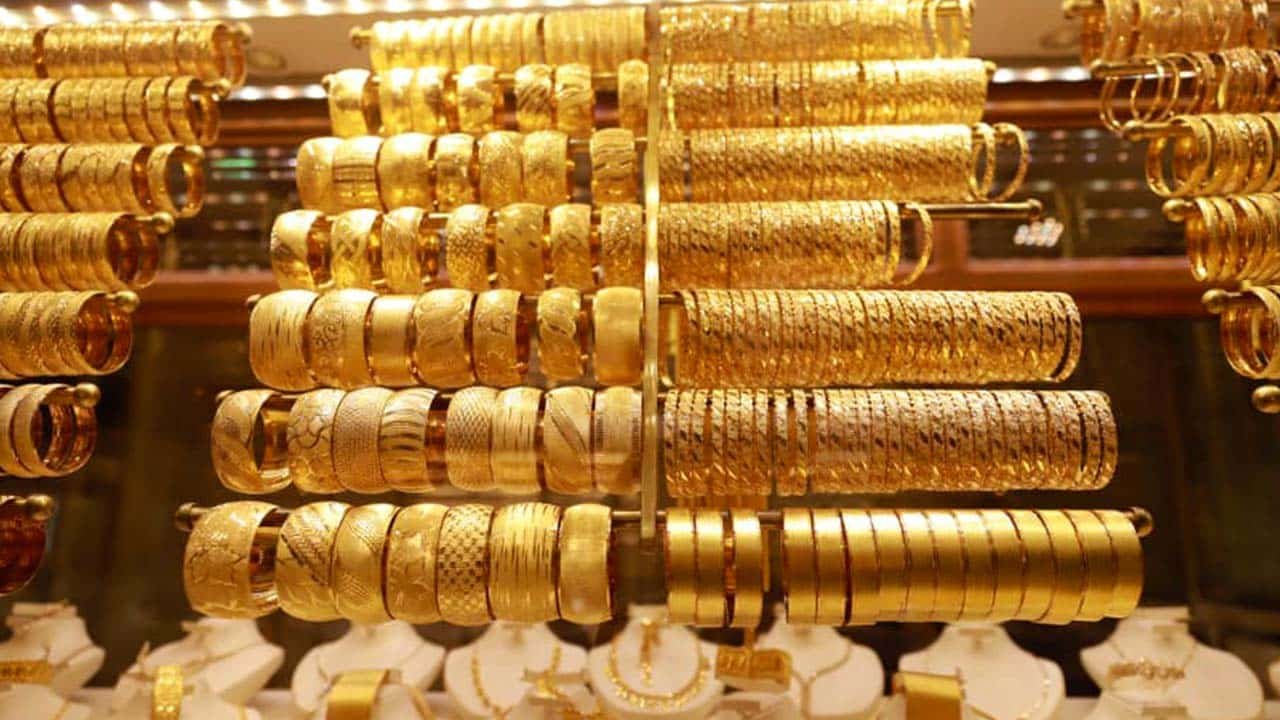
    The price of gold has soared to an all-time high following a significant slump in the rupee against the dollar, with the country struggling to secure external financing. The data released by the All-Pakistan Sarafa Gems and Jewellers Association (APSGJA) shows that the price of gold (24 carats) has spiked by Rs3,100 per tola and Rs2,656 per 10 grammes, settling at Rs217,700 and Rs186,643 respectively.

    The gold rush is in line with the movement of the rupee, which has fallen 2.44 or 0.85 per cent against the US dollar in the interbank market, and an increase in weekly inflation. Inflation has shot up 0.92 per cent week-on-week and 44.49 per cent year-on-year during the seven-day period that ended on April 6th. Prices of sugar and chicken have surged due to Ramzan, and hoarding has caused a likely uptick in inflation.

    Gold is often seen as a hedge against inflation, increasing in value as the purchasing power of the dollar declines. Plus, it’s the season of Ramzan, which brings with it a surge in demand for the precious metal. Investors’ attention has shifted towards gold as economic tensions continue to rise, with the International Monetary Fund (IMF) reviewing external financing commitments from friendly countries before it releases bailout funds. The delay in the revival of the program has negatively impacted the currency market, which is boosting demand for gold.

    The APSGJA also noted that the price of gold in Pakistan is Rs5,000 per tola “undercost” compared to the Dubai market. Thus, the Pakistani gold market is cheaper than the global market. Meanwhile, silver prices in the domestic market have also jumped to historic highs, increasing by Rs30 per tola and Rs25.72 per 10 grams to settle at Rs2,480 and Rs2,126.20, respectively.

    In the international market, the price of gold dropped $6 per ounce, settling at $2,002. Nevertheless, gold’s rise in Pakistan is set to bring a lot of excitement to the local market.

  • US Ambassador assures Pakistan of continued assistance for IMF bailout programme

    On Thursday, US Ambassador to Pakistan Donald Blome reassured Finance Minister Ishaq Dar that Washington would continue to assist Islamabad in unlocking a long-stalled International Monetary Fund (IMF) bailout. This bailout is intended to help the liquidity-challenged country’s economy avoid imminent default. The assurance was given during a meeting between the finance minister and the ambassador in the federal capital.

    According to details, the envoy was briefed on the progress of the Washington-based lender’s programme. During the meeting, FinMin Dar requested the US ambassador’s assistance in unlocking the bailout programme. He also informed him about a $2 billion commitment from Saudi Arabia and ongoing talks with the United Arab Emirates for financing $1 billion. The minister expressed the need for additional resources and financing, to which Blome promised cooperation from the United States.

    According to an official statement from the Ministry of Finance, Dar briefed the envoy on the country’s economic outlook and the challenges faced by the nation. He also shared the government’s pragmatic policy decisions aimed at stabilising and growing the economy.

    The statement noted that Blome expressed confidence in the government’s policies and programmes, supporting them for the economic sustainability of the country and the socio-economic upliftment of the masses. He extended his support to promote bilateral economic, investment, and trade relations between both countries.

    The two sides discussed matters of common interest and showed an interest in enhancing the existing bilateral relations between both countries. They also talked about various economic avenues through which both countries can strengthen their ties. This meeting with Blome took place days after FinMin Dar met with UAE’s ambassador to Pakistan, Hamad Obaid Ibrahim Salim Al-Zaabi, to discuss economic relations.

    Since early February, Islamabad has been hosting an IMF mission to negotiate a series of policy measures aimed at securing $1.1 billion in funding for the cash-strapped economy, which is on the verge of collapse.

    The IMF has requested Pakistan to secure assurances on external financing from friendly countries and multilateral partners to fund its balance of payment gap for this fiscal year, ending in June. The funds are part of a $6.5 billion bailout package the IMF approved in 2019, which analysts say is critical for Pakistan to avert defaulting on external payment obligations.

  • China approves rollover of $2 billion SAFE deposits for Pakistan

    China approves rollover of $2 billion SAFE deposits for Pakistan

    China has given approval for the rollover of $2 billion State Administration of Foreign Exchange (SAFE) deposits for a year. Pakistan’s Finance Minister, Ishaq Dar, confirmed, stating that the rollover was a requirement of the International Monetary Fund (IMF).

    The IMF had requested the rollover of Chinese SAFE deposits to fulfill external financing needs and move towards a staff-level agreement. The agreement involves filling nine tables under the Memorandum of Economic and Financial Policies (MEFP), including a table related to the Net International Reserves (NIR) as an indicative target.

    This target cannot be met without incorporating the external financing needs of the program period until the end of June 2023. The IMF has asked Pakistan to bridge the gap of $6 billion to ensure its credibility and avoid default. This condition was put forth largely because representatives of Gulf countries on the Executive Board had made commitments before the approval of the seventh and eighth reviews for providing financial assistance to Islamabad in various forms.

    Now, the IMF is seeking the support of Saudi Arabia, the UAE, and Qatar to help Pakistan’s struggling economy. The Fund has warned Islamabad that its credibility would be at stake if the staff-level agreement is finalised, and Pakistan fails to materialize its commitment from the bilateral partners, which could lead to default.

    The IMF is investigating why Pakistan’s bilateral partners are not fulfilling their earlier commitments. China is the only country that has come forward to rescue Islamabad by fulfilling its commitments on the re-financing of its commercial loans as well as the rollover of its SAFE deposits.

  • Chinese bank to provide Pakistan with another $500 million loan soon

    Chinese bank to provide Pakistan with another $500 million loan soon

    A Chinese bank has committed to provide Pakistan with another refinanced $500 million loan within the next few days. This brings the total of commercial loans to $1.7 billion out of the committed amount of $2 billion.

    Pakistani authorities are currently seeking 100 per cent confirmation from friendly donor countries and multilateral creditors before moving towards an agreement with the International Monetary Fund (IMF). The IMF has set an unwritten condition that Pakistan must secure refinancing of commercial loans and a rollover on deposits from China during the program period, which is set to expire in June 2023.

    A top official from the Finance Division confirmed that another $500 million commercial loan from a Chinese bank is on its way and will be completed soon. Chinese banks have already provided refinancing of $1.2 billion in commercial loans in the past few weeks, and Beijing has given assurance on another $500 million in loan refinancing in the next few days. Pakistan has also requested a rollover on the Chinese SAFE deposit of $2 billion within the ongoing month.

    All these factors are prerequisites for moving towards the signing of a staff-level agreement between the IMF and Pakistan. The Pakistani authorities are waiting for confirmation from Saudi Arabia, UAE, and Qatar, as well as from the World Bank and the Asian Infrastructure Investment Bank, to fulfill the external financing needs of $6 billion until the end of June 2023. The guarantees for securing external financing are crucial for the sustainability of the IMF program.

    Brent crude and WTI are both down in the international market, which is good news for Pakistan’s economy. However, the IMF has secretly launched “Inclusive growth in the MENA region” at NUST. The IMF high-ups argued that state-owned enterprises (SOEs) possessing a major footprint resulted in the crowding out of the private sector. Pakistan’s budget makers have also assured the IMF that they will prepare gender-based budgeting in the next financial year.

    To meet the IMF’s demands, the CPI-based and SPI-based inflations have risen to unprecedented levels of 31.5 per cent every month and 42.3 per cent every week. The development budget of the federal government, known as the Public Sector Development Program (PSDP), has been slashed by 50 per cent for the current fiscal year in line with the Fund’s demand to curtail the budget deficit target.

  • Pakistan reaches out to US for assistance in obtaining IMF deal

    Pakistan reaches out to US for assistance in obtaining IMF deal

    Pakistan has requested assistance from the United States to obtain “lenient treatment” from the International Monetary Fund (IMF) due to a delay in signing the staff-level agreement (SLA).

    The international lender has asked Pakistan to confirm external financing needs of $6 to $7 billion from Saudi Arabia, the United Arab Emirates, Qatar, and multilateral creditors until the end of June 2023.

    However, Pakistan has been unable to persuade the lender to sign the agreement and has requested assistance from Washington and its western allies.

    According to The News, Minister for Finance Ishaq Dar has contacted the US diplomatic corps based in Islamabad for help in ending the stalemate.

    The IMF considers that the loan facility’s “sustainability” could not be guaranteed without full assurance of external financing.

    Furthermore, the IMF has demanded a permanent abolition of power sector subsidies, which the government had only committed to until the end of the next financial year 2023-24.

    The IMF demanded changes in the wording of the Memorandum of Economic and Financial Policies (MEFP) during the last meeting held in the previous week.

    The IMF and Pakistani sides are yet to decide on further proceedings, with each side holding the other responsible for the delay in signing the SLA.