Google has opened a liaison office in Pakistan and registered with the Securities Exchange Commission of Pakistan (SECP), according to Brecorder.
A spokesman for SECP stated that the company “has been registered as a foreign company” in Pakistan, while a Google representative also verified that the liaison office had been opened.
A liaison office is a foreign company’s office set up to promote its products, offer technical support and advice, consider potential joint ventures, and promote exports.
The Ministry of Information Technology and Telecommunication (MoITT), according to insiders, was in contact with foreign companies and made arduous attempts to attract them to Pakistan, but the businesses hesitated owing to the political unrest.
However, there has been a breakthrough in this regard with Google and TikTok agreeing to set up offices in the country, while the talks between the ministry are ongoing with Meta.
Twitter goes through upheavals since Elon Musk’s takeover of the social media app, users have expressed extreme apprehension over rumors the app will shut down.
The bird app has announced that its office buildings will be temporarily closed, effective immediately and that offices will reopen on Monday, November 21.
Twitter employees were informed about the closure in a letter, but the company withheld an explanation.
The statement comes as rumours circulate that employees were leaving after the new owner, Elon Musk, told them to sign up for “long hours at high intensity” or quit. After the recent development, rumors of the micro-blogging website shutting down have taken hold of the micro blogging app.
Twitter users are sharing their concern over the expected shutdown of the site while others are sharing usernames of their handles on other social media sites and some are sharing memes.
Have a look at the reactions:
Dear @elonmusk cannot imagine a world without @Twitter so please sort and stop giving us goose bumps
With plans to layoff thousands of employees this week, Facebook parent company Meta will join a growing list of digital companies that are reducing their workforces.
As of September 30, Meta has over 87,000 people working for it across its various platforms, which include the social media sites Facebook and Instagram as well as the messaging service WhatsApp. According to WSJ, the social media business had reduced its ambitions to hire engineers by at least 30 per cent in June, and Mark Zuckerberg had advised staff to prepare for a slowdown in the economy.
In his announcement of Meta’s dismal third-quarter results, CEO Mark Zuckerberg stated that the company’s headcount will not rise by the end of 2023 and might even decline significantly.
“In 2023, we’re going to focus our investments on a small number of high-priority growth areas. So that means some teams will grow meaningfully, but most other teams will stay flat or shrink over the next year. In aggregate, we expect to end 2023 as either roughly the same size or even a slightly smaller organization than we are today,” Zuckerberg said on the last earnings call in late October.
Profits for Meta dropped to $4.4 billion in the third quarter, a 52 percent year-over-year decline. The poor findings had a significant negative impact on Meta’s stock price, which dropped by 25 per cent in one day.
Over the past year, the company’s market value has decreased to $600 billion.
In a previous open letter to Mark Zuckerberg, Meta’s shareholder Altimeter Capital Management stated that the company needed to streamline by eliminating positions and capital expenditures. They also stated that investors had lost faith in Meta as a result of its increased spending and pivot to the metaverse.
Owing to increased interest rates, rising inflation, and a European energy crisis, several technological businesses, including Microsoft Corp., Twitter Inc., and Snap Inc., have reduced workforce in recent months.
Over 1.1 million social media accounts were suspended by the Pakistan Telecommunication Authority (PTA) for posting “illegal” content and engaging in defamation campaigns against organisations.
According to specifics, PTA received over 1,200,000 complaints, including 134,000 against Facebook, and barred more than 1,135,000 IDs for uploading “illegal” content and taking part in a smear campaign against government institutions.
PTA reported that Facebook has blocked more than 112,000 bogus IDs. In addition, the agency received 65,122 complaints for immoral content posted on TikTok; following an investigation, 63,000 IDs were disabled.
According to ARY News, the PTA took down more than 36,000 YouTube videos and blacklisted 31,860 Twitter IDs in response to complaints.
After lowering the number of non-operational sites to 163, the PTA previously declared that it has restored telecom services in more flood-affected areas.
PTA said on Twitter via its handle that ongoing efforts by the organisation and telecom providers to restore connectivity in flood-affected areas have further reduced the number of non-operational sites to 163.
Additionally, PTA stated that work is underway to restore telecom services completely in flood-affected areas on a priority basis.
Owing to exorbitant PTA approval charges and soaring production costs, phone prices have hit an all-time high in Pakistan. Customers have a relatively limited number of options on the market.
While some customers are able to afford the hefty PTA approval fees, others consider getting a second phone so they can continue using their SIM as PTA approval charges for certain premium smartphones have increased up to Rs132,000.
Below are some of the most affordable phones on the market right now, which surprisingly support the majority of applications like Facebook and WhatsApp.
JAZZ DIGIT 4G – ENERGY
Touch and Type
Price: Rs7,999
JAZZ DIGIT 4G – SHINE
Price: Rs5,999
JAZZ DIGIT 4G – STAR
Price: Rs5,999
Jazz Digit 4G – E2 PRO
Touch & Type
Price: Rs8,900
These bar phones also have outstanding battery life and can be used to provide a hotspot for your primary smartphone.
All of these mobile devices are currently available at Jazz franchises or local stores and can be easily unlocked if a user wants to switch to a different network.
In order to raise awareness of digital literacy and social cohesion among young Facebook users in Pakistan, Meta has created the educational series “Chai Chats” in partnership with the Pakistan Telecommunication Authority (PTA).
According to DAWN, the series follows a close-knit group of college friends who face challenging online situations and overcome them with grace, friendship, and humour. Its goal is to encourage and persuade young people to adopt positive and responsible online behaviour.
Through the web series and local community training, the programme hopes to reach millions of young Pakistanis online as well as 180 secondary school teachers and more than 1,000 secondary school students. It will also train educators in at-risk communities to address these issues with at-risk communities.
The focus of the webisode series “Chai Chats” focuses on the daily online activities of five university buddies and how they support one another in navigating their online and offline lives while also taking into account their varied socio-cultural and behavioural tendencies.
By connecting with the young audiences, the characters and their story should function as positive role models.
Chairman PTA Maj. Gen (R) Amir Azeem Bajwa praised Meta’s efforts in a statement about the programme. “This effort will improve Pakistani youth’s capacity to utilise social media platforms in a beneficial, productive, and legal manner for both individual and group well-being.
Through better digital experiences, Meta has been at the forefront of fostering digital literacy.
The government of Pakistan is dedicated to using digital technology to hasten socio-economic development across the country, and I believe that this initiative will prove to be a significant first step in that direction, he continued.
“The programme furthers Meta’s long-term commitment to developing digital literacy in Pakistan and assisting all users to harness the benefits of technology innovation for their growth and socioeconomic success,” stated Ruici Tio, Policy Program Manager, APAC- Meta.
Its objective, according to him, was to improve the digital and critical thinking abilities of over 1,000 children and 180 teachers in these areas.
Instagram is testing a feature that converts video posts into Reels. According to the company, the modification is a part of Instagram’s plan to streamline video on the app and is currently being tested with a small number of users worldwide.
With the most recent move made by the blogging platform, Instagram’s efforts to surpass TikTok are clearly growing.
A representative from Meta stated, “We’re testing this feature as part of our efforts to simplify and improve the video experience on Instagram.”
The social media consultant Matt Navarra shared a screenshot of an in-app message that reads, “Video posts are now shared as Reels,” on Twitter. Participants in the test will see this message.
The message warns that anyone can find your Reel and use your original audio to make their own Reel if your account is public and you post a video that ends up being turned into one. Only your followers will be able to see your Reel if your account privacy setting is set to private.
The message also mentions that if your account is public and you post a reel, anyone can remix it. In your account settings, you can, however, stop people from remixing your Reels.
As Meta has placed significant wagers on Reels, the test is now. Reels now account for more than 20% of people’s Instagram usage, according to the company’s Q1 2022 earnings report.
It is not surprising that Instagram wants to completely replace video posts in order to expand Reels. People may spend even more time watching Reels if the company ultimately decides to make this change permanent, which would be something to brag about.
Instagram’s video components would be even more consolidated if it decides to convert all video uploads into Reels.
When Mosseri outlined Instagram’s goals for 2022 last year, he said the company would increase its investment in video and concentrate on Reels.
This change may have been intended all along, as he even made a hint that Instagram would center all of its video products around Reels and continue to expand the short-form product.
Data from the Reuters Digital Media Report 2022 shows that among users of social media platforms, TikTok took over Snapchat and Telegram in 2021 and 2022 respectively, across the world. It is the fastest growing platform among all social media channels. In 2021, only five per cent of the global audience was using TikTok and this number has grown to 16 per cent in 2022. Snapchat audience decreased by one per cent to 12 per cent while Telegram has seen an increase of five per cent with new global audience of 12 per cent.
The table shows change in audiences using Snapchat and TikTok
2020
2022
Change
TikTok
5 per cent
16 per cent
11 per cent
Snapchat
13 per cent
12 per cent
-1 per cent
Social media usage has also increased throughout the world.
Trust in BBC falls by 20%
Datamentioned in the report also shows that the average level of trust in news networks globally has reduced by eight points from 50 per cent to 42 per cent in a year. Moreover, in the UK, the proportion of people not trusting BBC has increased from 11 per cent to 26 per cent while the proportion trusting BBC has fallen by 20 per cent.
The attached graph shows how the UK audience’s trust in the BBC has dwindled over time.
Another important thing to notice is that TikTok is not just being used for fun videos. It is also emerging as a new player in the news ecosystem. More and more people are turning to TikTok for their news. It has also taken over Snapchat for news as well.
2020
2022
Change
TikTok
1 per cent
7 per cent
6 per cent
Snapchat
3 per cent
2 per cent
-1 per cent
Audience is less interested in news
Globally, the interest of people in news is falling. The proportion that says they are extremely interested in the news has fallen sharply over time. On average, in 2015, 67 per cent of global audiences was interested in the news while this number declined to 47 per cent in 2022 with a change of -20 per cent.
Country
2017
2022
Change
Argentina
77 per cent
48 per cent
-29 per cent
Brazil
82 per cent
57 per cent
-25 per cent
Spain
82 per cent
55 per cent
-27 per cent
UK
65 per cent
43 per cent
-22 per cent
USA
68 percent
47 per cent
-21 per cent
Consumers are avoiding the news
The report also says that 38 per cent of the audience actively avoided news in 2022. The audience becoming least interested in the news has been increasing from 2017 to 2022 in every country except for Italy. The attached graph shows the percentage of people staying away from news in different countries.
The most common reason for avoiding news is politics and Covid-19. Data shows that 43 per cent of users avoid the news because of excessive news regarding Covid-19 and politics. Moreover, 36 per cent of the audience thinks that the news has a negative impact on their mood.
People under the age of 35 struggle to understand news
People under 35 are also finding it hard to understand the news and it is causing them to avoid the news.
Younger audiences want journalists to express personal opinions
Data from the report shows that 46 per cent of the population between the ages of 18-24 do not want news channels to just report news on social media but want them to express their personal opinions alongside reporting news, while the opposite is true for people of age 55+. 57 per cent of older people want news channels to stick to reporting the news. The older the consumer, the more the proportion of them want journalists to stick to just posting news on social media.
Majority uses smart phones to access morning news
In most countries, the majority use mobile phones to access news in the morning with the highest percentage being 43 per cent in Norway. In most countries, the least used medium for news is print media. The 2021 report shows that the lockdown during Covid-19 proved to be a nail in the coffin for print media.
Younger audiences prefer watching the news rather than reading it
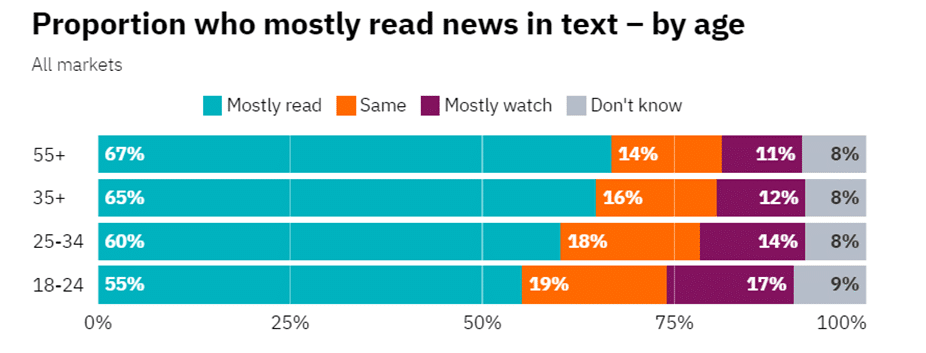
Although the significant majority still prefers reading news irrespective of age, data reveals that people aged 18-24 prefer watching the news (17 per cent) which is more when compared to older people (11 per cent for age above 55). The younger you are, the more you prefer watching the news rather than reading about it.
Key findings in Digital Media Report 2021
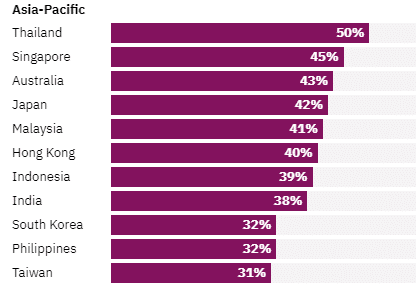
Data from the digital media report last year (2021)showed that the trust level for news reports in Asia-Pacific is no more than 50 per cent with the most being in Thailand. It is important to notice that the USA is reported to have a trust level of 29 per cent in the news, which is the lowest of all 46 countries selected for the report. The report says it is the aftermath of deep division over the US ‘stolen election reports’ and the killing of George Floyd.
To measure the trust level, people were asked to indicate if they trusted the news posted on social media,
Other key findings of last year’s report showed that Facebook, which was known for Covid-19 misinformation, was still used by 32 per cent for news and the most successful social media platform was YouTube.
On iPhones, Instagram stories have been acting up for certain users, forcing them to go through all of someone’s stories before being allowed to see new ones.
Since Monday, numerous users have been afflicted by the problem, and other Reddit users have complained that the same thing is occurring to them’.
The source of the problem appears to be that Instagram forgets where you left off when viewing someone’s story.
For example, if a user uploads five stories and you look at four of them before swiping away, you should see their fifth story the next time you tap on their symbol. Instead, each time you want to view the story, Instagram forces you to go back through the four you have previously seen.
When someone adds a new story to their feed, the problem occurs as well.
According to The Verge, Instagram released an update for the app in the iOS App Store on Wednesday morning that appears to have fixed the problem.
In case, you’re having problems, check for updates and make sure your app is up to date, to the latest version, which is v239.1.
The update notes only state that “the current version provides bug fixes and performance enhancements,” yet netizens claim that it has solved the problem of repeating Stories.
In an email to The Verge, Meta representative Christine Pai said the business is “aware that some customers are having problems accessing Instagram Stories”.
Pai apologised for the disruption and stated that Instagram is “trying to bring everything back to normal as quickly as possible”.
The exact number of users that have been affected is unknown. Many twitterati are saying that they have to replay stories on Instagram, still the platform is not that massively trending.
Facebook-parent Meta confirmed that Sheryl Sandberg is stepping down as its chief operating officer (COO) of the social media platform.
However, Sandberg did not specify the reason for her departure from the company, which will happen in the fall, in a Facebook post. Sandberg revealed that she intends to concentrate on her charity efforts in the future.
“The debate around social media has changed beyond recognition since those early days. To say it hasn’t always been easy is an understatement,” Sandberg wrote. “But it should be hard. The products we make have a huge impact, so we have the responsibility to build them in a way that protects privacy and keeps people safe”.
Mark Zuckerberg clarified that Sandberg will remain on the board of directors of Meta, according to Meta CEO Mark Zuckerberg in a separate Facebook post. The company’s Chief Growth Officer, Javier Olivan, will take over as COO, although his work will be “distinct from what Sheryl has done” and “a more traditional COO function”.
In a recent post, Zuckerberg said: “It’s unusual for a business partnership like ours to last so long. I think ours did because Sheryl is such an amazing person, leader, partner, and friend”.
Sandberg established herself as a high-profile figure in the IT industry prior to joining Facebook, having previously served as Google’s vice president of global online sales and operations. Prior to joining Google, she worked for President Bill Clinton at the World Bank and the Treasury Department.
She was often regarded as the adult supervisor for a firm led by a very young entrepreneur during her early years at Facebook.
Sandberg closely worked with Zuckerberg to increase Facebook’s income from around $150 million in 2007 to over $3.7 billion in 2011, the year before the company went public. She also rose to fame as one of the most powerful women in technology. Her notoriety was enhanced by her role in founding the Lean In movement, which outlined a strategy for women to succeed and achieve their objectives.