Tag: FBR

  • Telecom companies block 9,000 SIMs of non-filers under FBR directive

    Telecom companies block 9,000 SIMs of non-filers under FBR directive

    Telecom operators have taken action by blocking the mobile SIMs of approximately 9,000 individuals who have not filed their taxes, following directives from the Federal Board of Revenue (FBR).

    According to a spokesperson from the FBR, this measure has been expedited, with telecom companies receiving updated data daily for the purpose of blocking SIMs.

    It has been revealed that the FBR has already provided data for around 30,000 individuals whose SIMs are earmarked for blocking.

    However, the spokesperson acknowledged that there is still a substantial number of approximately 506,671 individuals who have not filed their Income Tax Return for Tax Year 2023 but are obligated to do so.

    Initially, telecom operators were hesitant to execute this directive, citing various legal concerns. Nevertheless, they eventually consented to manually block SIMs in smaller batches.

    The FBR had issued an Income Tax General Order (ITGO) in late April, instructing the disabling of mobile phone SIMs belonging to over half a million individuals not appearing on the active taxpayer list.

    At the time of issuance, telecom companies were directed to furnish a compliance report by May 15 regarding this matter.
  • IHC stops government from blocking SIMs of non-filers

    IHC stops government from blocking SIMs of non-filers

    The Islamabad High Court (IHC) on Tuesday stopped the government from blocking phone SIMs of non-filers.

    IHC Chief Justice Aamer Farooq issued a stay order effective till May 27 as the court took up the petition today filed by a mobile phone company challenging the government’s decision to block SIMs of non-filers.

    Salman Akram Raja, Pakistan Tehreek-e-Insaf leader, was the petitioner’s counsel and gave forward the argument that the amendment in the law is at odds with Article 18 of the Constitution which guarantees freedom to do business.

    The High Court order came out after the Federal Board of Revenue (FBR) and telecom operators agreed on blocking of SIMs of tax non-filers in a bid to reduce tax evasion and improve revenue.

    FBR had announced that telecom companies have agreed to commence the manual blocking process of SIMs in small batches until their systems are fully equipped to automate it.

    It also announced initially 5,000 non-filers would be targeted and then further more batches would be sent to telecom operators.

  • Tax chor tyar hojaen; FBR, telecos agree to start blocking SIMs

    Tax chor tyar hojaen; FBR, telecos agree to start blocking SIMs

    The Federal Board of Revenue (FBR) and telecom operators have agreed on blocking SIMs of tax non-filers as part of the government’s strategy to punish tax evasion, The News reported on Saturday.

    In a statement, the FBR announced that telecom companies have agreed to start the manual blocking process of SIMs in small batches until their systems are fully equipped to automate it.

    The FBR said that the first batch comprising 5,000 non-filers has been communicated to telecom operators and further batches would be sent to telecom companies on a daily basis.

    Meanwhile, the operators have also commenced sending messages to non-filers regarding the blocking of their SIMs for intimation purposes.

    Earlier, a deadlock had been created when telecom operators refused to implement FBR’s decision to block 500,000 SIMs of tax evaders.

  • Mobile SIMs of over 500,000 tax evaders to be blocked under FBR directive

    Mobile SIMs of over 500,000 tax evaders to be blocked under FBR directive

    The Federal Board of Revenue (FBR) has identified 506,671 individuals who have not filed their income tax returns for the 2023 tax year and issued an order to block their mobile phone SIM cards.

    This directive, known as Income Tax General Order No. 01 of 2024, was released on Tuesday, mandating the Pakistan Telecommunication Authority (PTA) and all telecom operators to comply immediately.

    According to the FBR, these non-filers are required to file their income tax returns under the Income Tax Ordinance of 2001. The list of those affected is available on the FBR’s website. Those listed can check to confirm whether their mobile phone service will be disrupted.

    Under Section 114B of the Income Tax Ordinance, the FBR has the authority to take such measures to enforce compliance with tax regulations.

    The PTA and telecom operators must block the SIM cards of the individuals named in the order, and the SIM cards will remain deactivated until the FBR or the respective Commissioner of Inland Revenue restores them.

    The FBR has set a deadline of May 15, 2024, for telecom operators to report their compliance with the order. Failure to meet this deadline could result in further regulatory action.

    The FBR is taking this step to ensure that all those required to file income tax returns do so promptly, contributing to the country’s revenue base.

  • FBR seizes counterfeit cigarettes worth Rs96 million in nationwide crackdown

    FBR seizes counterfeit cigarettes worth Rs96 million in nationwide crackdown

    In a sweeping enforcement effort spanning the nation, the Federal Board of Revenue (FBR) has confiscated 1,235 packs of counterfeit cigarettes, valued at approximately Rs96 million.

    Under the guidance of FBR Chairman, Malik Amjed Zubair Tiwana, and the direct supervision of Mir Badshah Khan Wazir, Member Inland Revenue (Operations), IR Field Formations of FBR executed a comprehensive crackdown on counterfeit and non-stamped cigarettes.

    During the operation, which targeted evasion practices, a total of 4,652 retail outlets were inspected nationwide. Out of these, 33 establishments were found engaged in illicit tobacco trade and subsequently sealed.

    The enforcement drive involved a significant deployment of resources, with a total of 204 teams comprising 1,047 personnel dedicated to the mission of curbing the circulation of illicit cigarettes.

    Chairman FBR, Malik Amjed Zubair Tiwana, and Member Inland Revenue (Operations) Mir Badshah Khan Wazir commended the diligent efforts of the IR field formations involved in the operation.

    Despite facing constraints in human resources and logistics, the Inland Revenue Enforcement Network persistently strives to eliminate the menace of illicit tobacco trade.

    The successful outcome of this operation underscores the FBR’s commitment to combating illegal activities and safeguarding public health and revenue integrity.

  • Crackdown against $23 billion black market results in attacks on custom officials

    Crackdown against $23 billion black market results in attacks on custom officials

    On Saturday, three people, including two Customs officials, were murdered in an attack near Bannu Road when unknown gunmen opened fire targeting their vehicle at the Yarak toll plaza in Dera Ismail Khan district of Khyber Pakhtunkhwa.

    This is the second attack on Pakistan Customs officials in less than a week in Dera Ismail Khan.

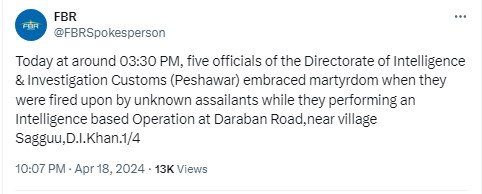
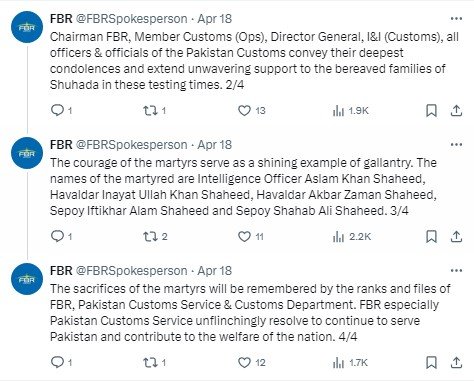
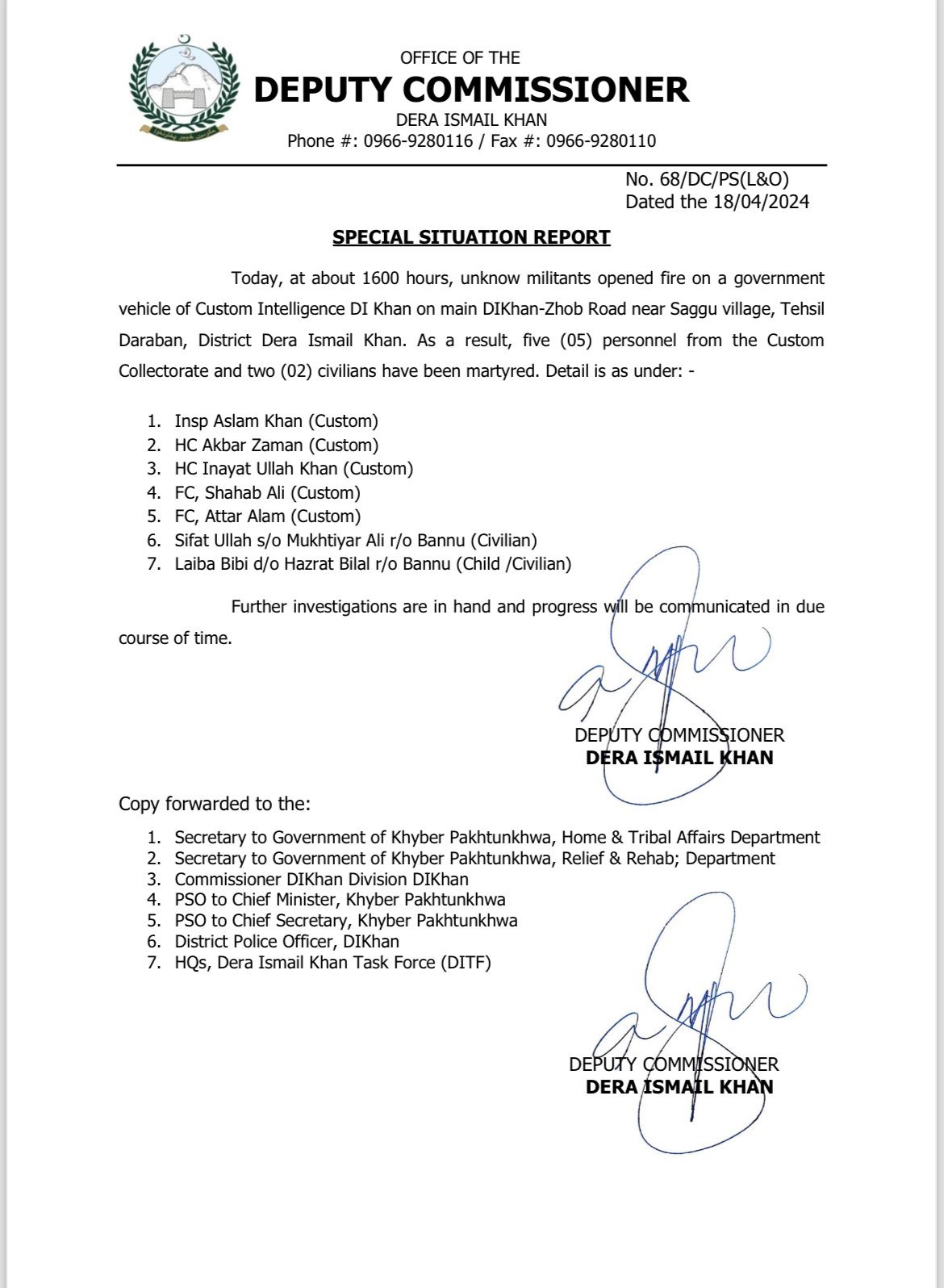
    Previously on April 18, seven people, including a child, were slain in an attack out of which five were Custom officials. Federal Board of Revenue (FBR) released a statement on X, formerly Twitter, reiterating Pakistan’s resolve to fight terrorism.

    The Khorasan Diary had reported that “Customs had tightened the noose around smuggling around this area as it was frequented by militant networks who were involved in smuggling weapons and vehicles used in attack in urban centres,” a senior customs official said.

    The special situation report of the April 18 incident was released by the Deputy Commissioner

    Moreover, Tehreek-e-Taliban Pakistan (TTP) claimed responsibility for the heinous attack.

    It should be noted that Dera Ismail Khan is an infamous route for illicit trade and smuggling as there have been many instances when the authorities have foiled bids to smuggle goods including arms, Iranian fuel and more.

    (Image taken from APP report)

    As Pakistan navigates through tough economic waters, Prime Minister Shehbaz Sharif ordered strict action against smugglers and urged law enforcement agencies to expedite their campaigns.

    Illicit activities such as black market and smuggling cost Pakistan $23 billion per year, according to the report by ACE Money Transfer, a UK-based company.

    Previously, the caretaker administration started the anti-smuggling drive in the country to protect the feeble foreign exchange and stop the devaluation of local currency (PKR).

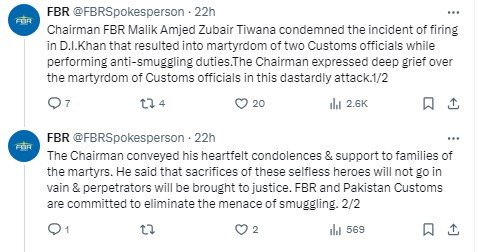
    The FBR released a statement offering condolences to the victims’ families.

  • PM orders rapid action against tax evaders

    PM orders rapid action against tax evaders

    In a meeting held on Monday, Prime Minister Shehbaz Sharif has authorised that swift action be taken against tax evaders and defaulters. He tasked the committee to identify all obstacles and delays in the implementation of Trace and Track System (TTS) in tobacco, sugar, cement and fertilizer industries.

    The PM also said that action should be taken within seven days against tax evaders. PM Shehbaz emphasized that all legal obstacles in the implementation of trace and track system should be removed and that this system should be enforced at all production lines of cement factories. Those factories who refuse to follow the rules, should be immediately sealed, the Premier ordered.

    He was of the opinion that besides an increase in revenue, the trace and track system could also be used for identification of counterfeit products.
    The premier also called for an end to fake and unregistered cigarettes. The meeting was apprised that TTS was fully operational in 14 tobacco factories whereas 12 other factories had been sealed for non-compliance.

    The system faced problems in sugar and cement industries due to technical issues while it was working in fertilizer industry. The PM also stressed action against smuggling that was causing serious loss to the national exchequer.

  • IMF wants Pakistan to increase petrol prices

    IMF wants Pakistan to increase petrol prices

    The International Monetary Fund (IMF) conveyed to the Pakistani authorities that while the Petroleum Development Levy (PDL) has considerably increased in recent years, the taxation of petroleum products has declined since 2019. “The relatively low rate of taxation of petrol is also reflected in the sale price relative to other countries.” The IMF emphasized that there is a difference of gasoline prices when compared to selected neighboring countries and emerging economies.

    The average 2023 price of gasoline at the pump was $1.12 per litre against $0.97 per litre in Pakistan. The IMF report said that taking off the exemption of petroleum products under the Sales Tax would increase prices by 18% with the standard rate of General Sales Tax.
    Moreover, the IMF has also recommended in its Technical Assistance Report with the Pakistani authorities to raise taxes on domestically manufactured automobiles and on luxury goods such as yachts. It also said to increase border control to stop smuggling of oil derivatives.

    Pakistan faces a problem of smuggling especially on it Western borders with both Iran and Afghanistan. A 2023 Civil Intelligence Agency report exposed that Pakistan faced loss of more than Rs. 60 billion annually due to smuggling of more than 2.81 billion litres of oil from Iran to Pakistan, as per the report of Business Recorder.

    The Fund also recommended the Federal Board of Revenue (FBR) to tax e-cigarettes equal to tobacco in the country.

  • IMF urges Pakistan to expand capital gains tax scope to include cryptocurrencies

    IMF urges Pakistan to expand capital gains tax scope to include cryptocurrencies

    The International Monetary Fund (IMF) has advised the Federal Board of Revenue (FBR) to broaden the scope of capital gains tax (CGT) by incorporating cryptocurrencies into the tax regime.

    This recommendation arises amidst ongoing discussions between the Fund and Pakistani authorities regarding the $3 billion stand-by arrangement (SBA).

    The four-day review, which commenced on Thursday, aims to unlock the final tranche of approximately $1.1 billion secured by Islamabad under a last-minute rescue package last summer, thus averting a sovereign debt default.

    During these deliberations, the IMF proposed a reassessment of tax slabs for real estate and listed securities to ensure comprehensive taxation of all gains, irrespective of asset holding periods.

    Moreover, the IMF urged the FBR to mandate property developers to monitor and report all pre-completion property transfers, with penalties for non-compliance. This move aims to bring under the tax umbrella the prevalent practice of trading property plot files within housing schemes.

    These recommendations are anticipated to be incorporated into the forthcoming bailout package under the Extended Fund Facility (EFF), potentially becoming integral to the FY2024–25 budget through the finance bill.

    The IMF’s technical assistance report highlights the challenges faced by Pakistani authorities in assessing and collecting taxes on capital gains from real estate transactions, particularly those occurring before formal property registration.

    To address this issue, the IMF suggests obligating property developers to track and report all pre-completion property transfers, with penalties for non-compliance, thereby shifting tax liabilities to developers if they are not recoverable from the initial transferor.

    Furthermore, the IMF advocates for the expansion of assets subject to capital gains tax to include emerging investment avenues such as cryptocurrencies alongside real estate and listed securities. 

    It also proposes revising tax slabs to ensure equitable taxation of capital gains, irrespective of asset holding durations.

    Overall, these IMF recommendations seek to fortify the taxation framework, ensuring a more inclusive and equitable approach to capital gains taxation in Pakistan.

  • IMF mission to arrive tomorrow for final review discussions on Pakistan’s SBA

    IMF mission to arrive tomorrow for final review discussions on Pakistan’s SBA

    The International Monetary Fund (IMF) mission is poised to commence vital economic review discussions from March 14 to 18, 2024, marking the conclusive evaluation of Pakistan’s Standby Arrangement (SBA).

    Sources within the Finance Ministry have confirmed that the IMF mission is scheduled to touch down in Pakistan tomorrow night, kickstarting a series of pivotal discussions set to unfold over the next four days.

    During this intensive period, the IMF mission is slated to engage in comprehensive dialogue with Pakistan’s economic team. Key participants include representatives from the Finance Ministry, Energy Ministry, Federal Board of Revenue (FBR), State Bank of Pakistan (SBP), Planning Commission, and the Petroleum Division.

    Insiders suggest that the IMF mission will delve into discussions covering a spectrum of economic facets. Talks are expected to encompass various critical sectors, including finance, energy, taxation, and central banking.

    Furthermore, in parallel with these discussions, preliminary conversations are anticipated to unfold regarding the potential initiation of a new loan programme with the IMF mission. This prospect adds an extra layer of significance to the ongoing economic deliberations as Pakistan navigates its financial landscape in the pursuit of sustainable economic growth.

    Stay tuned for comprehensive coverage as the IMF mission engages in the final review of Pakistan’s Standby Arrangement, paving the way for crucial decisions that could shape the nation’s economic trajectory in the coming months.