Tag: FBR

  • Government will soon lift the import ban on certain items

    Government will soon lift the import ban on certain items

    The government will lift the import ban on some items in the upcoming weeks, according to Finance Minister Miftah Ismail, but restrictions for cellphones, cars, and home appliances will remain in place.

    He stated that the Commerce Ministry has sent a summary to the federal cabinet for removing restrictions on the import of non-essential and luxury items while speaking at a seminar about the performance of state-owned enterprises (SOEs) here in the federal capital.

    According to the finance minister, the decision was made in light of a lower import bill as a result of restrictions placed on the import of new machinery and raw materials, as well as lower oil prices on the global market. “In the upcoming months, we anticipate a decrease in petroleum product imports. Lower imports will enable Pakistan to conserve its foreign currency, he continued.

    He continued by saying he was hopeful for higher dollar inflows compared to outflows starting in the upcoming month, which would ease pressure on the local currency.

    “Imports in Pakistan as of July 25 were $3.758 billion and our total imports are likely to be $4.824 billion. This number will be less than our exports plus remittance”, he had written on Twitter a day earlier.

    The ban on 30 categories and 83 Customs headings was reportedly requested to be lifted by the finance minister on Tuesday to Prime Minister Shehbaz Sharif.

    He did, however, suggest that the Commerce Ministry keep the ban on completely built units (CBUs), cars, and home appliances in place.

    Speaking with Profit, sources said that between May 19 and July 19, 2021, Pakistan imported CBU automobiles, mobile phones, and home appliances worth Rs399 million. However, after the ban was imposed on May 19, 2022, the trend of importing these items decreased.

    Pakistan imported goods worth Rs123 million between May 19 and July 19, 2022, a difference of Rs276 million compared to the corresponding months of the previous fiscal year.

    It is important to note that the government has outright banned the import of cars, mobile phones, home appliances, dry fruits (aside from those from Afghanistan), crockery, shoes, chandeliers, lights (except energy savers), headphones, and loudspeakers.

    Some items on the list included condiments, doors and window frames, travel bags and suitcases, sanitary ware, fish and frozen fish, preserved fruits, tissue paper, furniture, shampoos, confectionery, luxury mattresses, and sleeping bags, jams and jellies, cornflakes, toiletries, heaters, blowers, sunglasses, kitchenware, aerated water, frozen meat, juices, pasta, ice cream, cigarettes, shaving supplies, luxury leather apparel, and musical instruments.
  • Pressure on Pakistani rupee may decrease in August

    Pressure on Pakistani rupee may decrease in August

    Finance Minister Miftah Ismail expressed his continued faith in Pakistani rupee’s (PKR) ability to withstand pressure despite the PKR continuing to hit historic lows versus the US dollar and suffering its biggest weekly slide in more than 20 years.

    The finance minister stated in an interview with Radio Pakistan that the political climate and the fact that import payments are being made for shipments beginning in June are both contributing factors to the pressure on the PKR.

    “Import of $80 billion were made during the last fiscal year. We are still making payments for energy commodities purchased last month. Therefore, the rupee is under pressure. However, as we are importing less in July, its effect would be reflected from next month or, I should say, next week.”

    “The rupee’s fall is connected to the political situation as well. Before July 17, the situation wasn’t like this,” he added.

    Miftah also spoke about Pakistan’s economic issues, stating that the poor export base continues to be a matter of concern.

    The local currency has continued to depreciate against the US dollar, losing 7.6 per cent last week, more than what businesses typically account for in terms of annual currency depreciation, as the inter-bank market experienced a turbulent five sessions due to renewed political uncertainty and increased worries about Pakistan’s external financing needs.

    He also revealed that one friendly country is ready for an instant investment in Pakistan.

    It is worth noting that Pakistan anticipates receiving the next International Monetary Fund (IMF) tranche before the end of the following month following the board meeting.

  • FBR collects highest-ever tax of Rs6 trillion in FY22

    FBR collects highest-ever tax of Rs6 trillion in FY22

    The Federal Board of Revenue (FBR) achieved a significant feat by collecting a record Rs6,000 billion in revenue during the previous fiscal year 2021–2022.

    The FBR reported that during the current fiscal year, it collected Rs2,205 billion in income tax, Rs2,773 billion in sales tax, and Rs1,007 billion in customs duty. The organisation in charge of collecting taxes also released Rs305 billion in refunds during that time.

    According to former finance minister Shaukat Tarin, the government of Imran Khan’s policies and the country’s economic growth allowed FBR to meet its revenue goals.

    Tarin insisted that the government should continue enforcing the prior administration’s tax laws. According to Tarin, the government shouldn’t impose additional taxes on the current taxpayers. Heavy taxes shouldn’t be imposed on the economy’s productive sectors, he continued.

    The government has given the general public significant tax breaks on a number of necessities, but the FBR claims that these tax breaks haven’t prevented revenue collection from continuing on an unprecedented and constant growth trajectory. Sales tax on all POL products has been eliminated for the first time in the nation’s history, costing the FBR Rs45 billion per month.

    In order to maximise revenue potential through digitization, transparency, and taxpayer facilitation, the FBR has implemented a number of novel interventions at both the policy and operational levels. In addition to ensuring transparency, facilitating taxpayers, and making business easier, this has led to a steady increase in revenue collection.

  • Imposing super tax on the rich will reduce budget deficit: Miftah

    Imposing super tax on the rich will reduce budget deficit: Miftah

    The government’s recently announced indirect tax (super tax) is intended to assist the country in increasing tax revenue and lowering the budget deficit, according to Finance Minister Miftah Ismail.

    He was relating to the large industries’ 10 per cent super tax or poverty alleviation tax.

    13 industries, including LNG terminals, sugar, cement, steel, textile, tobacco, fertiliser, banks, oil and gas, beverages, automobiles, and steel, will be subject to this one-time levy, according to Miftah. The government labelled these 13 industries for a special tax as they made significant profits last year.

    Companies in these sectors earning more than Rs300 million will be subject to a 10 per cent super tax, he added.

    According to the finance minister, this tax is a one-time levy that will only be in effect for fiscal year 2022–2023.

    He clarified on Twitter that the 4 per cent super tax will be imposed on all industries.

    “For the specified 13 sectors, another 6 per cent will be added for a total of 10 per cent,” he said. “So their tax rates will go from 29 per cent to 39 per cent. This is a one-time tax needed to curtail the previous four record budget deficits.”

    The imposition of a super tax on the wealthy, according to Finance Minister, will lessen the country’s reliance on foreign aid, lower the budget deficit, and bring the country closer to financial stability.

    Other businesses that make over Rs150 million will be subject to a 1 per cent super tax, and those that make over Rs200 million will be subject to a 2 per cent tax. On top of the current rates, it is worth noting that these taxes are additional.

    Businesses that earn more than Rs250 million in revenue will pay a 3 per cent super tax, and those that earn more than Rs300 million will pay a 4 per cent super tax.

    He continued, citing statistics, that there were 9 million retail and wholesale establishments in Pakistan, and that the government wanted to bring an additional 2.5–3.5 million into the tax system.

    “We are linking the income tax and sales tax of these shops with the electricity bill,” Miftah said. “Now, small shops will pay a fixed tax of Rs3,000 and large shops will pay Rs10,000.”

    Only 22 of Pakistan’s more than 30,000 gold trading companies, he claimed, were registered, and their average annual sales came to Rs4,000.

    Sales tax and a fixed income of Rs40,000 will now be paid by gold shops of 300 square feet or less.

    He said that the government would lower the sales tax on large stores from 17 per cent to just 3 per cent.

    The withholding tax on jewellery sales to gold shops by the general public has been reduced from 4 per cent to 1 per cent.

    According to Miftah, fixed tax structures similar to these will be introduced for real estate agents, car dealers, and builders. Since this tax only applies to income and not to spending, inflation will not rise.

    Additionally, the withholding tax for the IT sector has been eliminated. Sales and income taxes would not apply to IT companies with annual revenue of less than Rs80 million.

    Miftah emphasised that Pakistan needs the IMF programme to resume as the country’s foreign exchange reserves are at a critical point.

  • Punjab’s ePay system collects over Rs90 billion tax revenue through 17 million transactions

    Punjab’s ePay system collects over Rs90 billion tax revenue through 17 million transactions

    Since its launch in October 2019, e-Pay Punjab, an online payment solution developed by the Punjab Information Technology Board (PITB) and the Punjab Finance Department, has collected over Rs90 billion in tax revenue through 17 million transactions.

    As per details released by the PITB on Friday, e-Pay Punjab has collected a total of Rs57 billion in sales tax, Rs11.5 billion in token tax, Rs9 billion in property tax, Rs4 billion in traffic challans, and Rs440 million in vehicle transfers.

    It’s worth noting that e-Pay Punjab now accepts online payments for 23 taxes and levies from ten different departments. Its 1-Link network integration with the State Bank of Pakistan (SBP) and all scheduled banks makes it a secure and dependable payment channel.

    The e-Pay Punjab application, which has over 1 million downloads, generates a unique PSID number that is accepted by banks across Pakistan through their various channels, including Internet and Mobile Banking, ATMs, and physical branch visits.

    It is also a secure, smart, and fast online payment option for the annual Token Tax. Vehicle owners can use e-Pay Punjab to pay their Token Tax from the comfort of their own homes.

    The app’s primary objective is to make it convenient for the government to gather revenue in the form of taxes through a simple solution. With Pakistan’s first digital tax aggregator, the app demonstrates how Pakistan and its government are rapidly integrating financial technology (fintech) into their processes.

  • IMF rejects proposed tax relief for the salaried class

    IMF rejects proposed tax relief for the salaried class

    The International Monetary Fund (IMF) has rejected the government’s proposed tax cut in the Personal Income Tax (PIT) to the tune of Rs47 billion, leaving the government with no choice but to reconsider amendments in order to revive the remaining funds.

    According to The News, the Federal Board of Revenue (FBR) granted relaxation to salaried workers earning up to Rs1.2 million annually, top official sources claim that the IMF has expressed strong misgivings about the planned PIT rate.

    To assist the urban middle class, the International lender recommends that the assistance be limited to persons earning up to Rs0.2 million per month, and that tax rates in other slabs be raised afterward.

    Compensation in PTI’s tenure

    During the sixth review under the PTI-led government, the FBR offered compensation to those making up to one million rupees per month in salary in the budget for 2022-23 through Finance Bill 2022 in Parliament, which was set as a structural benchmark under the Fund agreement. If the proposed PIT rates are not adjusted, it could become a major roadblock to reaching an agreement with the IMF at the staff level.

    The international lender intended to improve tax collection by Rs125 billion by putting PIT in a progressive manner, but the government went the other way, making it impossible for both parties to get a staff-level agreement under the $6 billion Extended Fund Facility (EFF) with the current PIT proposal.

    Proposed tax for salaried class in Finance Bill 2022

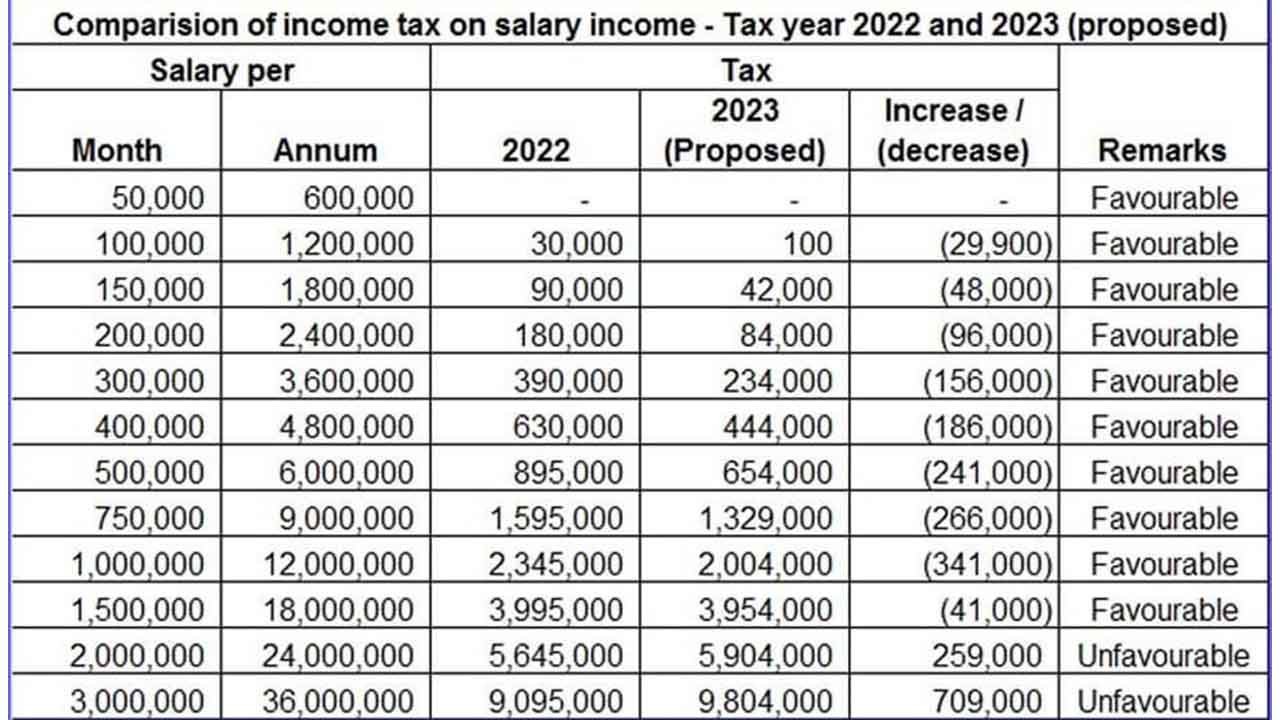
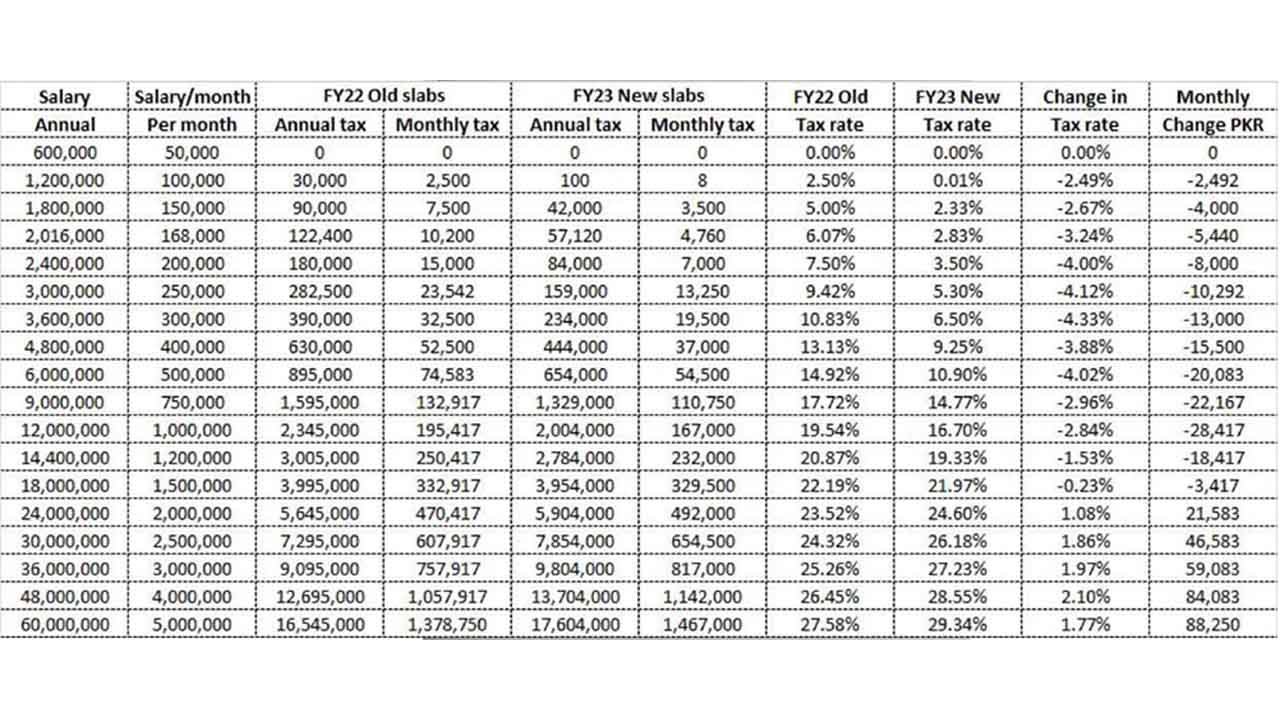
    According to the Finance Bill 2022, those earning up to Rs1.2 million will pay only Rs100 in tax. Previously, those earning up to Rs800,000 per year had to pay Rs10,000, those earning up to Rs1.2 million Rs30,000, and those earning up to Rs2 million Rs120,000. According to the suggested rate, a salary employee earning Rs2 million per year will only have to pay Rs56,000.

    The tax burden for salary earners up to Rs3 million was formerly Rs282,000 per year, but now it is projected to be Rs159,000. Up to Rs4 million in salary, a salary earner had to pay Rs470,000 in income tax, but under the proposed rate, the tax payment is reduced to Rs304,000. The tax due for a salary earner earning up to Rs5 million was Rs670,000, but it was cut to Rs479,000 under the proposed rate.

    The Finance Bill 2022 recommends providing relief up to Rs one million in salary earner who had to pay Rs1.845 million in tax, but now the tax burden has been lowered to Rs1.554 million for salary income up to Rs one million per month under the proposed Finance Bill 2022. The planned tax rates were amended upward in the remaining slabs up to Rs20 million, Rs40 million, Rs60 million, and Rs80 million.

    Increased taxable limit

    The FBR increased the taxable ceiling limit from Rs600,000 to Rs1,200,000 in the Finance Bill 2022, and the number of slabs in the PIT regime was decreased from 12 to 7.

    Where the taxable income does not exceed Rs600,000, there would be no tax, according to new slabs imposed for the salaried class. A tax of Rs100 would be levied on taxable income exceeding Rs600,000 but not exceeding Rs1,200,000.

    There would be a 7 per cent tax on the amount beyond Rs1,200,000 if the taxable income exceeds Rs1,20,000 but not Rs2,400,000.

    If an individual’s taxable income is over Rs2,400,000 but not over Rs3,600,000, you would be charged Rs84,000 plus 12.5 per cent of the amount over Rs2,400,000 per year. The FBR will levy a tax of Rs234,000 plus 17.5 per cent of the amount over Rs3,600,000.

    If the taxable income is more than Rs6,000,000 but not more than Rs12,000,000, the FBR will deduct Rs654,000 plus 22.5 per cent of the amount over Rs6,000,000.

    When taxable income reaches Rs12,000,000, the FBR will assess a tax of Rs2,004,000 plus 32.5 per cent of the amount over Rs12,000,000 every year.

  • Here are the latest income tax rates and slabs for salaried class

    Here are the latest income tax rates and slabs for salaried class

    In the budget for fiscal year 2022-23, the government has exempted those earning up to Rs100,000 per month from paying income tax, up from Rs50,000 last year.

    For the salaried income group, the latest budget is a mishmash as the government reduced tax rates and the number of slabs while eliminating available credit through the omission of deductible allowance for profit on debt and tax credit for investment in shares, health insurance, and pension funds.

    Moreover, the government has released a revamped list of income tax brackets for salaried employees. There were previously 12 slabs, which have now been shrunk to seven.

    Here are the new slabs:

    1. For annual incomes less than Rs600,000 (below Rs50,000 per month)
    2. For a yearly income of Rs600,000-Rs1.2 million (Rs50,000 to Rs100,00 per month).
    3. For annual earnings of Rs1.2m-2.4m (Rs100,000 to Rs200,000 per month)
    4. For annual earnings of Rs2.4m-3.6m (Rs200,000 to Rs300,000 per month)
    5. For earnings of Rs3.6m-6m (Rs300,000 to Rs500,000 per month)
    6. For annual earnings of Rs6m-12m (Rs500,000 to Rs10,00,000 per month)

    For annual earnings of more than $12 million (more than $100,000 per month), income tax is not to be levied on people earning between 0 and Rs600,000 per year (where income from salary exceeds 75 per cent of taxable income). A nominal amount of Rs100 will be subtracted per year from those earning between Rs600,000 and Rs1.2 million.

    Employees getting paid more than Rs1.2 million but less than Rs2.4 million per year will be levied 7 per cent of the amount that exceeds Rs1,200,000 in the third slab.

    An employee getting paid Rs1,400,000 per year will be levied 7 per cent of Rs200,000 (Rs1,400,000 minus Rs1,200,000 since that is the amount exceeding Rs1,200,000).

    As per the latest budget resolution, the government recommended an income tax rate of 20 per cent on small business earnings, 42 per cent on banking, and 29 per cent on related companies.

  • Getting a new car? Check out the new advance tax imposed on your favourite vehicle

    Getting a new car? Check out the new advance tax imposed on your favourite vehicle

    The government has released the fiscal budget for 2022-23, which includes several changes, including a 200 per cent advance tax on the purchase of cars with engine displacements greater than 1600cc for non-filers.

    This decision is likely to possess a considerable effect on the sales of several cars in Pakistan, which have already witnessed multiple price hikes in previous months. The tax amount for non-filers has now been doubled, which will have an influence on new car sales, particularly those with larger engines.

    The advance tax will now be applicable to several famous vehicles that have dominated the auto industry for years now from well-known manufacturers, including old players like Honda and Toyota, as well as new players like Hyundai, Kia, DFSK and BAIC.

    Taxes for filer and non-filer

    Toyota Corolla Altis Grande, 1800cc, ranges from Rs4,499,000-4,859,000, Tax for filer: Rs150,000, Tax for non-filer: Rs300,000

    Hyundai Elantra GLS, 2000cc, priced at Rs4,949,000, Tax for filer: Rs200,000, Tax for non-filer: Rs400,000

    Hyundai Tucson, 2000cc, ranges from Rs5,799,000-6,299,000, Tax for filer: Rs200,000, Tax for non-filer: Rs400,000

    Hyundai Sonata 2.0, 2000cc, priced at Rs6,999,000, Tax for filer: Rs200,000, Tax for non-filer: Rs400,000

    DFSK Glory 1.8 CVT, 1800cc, priced at Rs5,159,000, Tax for filer: Rs150,000, Tax for non-filer: Rs300,000

    Kia Sportage, 2000cc, priced at Rs5,300,000-6,300,000, Tax for filer: Rs200,000, Tax for non-filer: Rs400,000

    BAIC BJ40, 2000cc, priced at Rs8,199,000, Tax for filer: Rs200,000, Tax for non-filer: Rs400,000

    Hyundai Sonata 2.5, 2500cc, priced at Rs7,849,000, Tax for filer: Rs300,000, Tax for non-filer: Rs600,000

    Kia Sorento, 2400cc, ranges from Rs6,836,000-7,499,000, Tax for filer: Rs300,000, Tax for non-filer: Rs600,000

    Toyota Fortuner, 2700-2800cc, ranges from Rs9,959,000-12,679,000, Tax for filer: Rs400,000, Tax for non-filer: Rs800,000

    Toyota Hilux, 2800cc, ranges from Rs7,359,000-9,729,000, Tax for filer: Rs400,000, Tax for non-filer: Rs800,000

    Isuzu D-Max V-Cross, 3000cc, ranges from Rs6,600,000-6,960,000, Tax for filer: Rs400,000, Tax for non-filer: Rs800,000

    Kia Sorento V6, 3500cc, ranges from Rs7,499,000, Tax for filer: Rs450,000, Tax for non-filer: Rs900,000

    Local vehicle assemblers are dissatisfied with the new budget, claiming that the government unilaterally raised advance tax on motor vehicles larger than 1,600cc because the industry did not propose it. They claim that the decision is also discriminatory and will reduce auto sales.

    Read more: Energy sector to get a massive portion of the Rs699 billion subsidy

    Advance tax on motor vehicles larger than 1600cc has been doubled, while electric vehicles costing Rs5 million or more will be subject to a 3 per cent tax.

  • Direct taxes target predicted at Rs2,560 billion for FY 22-23

    In an attempt to meet the Federal Board of Revenue’s (FBR) revenue collection target of Rs7,255 billion for the upcoming fiscal year, the direct taxes target has been predicted at Rs2,560 billion, up from Rs2,182 billion in 2021-22.

    According to Brecorder, the indirect taxes (net) estimates were predicted at Rs4,695 billion in the macroeconomic framework for 2022-23. Direct taxes forecasts included income tax and withholding taxes, whereas indirect taxes projections included sales tax, customs duty, and Federal Excise Duty (FED).

    The indirect tax goal for 2022-23 has been set at Rs4,695 billion, up from Rs3,647 billion in 2021-22, representing a Rs1,048 billion rise. The indirect tax revenue for the fiscal year 2021-22 was Rs3,440 billion.

    The entire collection of indirect taxes in 2020-21 was Rs3,008.2 billion. Direct taxes are expected to reach Rs2,560 billion in the next fiscal year, up from Rs2,182 billion in 2021-22, a Rs378 billion increase.

    Read more: PM Shehbaz directs to eliminate taxes on raw materials used by export industries

    During the first 11 months of the current fiscal, the FBR collected roughly Rs1.9 trillion in direct taxes. In the fiscal year 2020-21, direct tax collections totalled Rs1,726.0 billion. Withholding taxes account for 72 per cent of the total direct tax collection.

  • IMF urges FBR to collect Rs7.2 trillion in the upcoming budget

    IMF urges FBR to collect Rs7.2 trillion in the upcoming budget

    The International Monetary Fund (IMF) urged the Federal Board of Revenue (FBR) to collect Rs7.2 trillion in taxes in the upcoming budget, with personal income tax (PIT) and GST harmonisation being prioritised.

    “Discussions are ongoing as the FBR pitched up its tax collection target in the range of Rs6.9 trillion, but the IMF insists on stretching the FBR’s tax collection target in the range of Rs7.2 trillion in the coming budget for 2022-23,” top official sources confirmed on May 26.

    When contacted for comment, FBR Chairman Asim Ahmed stated that work in this area was still ongoing.

    Total tax collection would be expanded to Rs7.2 trillion in the upcoming budget, up from Rs5.9 to Rs6 trillion in the previous fiscal year, according to revised estimates. The government was also having difficulty meeting its non-tax revenue target for the current fiscal year because the State Bank of Pakistan (SBP) did not provide its estimated Rs200 billion quarterly profit to the Ministry of Finance following the passage of the new SBP Amendment Act 2022. This sum may be provided in the next fiscal year, but the SBP found it difficult to provide it before June 30, 2022.

    Personal income tax (PIT) would be markedly restructured, with the taxable cap likely to be raised from the present level of 0.6 million to Rs1-1.2 million, and the amount of slabs lowered from 13 to six. The IMF also suggested significantly raising tax rates.

    Former Finance Minister Dr. Hafiz A Pasha stated that the maximum tax rate was imposed on an annual income ceiling of Rs 5 million, which was 300 per cent higher than Pakistan’s per capita income. He proposed that those earning Rs20 million or more per year be subject to the full tax rate.

    He furthermore recommended that the duration and rate of capital gains on stock shares be assessed and modified in order to collect more taxes.

    Via: Islamabad Post