The Federal Board of Revenue has collected Rs1.690 trillion during the first five months (July-Nov) of the fiscal year 20-21, collecting Rs17 billion more than the collection target set for the required period.
According to media reports, the overall collection could further increase to Rs1.694 billion after book adjustment.
Profit reported that the department had collected Rs350bn revenue in November, witnessing a growth of 4.4 per cent against last month’s 3.7 per cent.
According to a report in Express Tribune, the five-month target was set at a low level, which was equal to 33.7 per cent of the annual target and considered very low.
The report claimed that the FBR could not achieve the monthly target for the fourth successive month and the five-month target was achieved only due to the better performance of Pakistan Customs.
It is pertinent to mention that the government had fixed Rs4.963 trillion as tax target for the current fiscal year after consultation with the International Monetary Fund.
The Federal Board of Revenue (FBR) has proposed a Rs10 health levy on each packet of cigarettes. The proposal has the potential to encourage current smokers to quit, FBR believes.
Before devising policy formulation, FBR has sent its proposal to the Law Ministry seeking legal advice if the suggestion falls into the jurisdiction of the federal government or not in the aftermath of the 18th Amendment.
FBR officials say they are awaiting the response of the ministry and after receiving the advice, they would move forward accordingly.
Last year, an approval was granted for the same tax by the cabinet. The anti-tobacco lobby has been advocating imposition of the levy as the price increase would discourage consumption, especially among children and youth.
Tobacco companies, on the other hand, say this could cause a revenue loss worth Rs20 to Rs24 billion to the national exchequer per year.
Renowned preacher Maulana Tariq Jamil has rubbished claims that he received a hefty amount to officiate what is being dubbed as “Pakistan’s most expensive wedding ceremony”.
The Master Tiles-Jalal Sons wedding from earlier this month has been making headlines for its extravagant style and featuring several Pakistani celebrities in addition to a troupe of foreign gymnasts.
“By the tawfīq of Allah, I have traveled around 6 continents to preach the message of Allah and I have been preaching the life of our Prophet ﷺ to the Ummah for a very long time. The hurdle in our advancement is our moral decline,” Jamil said in a Facebook post.
“My message for those who accused me of taking money for performing Nikāh is that in the journey of preaching the message of Allah I have performed Nikāh of thousands of boys and girls for the sake of Allah,” he added.
Jamil went on to say that Sheikh Mahmood of Master Tiles was an old friend of his. “How can I take money for performing Nikāh of his daughter on his invitation? May Allah protect us all from distrust and false accusations.”
Earlier, it was reported that the preacher was paid Rs1 million rupees (Rs10 lacs) for his services.
A probe was conducted by the FBR into the “service providers involved in the lavish arrangements” to detect possible tax evasion. The document shared by the FBR said that Rosa Blanca Country Club, the venue of baraat located on Raiwind Road in Lahore, was paid Rs150 million for the premises.
The Federal Board of Revenue (FBR) has sent a notice to Master Tiles Director Sheikh Muhammad Iqbal, asking him to explain the source of income after he spent millions on a lavish wedding ceremony.
The notice was served by Gujranwala’s chief commissioner of Inland Revenue with regard to extravagant expenditure made on the marriage ceremony of the daughter of Master Tiles director and the son of the owner of a superstore chain, Jalal sons.
A notice, under section 176 of the Income Tax Ordinance, 2001, has been issued to the above in order to ascertain withholding tax and legal action will be taken accordingly, reported Pakistan Today.
At the wedding, Rose Blanca Club Lahore provided catering, KSC Concept were the event planners, Irfan Ahsan provided photography, while Rahat Fateh Ali Khan provided the entertainment. The wedding had been trending on social media the past week for being grand and extravagant.
The four-day festivities, which were attended by several celebrities and notable personalities, culminated in a one-of-a-kind valima which featured performances by Turkish gymnasts.
Several notable personalities including celebrities and politicians were spotted at the wedding. Among those present on the baraat were Special Assistant to Chief Minister Punjab on Information Dr Firdous Aashiq Awan and Maulana Tariq Jameel.
Maulana Tariq also conducted the nikkah ceremony of the bride and groom.
One of the major reasons behind tax gap due to a lower number of tax filers, especially in Pakistan, is lack of awareness as there are numerous benefits of being a filer that most self-employed and salaried individuals don’t know about.
Do you wish to avail better services at airports or excise offices? Want to buy a new car at an affordable price? Or even that top-tier piece of real estate at a lower rate? Want to enjoy a minimal withholding tax on all your banking transactions? Or did you recently suffer a loss in your business and are in dire need of a tax waiver?
If your answer to even any one of these questions is ‘yes’, you immediately need to start filing your tax returns and wealth statement.
You might have thought of becoming a filer but later changed your mind because:
It’s a very complexed process
“My employer deducted it, so why should I even bother?”
Lack of knowledge and awareness regarding this matter
“We are already paying tax through indirect mean”
“Who cares? It’s Pakistan”
Being a tax illiterate can hold you back from getting so many benefits, this article will surely get you on your way to becoming a filer.
Filing your tax returns and wealth statement is beneficial for both you and your government.
And here’s how you can start doing so.
Step 1: Know FBR’s Instructions for Filing Taxes in 2020
Before we get to how to register online as a tax filer and submit your returns, it is important to go through the Federal Board of Revenue’s (FBR) recent instructions on how to file your tax return.
Take a look of the tax slabs for salaried person for tax year 2020/2021
Step 2: Get Registered with FBR E-Enrollment System Online
You can get registered with FBR here and start filing your tax returns online. Previously, FBR used to have separate portals for individuals and companies. But now, they have simplified it further for everyone.
Once signed up, you’ll see a few categories on the left. Go to the registration document in the drafts folder and fill it. When you have filled it and submitted it, FBR will confirm your account and you will be able to submit your tax returns and wealth statements.
If going online is not an option for you, then you can manually file your returns on paper at Taxpayer Facilitation Counters of your respective Regional Tax Office. Paper Return Form can be downloaded from FBR’s website as well or you can file your tax return through Tax Asaan App.
You can also consult this video for any further details.
There are few things you need to know before becoming a filer, watch this video to know about all those things:
What happens if you don’t file your taxes?
Your Income Tax Returns will not Be Entertained if:
Under section 182(1), individuals and companies need to make sure that they don’t fill in wrong details in their forms, failing which will result in penalties for the concerned parties.
CNIC should not be missing or incorrect or invalid
Mandatory fields marked by * shouldn’t be empty
Returns should be duly signed by the taxpayer or his representative (as defined in section 172 of the Income Tax Ordinance, 2001)
Returns should be filed in the prescribed form and format
As announced by the government in a press conference, the due date for all income-tax return (ITR) for FY 2019-20 has been extended from July 31, 2020, and October 31, 2020, to December 8, 2020.
This guide is not meant to be used as an exhaustive resource, however, it does explain the first step for people who are looking to contribute to Pakistan’s well-being and become responsible citizens.
The Federal Board of Revenue (FBR) has collected more than Rs1,000 billion in revenue during the first quarter (July-Sept) of the current fiscal year (FY2020-21).
According to media reports, the tax department has collected Rs1,002 billion during the period under review, against the target of Rs970 billion.
The tax department had collected Rs593bn during the first two months of FY21, while collection in September stood at Rs408bn, as against the target of Rs418 billion.
The revenue collection during the quarter increased due to the resumption of economic activities post-COVID lockdowns. The department has also increased its crackdown on defaulters and tax evaders.
On Wednesday, the FBR’s Directorate of Intelligence and Investigation-Inland Revenue (Lahore) raided the business premises of a shoe manufacturing unit under Section 38 and 40 of the Sales Tax Act, 1990.
The unit was engaged in manufacturing activities, making taxable supplies of footwear etc while consuming huge amounts of raw materials and electricity. However, the unit had been deliberately filed “nil” sales tax returns since July 2015 to avoid payment of due sales tax.
During the search, important records were impounded which is under scrutiny while further investigation in this regard is underway. The directorate intends to intensify such operations to detect tax fraud and stop huge revenue leakage being caused to the national exchequer.
The Federal Board of Revenue (FBR) will regulate and monitor businesses of jewellers, accountants, and real estate agents, and they will be asked to maintain records of their customers to check money laundering transactions.
The FBR has issued Anti Money Laundering and Countering Financing of Terrorism Regulations for the Designated Non-Financial Businesses and Professions (DNFBRs) 2020.
The government on Tuesday declared FBR as the AMU/CFT Regulatory Authority.” Every DNFBP shall be registered with the Board. The DNFBP shall provide any information or documentation that may be required by the Board for the purposes of registration or keeping the DNFBP registration up to date, including but not limited to criminal records of the senior management and beneficial owners.
The record to be maintained and furnished by the Accountants, Real Estate Agents and Jewelers under these rules and as required by AML Act shall be subject to inspection by FBR, as laid down in section 6A(2)(f) of AML Act, who may be assisted by other law enforcement agencies.
Any violation of any provision of these regulations shall be subject to sanctions issued under the AML Act, FBR added.
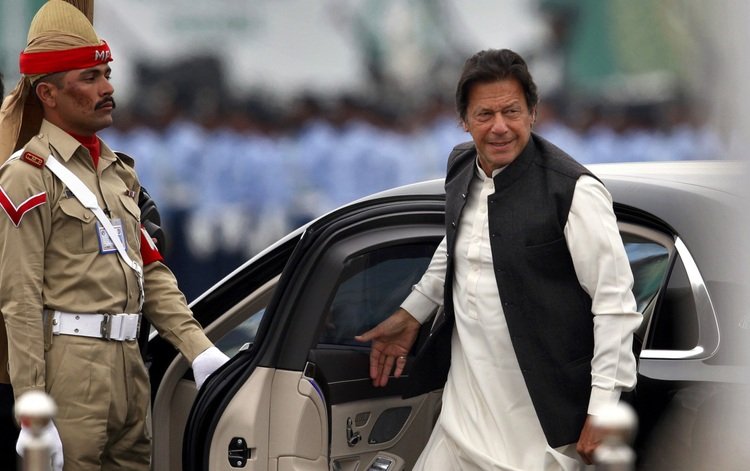
In light of a recent New York Times report and the tax details of parliamentarians revealed by Pakistan’s Federal Board of Revenue (FBR), it has emerged that Prime Minister (PM) Imran Khan’s mere Rs0.2 million in taxes was more than business tycoon and United States (US) President Donald Trump’s federal taxes during his first year in office.
The directory, published on the official website of FBR, contains tax details of elected representatives belonging to six different assemblies; National Assembly of Pakistan, Senate of Pakistan, Balochistan Assembly, Khyber Pakhtunkhwa Assembly, Sindh Assembly and Punjab Assembly.
According to the information released, former PM and Pakistan Muslim League-Nawaz (PML-N) leader Shahid Khaqan Abbasi was the highest taxpayer, as he paid a staggering amount of Rs241,329,362 in taxes.
The premier in 2018 — his first year in office — paid Rs282,449 in taxes whereas President Trump paid just $750 (Rs124,290 as of 2020) in federal income tax during his first year as president.
Trump, who in 2016 suggested reports of tax avoidance showed he was ‘smart’, denounced the findings as ‘completely fake news’. The New York Times said that of the 18 years its reporters examined, Trump had paid no income tax at all in 11 of them.
While there is no comparison between the taxes paid by the two leaders from Pakistan and the US, it merits a mention that both were equally criticised for alleged tax evasion.
As for Abbasi, his paid taxes were twice as much as the entire cabinet of the ruling Pakistan Tehreek-e-Insaf (PTI) paid.
Industries and Production Minister Hammad Azhar and Petroleum Division Minister Omar Ayub were the top two tax payers in the cabinet, contributing Rs59.4 million and Rs26 million to the exchequer respectively.
The Federal Board of Revenue (FBR) and National Database and Registration Authority (NADRA) have launched a web portal through which Pakistanis can view the list of declared assets and download information for documentation and record-keeping.
The portal provides the following services that allow you to check your asset details online:
a) FBR Tax Profiling System
b) FBR Assets Inquiry System (FBR Maloomat)
The web portal created by FBR and NADRA collects your data from official sources in order to calculate your assets. As long as you’re a Pakistani citizen, you can view the information from anywhere in the world.
ELIGIBILITY CRITERIA TO ACCESS THE INFORMATION:
You must be a Pakistani national with a valid CNIC or NICOP
You should be above 18 years of age
Citizens residing in Pakistan must have a PTA registered mobile number
Overseas Pakistanis must have a valid email address
You must make a payment of PKR500 through NADRA e-Sahulat or you credit/debit card
Create your account by entering your valid CNIC number in the relevant field followed by the computer-generated verification code and click on ‘Submit’
Pay the application fee via your credit/debit card or through a nearby NADRA e-Sahulat franchise. A city-based drop-down list of e-Sahulat outlets is also there on the portal for your convenience
Once you have successfully made the payment, here is the information that will be available for viewing:
Tax Filer Status
NTN number
Total Income
Tax Paid
Net Wealth
Withholding Tax
SIM card in your name
Number of cars
Arms License
Executive Services
Passports
Travel information
6. You can save the information in a PDF format and print it if needed.
FBR ASSETS INQUIRY SYSTEM
Here is a step-by-step tutorial on how to carry out an FBR assets check using the board’s web portal.
Use your registered mobile number to send your CNIC number to 9966
OR
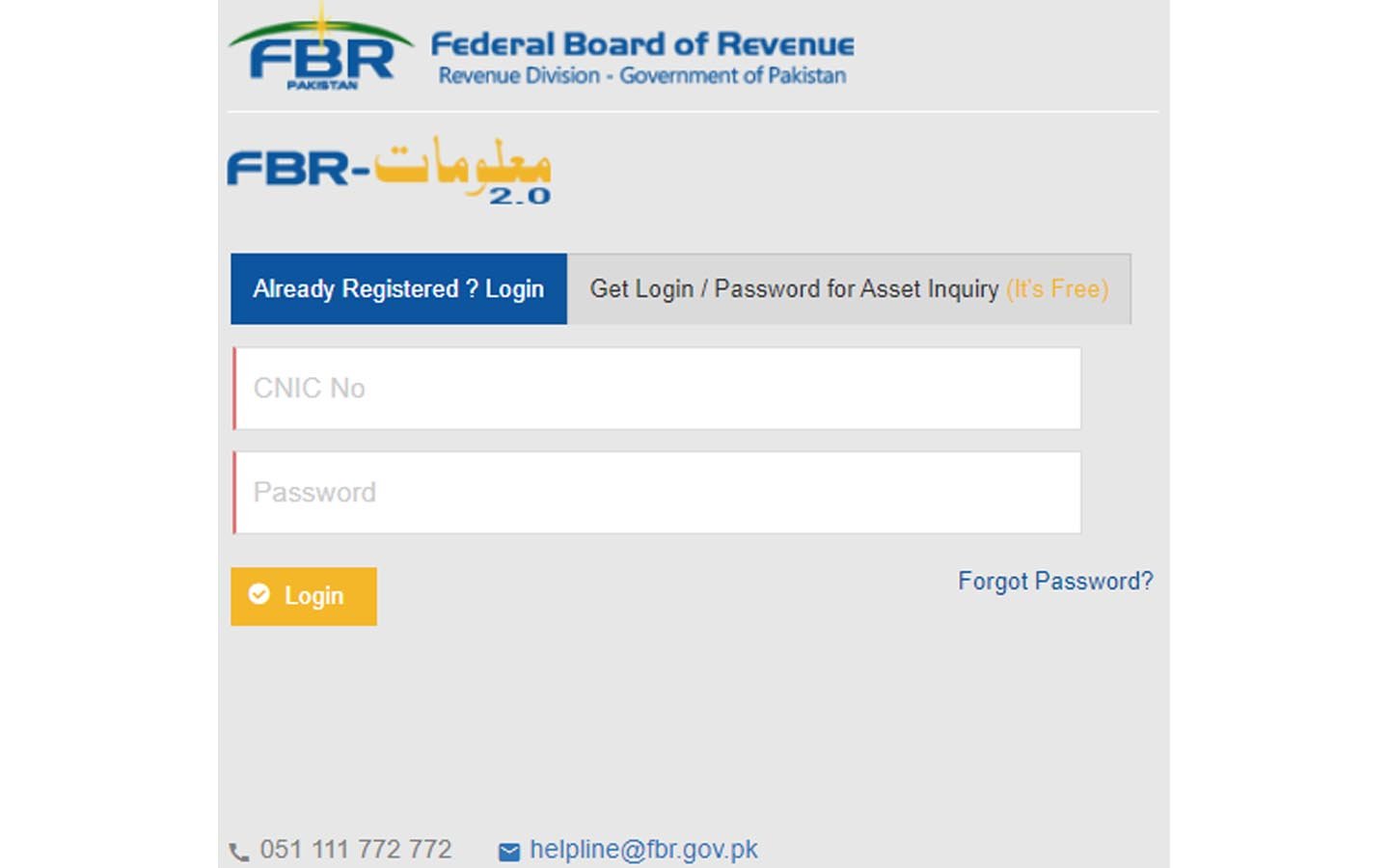
3. Select the ‘Get Login/ Password for Asset Inquiry (It’s Free)’ tab on the top. Then, enter your CNIC number, name, choose an appropriate prefix, pick current service provider and add your mobile number in the relevant fields. Just make sure the phone number you enter into the portal is registered in your name.
4. Receive the code on your mobile number
5. Once you login to the FBR Asset Inquiry System, you will be able to see different tabs. From there, select any tab and click on ‘Load Data’ to see your relevant data.
You can view the following information if you check your assets using FBR:
Withholding Tax
Vehicles
Travel Information
Utilities with bill amount
The details of properties in your name
FBR updates assets data on its portal on a regular basis. Therefore, you will be required to visit the portal regularly to view updated data.
Federal Minister for Industries and Production Hammad Azhar has said that the government is confident of achieving the tax collection target of Rs4,960 billion set in the 2020-21 federal budget through Federal Board Revenue (FBR).
Concluding discussion on the Finance Bill 2020-21 in the National Assembly, the minister on the floor of the House pointed out that the present government inherited a weak economy, but due to its concerted efforts, the government succeeded in stabilising it.
He said that all the international financial institutions are praising Pakistan government’s performance on economic front.
Hammad said that presenting a tax free budget while enhancing allocations for development shows the true leadership of Prime Minister Imran Khan. He said the government is trying to minimize the impact of Covid-19 on the economy by pursuing a prudent strategy.
The minister categorically stated that the federal government has not withheld any funds of the provinces under the National Finance Commission (NFC). He said that the recommendations of the Senate for the Finance Bill 2020-21 would be given due consideration.
Earlier, the National Assembly approved 96 demands for grants pertaining to different ministries, divisions and departments for the next fiscal year.
Presented by Minister for Industries and Production Hammad Azhar, these demands were related to Climate Change, Commerce Division, Communications Division, Pakistan Post, Defense Division, Survey of Pakistan, Economic Affairs Division, Power Division, Petroleum Division, Geological Survey of Pakistan, Foreign Affairs Division, Housing and Works Division, Human Rights Division, Information and Broadcasting Division, Information Technology and Telecommunication, Inter Provincial Coordination, Kashmir Affairs and Gilgit-Baltistan Division, Law and Justice Division, Federal Shariat Court, Council of Islamic Ideology, National Accountability Bureau, District Judiciary Islamabad Capital Territory, Maritime Affairs, Narcotics Control, National Assembly, The Senate, Overseas Pakistanis and Human Resource Development Division, Parliamentary Affairs Division, Planning Development and Special Initiatives Division, CPEC Authority, Privatization Division, Religious Affairs and Inter Faith Harmony Division, Science and Technology Division, States and Frontier Regions and Water Resources.
No cut motions were moved on these demands for grants.