Tag: FCA

  • Nepra allows passing Rs3.53 per unit burden on power consumers

    Nepra allows passing Rs3.53 per unit burden on power consumers

    National Electric Power Regulatory Authority (Nepra) has provisionally approved distribution companies (Discos) to recover Rs32.7 billion at Rs3.53 per unit from consumers for October 2023.

    Central power purchasing agency highlighted a negative impact of paisa 20 per unit for the Fuel Cost Adjustment (FCA), which rose to Rs3.53 per unit with Rs28.33 billion added in previous adjustments.

    China Power and Thar Coal Block-1 Power also had shares in the adjustments.

    Due to a potential negative impact on consumers, there’s a proposal to stagger the amount in the winter months. Electricity sales decreased by over 10 per cent, reaching 9.63 billion units in October 2023, and a 28 per cent reduction in demand occurred compared to September 2023.

    Concerns were raised about the decline in demand, with Nepra noting alarm if it’s due to reduced industrial consumption.

    In a public hearing, the National Transmission and Despatch Company (NTDC) representative urged a review of the “disallowed mechanism” due to financial difficulties, with Rs42 billion withheld, impacting salaries and pensions.

    In terms of electricity generation, various sources contributed differently in October 2023. Hydel generation was 32.54 per cent, local coal-fired plants were 13.94 per cent, and imported coal was 3.51 per cent.

    Gas-based plants generated 7.35 per cent, RLNG contributed 20.25 per cent, nuclear sources provided 19.08 per cent, and electricity imported from Iran constituted 0.24 per cent.

    Wind and solar energy made up 3.08 per cent and 0.79 per cent, respectively. The total energy generated was 9,572 GWh at Rs8.2605 per unit, with a cost of Rs79.066 billion.

    Discos received 9,253 GWh at Rs11.4277 per unit, totaling Rs105.737 billion in October 2023. The situation raises concerns about the financial viability of power entities and their potential impact on consumers.


  • Kya log waqai mehngai se tang aa kar apna sona baich rahay hain?

    Kya log waqai mehngai se tang aa kar apna sona baich rahay hain?

    From meeting hospitalisation expenses to paying hefty electricity bills, Pakistanis are increasingly selling their gold jewellery to tide over inflation in Pakistan.

    This trend has been fueled by mounting expenses, such as expensive food products, rising petroleum prices, education fees, medical expenses, and house rents, in the face of low income. According to multiple sources in the jewellers’ association, there has been an upsurge in the number of people selling off gold as compared to buyers, in recent months.

    Several social media posts indicated that people were compelled to sell their gold in order to pay for their electricity bills after the government imposed hefty Fuel Cost Adjustment (FCA) charges in monthly electricity bills.

    The FCA was added to the electricity bills for the month of August, drawing protests from citizens who demanded the government immediately withdraw the FCA as it was an injustice to the consumers and they did not have the capacity to pay outrageous electricity bills.

    The Current contacted several jewellers in Lahore to uncover whether people were actually selling gold to pay their electricity bills.

    According to the owner of a renowned gold shop in Liberty Lahore, when inflation is high, people’s only alternative is to sell any gold they may have. “There are undoubtedly more sellers because gold prices have reached an all-time high at this time. Comparatively, there are noticeably more sellers than purchasers. Another reason for selling gold is to combat inflation.”

    When asked if locals were really selling gold to pay their power bills, the goldsmith responded, “People sell gold for many different purposes outside merely paying their electricity bills. A lot of people sell their gold in order to invest in more lucrative assets, this may not necessarily be about bills. A number of individuals sell gold in order to invest in real estate or build their own houses.”

    Owing to overall inflation, gold prices had hit an all-time high, but since last week, they have been steadily declining. The latest drop in gold prices also prompted people to sell their gold as it was the ideal time to get the best price and acquire other assets, as they could later buy gold at a lower price after its price is stabilised.

    The majority of gold jewellers in the vicinity of Lahore’s posh area asserted that this unquestionably occurs at a time when the country’s economy is unstable and consumers are left with no choice but to sell the assets they have been saving for years to utilise in crises.

    Another jewellery store owner in Lahore’s less well-off area admitted that “This happens,” but added that “Not everyone is willing to discuss their personal and financial concerns or reveal causes why they are selling gold and what they need money for. People visit our shops for reasons other than just paying their electricity bills, such as emergencies or the urgent need for cash to cover healthcare expenses.”

    Investors frequently turn to gold as a safe haven when the economy is struggling or when there are conflicts on an international scale. For investors looking for a safe investment with a proven track record of profitability, gold appears to be an attractive alternative in light of rising inflation and the stock market trading far below its highs.

  • Weekly inflation down 8.1% due to lower FCA, timely import of vegetables

    Weekly inflation down 8.1% due to lower FCA, timely import of vegetables

    Weekly inflation measured by the Sensitive Price Indicator (SPI) for the week ending September 22, 2022, decreased by 8.11 per cent.

    The year-over-year (YoY) trend shows a rise of 29.28 per cent, which is down around 11 per cent from the 40.58 per cent observed last week. The YoY rise stayed above 40 per cent during the previous five weeks, reaching an all-time high of 45.50 per cent.

    The price increase over the previous year was mostly brought on by an increase in prices of tomatoes (117.55 per cent), diesel (105.12 per cent), petrol (91.87 per cent), pulse masoor (75.38 per cent), pulse gram (73.55 per cent), mustard oil (65.64 per cent), cooking oil-5 litre (63.63 per cent), washing soap (61.50 per cent), vegetable ghee-2.5 kg (59.42 per cent), pulse mash (56.93 per cent), vegetable ghee-1 kg (56.09 per cent), onions (50.83per cent) and LPG (49.89 per cent), while decrease was observed in the prices of electricity for q1 (45.61 per cent), chilies powder (43.05 per cent), sugar (19.20 per cent) and gur (3.37 per cent).

    According to the most recent PBS data issued on Friday, the SPI for the week under review in the aforementioned category was recorded at 203.21 points compared to 221.14 points observed in the previous week.

    Out of 51 items, 26 items (50.98 per cent) saw price increases during the week, 10 items (19.61 per cent) saw price decreases, and prices of 15 items (29.41 per cent) remain unchanged.

    For the first quarter, power charges were among the items whose average prices decreased on a week-over-week (WoW) basis showing a decrease of 64.23 per cent.

    Other items which recorded a decrease include tomatoes (8.15 per cent), LPG (3.82 per cent), bananas (1.90 per cent), garlic (1.31 per cent), pulse masoor (0.99 per cent), cooking oil-dalda or other similar brand (sn), 5 litre tin each (0.78 per cent), onions (0.46 per cent), vegetable ghee-dalda/habib 2.5 kg tin each (0.34 per cent) and vegetable ghee-dalda/habib or other superior quality 1 kg pouch each (0.06 per cent).

    The general populace has been impacted by the heavy rains and flooding since they are lacking in basic commodities while supply lines for food products have been disrupted.

    On the other hand, timely imports from Iran and Afghanistan are accountable for the decrease in vegetable prices, particularly for onions and tomatoes.

  • PM Shehbaz announces relief for 17 million power consumers

    PM Shehbaz announces relief for 17 million power consumers

    Prime Minister Shehbaz Sharif stated that 17 million of the nation’s electricity consumers would not be required to pay the excessive fuel cost adjustment (FCA) charges that are included in their monthly bills.

    According to Express, the prime minister outlined the rationale behind the FCA and claimed that it had resulted in a substantial increase in power rates for July and August due to high international oil prices.

    He claimed that following discussions with the IMF, PML-N leader Nawaz Sharif, and other coalition leaders, it was decided that 17.1 million energy users would not be required to pay the FCA.

    The remaining 13 million power consumers who are in a better financial situation are also being reviewed by the government, according to PM Shehbaz.

    Later, the PML-N tweeted that the relaxation will only apply to people with low electricity consumption.

    Shehbaz stated that Power Minister Khurram Dastgir will give a thorough explanation of the announcement’s process and how it would actually operate.

    The FCA exception would also apply to tube well users, who the prime minister estimated to number approximately 300,000.

    Earlier, PM Shehbaz also abolished the budget’s fixed tax on traders.

  • Fuel Cost Adjustment: Consumers protest against inflated electricity bills

    Fuel Cost Adjustment: Consumers protest against inflated electricity bills

    Power consumers protested in major cities against the government and power supply companies due to excessive residential and commercial bills that were issued under the pretext of Fuel Cost Adjustment (FCA).

    A number of Lahore residents were seen protesting outside LESCO offices, complaining about the skyrocketing electricity bills, chanting anti-LESCO slogans at Dharam Pura, Begum Kot and Ghazi Road.

    A number of farmers in Jhang also participated in a protest by burning their power bills while obstructing traffic on the Jhang Road. On the other hand, the shopkeepers and locals of Faisalabad organised a sizable protest against FESCO for billing residential and commercial customers for nearly twice the actual cost of electricity.

    PM Shehbaz demands urgent report on inflated electricity bills

    In response to complaints from the public about excessive electricity bills, Prime Minister Shehbaz Sharif ordered the relevant authorities to provide an immediate report to address the issue.

    The premier ordered the concerned officials to present a thorough report with recommendations for resolving consumer complaints against energy bills on an urgent basis.

    What is FCA?

    In addition to criticising the power supply companies, consumers are questioning the FCA charges that take up a significant portion of their monthly bills.

    Understanding the actual fuel cost (the cost of fuel in a month) and the reference fuel cost is crucial for comprehending the fuel price adjustment.

    Simply put, FCA is charged/adjusted in customers’ monthly bills to reflect the actual increase or decrease in fuel prices.

    Based on the price of fuel (such as coal, LNG, or furnace oil) used in the nation’s various energy sources, the total cost of fuel used in the production of electricity in a month (basket fuel cost) is calculated.

    The entire fuel cost for that month is therefore compared to the reference fuel cost at the end of each month, and as a result, the FCA is applied to the power bills after two months.

    The electricity bill will reflect a change in the FCA amount if the total fuel cost for that month exceeds the reference cost, while it will reflect a change in the FCA amount if the total fuel cost is less than the reference cost. We refer to this as a fuel price adjustment.

    How power suppliers calculate FCA?

    Whenever a power plant uses coal, it is possible to estimate how much coal was burnt and at what cost, as well as the total cost of the energy needed to generate the power.

    For instance, if hydel electricity generation has increased, the overall fuel price will reduce; likewise, if gas is consumed more frequently in a month due to its higher price, the fuel price would climb.

    It is also impacted by the rupee’s appreciation or depreciation. This is due to the fact that coal, LNG, and furnace oil are imported, therefore a weakening or strengthening rupee directly affects the cost as a whole.

  • Cabinet approves Rs7.91 per unit increase in power tariff

    Cabinet approves Rs7.91 per unit increase in power tariff

    After several postponements, the Federal Cabinet finally decided to approve the Rs7.91 per unit increase in the power tariff.

    The Federal Minister of Power, Khuram Dastgir, and Minister of Petroleum, Musadik Malik, made the announcement during a press conference.

    Dastgir claimed that because Prime Minister (PM) Shehbaz Sharif wanted to provide relief to the masses. The consent was not given until 45 per cent of the population had been exempted from the tariff increase.

    Musadik Malik, the minister of petroleum, disclosed that by leaving out the protected sector, the homes with consumption of less than 200 units per month, or up to 90 million people, had been left out of the price increase.

    Previously, the government’s proposal for the tariff increase was subject to the National Electric Power Regulatory Authority’s (NEPRA) reserve decision, according to Dawn.

    In accordance with the approval, the government will raise the rate by Rs3.5 per unit starting on July 26. A similar price rise will be implemented in August. The cost would then be raised by Rs0.91 per unit in October by the government, bringing the total rise to Rs7.91.

    Malik blamed the previous administration’s lack of frequent fuel adjustments and transmission losses rebasing for the sharp increase in tariffs. Fuel surcharges were raised without notifying the public at the final rebasing, which took place in February 2021.

    The power minister informed the media that the present administration had paid Rs214 billion toward circular debt, bringing the total down from Rs2,476 billion on March 31, 2022, to Rs2,253 billion on June 30, 2022.

  • Nepra approves price increase of Rs9.66 per unit for Karachi

    Nepra approves price increase of Rs9.66 per unit for Karachi

    On account of the fuel cost adjustment (FCA) for May 2022, the National Electric Electricity Regulatory Authority (Nepra) allowed K-Electric to increase its power rate by Rs9.66 per unit on Monday.

    According to Aaj News, Nepra will make the announcement following careful consideration.

    In order to transfer the financial burden of Rs22.65 billion to consumers for May 2022, K-Electric requested an increase of Rs11.34 per unit.

    Officials from Nepra questioned K-Electric during a hearing about why it wasn’t buying less expensive electricity and offered to help K-Electric establish a connection with the provincial and federal governments for this reason.

    The power distributor also questioned K-Electric’s decision not to use the inexpensive oil it had acquired for power production.

    Nepra’s representatives responded that the company was using peak hours, which are from 6:30 PM to 10:30 PM, to provide electricity and that the cost of power is much greater at these times.

    The FCA estimate for May 2022, according to K-Electric, was based on the requested rate for the month from CPPA-G and is subject to change based on a decision to be made by Nepra.

    In its FCA adjustment request, the power utility informed the regulator that it imports from outside sources and dispatches power from its own generating units (with the available fuel resources) in accordance with economic merit orders (EMOs).

  • NEPRA announces increase of Rs7.90 per unit in power tariff

    NEPRA announces increase of Rs7.90 per unit in power tariff

    An additional increase in the price of power of Rs7.90 per unit was announced by the National Electric Power Regulatory Authority (NEPRA) on Monday.

    After hearing the Central Power Purchasing Agency’s (CCPA) argument today, the power regulatory authority made the final hike announcement, according to ARY News.

    It is worth noting that life consumers and K-Electric are protected from the tariff increase and that the amount would be paid in July’s bills.

    In response to a request from CPPAG for a raise of Rs7.96 per unit, the increase was granted under fuel adjustment costs (FAC) for the month of May 2022, according to a notification released by the power regulating authority.

    Additionally, after a substantial increase of Rs7.91 per unit, the National Electric Power Regulatory Authority has just set the power rate at Rs24.82 per unit for the fiscal year 2022–23.

    The authority approved a Rs5.27 per unit increase in electricity rates for K-electric customers on June 24.

    According to a handout provided by NEPRA, K-Electric requested an increase in the electricity rate of Rs5.25 to account for fuel adjustment charges for April.

    Earlier, The Economic Coordination Committee (ECC) of the cabinet approved an increase in power costs for K-Electric customers of 57 paisa per unit.

    However, ECC deferred making a decision on a different proposal that called for charging K-Electric customers a surcharge of Rs1.45 per unit in order to recover Rs113.1 billion in past-due amounts related to quarterly rate increases. 

  • NEPRA hikes power tariff by Rs2.86 per unit

    NEPRA hikes power tariff by Rs2.86 per unit

    The National Electric Electricity Regulatory Authority (NEPRA) has increased the power price by Rs2.86 per unit for the month of March 2022 due to Fuel Charges Adjustment (FCA) and also issued a notification in this regard.

    As per NEPRA’s notice, power consumers of Ex Wapda Distribution Companies (DISCOS) will be charged an increase of Rs2.86 per unit on account of FCA for March 2022 in their electricity bills for May 2022, resulting in an added strain of Rs29 billion on consumers, along with General Sales Tax (GST).

    The Central Power Purchasing Agency (CPPA) had urged the administration to raise the electricity tariff by Rs3.16 per unit. Except for lifeline and K-Electric (KE) customers, the hike will apply to all consumer categories.

    Read more: Pakistan starts oil and gas production from Dhok Sultan DS X-1

    Moreover, the authority also announced Rs1.38 per unit increase for K-Electric customers. For the month of February 2022, Karachi Electric (KE) requested an increase of Rs3.45 per unit. The hike will be billed to electricity customers in May 2022, according to the announcement. Except for lifeline customers who use less than 100 units per month, the tariff increase would affect all KE customers.

  • Another hike of Rs4.9 per unit approved in power tariff

    Another hike of Rs4.9 per unit approved in power tariff

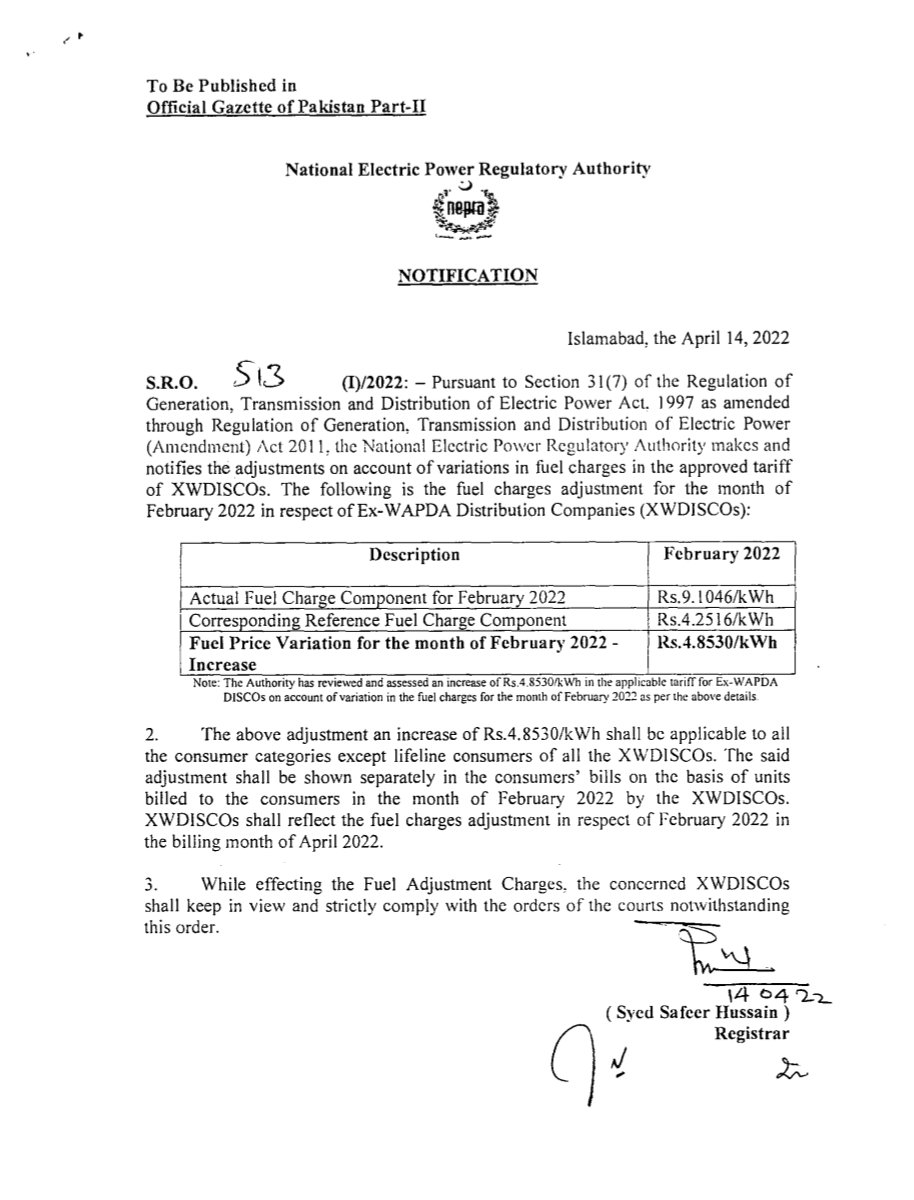
    Owing to the monthly Fuel Cost Adjustment (FCA) for February, the National Electric Power Regulatory Authority (NEPRA) on April 15 increased the price of electricity by Rs4.85 per unit.

    It has also announced an increase in the price of power, stating that the power output in February was more expensive than the previously set fuel price.

    According to the notice, the power distribution companies (DISCOs) will collect the amount from electricity consumers in the April bill. In addition, consumers will be hit with a charge of Rs37.7 billion, excluding general sales tax (GST). However, K-Electric and lifeline customers will be exempt from the hike.

    On March 31, the NEPRA held a hearing to determine the FCA but did not make a decision. The Central Power Purchasing Agency (CPPA) requested that the cost per unit be increased to Rs4.94 by the NEPRA.

    Following the monthly FCA, which only operates for one month, the administration had already hiked the power price to Rs5.95 per unit for the month of January.

    As per NEPRA’s data, the most expensive energy production sources, including High-Speed Diesel (HSD) and Residual Fuel Oil (RFO), were used more than average in the prior months, raising the overall cost of production.