Tag: federal cabinet

  • Caretaker govt decides to transfer ownership of electricity distribution companies to provinces

    Caretaker govt decides to transfer ownership of electricity distribution companies to provinces

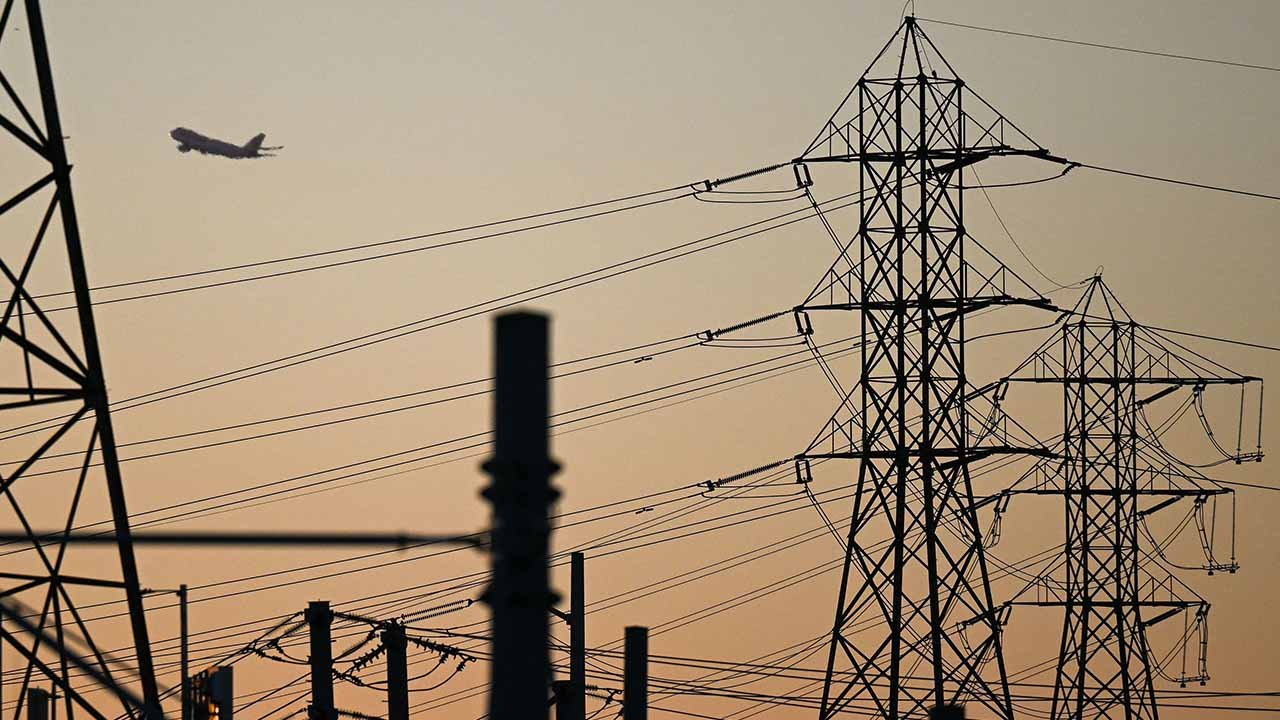
    The caretaker government has issued an order for the transfer of ownership of electricity distribution companies to the provinces.

    To accomplish this, the caretaker prime minister has granted approval to submit the summary to the federal cabinet. A decision has been reached to overhaul the existing system concerning the sale, distribution, and pricing of electricity under the caretaker federal government’s jurisdiction.

    As a result of this federal government directive, the practise of implementing a uniform electricity tariff across the nation will be discontinued. Instead, the responsibility for determining electricity rates and providing subsidies will be entrusted to the respective provinces.

    In line with these developments, the Hyderabad and Sukkur Electric Supply Company will come under the ownership of Sindh, while the ownership of the Quetta Electric Company will be transferred to Balochistan, according to HUM News.

    Likewise, the Lahore Gujranwala, Faisalabad, and Multan Electric Supply companies will be transferred to the ownership of Punjab. The Islamabad Electric Supply Company will be jointly owned by Punjab and the Federation, while the Peshawar and Tribal Area Electric Supply Company will be under the ownership of KP.

    As per official documents, a comprehensive policy framework has been formulated for the transfer of distribution company ownership to the provinces. This move is motivated by challenges such as electricity theft and revenue losses, which have placed a strain on the national treasury.

  • New laws to fight cybercrime in Pakistan: Cabinet passes e-safety and data protection bills

    New laws to fight cybercrime in Pakistan: Cabinet passes e-safety and data protection bills

    In a significant development, the federal cabinet of Pakistan granted principle approval to two crucial pieces of legislation on Wednesday, which are expected to have a far-reaching impact on digital rights, e-commerce, and the digital economy of the country.

    The first bill, named the E-Safety Bill 2023, aims to tackle and prevent online crimes such as cyberbullying, online harassment, and blackmailing. To enforce the provisions of this bill, the cabinet also greenlit the establishment of a regulatory authority known as ‘The E-Safety Authority.’ This authority will be responsible for registering and monitoring websites, web channels, YouTube channels, and existing media houses’ websites. The main objective behind this initiative is to safeguard the rights of citizens, businesses, as well as public and private institutions from online harassment and blackmail.

    Presently, the Pakistan Telecommunication Authority (PTA) has the authority to monitor content and enforce relevant laws online, while the Federal Investigation Agency (FIA) handles cybercrime-related cases. However, the proposed E-Safety Authority will take charge of the front-end monitoring of all websites, promptly addressing violations and imposing penalties. This measure is deemed necessary due to the rapid pace at which cybercrime incidents occur, often exceeding the FIA’s investigative capacity, while the PTA’s role is primarily limited to regulatory functions for internet and telecom service providers.

    According to Dawn, the second bill, titled the Personal Data Protection Bill 2023, focuses on protecting user data and preventing the unauthorised use of information systems. The bill will apply to all types of online services, including online shopping platforms, various companies, and social networking websites operating in Pakistan. It aims to safeguard consumers’ data and ensure that it is not misused or illegally accessed.

    As per the official statement, “personal data” under the proposed legislation refers to any information directly or indirectly related to an identifiable individual, encompassing sensitive or critical personal data. The bill mandates all entities collecting or maintaining data, digitally or non-digitally operational in Pakistan, to register themselves locally and appoint a data protection officer. The National Commission for Personal Data Protection (NCPDP) will oversee the registration process and will establish sub-offices in provincial capitals and other necessary locations within six months of the bill’s passage.

    However, the approval of the Personal Data Protection Bill 2023 has raised concerns among international bodies representing internet-based platforms. The Asia Internet Coalition (AIC), through its Managing Director Jeff Paine, highlighted that the bill’s current form falls short of international data protection standards and imposes unnecessary complexities that may increase the cost of doing business and hinder foreign investment. The requirement for “critical” data to be stored locally and the restriction on cross-border transfer of other personal data could potentially limit access to global digital services for Pakistanis.

    In response to these concerns, the AIC has called for more transparent stakeholder consultations by the government. Digital rights campaigner and Meta board member, Nighat Dad, expressed similar sentiments, stating that while the bill addresses important issues, the lack of consultations is undemocratic.

    Despite concerns from international bodies, an official from the IT ministry defended the legislation, emphasising that the government’s primary responsibility is to protect Pakistan’s interests and its citizens. He asserted that commercial entities’ apprehensions are primarily driven by their business concerns.

    The approval of these significant bills marks a crucial step towards enhancing digital rights and data protection in Pakistan. As the nation progresses into a more digitally interconnected era, finding a balanced approach that addresses concerns from both local and international stakeholders will be crucial for the country’s digital economy and growth.
  • Pakistan fails to meet Hajj quota due to rising inflation and dollar shortage

    Pakistan fails to meet Hajj quota due to rising inflation and dollar shortage

    On Wednesday, sources within the Ministry of Religious Affairs reported that the government has decided to return Pakistan’s quota of Hajj pilgrimage to Saudi Arabia due to a shortfall of applications caused by rising inflation.

    This year marked the first time a quota for Hajj pilgrimage was available in the country, but the shortage of dollars and rising inflation prevented Pakistanis from applying for Hajj.

    The final decision to return the Hajj quota will be made by the federal cabinet. The authorities considered giving the official Hajj quota to private operators after a few applications turned out for the government scheme. However, this option would lead to private operators collecting dollars from the open market, causing unnecessary demand for foreign currency.

    Pakistan had been demanding an increase in the Hajj quota, allowing 179,210 pilgrims to 202,000 or 201,000 pilgrims. This year, the country received its complete quota of 179,000 pilgrims after many years but couldn’t utilize it entirely. It’s worth noting that the cost of government-sponsored Hajj is around Rs1.2 million.

    Due to an acute shortage of the greenback amid the collapsing economy, the Ministry of Religious Affairs and Interfaith Harmony decided to allocate a 50% special quota in the Government Hajj Scheme-2023 for pilgrims who will pay in US dollars. However, a quota of 89,605 Hajj pilgrims was set under the government scheme, falling short of 9,000 applicants.

    The government received 72,869 applicants under the regular scheme and only 8,000 under the sponsorship scheme. Moreover, 28,679 additional applications were received under the official regular scheme against the quota of 44,190. Additional applicants are being sent for Hajj pilgrimage without a lucky draw.

    The sources indicated that a total of $235 million is required for the government scheme, some of which will be provided by the sponsorship scheme and the rest by the government.

  • How many people does PM Shehbaz need in his cabinet to run the country?

    How many people does PM Shehbaz need in his cabinet to run the country?

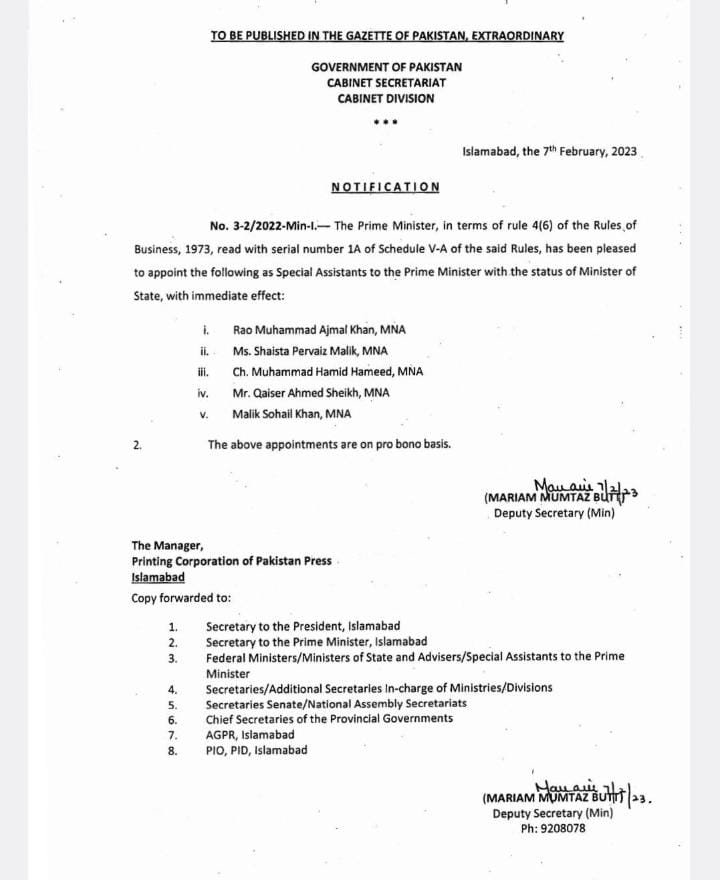
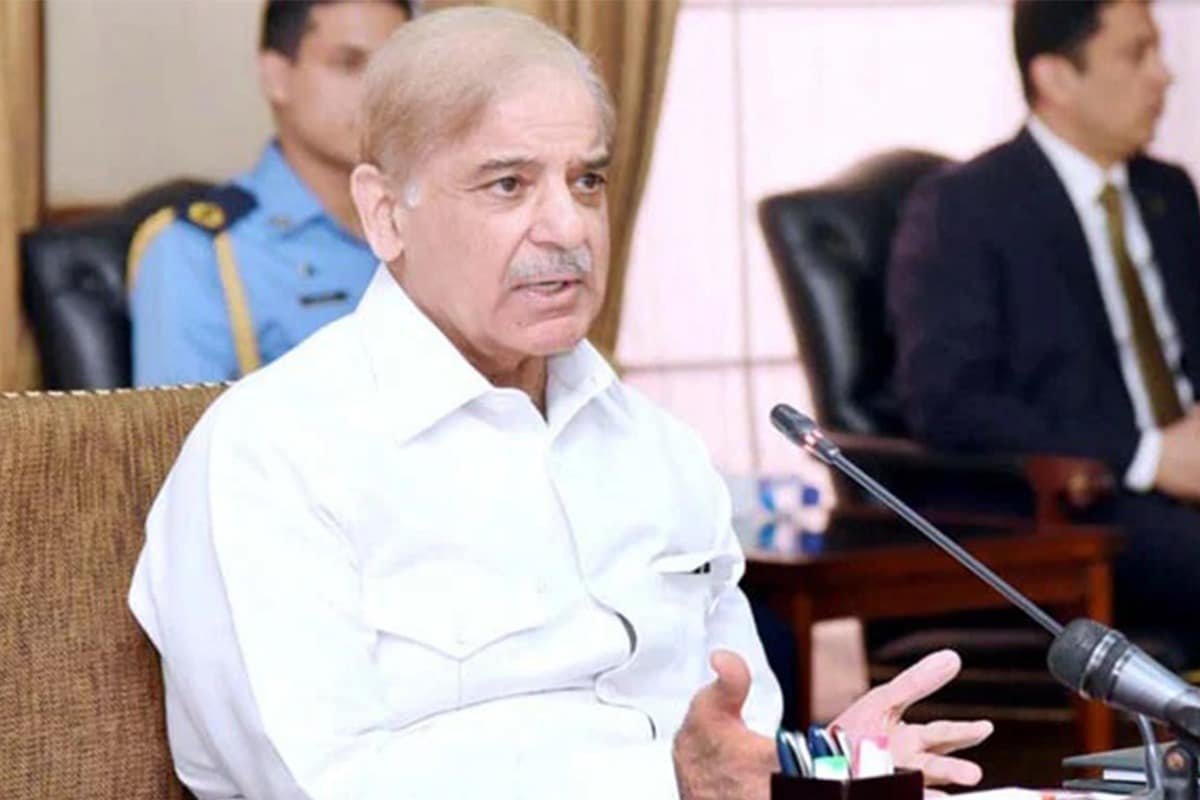
    Prime Minister (PM) Shehbaz Sharif has appointed seven more Special Assistants to the PM (SAPMs) on pro bono basis, as the federal cabinet swells to 85.

    As per details, the PM has appointed five new SAPMs including Members of National Assembly Rao Ajmal, Shaista Parvez, Qaiser Ahmed Sheikh, Muhammad Hamid Hameed, Malik Sohail Khan, Chaudhary Abid Raza and Muhammad Moeen Wattoo.

    Criticising the PM’s decision, PTI leader Farrukh Habib remarked that the government was close to making a century of cabinet members.

    The newly appointed SAPMs will enjoy the status of ministers of state, however they have not been assigned any portfolios yet.

    Of the 85 cabinet members, 34 are federal ministers, seven are ministers of state, and there are four advisers to the PM and 40 SAPMs.

    Besides the long list of federal cabinet members, 38 parliamentary secretaries in the National Assembly answer questions on behalf of the ministers in their absence.

  • Pakistan decides to ease visa regulation policy for Afghans

    Pakistan decides to ease visa regulation policy for Afghans

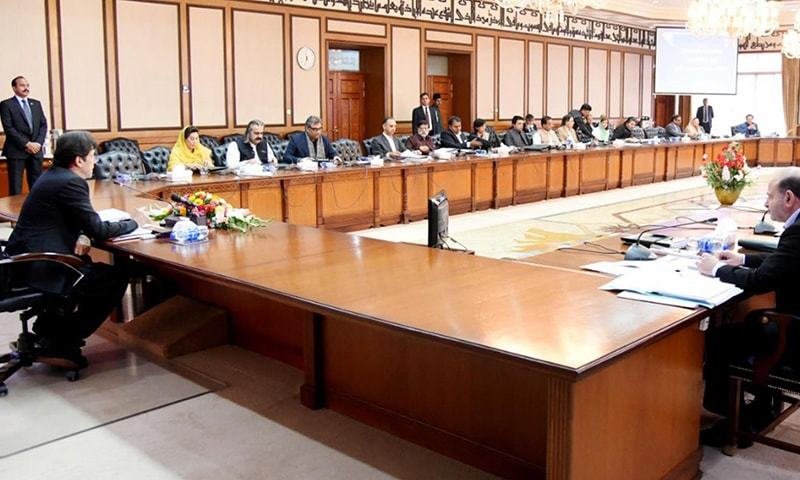
    In a federal cabinet meeting held on June 28, the government decided to ease the visa regulation policy for Afghans to encourage bilateral trade with Afghanistan in the hopes that this would benefit both the country’s economies.

    Prime Minister (PM) Shehbaz Sharif was presiding over the federal cabinet meeting.

    PM Shehbaz issued orders that six-month multiple-entry visas be given to the transporters from Afghanistan. The interior ministry has been given the power to extend this period to one year.

    A sub-category will also be introduced under the work visa category in the online visa system. The visa applications will be assessed on the basis of their existing passports and nationalities instead of their country of origin.

    The federal cabinet noted that this decision comes in an effort to promote bilateral trade with Afghanistan.

  • PPP to get 11 ministries, PML-N 14 in federal cabinet: Rana Sanaullah

    PPP to get 11 ministries, PML-N 14 in federal cabinet: Rana Sanaullah

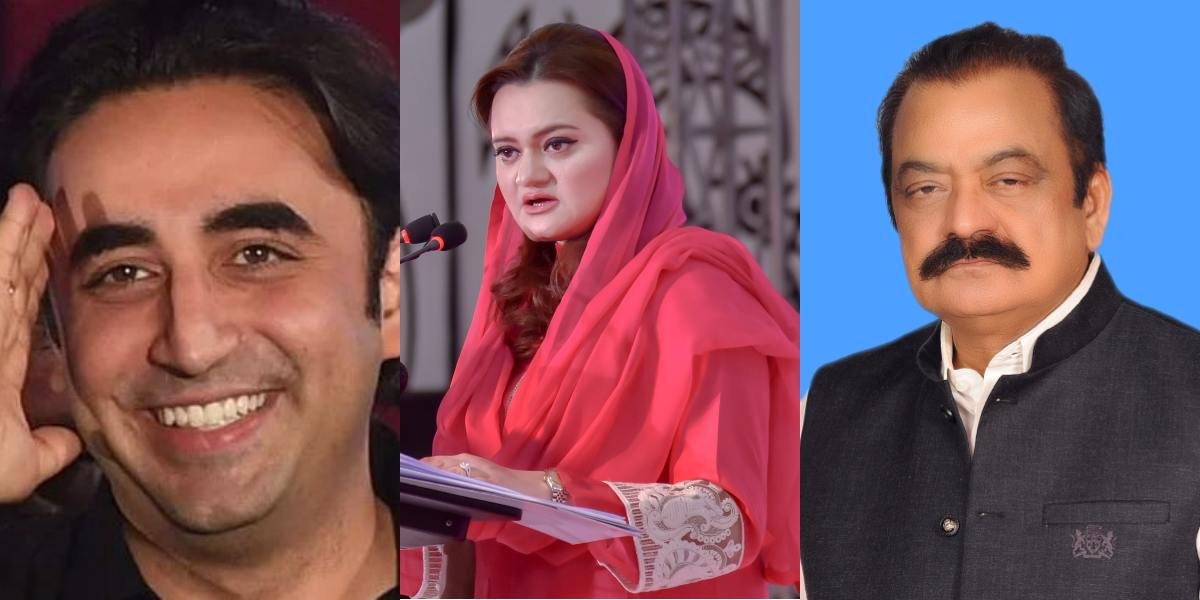
    Pakistan Muslim League-Nawaz (PML-N) will get 14 ministries, while Pakistan People’s Party (PPP) will get 11 ministries. Bilawal Bhutto-Zardari is all set to become the Foreign Minister of Pakistan. Hina Rabbani Khar will most likely be the Minister of State in the Foreign Ministry.

    PML-N’s Rana Sanaullah told Geo News‘ anchorperson Shahzad Iqbal on “Naya Pakistan” that the Finance Ministry, Interior Ministry, Defence Ministry, Planning Ministry, Ministry of Energy and Information Ministry will remain with PML-N. Commerce Ministry and Communications Ministry will go to PPP and PML-N while MQM and PPP will get Maritime Ministry and Overseas Ministry. Marriyum Aurangzeb will most likely get Information Ministry as per media reports. Rana Sana said that these decisions have been taken after a joint committee of all allied parties finalised the formation of the new cabinet.

    According to The News, Asif Zardari advised Prime Minister Shehbaz Sharif to give cabinet posts to all coalition partners in the first phase and the PPP would join the cabinet in the second phase. It is expected that the first phase of the cabinet will take oath today (Monday) or tomorrow (Tuesday). In the first phase, 10 to 12 ministers will take the oath.

    Last week, PPP Co-chairman Asif Zardari had hinted that the PPP may not join the federal cabinet.

    “I don’t think we are taking any ministries. We want to first accommodate our friends,” said Zardari, talking about government’s other coalition partners.

    On Friday, PPP’s Raja Pervez Ashraf was elected Speaker of the National Assembly unopposed.

  • Govt cancels all exams until June 15

    In lieu of rising cases of COVID-19 Federal Minister for Education Shafqat Mehmood on Tuesday announced that no examinations will take place in the country until June 15.

    “O’ and A’ Level exams have been cancelled and will now take place in the October-November cycle,” said the minister in an announcement.

    “Exams of Classes 9, 10, 11 and 12 which were supposed to begin from the end of May have been delayed further,” added the minister. “No board exams will be held till mid-June (June 15).”

    He also added that another meeting of the NCOC will decide in the third week of May to decide whether these exams will be postponed further or not.

    The minister also took time to answer the questions of students :

    #ImranKhanCancelExams and #ImranKhanJawabDou were among the top trends on Twitter from the past few days as National Command and Operation Centre (NCOC) and the Government of Pakistan refused to cancel this year’s O’ and A’ Level exams and went on to take the exams as scheduled.

    Pakistan is currently experiencing a deadly third wave of COVID-19 with fears of an India-like situation and students argued that the exams not only pose a risk to their health but they have also been unable to prepare for them because of school closures. The high courts in Lahore, Islamabad, Peshawar and Karachi also dismissed students petitions.

  • Cabinet reshuffled, again

    Prime Minister Imran Khan has once again reshuffled the federal cabinet, appointing Shaukat Tareen as new finance minister.

    Tareen has replaced federal minister Hammad Azhar, who was appointed as the country’s finance minister a few weeks ago when the premier replaced him with Dr Abdul Hafeez Shaikh.

    Other changes include Khusro Bakhtiar as the minister for industries and production, Shibli Faraz as the minister for science and technology, replacing Fawad Chaudhry, who has been appointed as the minister for information and broadcasting, replacing Faraz.

    Omar Ayub has been appointed as the minister for economic affairs, replacing Khusro Bakhtiar.

    Last month, Faraz had shared the premier’s intentions on reshuffling the cabinet, saying that he was bringing in a new team.

    Prior to that, the government had asked Hafeez Shaikh to step down and appointed Azhar in his place.

    Faraz said decisions were made keeping in view the realities of the country and that the PTI regime wished to give relief to the poor.

    “When a new individual comes along, they come up with new ideas,” he had said.

    Reports had earlier quoted sources as saying that PM Imran was considering bringing about important changes to the cabinet on a “big scale”, adding that ministers who did not perform up to the expectations will be removed from their portfolios.

  • Govt’s ‘Rehmatul-Lil Alameen Scholarship’ to also cover non-Muslims

    Prime Minister (PM) Imran Khan has launched the Rehmatul-Lil Alameen scholarship program for underprivileged students, Radio Pakistan has reported.

    As per details, a budget of 27.93 billion rupees has been approved for this national-level program which will be used over the next five years. The program will be implemented in 129 public sector universities across the country.

    Speaking at the inauguration ceremony in Islamabad, PM Imran said the scholarship will be available to all Pakistanis including non-Muslims, adding that the federal government will annually provide Rs 5.5 billion for 70,000 scholarships. 

    PM Khan said that under the scholarship program a total of 350,000 scholarships will be provided in five years at a cost of Rs 28 billion.

    He further said that the provincial governments of Punjab and Khyber Pakhtunkhwa will also separately provide scholarship to the students.

    Read more – Pakistanis appreciate PM Imran for ‘Koi Bhooka Nahi Soye Ga’ programme

    The premier asserted that the government is especially focusing on the education sector with the aim that “our youth learn from the Sunnah of Hazrat Muhammad Sallallaho Alaihe Wa Salam Khatim-un-Nabiyeen“.

    Meanwhile, speaking on the occasion, Minister for Education Shafqat Mahmood said the Rehmatul-Lil Alameen Scholarship is a nationwide program and will be implemented in 129 universities across the country.  He said fifty percent scholarships will be given to women whilst two percent to specially-abled persons.

    Minister for Information and Broadcasting Fawad Chaudhry and Minister for Human Rights Shireen Mazari also announced the news on social media, encouraging those eligible to apply for it.

    The provinces are also separately pursuing the Rehmatul-Lil Alameen Scholarship program. In Punjab, one billion rupees has been approved for this scholarship program annually, while Khyber Pakhtunkhwa has allocated Rs 427 million for it.

  • Cabinet rubbishes ECC approval to resume cotton, sugar import from India: report

    Cabinet rubbishes ECC approval to resume cotton, sugar import from India: report

    A meeting of the federal cabinet chaired by Prime Minister (PM) Imran Khan has rejected the Economic Coordination Committee (ECC) approval to import cotton yarn and white sugar from India, reports quoted sources as saying.

    A day earlier, the ECC had approved two summaries of the commerce and textile ministry to lift ban on import of cotton and white sugar from India.

    According to reports, there were 21 items on the agenda of the ECC meeting to be chaired by newly appointed Finance Minister Hammad Azhar. Commerce and Textile divisions had submitted five crucial summaries for approval besides others.

    At the agenda no. 16, the Textile Division summary sought permission from the ECC to lift ban on import of cotton and cotton yarn from India in a bid to bridge raw material shortfall for the value-added textile sector.

    In addition to this, another summary of the commerce ministry at agenda no. 20 also sought permission to allow import of white sugar from India through the Trading Corporation of Pakistan and commercial importers.

    The resumption of import of these goods was expected to lead to partial revival of trade relations. On Aug 9, 2019 Pakistan downgraded trade relations with India in reaction to the latter’s decision to revoke Article 370 of its Constitution that granted occupied Kashmir a special status.

    In May 2020, Pakistan lifted the ban on import of medicines and raw material from India to ensure there is no shortage of essential drugs amid the COVID-19 pandemic. This was the first step of reversing of complete suspension of trade with India.

    However, Indian premier’s letter to Prime Minister (PM) Imran Khan on Pakistan Day was the first step in the right direction amid reports of UAE Royals brokering peace.

    On Tuesday, PM Imran replied to Modi’s letter, saying Pakistan also desired peaceful relations with India.

    “The people of Pakistan also desire peaceful, cooperative relations with all neighbours, including India,” he said in his reply.

    “I thank you for your letter conveying greetings on Pakistan Day.”