Tag: finance

  • Pak Suzuki increases motorcycle prices for all models

    Pak Suzuki increases motorcycle prices for all models

    Pak Suzuki has once again announced a rise in prices across the board due to the depreciation of the Pakistani rupee (PKR), much like all of its two-wheeler rivals in the Pakistani market.

    The majority of motorcycle consumers are no longer able to afford the motorcycles due to price increases. Unfortunately, the only option left for the locals is the Chinese bike, which has become more expensive and of lower quality.

    Here are Suzuki motorcycles’ most recent prices:

    Variant Old Invoice New Price Increase
    Suzuki GD-110S Rs219,000 Rs229,000 Rs10,000
    Suzuki GS-150 Rs239,000 Rs251,000 Rs12,000
    Suzuki GS-150 SE Rs256,000 Rs271,000 Rs15,000
    Suzuki GR-150 Rs349,000 Rs365,000 Rs16,000
    Pak Suzuki Motorcycles Latest Price List August 2022

    In comparison to its earlier price of Rs349,000, the Suzuki GR-150 150cc model saw the largest price increase of Rs16,000; the bike now costs Rs365,000.

    It’s important to note that since the start of the year, Pak Suzuki has announced four price increases. In addition to motorbikes, Pak Suzuki also announced a price rise for its car lineup.

    Many assemblers have reported running out of production-critical materials, which the majority of automakers have mostly attributed to the ongoing decline of the Pakistani rupee versus the US dollar.

  • FBR surpasses revenue collection target by Rs15 billion for July

    FBR surpasses revenue collection target by Rs15 billion for July

    The Federal Board of Revenue (FBR) revealed the provisional revenue collection data for July 2022, which came to Rs458 billion.

    The FBR generated net revenues of Rs458 billion in July, which was Rs15 billion more than its goal of Rs443 billion.

    These collections—which represent an increase of roughly 10 per cent over the Rs417 billion collected during the same time last year—are the biggest ever for the month of July.

    The gross revenue increased from Rs438 billion in July of the previous year to Rs486 billion, a rise of 11 per cent. Similarly, the amount of refunds given out in July increased by 32 per cent to Rs28 billion from Rs21 billion paid in the previous year.

    Domestic taxes made up 55 per cent of the total collection while import taxes kept their 40 per cent share.

    Previously, 52–53 per cent of the total revenue was collected via taxes at the import stage. Similarly, the increase in domestic income tax is close to 31 per cent, which the FBR described as a dramatic move toward direct taxation.

    The Advance Tax collected in July has increased significantly. Due to the implementation of a withholding provision that is applicable regardless of the holding term, there is also a 118 per cent rise in the advance tax on the sale of properties under Section 236-C.

    Similarly, a change in the tax rate has led to a 40 per cent increase in Advance Tax under Section 147, particularly from financial companies.

    Raising the FED rate on tobacco and cigarettes has also paid off. Sales tax from the tobacco sector increased by a record-breaking 67 per cent, while the FED from tobacco saw a record-high growth of over 47 per cent, or Rs2.6 billion.

    Additionally, the FED for international flight travel has climbed by more than 200 per cent. Additionally, Pakistan Customs saw a modest 2.58 per cent increase in revenue under the heading of customs duty during July 2022 compared to Rs65 billion collected during the same time last year.

    However, it fell short of the Rs77 billion target set for July as a result of the government’s import compression policy, which aims to limit the outflow of US dollars.

    In addition, the FBR lost around Rs11 billion in sales tax due to the zero-rating of petroleum goods.

    It is important to note that the number of income tax returns for the tax year 2021 has increased by 13 per cent to 3.4 million from 3.0 million for the tax year 2020.

  • Pakistani rupee falls to Rs233 per US dollar in the interbank market

    Pakistani rupee falls to Rs233 per US dollar in the interbank market

    The Pakistani rupee (PKR) continued to fall on Tuesday as the country’s political turmoil worsened, trading at Rs233 to the dollar in the interbank market.

    Today, the US dollar gained Rs3.12 versus the local currency, compared to the previous day’s finish of Rs229.88, which was an all-time high at the time.

    The local currency has been under pressure for the past week due to increased political tensions in the country following the July 17 by-elections in Punjab, which the PTI easily won. Also, the rupee has been one of the world’s worst performers, falling 30.2 per cent since the beginning of 2022.

    PKR had its worst week in more than two decades, ending on July 22, highlighting investor fear that a $1.2 billion loan tranche from the IMF approved last week could not be enough to alleviate the balance of payment crisis.

    Fears of Pakistan defaulting on its foreign repayments remain in the market, despite the central bank’s guarantee that the country would comfortably cover its funding obligations as long as an International Monetary Fund (IMF) loan programme remained in place.

    The rupee fell by nearly 8 per cent last week, the most in a single week since October 1998.

  • Pressure on Pakistani rupee may decrease in August

    Pressure on Pakistani rupee may decrease in August

    Finance Minister Miftah Ismail expressed his continued faith in Pakistani rupee’s (PKR) ability to withstand pressure despite the PKR continuing to hit historic lows versus the US dollar and suffering its biggest weekly slide in more than 20 years.

    The finance minister stated in an interview with Radio Pakistan that the political climate and the fact that import payments are being made for shipments beginning in June are both contributing factors to the pressure on the PKR.

    “Import of $80 billion were made during the last fiscal year. We are still making payments for energy commodities purchased last month. Therefore, the rupee is under pressure. However, as we are importing less in July, its effect would be reflected from next month or, I should say, next week.”

    “The rupee’s fall is connected to the political situation as well. Before July 17, the situation wasn’t like this,” he added.

    Miftah also spoke about Pakistan’s economic issues, stating that the poor export base continues to be a matter of concern.

    The local currency has continued to depreciate against the US dollar, losing 7.6 per cent last week, more than what businesses typically account for in terms of annual currency depreciation, as the inter-bank market experienced a turbulent five sessions due to renewed political uncertainty and increased worries about Pakistan’s external financing needs.

    He also revealed that one friendly country is ready for an instant investment in Pakistan.

    It is worth noting that Pakistan anticipates receiving the next International Monetary Fund (IMF) tranche before the end of the following month following the board meeting.

  • Pakistani rupee hits new all-time low of Rs224 against US dollar

    Pakistani rupee hits new all-time low of Rs224 against US dollar

    Despite the International Monetary Fund’s (IMF) announcement that the multibillion-dollar loan programme would resume, the Pakistani rupee plunged to an all-time low against the US dollar on Tuesday, reaching Rs224 in the interbank market.

    Today, the local currency continued to lose value against the US dollar and lost another Rs8.80. In the interbank market on Monday, the rupee fell by Rs4.25 or 1.97 per cent against the US dollar.

    With ongoing political unrest and a bad macroeconomic environment, the currency has considerably depreciated.

    The State Bank of Pakistan (SBP) has begun to stifle the outflow of small dollar amounts of less than $100,000 in order to prevent a further decline in the reserves, putting numerous factories at risk of closure and financial penalties.

    According to the sources, Pakistan is using a variety of capital controls, including restrictive measures, to prevent a situation resembling default while the IMF takes its time approving and disbursing a $1.12 billion loan tranche.

    Resuming the loan programme will increase the nation’s ability to make international payments and unlock foreign currency inflows from other bilateral and multilateral sources as well.

    Additionally, China has extended its $2.3 billion loan to Pakistan and deposited it in the State Bank a few weeks ago. In line with the decline in the rupee, the Pakistan Stock Exchange (PSX) fell 770 points during Monday’s intraday trading. After “political and economic uncertainties in Pakistan,” the capital market came under fresh pressure, a specialist claimed.

    Finance Minister Miftah Ismail stated in an interview that the government would keep making difficult choices in an effort to save the economy and keep the nation from going bankrupt.

  • Pakistan, IMF reach staff-level agreement to resume loan

    Pakistan, IMF reach staff-level agreement to resume loan

    The International Monetary Fund (IMF) extended the total loan size to $7 billion on Thursday and announced a staff-level agreement on the completion of two unfinished programme assessments, but cautioned Pakistan to be prepared to take any extra measures.

    “The IMF team has reached a staff-level agreement (SLA) with the Pakistan authorities for the conclusion of the combined seventh and eighth reviews of the EFF-supported program. The agreement is subject to approval by the IMF’s Executive Board. Subject to Board approval, about $1,177 million (SDR 894 million) will become available, bringing total disbursements under the program to about $4.2 billion,” IMF said in a statement.

    The statement added, “Additionally, in order to support program implementation and meet the higher financing needs in FY23, as well as catalyze additional financing, the IMF Board will consider an extension of the EFF until end-June 2023 and an augmentation of access by SDR 720 million that will bring the total access under the EFF to about $7 billion.”

    IMF team leader Nathan Porter noted in a statement “Pakistan is at a challenging economic juncture. A difficult external environment combined with procyclical domestic policies fueled domestic demand to unsustainable levels.”

    According to him, the ensuing economic overheating reduced reserve buffers, increased inflation, and resulted in significant fiscal and external deficits in FY22.

    The statement continued, “Policy priorities include the consistent implementation of the FY23 budget, which aims to reduce the government’s significant borrowing needs by targeting an underlying primary surplus of 0.4 per cent of GDP, underpinned by current spending restraint and extensive revenue mobilisation efforts targeted particularly at higher-income taxpayees.”

    According to Express Tribune, the international lender claimed that due to poor implementation of the previously agreed upon plan, the circular debt (CD) flow in the power sector is predicted to increase significantly to about Rs850 billion in FY22, exceeding programme targets, endangering the viability of the sector, and resulting in frequent power outages.

    To improve the situation in the electricity sector and reduce load shedding, the authorities are committed to resuming reforms, which crucially include the timely adjustment of the power tariff, including the delayed yearly rebasing and quarterly adjustments.

    According to the IMF, Pakistan’s headline inflation rate hit 20 per cent in June, impacting the most vulnerable people the most. The recent monetary policy boost was reasonable and necessary in this regard, and future monetary policy must be designed to ensure that inflation is slowly brought down to the medium-term goal of 5-7 per cent.

    “Importantly, to enhance monetary policy transmission, the rates of the two major refinancing schemes EFS and LTFF (which have over recent months been raised by 700 bps and 500 bps respectively) will continue to be linked to the policy rate. Greater exchange rate flexibility will help cushion activity and rebuild reserves to more prudent levels,” it added.

    The unconditional cash transfer (UCT) Kafalat scheme reached nearly 8 million households during FY22, with a permanent increase in the stipend to Rs14,000 per family, while a one-time cash transfer of Rs2,000 (Sasta Fuel Sasta Diesel, SFSD) was made to approximately 8.6 million families to lessen the effects of the inflationary crisis.

    The government has increased the BISP budget for FY23 from Rs250 billion to Rs364 billion in order to expand the SFSD programme to more non-BISP, lower-middle class beneficiaries and to accommodate 9 million extra families into the BISP safety net.

    The statement further stated that in order to maintain the effectiveness of the anti-corruption agencies (including the National Accountability Bureau) in investigating and prosecuting corruption cases, the authorities are putting in place a strong electronic asset declaration system.

    According to the SLA for the combined seventh and eighth reviews, consistent execution of the defined policies will support the development of growth that is more equitable and sustainable.

    “The authorities should nonetheless stand ready to take any additional measures necessary to meet program objectives, given the elevated uncertainty in the global economy and financial markets,” the statement concluded.

  • SBP raises policy rate to 14-year-high of 15 per cent

    SBP raises policy rate to 14-year-high of 15 per cent

    In an attempt to calm the economy, control inflation, and support the beleaguered rupee, the State Bank of Pakistan’s Monetary Policy Committee (MPC) decided to raise the policy rate by 125 basis points (bps) to 15 per cent on Thursday.

    The previous policy rate at the same level was in 2008, so the current policy rate is at a level that is 14 years higher. The committee also disclosed that, in order to improve the transmission of monetary policy, interest rates on EFS and LTFF loans are now tied to the policy rate.

    Following the MPC meeting on Thursday, SBP Acting Governor Dr Murtaza Syed gave a virtual press conference where he announced the monetary policy decision. He told the media that the rate of inflation has been rising at its highest rate since 1970.

    “Globally, inflation is at multi-decade highs in most countries, and central banks are acting aggressively, putting pressure on most emerging market currencies to depreciate,” he continued.

    He praised recent government decisions, such as ending petroleum subsidies, and claimed that these actions had made it possible to finish the IMF loan programme. Pakistan’s external financing requirements for FY23 will be met thanks to significant additional funding from external sources, which will be stimulated by the anticipated conclusion of the ongoing IMF review.

    Then, during the course of FY23, rupee pressures should ease and the SBP’s FX reserves should gradually resume their prior upward trajectory.

    According to him, monetary tightening and fiscal consolidation will cause GDP growth to moderate to 3–4 per cent in FY23, helping to close the positive output gap and lessen demand-side pressures on inflation.

    The acting governor SBP stated that, according to the MPC’s baseline outlook, headline inflation is likely to remain high in FY23, hovering around 19–20 per cent, before dropping sharply to the target range of 5–7 per cent by the end of FY24, driven by stringent policies, a normalisation of global commodity prices, and advantageous base effects.

  • FBR collects highest-ever tax of Rs6 trillion in FY22

    FBR collects highest-ever tax of Rs6 trillion in FY22

    The Federal Board of Revenue (FBR) achieved a significant feat by collecting a record Rs6,000 billion in revenue during the previous fiscal year 2021–2022.

    The FBR reported that during the current fiscal year, it collected Rs2,205 billion in income tax, Rs2,773 billion in sales tax, and Rs1,007 billion in customs duty. The organisation in charge of collecting taxes also released Rs305 billion in refunds during that time.

    According to former finance minister Shaukat Tarin, the government of Imran Khan’s policies and the country’s economic growth allowed FBR to meet its revenue goals.

    Tarin insisted that the government should continue enforcing the prior administration’s tax laws. According to Tarin, the government shouldn’t impose additional taxes on the current taxpayers. Heavy taxes shouldn’t be imposed on the economy’s productive sectors, he continued.

    The government has given the general public significant tax breaks on a number of necessities, but the FBR claims that these tax breaks haven’t prevented revenue collection from continuing on an unprecedented and constant growth trajectory. Sales tax on all POL products has been eliminated for the first time in the nation’s history, costing the FBR Rs45 billion per month.

    In order to maximise revenue potential through digitization, transparency, and taxpayer facilitation, the FBR has implemented a number of novel interventions at both the policy and operational levels. In addition to ensuring transparency, facilitating taxpayers, and making business easier, this has led to a steady increase in revenue collection.

  • Pakistani rupee fell by 34 per cent in FY 2021-22: Report

    Pakistani rupee fell by 34 per cent in FY 2021-22: Report

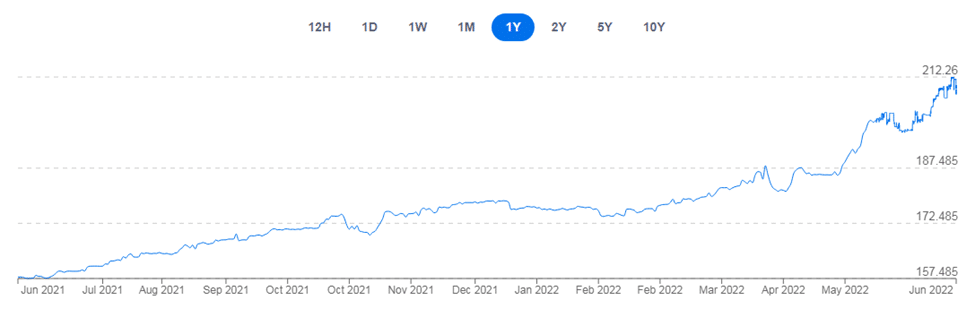
    Pakistan’s fiscal year starts on July 1st and ends on June 30th. The rupee to US dollar exchange rate was Rs158.06 at the beginning of fiscal year 2021-2022, and it reached an all-time high of Rs212.103 in the inter-bank market on June 21, 2022. This represents a depreciation of more than 34 per cent in less than a year.

    The graph below demonstrates how the PKR to USD exchange rate varied over time:

    During the fiscal year 2020-2021, the local currency plunged 17.47 per cent from Rs158.062 to Rs184.159 in 9 months, from July 1, 2022 to April 11, 2022, under the PTI regime. Since PDM took over, the rupee has lost nearly 14.31 per cent of its value in just three months.

    The table below compares PKR to dollar values over time, as well as the government in power at the time:

      PKR to Dollar Government
    July 2021 158.062 PTI
    August 2021 162.571 PTI
    September 2021 166.872 PTI
    October 2021 170.997 PTI
    November 2021 170.92 PTI
    December 2021 176.042 PTI
    January 2022 176.214 PTI
    February 2022 176.736 PTI
    March 2022 177.573 PTI
    April 2022 184.159 PTI and PDM
    May 2022 185.794 PDM
    June 2022 197.744 PDM
    June 23 2022 207.516 PDM

    Dollar demand remains strong in the market, pushing the greenback’s value higher against the rupee. The local currency is likely to remain volatile until the IMF agrees to disburse the next tranche of loans to Pakistan.

  • Microsoft reduces profit estimation due to market volatility

    Microsoft reduces profit estimation due to market volatility

    Microsoft slashed its fourth-quarter profitability and earnings projections on June 2, becoming the latest U.S. corporation to notify of the impact of a stronger dollar.

    An aggressive Federal Reserve and increased geopolitical tensions have driven the dollar up 14 per cent against a basket of currencies in the last year, forcing companies like Coca-Cola Co and Procter & Gamble to lower their expectations for the rest of the year.

    A stronger dollar generally consumes the earnings of multinational corporations that have extensive global operations and convert foreign currencies into dollars. Microsoft has lowered its sales forecast for all three segments, which include Windows products, cloud services, and personal computing.

    Corporate hedging activity has increased as more businesses seek to protect their revenues from the impact of market volatility in the face of rising inflation. It’s indeed common for businesses to preserve themself from unusual currency transitions, however, the intensity comes after years of low forex fluctuation when market volatility had little impact on income.

    Revenue for the quarter is expected to be between $51.94 billion and $52.74 billion, down from a previous range of $52.40 billion to $53.20 billion. Microsoft reduced its profit forecast from $2.28 to $2.35 per share to between $2.24 and $2.32 per share.

    Considering Refinitiv data, analysts expect earnings per share of $2.33 on revenue of $52.87 billion. In April, the company forecasted double-digit revenue growth for the next fiscal year, owing to increased demand for its office software and cloud services as economies reopen and businesses shift to a hybrid model that allows employees to work from both the office and from home.