Tag: finance

  • Germany to strengthen trade and investment ties with Pakistan

    Germany to strengthen trade and investment ties with Pakistan

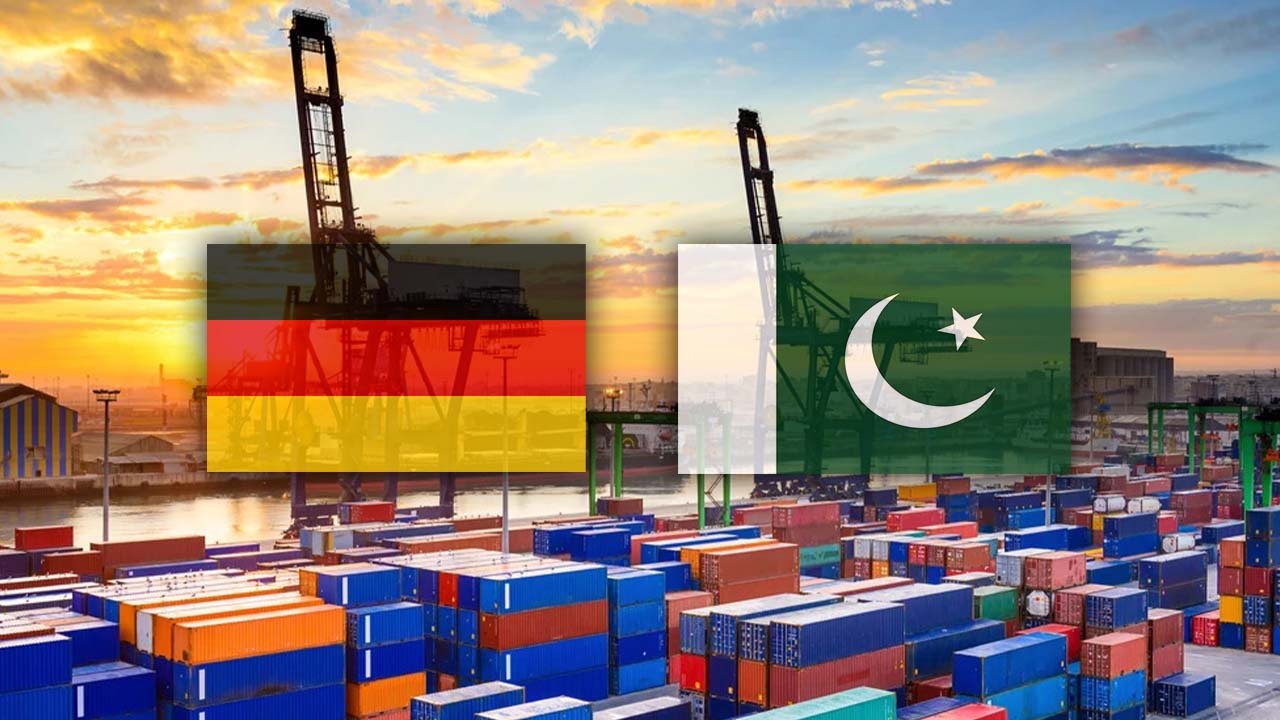
    In a recent meeting with Federal Minister of Commerce and Investment Syed Naveed Qamar, German Minister of State for Foreign Affairs Dr Tobias Lindner expressed his hope that Germany and Pakistan would further strengthen and expand bilateral relations, particularly in trade and investment.

    Both countries discussed multiple aspects of bilateral ties, along a great emphasis on improving trade and financial collaboration to sustain economic growth in a post-Covid pandemic world. The duo agreed to exchange business envoys to look into the prospect of B2B cooperation in renewable power, farming, food security, autos, and technical assistance.

    The Commerce Minister praised Germany for its constant support for Pakistan’s GSP Plus scheme. He emphasized the importance of GSP Plus in widening bilateral trade and offering Pakistan a level playing field in the European segment.

    He also clarified that the scheme has served as a precursor for essential progressive social changes, particularly those relating to women’s empowerment. The German Minister convinced his nation’s continued and forthcoming assistance for the GSP Plus Scheme.
  • Pakistani rupee crashes to historic low of Rs194 against US dollar

    Pakistani rupee crashes to historic low of Rs194 against US dollar

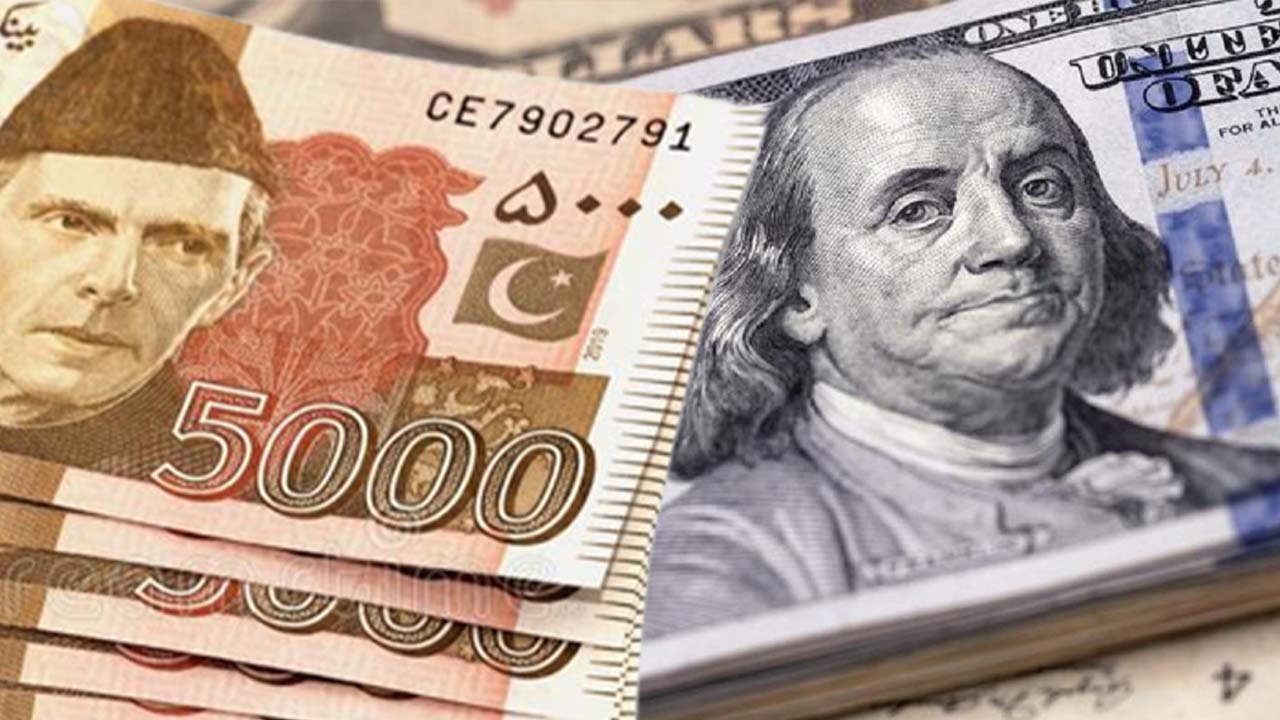
    During the trading session on Monday, the Pakistani rupee (PKR) maintained its declining trend, touching Rs194, its worst rate versus the US dollar. At the interbank, the greenback strengthened by Rs1.47 during the trading hours.

    The General Secretary of the Exchange Companies Association of Pakistan, Zafar Paracha said that the greenback climbed by Rs11.07 since the new government took government, while debt has increased by Rs1,400 billion due to the disparity.

    Pakistani currency lost 3.1 per cent of its value against the US dollar in the previous week in the interbank market, with Pakistan’s currency hitting new record lows to end the week at Rs192.53, its worst closing in history.

    Read more: Pakistani Rupee crashes to a record low against US dollar 

    The local currency fell in value across the board as concerns about the economy, declining foreign currency reserves, and worsening trade imbalance intensified. Concerns over the International Monetary Fund (IMF) programme have also caused fear and speculation in the market.

  • Dr Murtaza Syed assumes charge as the new Governor State Bank of Pakistan

    Dr Murtaza Syed assumes charge as the new Governor State Bank of Pakistan

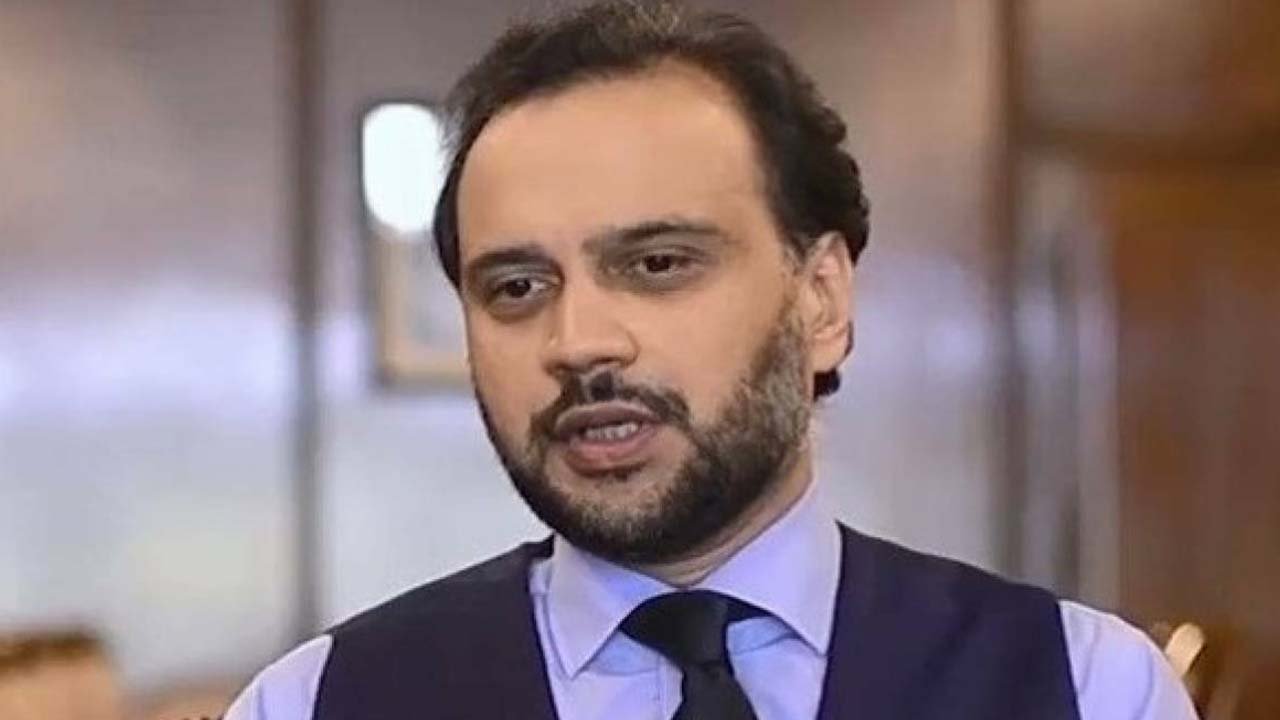
    With effect from May 5, Dr Murtaza Syed, the senior-most Deputy Governor and a former Deputy Resident Representative of the International Monetary Fund (IMF), became the new acting Governor of the State Bank of Pakistan (SBP).

    Prior to this, the federal government named Dr Syed as the Deputy Governor of the SBP for three years on January 27, 2020.

    Dr Syed has taken up the position in light of Section 10(2) of the State Bank of Pakistan (SBP) Act 1956 (amended), and has therefore succeeded Dr Reza Baqir, whose term ended on May 4, according to the notification.

    He holds a Ph.D. in Economics from the University of Oxford’s Nuffield College and has more than 20 years of experience in macroeconomic research and policymaking, including 16 years at the IMF. He worked on IMF initiatives and monitoring of emerging markets and advanced economies such as the Eurozone, Japan, and Korea. Dr Syed also handled IMF training and technical support projects around the world, and between 2010 and 2014, he was the IMF’s Deputy Resident Representative in China.

    Dr Syed started his career as a Senior Policy Analyst at the Human Development Center in Islamabad, where he worked under former Finance Minister D. Mahbub ul Haq. Afterward, he worked for the Institute for Fiscal Studies (IFS), a London-based public policy think tank, where he did research on company investment and employment behaviour, as well as evaluating Latin American anti-poverty programmes.

    Read more: Pakistan’s foreign currency reserves down by $328 million

    Dr Syed has produced papers on a multitude of macroeconomic topics, including fiscal and monetary policy, financial stability, economic crises, investment, demographics, poverty, and inequality, in addition to teaching public policy at the universities of Cambridge and Oxford.

  • Pakistan’s forex reserves inch up to $17.05 billion

    Pakistan’s forex reserves inch up to $17.05 billion

    The State Bank of Pakistan’s (SBP) foreign reserves saw inflows of $36 million in the week ending April 16, 2022, representing a 0.3 per cent increase week over week.

    According to the SBP weekly update posted on Thursday, the country’s total liquid foreign exchange reserves increased by $16.9 million (+0.1 per cent) to $17.045 billion on April 16, 2022, up from $17.028 billion the previous week. SBP reserves rose by $36.1 million to $10.88 billion (+0.3 per cent), up from $10.85 billion the week before.

    Likewise, commercial banks’ net foreign reserves stood at $6.1 billion, down $19.3 million (-0.3 per cent) on a weekly basis.

    Read more: Pakistani rupee plunges by Rs1.05 against the US dollar

    In the interbank market on Thursday, however, the Pakistani Rupee (PKR) resumed its downward trend versus the US Dollar (USD). It fell by Rs1.04 to the dollar, Rs1.15 to the Australian Dollar (AUD), Rs2.04 to the Canadian Dollar (CAD), Rs2.42 to the Pound Sterling (GBP), and Rs2.96 to the Euro (EUR).

  • PKR declines against US Dollar after winning for a week

    PKR declines against US Dollar after winning for a week

    The winning days for Pakistani currency are over. On April 18, the Pakistani Rupee (PKR) overturned gains against the US Dollar (USD) and registered losses in the interbank market.

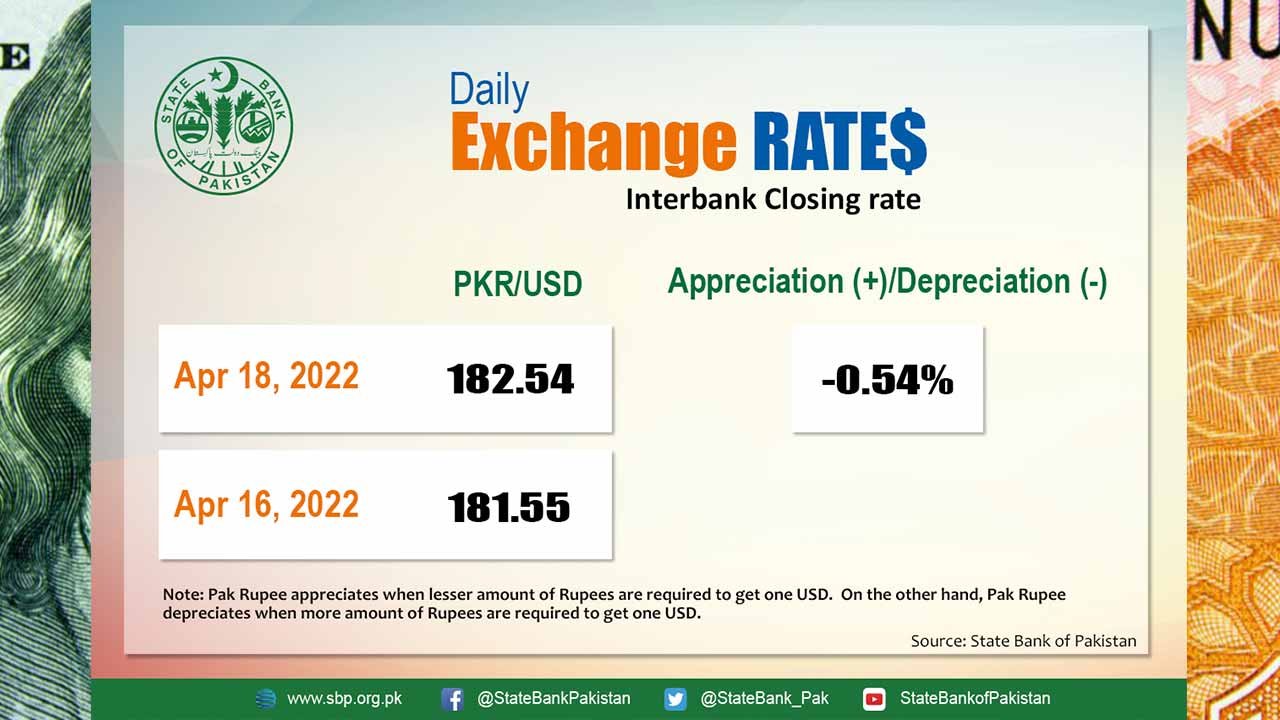
    At the completion of the session, the local currency had lost 99 paisas against the US dollar. It declined by 0.54 per cent versus the US dollar, closing at Rs182.54.

    The rupee declined by 0.54 per cent versus the US dollar, closing at Rs182.54 after winning three paisas and settling at Rs181.55 on Saturday, April 16. During the open market session, the Indian rupee (INR) touched an intraday high of Rs181.00 versus the US dollar.

    After the International Monetary Fund (IMF) decided to resume talks with Pakistan under the $6 billion Extended Fund Facility (EFF) programme, the rupee’s seven-day winning streak versus the dollar ended today.

    Considering global variables influencing the local currency, crude prices declined as concerns about slowing demand in China outweighed support despite a constrained global supply situation and the escalating Russia-Ukraine conflict.

    Read more: Global oil prices climb to highest in three weeks

    It is worth noting that the local currency has depreciated by 15.85 per cent (Rs24.98) since the beginning of the current fiscal year on July 1, 2021.

  • New bank timings announced by SBP, Saturday will now be observed as a working day

    New bank timings announced by SBP, Saturday will now be observed as a working day

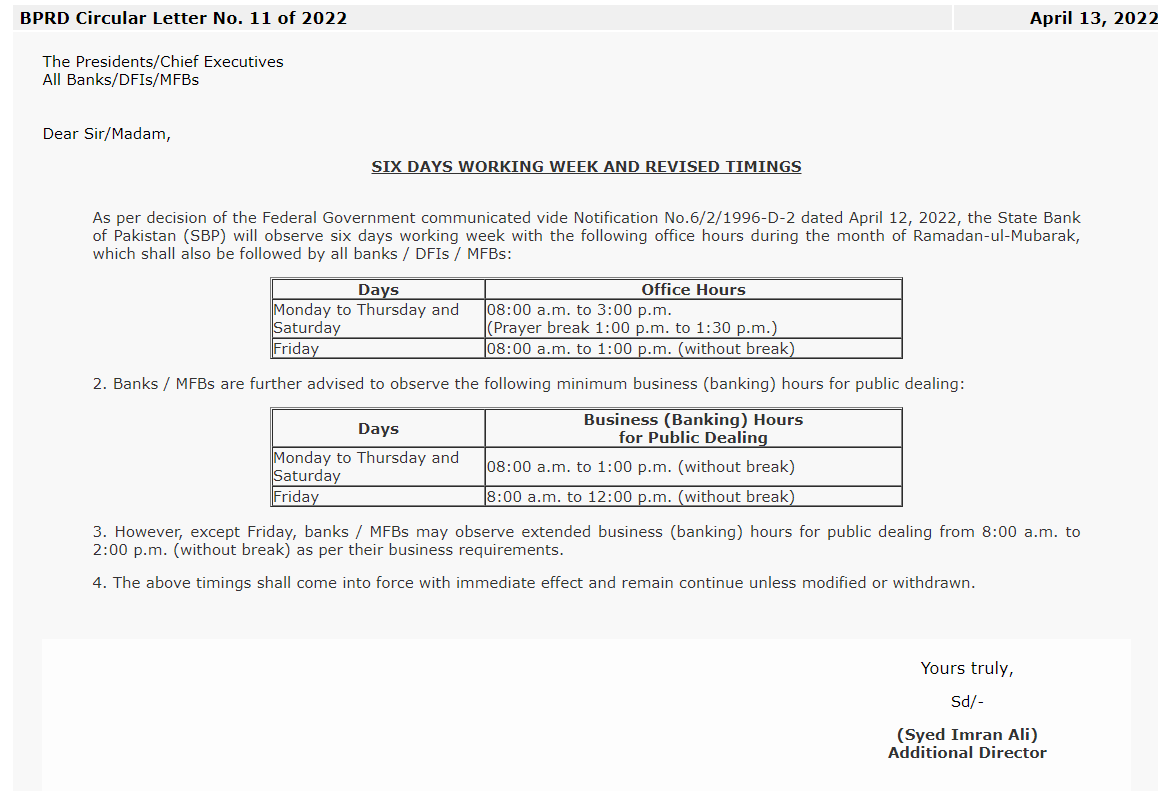
    Pursuant to the federal government’s directive issued on April 13, the State Bank of Pakistan (SBP) would observe a six-day work week with amended timings.

    During Ramzan, working hours for the central bank, development finance institutions (DFIs), microfinance banks (MFBs), and all commercial banks, are as follows:

    Monday to Thursday and Saturday from 8:00 am to 3:00 pm with a prayer break from 1:00 pm to 1:30 pm.

    Fridays: from 8:00 am to 1:00 pm without a break, according to a notification from SBP.

    Public dealing hours

    Banks and MFBs have been advised to adhere to the following public dealing business hours:

    Monday through Thursday and Saturday from 8:00 am to 1:00 pm (no break).

    Fridays from 8:00 am to 12:00 pm (no break).

    Banks and MFBs may observe longer business (banking) hours for public dealing from 8:00 am to 2:00 pm (without break) on weekdays excluding Fridays, depending on their business needs.

    The abovementioned schedule will take effect immediately and will not be changed or withdrawn unless it is amended or canceled.

  • Petroleum sales increase by 23% in March, despite hefty oil prices

    Petroleum product sales rebounded in the last month after a dismal February with Oil marketing companies (OMC) witnessing an increase of 23 per cent in sales of petroleum products on a year-over-year (YoY) basis in March 2022.

    Overall petroleum sales in March 2022, increased to 1.82 million tonnes compared to 1.54 million tonnes in March 2021, as per the data released by Arif Habib Limited.

    The stability comeback shows a 19 per cent increase in overall OMC sales on a month-over-month (MoM) basis.

    OMC volume growth was driven by furnace oil, which climbed by 34 per cent on a YoY basis, followed by HSD volume growth of 29 per cent and MS volume growth of 13 per cent. MoM growth in OMC volumes followed a similar pattern, with FO taking the lead.

    Although the increase in furnace oil volumes was driven by increased furnace oil usage in the power sector due to low gas and Re-Gasified Liquefied Natural Gas (RLNG) availability.

    The increase in HSD volumes was driven by increased demand from the transportation and agriculture sectors and increased usage in generators and the power sector.

    Moreover, the government’s price caps and the additional number of days in March compared to February were the main contributors to MoM growth in diesel and gasoline sales.

    Consequently, petroleum sales increased by 19 per cent on a YOY basis in 9MFY22, with double-digit increases for petroleum products.

    Diesel sales grew by 17 per cent, followed by 16 per cent increase for furnace oil and a 10 per cent growth for motor oil.

    While some are expecting a drop in petroleum sales due to the political turmoil and rising commodity prices, others say that higher oil consumption cannot be overturned as the summer is already here and people are likely to consume more electricity, also that the power sector may switch to furnace oil due to RLNG commitment defaults.

  • Pakistan’s exports grew 25% in the last nine months

    Pakistan’s exports increased by 17.3 per cent in March 2021 to $2.773 billion, up from $2.365 billion in March 2021 and 25 per cent in the last nine months.

    The Prime Minister’s Adviser on Commerce and Investment, Abdul Razak Dawood, said that exports increased by 25 per cent to $23.332 billion in the July-March fiscal year 2021-2022, compared to $18.688 billion in the same period last year, implying a $4.644 billion upsurge.

    On the other hand, according to preliminary data from the Pakistan Bureau of Statistics (PBS), exports fell 2 per cent on a month-on-month (MoM) basis to $2.77 billion in March 2022, down from $2.82 billion in February 2022.

    Dawood said in a tweet, “We are glad to share that Pakistan’s exports for Mar-2022 grew by 17.3 per cent to $2.773 billion as compared to $2.365 billion Mar-2021. For Jul-Mar 2022, our exports grew by 25 per cent to $23.332 billion as compared to $18.688 billion in Jul-Mar 2021. This is an increase $4.644 billion”.

    While talking about the target for exports he added that “We expect to achieve our yearly target. The import figures would be shared when finalised by the PBS. We would like to congratulate our exporters for maintaining the momentum of exports under these testing times in the global market”.

    Pakistan’s current account deficit (CAD) decreased by 78.46 per cent to $545 million in February from $2.531 billion in January, owing primarily to a steep drop in imports.

    Read more: FBR records 29.1% growth during July 2021 to March 2022, despite providing ‘massive tax relief’

    Surprisingly, the CAD crossed the $12 billion level in the first eight months of FY22, showing no signs of improvement in the external account. The CAD was only $34 million in February 2021.

  • FBR records 29.1% growth during July 2021 to March 2022, despite providing ‘massive tax relief’

    The provisional revenue collection data for the months of July 2021 to March 2022 of the current financial year 2021-22 have been announced by the Federal Board of Revenue (FBR).

    The net collection was Rs575 billion for the month of March 2022, up 20.5 per cent from Rs477 billion in March 2021.

    Conversely, the gross revenues, rose by 28.9 per cent in the current financial year, from Rs3,577 billion in July 2020 to March 2021 to Rs4,611 billion in July 2021 to March 2022. Furthermore, the amount of reimbursements granted in March 2022 was Rs31.9 billion, compared to Rs26.3 billion in March 2021, showing a 21.3 per cent upsurge.

    Then again, refunds of Rs229 billion were paid from July 2021 to March 2022, a 25 per cent increase over the Rs183 billion paid the previous year.

    Read more: Petrol, Diesel prices to remain unchanged till April 15

    It is worth noting that the continuous remarkable growth in revenue collection has been achieved despite the government providing ‘massive tax relief’ to the general public on a variety of vital commodities.

    For the first time in Pakistan’s history, the sales tax on all petroleum products was abolished, costing the FBR Rs45 billion in the past month.

  • Nisab amount of zakat deduction set at Rs88,927 for 2022

    Nisab amount of zakat deduction set at Rs88,927 for 2022

    The nisab amount of zakat for the year 2022 is set at Rs88,927, according to a notification dated March 30, 2022, issued by the Poverty Alleviation & Social Safety Division, Cabinet Secretariat, Government of Pakistan.

    The account holders, maintaining a minimum of Rs88,927 balance on the first day of Ramzan would be liable to pay 2.5 per cent Zakat on the first day of the fasting month of Ramzan.

    If the amount standing to the credit of an account is less than the said amount, no Zakat deduction shall be made. While savings, profit-and-loss sharing, and other similar accounts are subject to nisab deductions. it is worth noting that the zakat deduction has surged by Rs7,994 as compared to last year, due to an increase in gold and silver prices.

    Read more: Banks to remain closed for public dealing on 4 April

    The amount for nisab in 2021 was set at Rs80,933 and Rs46,329 for 2020. In the majority of Islamic countries, It is adjusted at 2.5 per cent of one’s wealth above the nisab.