Tag: fiscal year 2023

  • Govt’s bank borrowings jump 3.15x in six months

    Govt’s bank borrowings jump 3.15x in six months

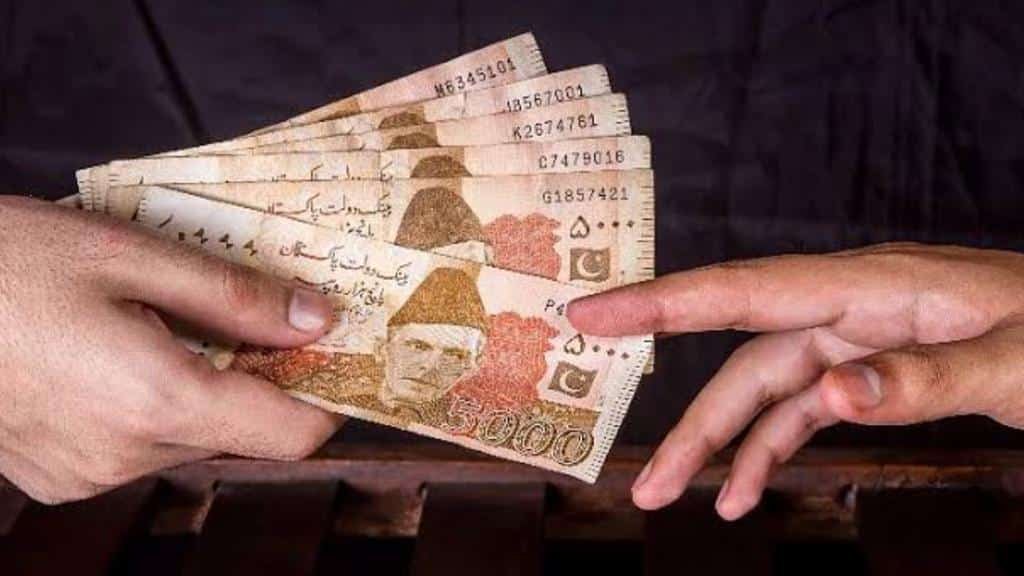
    The government’s reliance on bank borrowings has displayed a concerning upward trajectory, intensifying the nation’s debt burden and raising doubts about its optimistic economic outlook. 

    Recent data for the six months ending December 2023 reveals a substantial increase in borrowing through banks, soaring to Rs3.214 trillion compared to Rs1.019 trillion during the same period last year—an alarming surge of 3.15 times.

    Notably, this surge occurs amid a caretaker government’s administration, signalling that within six months, the government has amassed a level of debt equivalent to the entire fiscal year 2023. 

    While governments commonly borrow from banks to address financial gaps, refinance debts, and fund public projects, the scale of the borrowing indicates a matter of heightened concern.

    Despite the Federal Board of Revenue’s commendable performance in tax collections, with historic achievements of over Rs1 trillion in December and Rs4.468 trillion in 6MFY24, these impressive figures clash with the substantial reliance on bank borrowings.

     Economic apprehensions grow as these borrowing patterns contradict the government’s objective of optimising the allocation and expenditure of public funds.

    The caretaker government’s limited authorisation of Rs300.904 billion for development funds, out of a total allocation of Rs950 billion for ongoing and new social sector uplift projects, contrasts starkly with the escalating borrowing figures, hinting at the possibility of an expanding Public Sector Development Programme (PSDP).

    Furthermore, this escalating trend in government borrowings raises concerns among economists and financial experts who emphasise the importance of fiscal discipline. 

    The growing debt levels may not only impact the country’s creditworthiness but also strain future budgetary allocations, potentially limiting the government’s capacity to respond to unforeseen economic challenges. 

    As stakeholders closely monitor these developments, there is a pressing need for transparent fiscal policies and strategic measures to ensure a sustainable and resilient economic future for the nation.
  • State Bank of Pakistan maintains 22% policy rate in line with market consensus

    State Bank of Pakistan maintains 22% policy rate in line with market consensus

    Following the consensus in the broader market, the Monetary Policy Committee (MPC) of the State Bank of Pakistan (SBP) announced on Monday that it would maintain the key policy rate at 22 per cent, as stated in their press release.

    The Committee recognised that headline inflation, as expected, increased in September 2023 but anticipates a decline in October, followed by a sustained decrease, particularly in the latter half of the fiscal year.

    While the MPC acknowledged potential risks to the FY24 inflation outlook and the current account due to recent global oil price volatility and forthcoming gas tariff increases in November 2023, they also identified mitigating factors.

    These factors include targeted fiscal consolidation in the first quarter, enhanced availability of crucial commodities in the market, and the alignment of interbank and open market exchange rates.

    The MPC emphasised that the real policy rate, looking forward over a 12-month horizon, remains significantly positive.

    This is deemed appropriate to achieve the medium-term inflation target of 5-7 per cent by the end of FY25, contingent upon the sustained fiscal consolidation and timely realisation of planned external inflows, as articulated in the MPC statement.

  • Power sector’s circular debt surpasses Rs2 trillion despite massive tariff increase 

    Power sector’s circular debt surpasses Rs2 trillion despite massive tariff increase 

    Despite raising tariffs significantly, Pakistan’s power sector debt grew to Rs2.31 trillion by June 2023, up from Rs2.25 trillion in the previous fiscal year (FY22). This increase of Rs57 billion (about 3 per cent) over 12 months is quite different from FY22 when the debt actually decreased by Rs27 billion. 

    Here’s a breakdown of the key points: 

    1. In FY22, the debt was Rs2.25 trillion, but by June 2023, it had risen to Rs2.31 trillion. 

    2. In FY22, power producers were owed Rs1,351 billion, generation companies owed Rs101 billion to fuel suppliers, and Rs800 billion was held in Pakistan Holding Limited (PHL).  

    3. In FY22-23, the debt to power producers increased to Rs1,434 billion, while the debt to PHL decreased to Rs765 billion in FY23. 

    4. In FY22, some subsidies were reduced by Rs12 billion, but in FY23, there were no subsidies left. 

    5. The interest charges on delayed payments by independent power producers (IPPs) increased to Rs105 billion in FY22 but dropped to Rs100 billion by the end of FY23. 

    6. The markup paid on IPPs’ claims by PHL increased from Rs29 billion in FY22 to Rs43 billion in FY23. 

    7. The pending generation cost, including tariff adjustments and fuel charges, decreased from Rs414 billion in FY22 to Rs250 billion in FY23. 

    8. K-Electric’s outstanding dues went from Rs107 billion in FY22 to an excess payment of Rs53 billion in FY23. 

    9. However, power distribution companies (Discos) saw their losses due to inefficiency rise from Rs133 billion to Rs160 billion in FY23. 

    Read more: Pakistan to launch digital rupee to reduce printing and distribution costs 

    In simple terms, even though the government raised tariffs to collect more money for the power sector, the debt continued to increase. This debt is owed to various power-related entities, and some subsidies and charges also changed over the years. Additionally, while some costs went down, the losses due to inefficiencies in power distribution increased.