Tag: foreign exchange reserves

  • Pakistan’s forex reserves increase by 9%, cross $3 billion mark

    Pakistan’s forex reserves increase by 9%, cross $3 billion mark

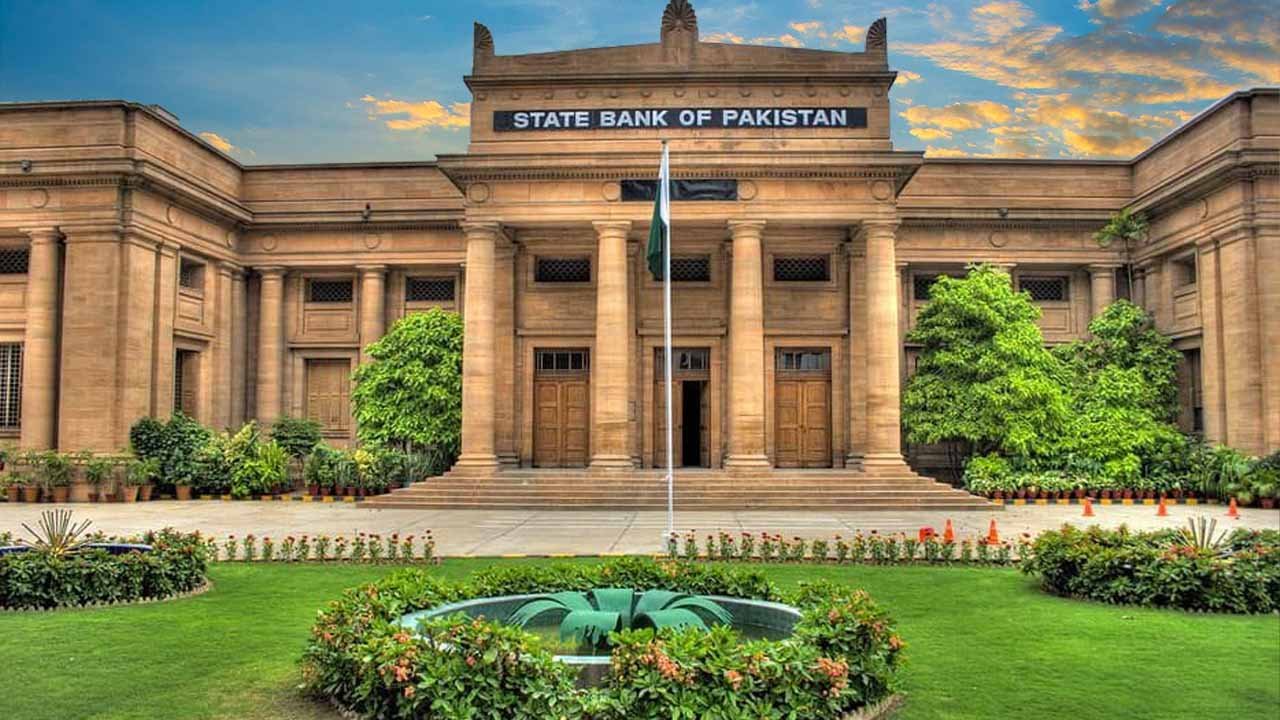
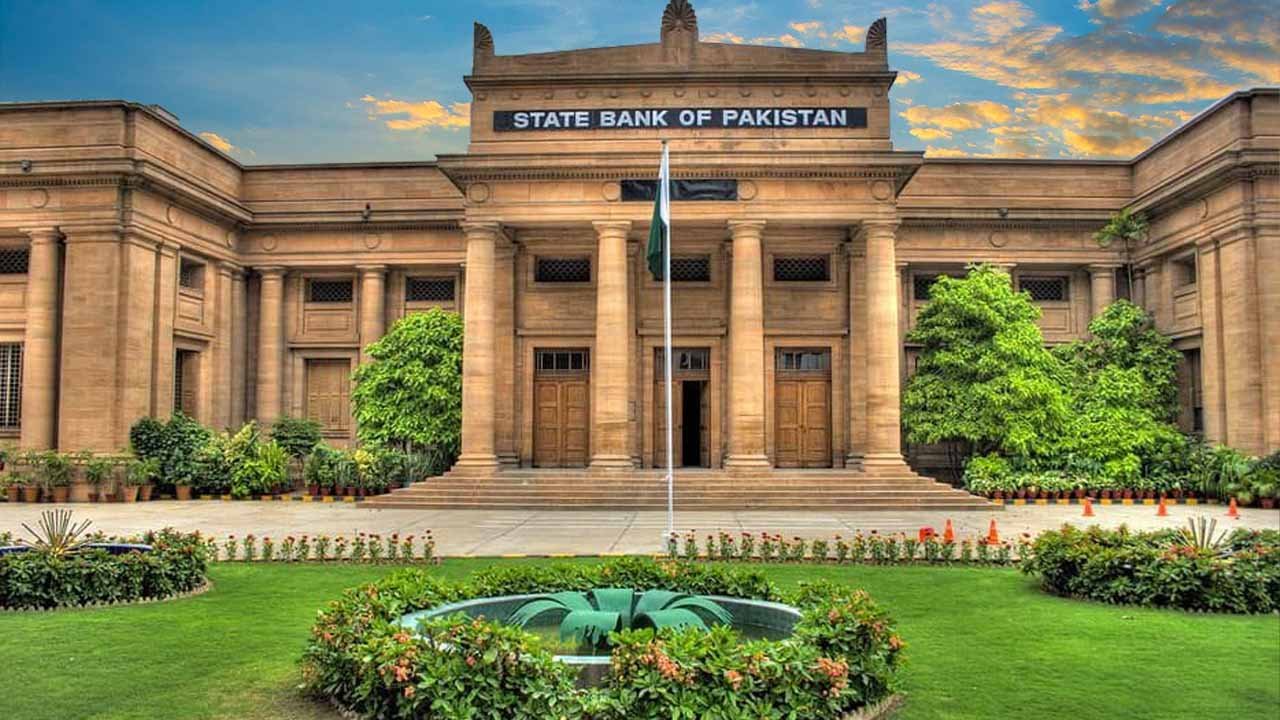
    After declining for three weeks in a row and losing a cumulative $1,685 million during that period, the foreign exchange reserves held by the State Bank of Pakistan (SBP) have rebounded, according to a statement from the central bank.

    As of February 10, SBP’s foreign currency reserves totaled $3,192.9 million, which is up $276 million from the previous week. This increase represents a gain of over 9 per cent and has broken the streak of declining reserves.

    However, even with this increase, the amount is still only enough to cover one month of imports. Meanwhile, the net forex reserves held by commercial banks are $5,509.3 million, which is $2,316.4 billion more than SBP, bringing the total liquid foreign reserves of the country to $8,702.2 million. The statement did not provide a specific reason for the increase in SBP-held reserves.

    Pakistan’s economy is in dire straits due to a balance-of-payments crisis, political chaos, and deteriorating security. The government has banned all but essential food and medicine imports until it receives a crucial loan tranche from the International Monetary Fund (IMF), which could unlock other sources of funding for the country.

    Inflation has risen sharply, the rupee has declined, and the country is struggling to afford imports, which has caused a severe decline in its industry. Pakistan is no longer issuing letters of credit, except for essential food and medicine, since January, which has led to a backlog of raw material imports that the country can no longer afford.

    According to Geo, the rupee devaluation and the logjam have resulted in a significant decline in manufacturing, including textiles and steel, and building projects.

    While the IMF cash injection alone will not be enough to rescue Pakistan, the government hopes that it will boost confidence and pave the way for other friendly countries like Saudi Arabia, China, and the UAE to offer additional loans.

  • SBP-held foreign exchange reserves drop to a highly critical level of $2.92 billion

    SBP-held foreign exchange reserves drop to a highly critical level of $2.92 billion

    The State Bank of Pakistan (SBP) has reported a decrease in its foreign exchange reserves, as reflected in data released on Thursday. The reserves fell to a total of $2.92 billion, marking a reduction of $170 million.

    According to the recent data, the current level of reserves held by the bank has reached its lowest point since February 2014.

    The country’s total liquid foreign reserves were reported to be at $8.54 billion, according to the latest data. Meanwhile, commercial banks in the country held net foreign reserves of $5.62 billion.

    “During the week ended on February 3, 2023, SBP’s reserves decreased by $170 million to $2,916.7 million due to external debt repayments,” the SBP said in a statement.

    The State Bank of Pakistan (SBP) experienced a substantial decrease in its foreign exchange reserves last week, declining to $3.09 billion, a drop of $592 million. This represents the lowest level of reserves for the central bank since February 2014. The current level of reserves falls below one month’s worth of import coverage.

    The depletion of the central bank’s reserves, which stood at nearly $18 billion at the beginning of 2022, highlights the pressing need for Pakistan to move forward with the next review of its International Monetary Fund (IMF) program.

    These declining reserves serve as a reminder of the economic challenges facing the country and the importance of addressing them in a timely and effective manner.

  • Everything is going alright with IMF, says Ishaq Dar

    Everything is going alright with IMF, says Ishaq Dar

    Finance Minister Ishaq Dar said on Thursday that it is expected that the matters between the government and the International Monetary Fund (IMF) regarding the conclusion of the 9th review of the $7 billion loan program will be settled today.

    “Everything is going alright,” replied the finance minister when asked about the status of the discussions with the visiting IMF delegation. “The final round is currently underway. I have daily meetings with the IMF team and will do so again today,” he added.

    “It is expected matters will be settled today,” Dar said. “We will give you the news very soon.”

    A delegation from the IMF, led by Nathan Porter, has arrived in Islamabad for discussions surrounding the completion of the ninth review. The discussions are set to conclude on the same day.

    The successful completion of the review would result in the disbursement of $1.2 billion from the IMF and also unlock additional funding from friendly nations and other multilateral lenders, which is crucial for Pakistan to avoid default.

    Minister of State for Finance and Revenue Aisha Ghaus Pasha informed journalists on Wednesday that the government and the IMF are in close proximity to finalizing the Memorandum of Economic and Financial Policies (MEFP).

    Minister of State for Finance and Revenue Aisha Ghaus Pasha stated that the Memorandum of Economic and Financial Policies (MEFP) would be delivered to Pakistan by the IMF once all issues have been resolved. The Minister noted that significant progress had been made, but added that the IMF was seeking clarification on certain aspects, which the government team is working to address.

    In a written statement, the ministry said the talks with the IMF continued on Wednesday and “focused on fiscal table, financing, etc. There is a broad consensus on the reform actions and measures”.

    Additionally, the mission chief also held a meeting with the finance minister to provide an update on the discussions. “The mission is working on putting it all together and will finalise the MEFP,” stated the finance secretary, who declined to comment on the possibility of extending the scheduled talks in order to reach a staff-level agreement.

    According to Dawn, it is of utmost importance for Pakistan to reach a agreement with the IMF, as the foreign exchange reserves have depleted to a low of $3.09 billion as of January 27th, which is only sufficient to cover 18 days’ worth of imports.

  • Pakistan will have to agree to ‘unimaginable’ IMF conditions for bailout: PM Shehbaz

    Pakistan will have to agree to ‘unimaginable’ IMF conditions for bailout: PM Shehbaz

    The government will have to accept “beyond imagination” International Monetary Fund (IMF) bailout requirements, according to Pakistan’s Prime Minister (PM) Shehbaz Sharif, who made the statement on Friday in a meeting of civil and military leaders in the northwestern city of Peshawar.

    In order to avoid backlash before the upcoming elections in October, the administration has refused to implement the tax increases and subsidy reductions that the IMF has required.

    “I will not go into the details but will only say that our economic challenge is unimaginable. The conditions we will have to agree to with the IMF are beyond imagination. But we will have to agree with the conditions,” PM Shehbaz said.

    In the midst of political unrest, a deteriorating security situation, and a balance of payments crisis caused by its high levels of foreign debt, Pakistan’s economy is in terrible circumstances.

    The nation’s central bank announced Thursday that its foreign exchange holdings had decreased once again to $3.1 billion, which analysts said was just enough to cover imports for fewer than three weeks.

    On Wednesday, year-over-year inflation reached a 48-year high, making it difficult for Pakistanis to afford food products.

    With the possibility of national bankruptcy looming and no friendly countries prepared to give less painful bailouts, Islamabad started to submit to pressure ahead of the IMF visit.

    To manage a rogue illicit market in US dollars, the government relaxed regulations on the rupee, which led to the currency falling to historic lows. Additionally, artificially low gasoline costs have increased.

    A backlog of thousands of cargo containers filled with material the countrycannot afford is accumulating at Karachi port as a result of the government no longer providing letters of credit, with the exception of necessary food and medication.

    IMF advises Pakistan to fetch additional revenue

    The IMF has suggested the Pakistani government implement significant, high-quality, and long-lasting tax and non-tax revenue initiatives in order to raise extra funds to close the anticipated Rs. 600 billion fiscal framework shortfall.

    Currently in Pakistan, an IMF delegation led by Mission Chief Nathan Porter is having discussions for the ninth review, which will go through February 9.

    After months of resistance, the government was finally obliged to agree to all the terms laid forth by the Washington-based lender due to the country’s declining foreign exchange reserves and deteriorating economic circumstances.

    Following the conclusion of the negotiations under the $6.5 billion Extended Fund Facility, a staff-level agreement is anticipated.

  • SBP-held foreign exchange reserves now stand at only $3.09 billion

    SBP-held foreign exchange reserves now stand at only $3.09 billion

    According to figures issued on Thursday, the State Bank of Pakistan’s (SBP) foreign reserves fell precipitously by $592 million to just $3.09 billion. This is the lowest level of central bank reserves since February 2014.

    The nation’s total holdings of liquid foreign exchange were $8.74 billion. There were $5.65 billion in net foreign reserves held by commercial banks.

    “During the week ended January 27, 2023, SBP’s reserves decreased by $592 million to $3,086.2 million due to external debt repayments,” the SBP said in a statement.

    The SBP’s foreign exchange reserves decreased sharply last week, falling by a whopping $923 million to only $3.7 billion.

    The central bank reserves, which were around $18 billion at the beginning of 2022 but have significantly decreased, highlight the pressing need for Pakistan to finish the next assessment of the International Monetary Fund (IMF) programme.

  • Dollar inflows from next week will increase foreign exchange reserves: SBP governor

    Dollar inflows from next week will increase foreign exchange reserves: SBP governor

    Governor of the State Bank of Pakistan (SBP) Jameel Ahmad expressed hope on Wednesday that the situation of Pakistan’s foreign exchange reserves will improve as the country is anticipated to receive capital inflows in the coming days.

    “We are expecting inflows from next week onwards, which would reduce pressure on our foreign exchange reserves,” the SBP governor said.

    Ahmad reaffirmed his commitment to addressing the concerns of manufacturers and claimed that the nation’s foreign exchange reserves have reached very low levels. But as projects in the pipeline start to take shape, he predicted, “we will see a boom in reserves, which will increase our ability to support businesses.”

    According to the most recent SBP data, the central bank’s foreign exchange reserves dropped significantly by $1.23 billion, to a critically low level of $4.34 billion. SBP’s reserves are at their lowest point since February 2014.

    The country held $10.19 billion in liquid foreign reserves, and commercial banks kept $5.85 billion in net foreign reserves, according to Brecorder.

    To the dismay of many importers and firms in Pakistan, who claimed these limits as the cause for closing or curtailing operations, the SBP restricted imports earlier this year due to the low level of reserves.

    According to Ahmad, the SBP facilitated shipments under the headings of necessities, energy, industries focused on exports, agricultural inputs, deferred payment / self-funded imports, and imports for projects focused on exports that were almost finished.

    Prior to this, the central bank made the decision to remove import restrictions beginning on January 2, 2023.

    “Our capacity to export will build up only after we complete export-oriented projects, thus we have facilitated the timely completion of these projects,” he said.

    “We want to facilitate all the industries, however, we can only do so under our given capacity of inflows. We do not produce dollars locally, they come through exports, remittances, and inflows from lenders,” said Ahmed.

    “We are focusing on improving our capacity, and are also taking administrative intervention to bring our imports on a reasonable level,” he added.

    The SBP chief said evaluating the Letter of Credit (LC) is a time-consuming exercise. “We have cleared 33,000 LC cases,” he said.

    He added that steps had been done to control the current account deficit and that the central bank was aware of issues facing the business community.

    The governor stated that an action plan in this regard will soon be launched after the SBP carefully evaluates the business community’s ideas.

    He assured the business community that the central bank will ensure the approval of 365 days or over LCs from banks. “Similarly, if you have arranged a project loan, and yet the LCs are not being opened, the SBP will ensure it,” he said.

    The SBP had recommended banks to compel the retention of 35% of their export receipts in special foreign currency accounts in order to encourage IT companies and independent contractors to bring their foreign exchange earnings into the nation.

    “We are hopeful that the problems of the IT sector will be addressed, and as a consequence, our exports from the IT sector will increase,” said Ahmed in his address.

  • Pasha warns inflation may increase to 70% if Pakistan defaults

    Pasha warns inflation may increase to 70% if Pakistan defaults

    Former finance minister Dr Hafiz Pasha on Tuesday warned that inflation in Pakistan may soar to 70 per cent in the event of a default.

    Pasha predicted that Pakistan’s general economy would likely continue to experience severe stagflation in 2023. He was speaking to members of the Pakistan Industrial and Traders Associations Front (PIAF).

    Due to the International Monetary Fund (IMF) stringent requirements, inflation will still increase to at least 35 per cent even if the loan from international lender is restored, according to Express Tribune.

     “If the government implements the key reforms agreed with the IMF, including a Rs50 levy per litre on POL, an electricity tariff hike of 40 per cent, doubling of the gas tariff, and shift to market-based exchange rate policy, the inflation rate could exceed 35 per cent,” Pasha cautioned.

    If the government does not implement the agreed reforms, he said, “It will lead to a termination of the IMF programme and will virtually dry-up the country’s capital.”

    According to Pasha, Pakistan’s reliance on pricey foreign loans has been disastrous. The nation’s debt in the first 65 years was $65 billion. In the following seven years, as we increased our reliance on costly loans with high interest rates, this amount increased to approximately $130 billion.

  • Exchange companies suggest higher US dollar rate to increase remittances

    Exchange companies suggest higher US dollar rate to increase remittances

    The government has been advised by the Exchange Companies Association of Pakistan (ECAP) to “set” the dollar rate to lessen currency market volatility as the country fights a severe economic crisis and declining foreign exchange reserves.

    The general secretary of ECAP Zafar Paracha said in a statement on Monday, “It is advised to fix the rupee/dollar exchange rate for export-import bills and remittances”. He further said these remittance proceeds could be received by banks and money changers at a fixed rate of Rs240 per dollar.

    Pakistani rupee closed at Rs228.34 per US dollar, compared with the previous close of Rs228.15 in the interbank market. In the open market, the local unit was trading at Rs238.75 against the greenback.

    Paracha suggested the government to set the rate of Rs240 per dollar for overseas Pakistanis and for inward remittance.

    He expects that by making the change, the official channel would be strengthened, remittances would increase, Hundi/Hawala would decline, and eventually, the grey market would vanish.

    According to Paracha, the exchange rate between the dollar and the local currency has hit Rs267 to Rs270. The offer could be made at Rs228 against/ the dollar in order to obtain exporters’ revenues. Additionally, the rate for importers would be determined by the weighted average of the exporter and home remittance rates. He said that it would help remittances and exporters.

    It will boost the nation’s foreign exchange reserve, encourage exporters to bring dollars, and strengthen the exchange companies’ remittances division.

    The country received $14.1 billion in remittances during the first six months (July-December) of the current fiscal year, a decline of 11.1 per cent from a year earlier.

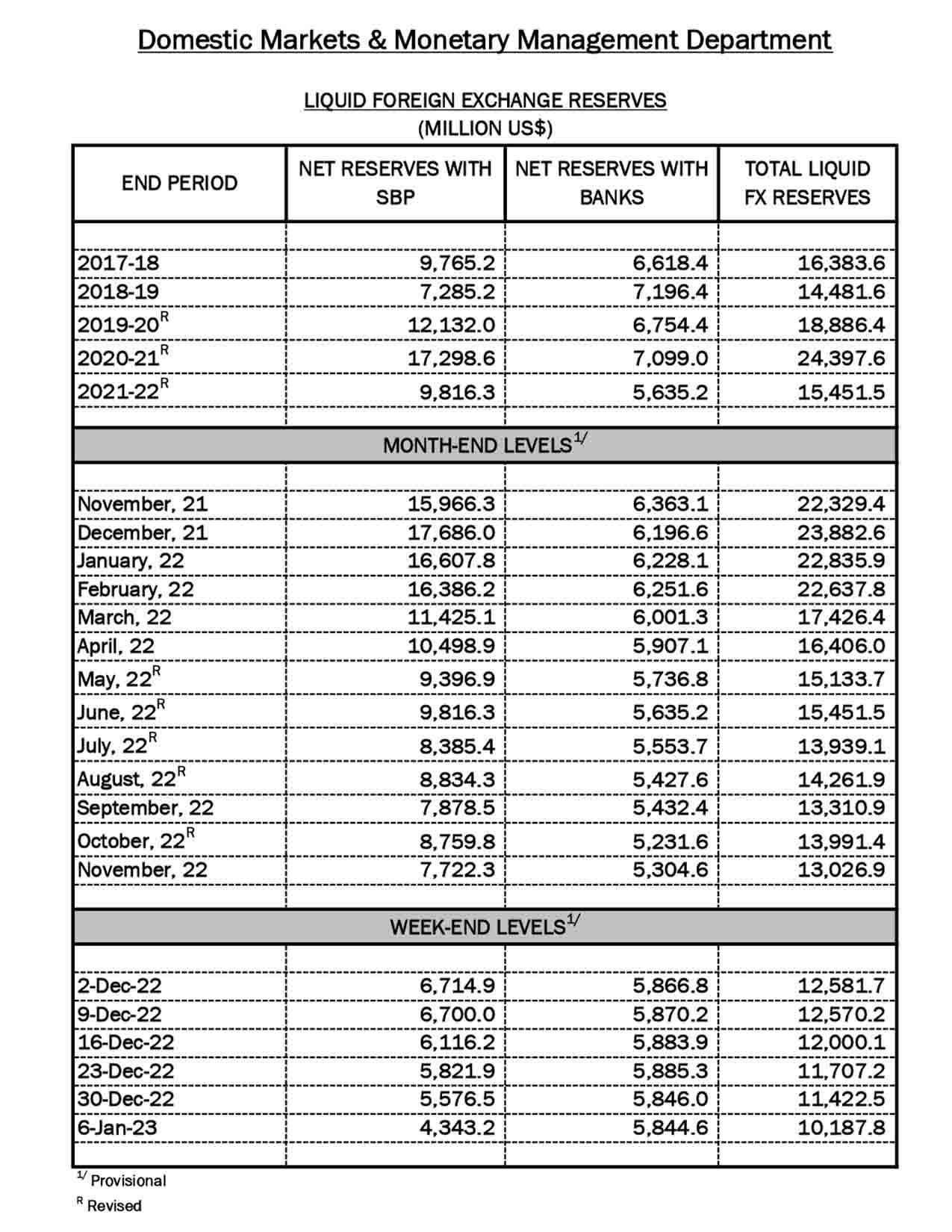
    As of January 6, Pakistan’s foreign exchange reserves at the State Bank of Pakistan fell by $1.2 billion to $4.3 billion, just enough to fund three weeks’ worth of imports.

    Due to significant repayments of foreign debt and a lack of external funding, which have severely reduced Pakistan’s foreign reserves and resulted in ongoing dollar shortages, the country is currently facing a balance of payments crisis.

  • SBP-held foreign exchange reserves dropped to 9-year low of $4.34 billion

    SBP-held foreign exchange reserves dropped to 9-year low of $4.34 billion

    The State Bank of Pakistan’s (SBP) foreign exchange reserves fell to $4.34 billion, its lowest level since February 2014, due to a lack of dollar inflows from the International Monetary Fund (IMF) or friendly nations.

    The SBP disclosed on Thursday that due to the repayment of external debt, its reserves fell by $1.23 billion during the week ended January 6.

    The country has been experiencing a severe dollar shortage, which is having a negative impact on the capacity to import even food and industrial raw supplies. The country doesn’t have enough dollars, according to the most recent status of foreign exchange reserves, to pay for even one month’s worth of routine imports.

    Data showed that commercial banks held $5.84 billion in net foreign currency reserves, while the overall amount of liquid foreign exchange reserves was $10.18 billion.

    Ever since the beginning of 2022–2023, reserves have been rapidly decreasing. In the upcoming months, analysts predict rising inflation and limited industrial output as manufacturing is constrained by the scarcity of imported raw materials.

    According to Geo, United Arab Emirates (UAE) will roll over the existing loan of $2 billion and give an additional $1 billion loan, which should stabilise the reserve position in the coming days.

    As the government strives to reduce imports amid a dollar shortage, the reserves, which fell to their lowest level since February 2014, would now only provide import coverage of 0.82 month.

  • Pakistan will take fiscal measures set by IMF but there will be no burden on the common man: Ishaq Dar

    Pakistan will take fiscal measures set by IMF but there will be no burden on the common man: Ishaq Dar

    Federal Minister for Finance and Revenue Ishaq Dar has categorically denied rumours suggesting that the government is considering “access to foreign exchange held with commercial banks.”

    “It is categorically denied and clarified that there is no such move under consideration of the government,” said Dar, in a series of tweets.

    The statement come days after the finance minister said that the country’s foreign exchange reserves stand at $10 billion, a much higher amount than the SBP’s $5.6 billion reserves as of December 30, 2022, since “dollars held by commercial banks also belonged to the country.”

    This comment gave rise to fears that the government may confiscate dollars from private banks as had been done in 1998 when Dar was the finance minister.

    However, Dar said that his comment was “greatly misconstrued” and nothing like this would happen.

    Dar explained at a press conference with Prime Minister Shehbaz Sharif and other federal cabinet members that before 1999, all foreign currency was deposited with the State Bank of Pakistan (SBP), and private banks were not permitted to hold any foreign currency.

    “In February 1999, when I was the finance minister, we devised a system whereby a substantial amount [of dollars] remain with [private] banks. It was on June 30, 1999 that reserves were broken down into three columns — those with the SBP, commercial banks and total.

    “Whenever Pakistan’s reserves are quoted anywhere in the world — a survey or a document — the [total figure] is quoted and then a breakdown is given. I gave a breakdown too,” he added.

    The minister claimed that certain people were to blame for the country’s dire circumstances, which caused it to drop from the 24th to the 47th largest economy in 2016.

    “Even now, they cannot tolerate any good development. They gave such a twist [to my statement],” he said, adding that while the federal cabinet was busy working for Pakistan under PM Shehbaz’s guidance, such people were spreading rumours that the government would take dollars from commercial banks.

    “Nothing of that sort will happen. Everything is all worked out … and in order. Nothing to worry about,” he assured, urging those “spreading the rumours” to play a positive national role.

    Dar also tweeted about the reserves later, saying national foreign exchange reserves always include forex held with SBP and commercial banks.

    Furthermore, Dar tweeted about the reserves and stated that SBP and commercial bank holdings are usually included in the nation’s foreign exchange reserves.

    “Recently I quoted the forex reserves figure based on this principle. Some vested elements who ruined this country’s economy in the past, gave it a deliberate twist and started a campaign as if govt was considering access to foreign exchange held with commercial banks which indeed is the property of the citizens.

    “It is categorically denied and clarified that there is no such move under consideration of the government,” he emphasised.

    The finance minister once again claimed that Pakistan’s foreign exchange reserves would increase soon.

    As of December 30, 2022, Pakistan’s foreign exchange reserves had decreased to $5.6 billion, an eight-year low. This is equivalent to imports for three weeks.

    The swift decrease has made it impossible for the government to repay its international debts without taking out new loans from allies.

    Govt to comply with IMF conditions without burdening common man

    The International Monetary Fund (IMF) programme’s ninth review, which would release $1.18 billion, has been postponed for months due to the government’s refusal to comply with some conditions imposed by the international lender.

    In today’s press conference, Dar acknowledged the delay and claimed that it was due to revenue collection. The Federal Board of Revenue (FBR) missed its goal in December, the finance minister said, and the super tax that the administration enacted in June of last year had been declared unlawful by a high court.

    Dar said that his team informed the IMF that Pakistan could recover the amount easily after the Supreme Court takes a decision on the super tax.

    “We are not changing the fiscal budget target and we will achieve it,” he claimed.

    Dar said that the IMF suggested that the government implement fiscal measures and eliminate some subsidies. “We have identified some budgetary measures, but the average person won’t be overburdened.”

    He asserted that the measures would be very specific and classified.