Tag: foreign exchange reserves

  • World Bank cuts Pakistan’s GDP growth forecast from 4% to 2%

    World Bank cuts Pakistan’s GDP growth forecast from 4% to 2%

    Due to the unstable economy and floods, the World Bank predicted that Pakistan’s economic growth would drop by half, falling by 4 per cent to 2 per cent, during the current fiscal year.

    According to the Bank’s latest report, “Global Economic Prospects,” Pakistan is experiencing growing economic woes, especially those caused by the recent flooding as well as ongoing policy and political uncertainties.

    “Pakistan faces mounting economic difficulties and Sri Lanka remains in crisis. In all regions, improvements in living standards over the half-decade to 2024 are expected to be slower than from 2010-19,” the World Bank stated in Global Economic Prospects released on Tuesday.

    Pakistan’s currency declined by 14 per cent between June and December, and its national risk premium climbed by 15 per cent over this same time frame due to the nation’s low foreign exchange reserves and rising sovereign risk.

    It went on to say that growth is anticipated to pick up to 3.2 per cent in the fiscal year 2023–24 (FY24), still under previous forecasts, as the country implements policy measures to stabilise macroeconomic conditions, inflationary pressures subside, and reconstruction after the floods gets underway.

    According to the analysis, Pakistan’s recent floods are thought to have cost the country damage equal to 4.8 per cent of GDP.

  • Saudi Arabia mulls increasing investments in Pakistan to $10 billion

    Saudi Arabia mulls increasing investments in Pakistan to $10 billion

    Saudi Crown Prince Mohammed Bin Salman has directed the Saudi Development Fund (SDF) to study increasing the deposit amount in the State of Bank of Pakistan (SBP) to $5 billion.

    “His Royal Highness Prince Mohammed bin Salman bin Abdulaziz Al Saud, Crown Prince and Prime Minister, has directed to study augmenting the Kingdom of Saudi Arabia’s investments in the sisterly Islamic Republic of Pakistan which have previously been announced on August 25, 2022, to reach $10 billion,” it said.

    “The crown prince also directed the Saudi Development Fund to study increasing the amount of the deposit provided by the Kingdom of Saudi Arabia in favour of the Central Bank of Pakistan which have previously been extended on December 2, 2022, to hit a $5 billion ceiling,” according to Saudi Press Agency.

    The move, according to SPA, confirmed Saudi Arabia’s commitment to assist Pakistan’s economy and its sisterly people.

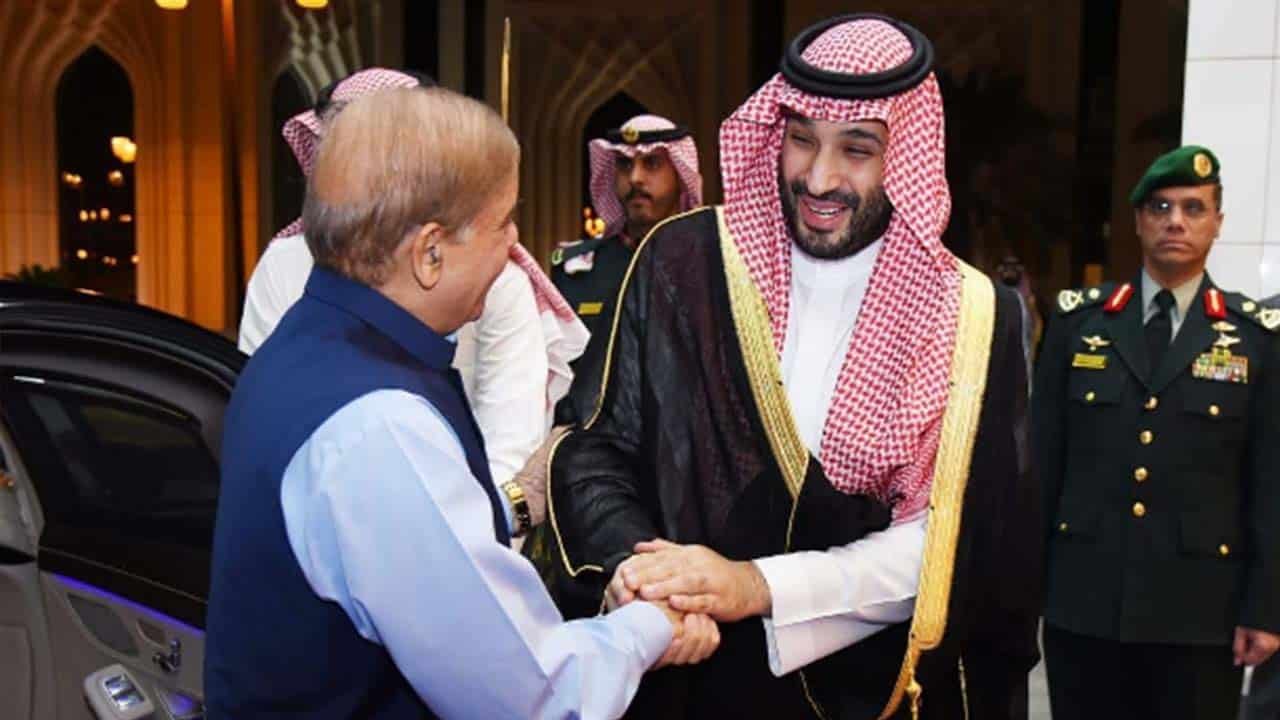
    The development was reached within the framework of the ongoing dialogue between Prime Minister Shehbaz Sharif and Prince Salman.

    The announcement made today comes the day after Prince Salman and Chief of Army Staff General Asim Munir met in Madina to discuss ways to strengthen bilateral ties between the two nations. Munir was on a week-long official visit to Saudi Arabia and the United Arab Emirates.

    The SBP and SFD entered into a contract in 2021 for the SBP to receive $3 billion, which would be deposited in the central bank’s account to increase its foreign exchange reserves.

    The SFD subsequently acknowledged the rollover of a $3 billion deposit for an additional year in September of last year. The deposit was supposed to maturity on December 5 but Saudi Arabia extended its term on December 2.

    Saudi Arabia had previously committed to restart its financial assistance to Pakistan in the final week of October 2021, providing $1.2 billion in oil deliveries on a deferred payment plan and around $3 billion in safe deposit boxes.

    The accord was made the same month when former prime minister Imran Khan visited Saudi Arabia.

  • Ishaq Dar says Pakistan’s foreign exchange reserves will strengthen soon

    Ishaq Dar says Pakistan’s foreign exchange reserves will strengthen soon

    Pakistan’s foreign exchange reserves, which currently stand at $10 billion, will strengthen very soon, according to Finance Minister Ishaq Dar.

    Dar recalled the economic achievements made by the PML-N government from 2013 to 2018, saying that during that time, the GDP of the nation increased from $244 billion to $356 billion.

    He said, “Pakistan reserves stood at a total of $10 billion — $4 billion of the State Bank of Pakistan and $6 billion of commercial banks. Pakistan is repaying its loans on time, and the foreign exchange reserves will soon boost.”

    The finance minister announced that an IMF group would soon be in the nation and that he would be seeing IMF representatives at the Geneva summit.

    The coalition administration plans to seek money at the International Conference on Climate Resilient Pakistan on January 9 in Geneva, Switzerland, in order to recover from the disastrous floods.

    Dar informed the media outlet that he will travel to the United Arab Emirates (UAE) for a three-day official tour after his visit to Geneva comes to an end.

    “Funds from Saudi Arabia and other friendly countries will soon be received,” the finance minister said, who told journalists earlier this week that he expects inflows from China “in a few days.”

  • IMF team to visit Pakistan in 2-3 days to finalise ninth review

    IMF team to visit Pakistan in 2-3 days to finalise ninth review

    A delegation from the International Monetary Fund (IMF) will visit Pakistan in two to three days to “undertake and complete” the key ninth review, according to Prime Minister (PM) Shehbaz Sharif.

    PM Shehbaz said that he spoke to IMF Managing Director Kristalina Georgieva and stressed that Pakistan will complete the IMF bailout programme.

    “I told her to ease the terms of the deal because I cannot burden the common man any further. We have imposed taxes on the rich strata of the society. I requested her to send a delegation for the ninth review and she replied that a team will visit Pakistan in 2-3 days.”

    “After inquiring about Pakistan’s relations with China and Saudi Arabia, she also told me that China had urged IMF to support Pakistan,” he said.

    The IMF programme is currently stalled, with experts suggesting that the government is reluctant to implement some of the lender’s conditions over their effect on political capital in a year when elections are scheduled to take place.

    PM Shehbaz said that Pakistan was trying to mend its ties with friendly countries as well. “We should appreciate friendly countries for supporting Pakistan over the past few years but the previous government slapped allegations of corruption on Chinese firms and jeopardised the China-Pakistan Economic Corridor (CPEC).”

    He stated that the former leadership “had angered friendly nations”, adding that the contribution of Saudi Arabia, UAE and China to Pakistan’s economy is priceless.

    Pakistan needs the IMF programme to restart due to its declining rupee, shrinking reserves, and worse macroeconomic indices.

    The State Bank of Pakistan’s (SBP) foreign exchange holdings dropped by another $245 million on Thursday, down to a critically low level of $5.58 billion. Since April 2014, SBP-held reserves have never been this low.

    At the same time, the government has also been unable in obtaining crucial support from allies.

    The challenge has left Pakistani authorities scurrying to set up foreign exchange amid increased concerns over the country’s capacity to pay its debts and fund imports.

    Additionally, there are market rumours that Pakistan could possibly default, but the Pakistani government is still confident that Saudi Arabia would provide essential assistance for the country’s foreign exchange reserves.

  • SBP-held foreign exchange reserves drop to 8-year low

    SBP-held foreign exchange reserves drop to 8-year low

    The foreign exchange reserves held by the State Bank of Pakistan (SBP) continued their declining spree, plunging by $584 million to reach $6.1 billion as of December 16.

    According to SBP, this is the lowest level of reserves since April 2014.

    SBP’s reserves have decreased by $11.6 billion over the past 12 months. The central bank’s reserves, which were $17.7 billion in December 2021 and are now at $6.1 billion, hardly cover a month’s worth of imports.

    Pakistan’s total liquid foreign reserves are currently $12 billion, with $5.9 billion of that amount held by commercial banks as net foreign reserves.

    The lack of foreign assistance along with a delay in the IMF program’s revival, a greater trade imbalance, and rising foreign debt payments severely depleted the reserves.

    The Fund’s criticism over an elevated budget deficit is said to be the reason why the ninth review discussions have been postponed.

    While the IMF urges that the government must stabilize the economy, the government seems unwilling to levy more taxes in order to raise income.

  • S&P Global lowers Pakistan’s credit rating to CCC+

    S&P Global lowers Pakistan’s credit rating to CCC+

    Pakistan’s long-term sovereign credit rating was downgraded by S&P Global from “B” to “CCC+” to reflect the continuous deterioration of the country’s external, fiscal, and economic metrics.

    According to S&P, Pakistan’s already meagre foreign exchange reserves would continue to be under pressure through 2023 without a drop in oil prices or an improvement in international aid. The nation also faces significant political risks that could alter its future course of policies.

    According to the report, Pakistan’s economic and fiscal results are predicted to be negatively impacted by this year’s devastating floods, skyrocketing food and energy prices, and rising global interest rates, with refinancing issues over the medium term.

    The agency maintained its outlook at “stable”.

    With barely enough reserves to pay one month’s worth of imports, a dollar shortage, and a delay in its loan programme with the International Monetary Fund, Pakistan is in the midst of an economic catastrophe. Despite the payment of a $1 billion bond this month, long-term dollar bonds continue to trade at distressed prices, reflecting investors’ lack of confidence in Pakistan’s capacity to meet its international debt commitments.

    Following the terrible floods that hit the country earlier this year, Moody’s lowered Pakistan’s sovereign credit rating by one notch, from B3 to Caa1, citing heightened government liquidity and external vulnerability risks.

  • Pakistan receives $500 million from Asian Infrastructure Investment Bank

    Pakistan receives $500 million from Asian Infrastructure Investment Bank

    The government of Pakistan on Tuesday received $500 million from Asian Infrastructure Investment Bank (AIIB), the Ministry of Finance announced on Tuesday.

    “Government of Pakistan has today received $500 million from AIIB. The funds are deposited with the State Bank of Pakistan (SBP) and will augment our reserves,” the ministry said.

    The funds by AIIB are crucial for the cash-strapped country, which has seen its foreign exchange reserves dwindle in recent months. The country’s reserves stood at $7.8 billion as of November 18.

    “During the week ended on November 18, 2022, SBP’s reserves decreased by $134 million to $7,825.7 million due to external debt repayment,” said the SBP on Friday.

    It is important to note that on October 26, 2022, the SBP got $1.5 billion from ADB as a loan disbursement for the government of Pakistan.

    An agreement between the ADB and Pakistan was inked last month to offer a $1.5 billion loan for budgetary support as well as assistance with flood-related repair and reconstruction efforts.

    The government’s $2.3 billion countercyclical development spending programme, created to lessen the effects of external shocks like the Russian invasion of Ukraine, was funded in part by a loan issued under the BRACE Program.

  • Pakistan’s total liquid foreign reserves increases to $14.68 billion

    Pakistan’s total liquid foreign reserves increases to $14.68 billion

    The Asian Development Bank (ADB) contributed to an increase of $1.517 billion in Pakistan’s foreign exchange reserves during the week ending October 28 to bring them to $14.679 billion, the central bank reported on Thursday.

    The State Bank of Pakistan’s foreign exchange holdings increased by $1.473 billion to $8.912 billion.

    “This increase is attributed to the receipt of US$ 1,500 million from ADB,” the SBP said in a statement.

    The SBP has enough reserves to cover imports for 1.29 months. Additionally, commercial bank reserves increased by $44 million to $5.766 billion.

    When the government is dealing with a balance of payments issue, the increase in foreign reserves is encouraging for the nation’s finances. At least $30 billion has been lost as a result of the country’s devastating floods this summer.

    A $500 million deal between Pakistan and the World Bank has been signed. The $200 million investment will be used to support an agricultural transformation project in Punjab.

    According to The News, another project in Khyber Pakhtunkhwa for $300 million in climate change projects will be funded by the World Bank.

  • Pakistan’s default risk hits a 13-year-high, reflecting foreign investors’ lack of faith

    Pakistan’s default risk hits a 13-year-high, reflecting foreign investors’ lack of faith

    The risk of default for Pakistan, as determined by the 5-year credit default swap (CDS), increased on Tuesday by 3.07 percentage points in a single day to reach a 13-year high of 52.8 per cent, indicating that foreign investors no longer have confidence in the nation.

    Before the Covid-19 outbreak in Pakistan in February 2020, the CDS was between 5 per cent and 6 per cent.

    According to Express Tribune, owing to uncertainties surrounding the renewal of the International Monetary Fund (IMF) loan programme, it peaked at over 30 per cent in the middle of this year.

    Later, as the major lender resumed its $6.5 billion programme in late August 2022 and subsequently released a $1.2 billion tranche, the CDS experienced a small recovery.

    Today, meanwhile, it is rapidly rising once more, indicating that international investors now believe Pakistan will not be able to pay back its maturing debt.

    On December 5, 2022, the country is required to repay $1 billion to overseas investors against the maturity of the 5-year Sukuk.

    The 5-year Third Pakistan International Sukuk’s yield (rate of return) is quite high, hovering at 145 per cent. Before the Covid-19 epidemic, it was around 10 per cent.

    In addition, the yield on bonds due in 2024 and 2025 is currently high at 90 per cent and 57.5 per cent, respectively, up from a low of 10 per cent in the past.

    The country’s foreign exchange reserves have decreased by about $9 billion over the past 10 months, which has caused alarm among the foreign investors.

    They are currently only covering about 1.10 months’ worth of imports at $7.6 billion, down from $20 billion (three months’ worth of imports) in August 2021.

    Ishaq Dar, the finance minister, and Miftah Ismail, his predecessor, have taken every precaution to avoid the likely default.

    They have repeatedly reassured the foreign investors that when the time came, the nation would easily repay the maturing $1 billion in December as well as fulfil other international payment obligations.

    Foreign investors are receiving warnings from the situation that the nation may default.

    However, the leadership of the nation has fully secured the $36–40 billion needed from international lenders for the current fiscal year 2023 to pay off the nation’s approximately $21 billion in foreign debt, finance approximately $10–12 billion current account deficit, and increase its foreign exchange reserves to approximately $16 billion by June 30.

    According to experts, the country’s foreign exchange reserves will increase and confidence among foreign investors will be restored with the arrival of $1.5 billion from the Asian Development Bank (ADB) in a few days and another $500 million from the Asian Infrastructure Investment Bank (AIIB) in the current month.

    They continued by saying that the inflows should also aid in lowering bond and CDS yields.

    Experts said that Saudi Arabia was the destination of Prime Minister Shehbaz Sharif’s official visit. The host nation has declared that it is resuming its investment ambitions, which include establishing an oil refinery in Pakistan for an investment of $10 billion.

    The Kingdom’s investment choice coming to fruition will also aid in regaining the trust of foreign investors in Pakistan.

    When PM Shehbaz travels to the second-largest economy in the world in November, the nation is also anticipated to get a rollover loan from China worth $6.3 billion, they claimed.

  • IMF Executive Board meeting to discuss revival of loan plan today

    IMF Executive Board meeting to discuss revival of loan plan today

    The International Monetary Fund (IMF) executive board will meet on Monday (today) to discuss the bailout plan for Pakistan.

    The 8th and 9th tranches, totaling over $1.2 billion, are anticipated to be disbursed with board approval.

    According to Geo, Pakistan also requested that the Extended Fund Facility (EFF) be increased from $6 billion to $7 billion and that the term be extended from September 2022 to June 2023.

    If the contract is approved by the board, the IMF will give Pakistan an initial payment of roughly $1.2 billion and could give up to $4 billion during the remaining months of the current fiscal year, which started on July 1.

    The board gave its approval for the transfer of $1.386 billion to Pakistan under the RFI in April 2020 to help with the economic effects of the Covid-19 shock.

    Additionally, according to The Wall Street Journal, Pakistan has secured at least $37 billion in foreign loans and investments in recent weeks, saving it from a financial catastrophe similar to that of Sri Lanka.

    The restart of the programme will greatly benefit the government led by Prime Minister Shehbaz Sharif as it will assist prevent what would be the second default in Asia this year after Sri Lanka.

    Bloomberg estimates that Pakistan would have to pay at least $3 billion in debt payment during the first half of the fiscal year 2023.

    The State Bank of Pakistan anticipates that foreign exchange reserves would increase to around $16 billion this fiscal year from $7.8 billion, thanks to the IMF loan opening the door for additional funding.