Tag: foreign exchange

  • Pakistani rupee finally ends 28-day winning streak, loses against US dollar

    Pakistani rupee finally ends 28-day winning streak, loses against US dollar

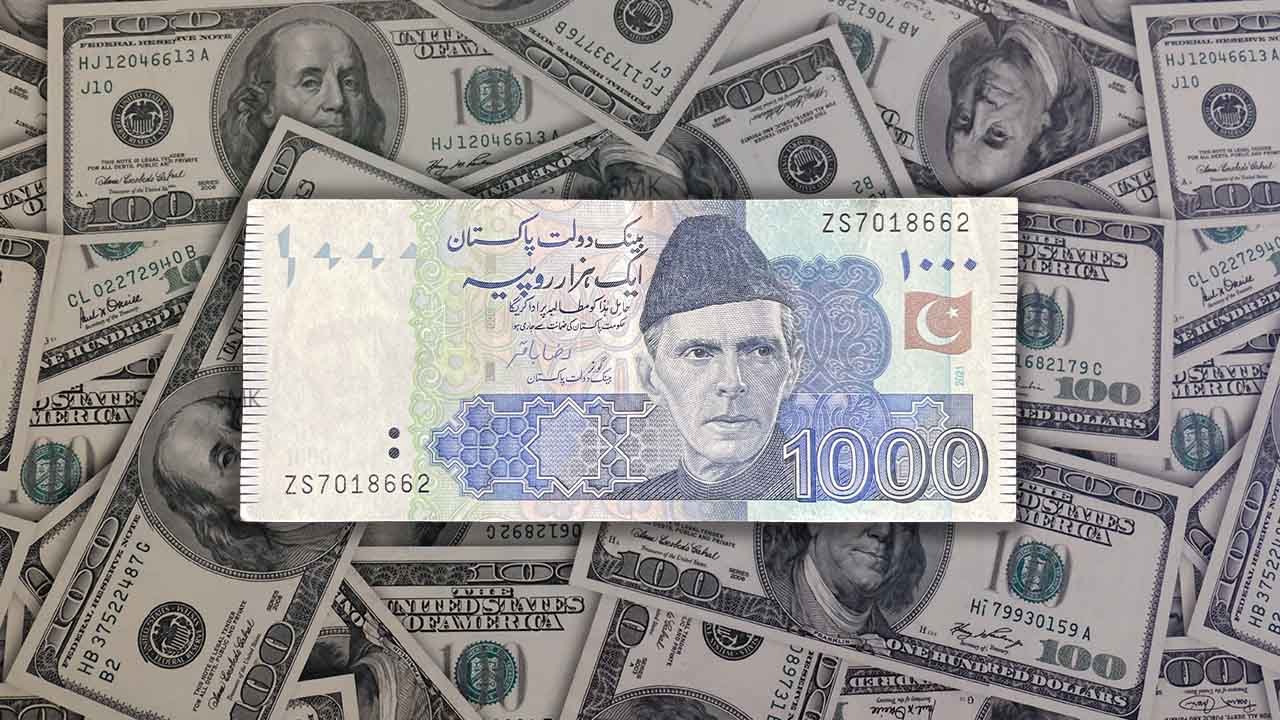
    The Pakistani rupee’s remarkable 28-day winning streak against the US dollar came to an end today, as it recorded losses following an initial trade opening at Rs278.5 in the interbank market.

    In the morning, the rupee had steadied, maintaining a level of Rs276 against the greenback. Subsequently, between 1:00 PM and 2:35 PM, the interbank rate dipped to Rs278 before settling at Rs277 for the rest of the day. 

    Open market rates, observed across various currency exchange counters, ranged from Rs277 to Rs279 throughout the day.

    At the close of the trading day, the PKR experienced a depreciation of 0.07 per cent, concluding at Rs277.03 after losing 20 paisas against the US dollar.

    Despite today’s setback, it is noteworthy that the disparity between interbank and open market rates has significantly decreased by Rs60 since September 4th. The rates have fluctuated between as low as Rs277 and sporadic spikes up to Rs280 today.

  • Pakistani rupee settles at Rs290.86 against US dollar, marking 14th consecutive gain

    Pakistani rupee settles at Rs290.86 against US dollar, marking 14th consecutive gain

    In continuation of its recent positive streak, the Pakistani rupee extended its upward trajectory against the US dollar for the 14th consecutive session, marking a gain of 0.31 per cent in the interbank market on Monday.

    According to data released by the State Bank of Pakistan (SBP), the rupee closed at Rs290.86, representing a noteworthy increase of Re0.9 in the inter-bank market. This sustained appreciation trend has seen the rupee make significant gains, amounting to 5.28 per cenr, or Rs16.24, since its record low of Rs307.1 against the US dollar on September 5 in the inter-bank market.

    In the previous week, the rupee experienced a further appreciation of 1.74 per cent, concluding positively for all five trading sessions and settling at Rs291.76 against the US dollar in the inter-bank market by the end of the week. Additionally, the rupee’s performance in the open market has strengthened, reducing the ‘premium’ to negligible levels and aligning with the benchmarks established by the International Monetary Fund (IMF).

    While several experts attribute the rupee’s recent gains to administrative and enforcement measures, some argue that these increases reflect the currency’s intrinsic value when speculative influences and negative sentiment are excluded.

  • 7th straight win: Pakistani rupee gains 86 paisas, closes at Rs297.96 per US dollar

    7th straight win: Pakistani rupee gains 86 paisas, closes at Rs297.96 per US dollar

    The Pakistani Rupee (PKR) has extended its impressive winning streak against the US dollar for the seventh consecutive session, concluding at PKR 297.96 to the dollar. This marks a gain of 86 paisas when compared to the previous rate of Rs298.82 in the interbank foreign exchange market on Wednesday.

    The PKR’s recent surge follows its all-time low of PKR 307.10 on September 5, 2023. Within this short span, the Pakistani rupee has appreciated by PKR 9.14, equivalent to an impressive 3 percent increase in the interbank foreign exchange market.

    Following a concerted effort by authorities to suppress illicit black market activities in the major cities of Pakistan, the Pakistani rupee continued its upward trajectory against the US dollar, marking a substantial three-point gain in the open market on Thursday.

    The Exchange Companies Association of Pakistan (ECAP) reported a noteworthy recovery of the rupee, which surged to 298 in relation to the greenback, reflecting a significant increase.

    This crackdown on black market operators was initiated earlier in the month in response to a precipitous decline in the rupee’s value, hitting a record low of Rs333.7 on September 5. The impetus for this decisive action stemmed from appeals made to Chief of Army Staff (COAS) Gen. Asim Munir by currency dealers, beseeching him to intervene and stabilise the escalating value of the American currency.

    As a direct outcome of these concerted efforts, the Pakistani currency rebounded to a level below 300 per dollar in the open market earlier this week. This positive shift also saw a substantial influx of tens of millions of dollars back into the country’s interbank and open markets, according to reports from dealers.

  • Pakistan’s textile exports dip 6% in August 2023, posing economic challenges

    Pakistan’s textile exports dip 6% in August 2023, posing economic challenges

    Pakistan’s textile sector has experienced a continued decline in exports, with provisional data released by the All Pakistan Textile Mills Association (APTMA) indicating that in August, exports reached $1.48 billion, down by 6 per cent compared to the same month in the previous year when they stood at $1.58 billion.

    Moreover, the data reveals that Pakistan’s textile exports for the first eight months of the calendar year 2023 have seen a significant drop of 19 per cent, totaling $10.58 billion, as opposed to the $13 billion recorded during the equivalent period in 2022. This year-on-year decline raises concerns for Pakistan’s economy, especially in light of its foreign exchange shortage, which has already led to a depreciation of the rupee by more than 25 per cent in the inter-bank market since the beginning of 2023.

    However, there is a glimmer of optimism as monthly figures indicate a 13 per cent improvement in textile exports, rising to $1.48 billion in August compared to $1.31 billion recorded in July.

  • Pakistani rupee slides to Rs297.13 against US dollar on first day of the week, losing Rs1.35

    Pakistani rupee slides to Rs297.13 against US dollar on first day of the week, losing Rs1.35

    The Pakistani rupee (PKR) continued its decline against the US dollar on the first working day of the week. PKR went down by 0.45 per cent, which is about Rs1.35, and closed the day at Rs297.13 in the interbank market, as reported by the State Bank of Pakistan.

    This shows that over the past five trading sessions, the Pakistani rupee has lost a total of Rs8.64. It’s important to note that on the previous Friday, the rupee had closed at Rs295.78 after losing 0.86 paisas, which is about 0.29 per cent.

    Looking at last week, from Tuesday to Friday, the Pakistani rupee experienced a significant loss of Rs7.29. This indicates a period of notable fluctuation for the rupee in the foreign exchange market.

  • Chery Pakistan increases Tiggo 4 Price to Rs7 million

    In the face of mounting economic uncertainty, import restrictions, and complications surrounding Letter of Credit (LC) transactions, Chery Pakistan has been forced to implement a significant price hike on one of its popular crossover SUVs.

    According to Pakwheels, the Chery Tiggo 4, a favoured choice among Pakistani car enthusiasts, will now come with a heftier price tag, soaring from Rs6,399,000 to Rs6,999,000, reflecting an increase of Rs600,000. This move comes as Chery Pakistan grapples with the multifaceted challenges posed by a volatile economic landscape and supply chain disruptions, as the company revealed in an official statement.

    The surge in pricing has been attributed to the prevailing precarious economic conditions and the stifling supply constraints that have been a constant thorn in the side of numerous industries, including the automotive sector. Nevertheless, Chery Pakistan aims to mitigate the impact on its customers by extending a price lock guarantee to all new bookings for the Chery Tiggo 4, providing a semblance of stability amidst the tumultuous market fluctuations.

    The price escalation, while not entirely unexpected, underscores the current tribulations faced by Pakistan’s local auto industry. As a sector heavily reliant on imported components, particularly critical vehicle parts, the domestic car manufacturing industry is inherently susceptible to the ripple effects of foreign exchange rate fluctuations.

    Compounding the challenges are the import restrictions introduced by governmental authorities, leading to a cascade of delays and, in some instances, complete production standstills for various car manufacturers.

    The predicament has been further exacerbated by the non-issuance of LCs by the State Bank of Pakistan (SBP), casting a darker shadow over an already beleaguered landscape. Industry experts predict that the situation is poised to persist for the foreseeable future, with a grim timeline of at least 2–3 years for the auto sector to regain its footing.

    The intertwining of persistent economic woes with a backdrop of political instability paints a disheartening picture, further clouding the prospects of a swift recovery.