Tag: Forex

  • SBP-held foreign exchange reserves dropped to 9-year low of $4.34 billion

    SBP-held foreign exchange reserves dropped to 9-year low of $4.34 billion

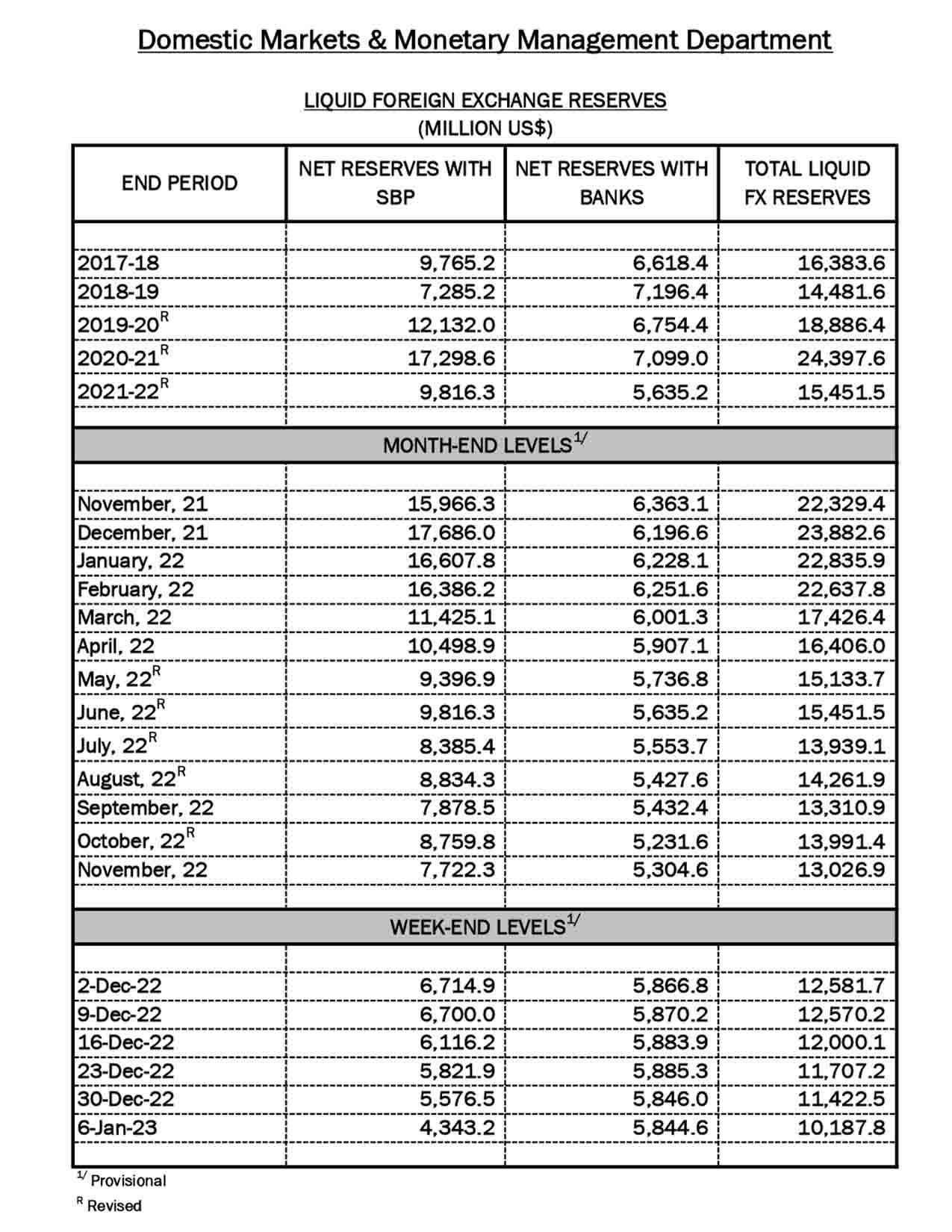
    The State Bank of Pakistan’s (SBP) foreign exchange reserves fell to $4.34 billion, its lowest level since February 2014, due to a lack of dollar inflows from the International Monetary Fund (IMF) or friendly nations.

    The SBP disclosed on Thursday that due to the repayment of external debt, its reserves fell by $1.23 billion during the week ended January 6.

    The country has been experiencing a severe dollar shortage, which is having a negative impact on the capacity to import even food and industrial raw supplies. The country doesn’t have enough dollars, according to the most recent status of foreign exchange reserves, to pay for even one month’s worth of routine imports.

    Data showed that commercial banks held $5.84 billion in net foreign currency reserves, while the overall amount of liquid foreign exchange reserves was $10.18 billion.

    Ever since the beginning of 2022–2023, reserves have been rapidly decreasing. In the upcoming months, analysts predict rising inflation and limited industrial output as manufacturing is constrained by the scarcity of imported raw materials.

    According to Geo, United Arab Emirates (UAE) will roll over the existing loan of $2 billion and give an additional $1 billion loan, which should stabilise the reserve position in the coming days.

    As the government strives to reduce imports amid a dollar shortage, the reserves, which fell to their lowest level since February 2014, would now only provide import coverage of 0.82 month.

  • Pakistan will take fiscal measures set by IMF but there will be no burden on the common man: Ishaq Dar

    Pakistan will take fiscal measures set by IMF but there will be no burden on the common man: Ishaq Dar

    Federal Minister for Finance and Revenue Ishaq Dar has categorically denied rumours suggesting that the government is considering “access to foreign exchange held with commercial banks.”

    “It is categorically denied and clarified that there is no such move under consideration of the government,” said Dar, in a series of tweets.

    The statement come days after the finance minister said that the country’s foreign exchange reserves stand at $10 billion, a much higher amount than the SBP’s $5.6 billion reserves as of December 30, 2022, since “dollars held by commercial banks also belonged to the country.”

    This comment gave rise to fears that the government may confiscate dollars from private banks as had been done in 1998 when Dar was the finance minister.

    However, Dar said that his comment was “greatly misconstrued” and nothing like this would happen.

    Dar explained at a press conference with Prime Minister Shehbaz Sharif and other federal cabinet members that before 1999, all foreign currency was deposited with the State Bank of Pakistan (SBP), and private banks were not permitted to hold any foreign currency.

    “In February 1999, when I was the finance minister, we devised a system whereby a substantial amount [of dollars] remain with [private] banks. It was on June 30, 1999 that reserves were broken down into three columns — those with the SBP, commercial banks and total.

    “Whenever Pakistan’s reserves are quoted anywhere in the world — a survey or a document — the [total figure] is quoted and then a breakdown is given. I gave a breakdown too,” he added.

    The minister claimed that certain people were to blame for the country’s dire circumstances, which caused it to drop from the 24th to the 47th largest economy in 2016.

    “Even now, they cannot tolerate any good development. They gave such a twist [to my statement],” he said, adding that while the federal cabinet was busy working for Pakistan under PM Shehbaz’s guidance, such people were spreading rumours that the government would take dollars from commercial banks.

    “Nothing of that sort will happen. Everything is all worked out … and in order. Nothing to worry about,” he assured, urging those “spreading the rumours” to play a positive national role.

    Dar also tweeted about the reserves later, saying national foreign exchange reserves always include forex held with SBP and commercial banks.

    Furthermore, Dar tweeted about the reserves and stated that SBP and commercial bank holdings are usually included in the nation’s foreign exchange reserves.

    “Recently I quoted the forex reserves figure based on this principle. Some vested elements who ruined this country’s economy in the past, gave it a deliberate twist and started a campaign as if govt was considering access to foreign exchange held with commercial banks which indeed is the property of the citizens.

    “It is categorically denied and clarified that there is no such move under consideration of the government,” he emphasised.

    The finance minister once again claimed that Pakistan’s foreign exchange reserves would increase soon.

    As of December 30, 2022, Pakistan’s foreign exchange reserves had decreased to $5.6 billion, an eight-year low. This is equivalent to imports for three weeks.

    The swift decrease has made it impossible for the government to repay its international debts without taking out new loans from allies.

    Govt to comply with IMF conditions without burdening common man

    The International Monetary Fund (IMF) programme’s ninth review, which would release $1.18 billion, has been postponed for months due to the government’s refusal to comply with some conditions imposed by the international lender.

    In today’s press conference, Dar acknowledged the delay and claimed that it was due to revenue collection. The Federal Board of Revenue (FBR) missed its goal in December, the finance minister said, and the super tax that the administration enacted in June of last year had been declared unlawful by a high court.

    Dar said that his team informed the IMF that Pakistan could recover the amount easily after the Supreme Court takes a decision on the super tax.

    “We are not changing the fiscal budget target and we will achieve it,” he claimed.

    Dar said that the IMF suggested that the government implement fiscal measures and eliminate some subsidies. “We have identified some budgetary measures, but the average person won’t be overburdened.”

    He asserted that the measures would be very specific and classified.
  • Ishaq Dar says Pakistan’s foreign exchange reserves will strengthen soon

    Ishaq Dar says Pakistan’s foreign exchange reserves will strengthen soon

    Pakistan’s foreign exchange reserves, which currently stand at $10 billion, will strengthen very soon, according to Finance Minister Ishaq Dar.

    Dar recalled the economic achievements made by the PML-N government from 2013 to 2018, saying that during that time, the GDP of the nation increased from $244 billion to $356 billion.

    He said, “Pakistan reserves stood at a total of $10 billion — $4 billion of the State Bank of Pakistan and $6 billion of commercial banks. Pakistan is repaying its loans on time, and the foreign exchange reserves will soon boost.”

    The finance minister announced that an IMF group would soon be in the nation and that he would be seeing IMF representatives at the Geneva summit.

    The coalition administration plans to seek money at the International Conference on Climate Resilient Pakistan on January 9 in Geneva, Switzerland, in order to recover from the disastrous floods.

    Dar informed the media outlet that he will travel to the United Arab Emirates (UAE) for a three-day official tour after his visit to Geneva comes to an end.

    “Funds from Saudi Arabia and other friendly countries will soon be received,” the finance minister said, who told journalists earlier this week that he expects inflows from China “in a few days.”

  • Pakistani banks start charging dollar transactions at open market rates

    Pakistani banks start charging dollar transactions at open market rates

    Pakistani banks have announced that they will settle debit and credit card transactions made with foreign retailers and websites at the open market exchange rate for the US dollar.

    The conversion rate for the transactions would be calculated by the open market rate in place at the time, which might not match the rate listed on the foreign merchant’s website.

    Customers were advised by the banks in a statement that they could only settle debit or credit card purchases with foreign retailers or websites by buying dollars on the open market. As a result, the conversion rate for these transactions will be determined by the current open market rate.

    The statement, according to bankers, was made in response to several client concerns over the increased exchange rate.

    On Friday, the Pakistani rupee lost Rs0.02 to the US dollar in the interbank market, continuing its downward trajectory.

    The State Bank of Pakistan (SBP) reported that the exchange rate of the local currency for the dollar was Rs227.12. Which shows a 0.01 per cent decline from the close of Rs227.12 on Thursday.

    According to SBP, the Pakistani rupee is valued at Rs227–228 against the dollar. However, in the open market, the greenback is priced above Rs250 and goes as high as Rs275.

  • Pakistani rupee reverses losses against greenback

    Pakistani rupee reverses losses against greenback

    After strengthening against the US dollar on Monday, the Pakistani rupee started the new week positively.

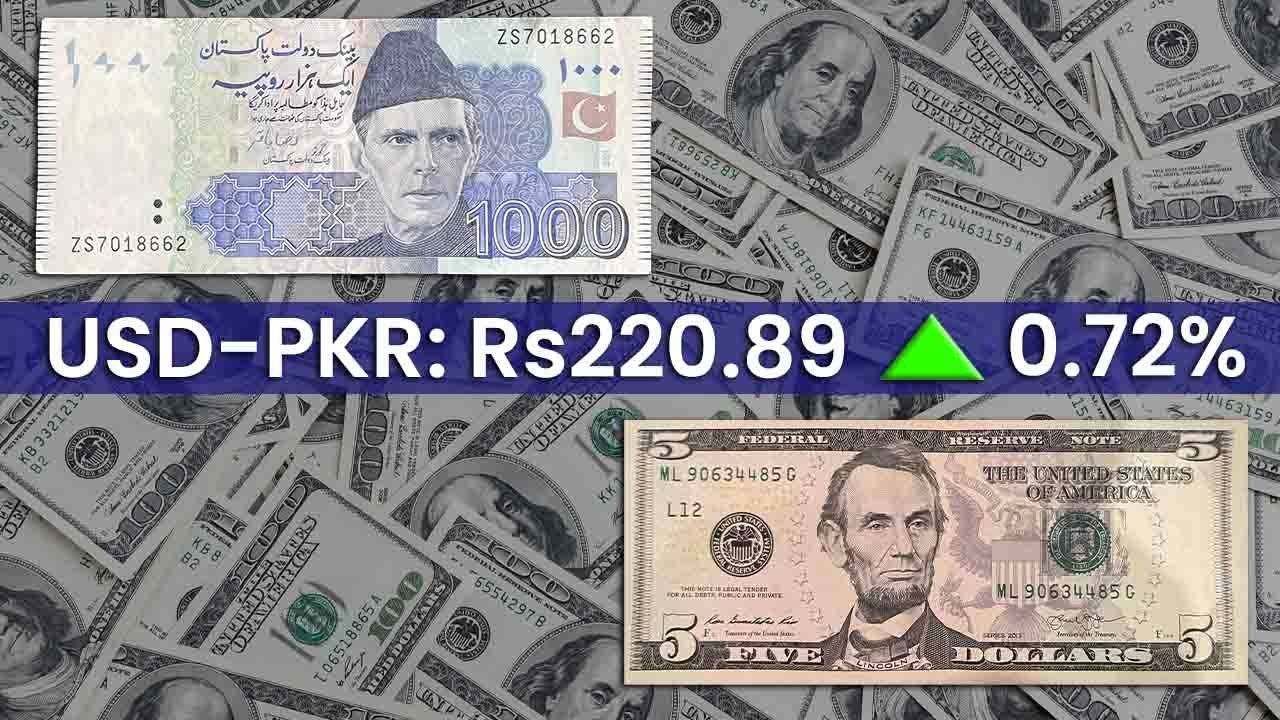
    Discussions between Finance Minister Ishaq Dar and State Bank of Pakistan (SBP) employees and currency traders had positive effects as the local currency increased by Rs1.59, or 0.72 per cent, versus the dollar.

    In the interbank market, the rupee was able to settle at Rs220.89, according to the SBP.

    The rupee last week dropped 0.93 per cent versus the dollar, trading at Rs222.47. Analysts predicted that this week will see range-bound trading in the local currency.

    Earlier, Ishaq Dar issued a warning last week saying that anyone detected manipulating the currency rate will face harsh punishment.

    Dar said that the rupee’s true worth in relation to the dollar is less than Rs200. He predicted that the rupee will soon strengthen against the dollar and gave a warning to those who were speculating in and hoarding foreign cash.

    Furthermore, the price of Brent oil fell by 0.65 per cent to $95.15 per barrel on Monday, while the price of US West Texas Intermediate (WTI) fell by 0.83 per cent to $87.17 per barrel. With advances of 7.7 per cent and 9.3 per cent so far in October, respectively, Brent and WTI are on course to post their first monthly gains since May.

    Europe, which is anticipated to experience a recession this winter, poses a threat to global oil consumption. The European Central Bank’s policymakers are also continuing with their plans to raise interest rates, despite the fact that doing so might plunge the region into recession and stoke political unrest.

  • Pakistani rupee continues to fall against USD for the third consecutive session

    Pakistani rupee continues to fall against USD for the third consecutive session

    For the third session in a row, the Pakistani rupee lost 97 paise in the interbank market on Friday as it fell against the dollar.

    The local currency depreciated by 0.44 per cent from yesterday’s finish of Rs221.5 to settle at Rs222.47 per dollar, according to the State Bank of Pakistan.

    Data gathered by Mettis Global show that the value of the PKR has decreased by Rs16.64 or 7.52 per cent since the beginning of this fiscal year.

    This week’s first day saw the sovereign default risk rise to its highest level since November 2009. On October 25, the country’s five-year credit default swap (CDS), which functions as a form of insurance against the risk of sovereign default, climbed by more than three per centage points, reaching 52.8pc, a 13-year high.

    Investors’ decreasing confidence in Pakistan’s capacity to repay its international loans is reflected in the growing CDS level.

  • PKR loses for 6th straight session due to declining reserves

    PKR loses for 6th straight session due to declining reserves

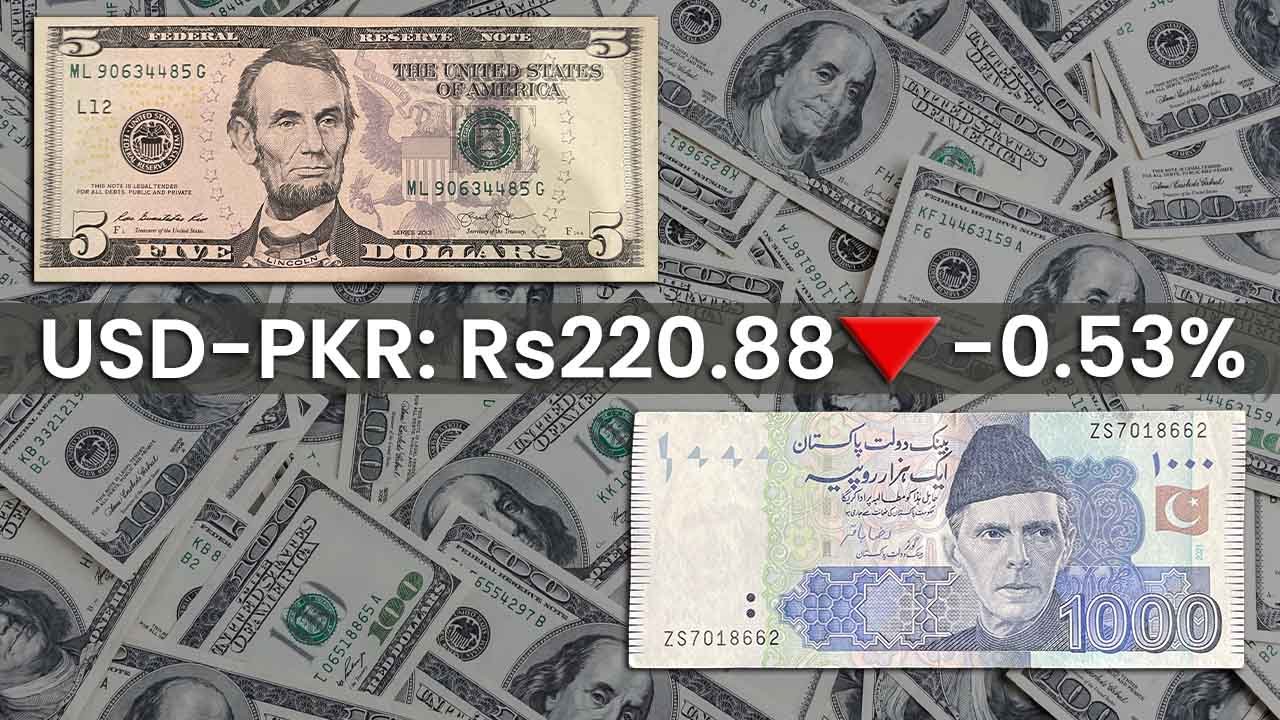
    The Pakistani rupee dropped against the US dollar for the sixth straight session on Wednesday, losing 0.53 per cent in the inter-bank market.

    According to the State Bank of Pakistan (SBP), the local currency dropped by Rs1.17, or 0.53 per cent, to close at Rs220.88. In the last six trading sessions, the rupee has lost Rs3.09, or 1.4 per cent, of its value overall.

    The rupee lost value against the US dollar on Tuesday for the fifth consecutive session, closing at Rs219.71 after losing Rs0.82 (0.37 per cent).

    According to market analysts, the local currency’s weakness is caused by declining reserves and a lack of evidence of foreign capital inflows.

    In an interview with Bloomberg, Finance Minister Ishaq Dar said that the rupee has been “heavily undervalued”.

    “It is due to speculation – and some players in the market have been responsible for that,” he added.

    Globally, the greenback hung close to a 32-year peak versus the yen on Wednesday while edging up from a two-week trough against a basket of major peers as traders weighed improved risk sentiment against the prospect of aggressive Federal Reserve rate hikes.

    The dollar index – which measures the currency against six peers including the yen, sterling and euro – edged up to Rs112.01, after dropping to the lowest since October 6 at Rs111.76 overnight.

    On Wednesday, oil prices increased marginally despite bearish factors like unclear Chinese demand growth and falling gas costs, which were offset by bullish factors like declining crude stocks and a generally undersupplied market.

  • Pakistani rupee crashes against US dollar for 11th day in a row

    Pakistani rupee crashes against US dollar for 11th day in a row

    For the eleventh session in a row, Pakistan’s rupee has lost value versus the US dollar, falling 0.41 per cent on Friday in the interbank market as the dollar gained momentum throughout the world and investors’ concerns about the increasing trade imbalance intensified.

    The rupee dropped by Rs0.96, according to the State Bank of Pakistan (SBP), and ended the day at Rs236.84. The rupee has lost Rs18.24, or 7.7 per cent, overall over the last 11 trading sessions against the US dollar.

    In the interbank market on Thursday, the Pakistani rupee declined against the US dollar for the tenth straight session as investors expected funding from allies and foreign creditors. It ended the day down 0.66 per cent at Rs235.88.

    The local currency increased in value last month as a result of Pakistan fulfilling all previous IMF requirements, which allowed the programme to resume. This development enabled Pakistan to receive $1.17 billion under the Extended Fund Facility (EFF).

    The local currency has recently, however, been under intense pressure once more and is currently hovering close to its all-time low as funding anticipated from allies has not yet materialised.

    Additionally, the State Bank of Pakistan’s (SBP) foreign exchange reserves decreased by $176 million, reaching $8.62 billion as of September 9, 2022, according to information made public on Thursday.

    According to the SBP, the nation possessed $14.32 billion in liquid foreign reserves. Commercial banks held $5.7 billion in net foreign reserves.

    Globally, the dollar remained close to recent highs on Friday as Treasury yields rose and the demand for the currency persisted on expectations that the Federal Reserve would need to raise rates further to control inflation.

    The US dollar index, which compares the value of the dollar to a basket of other currencies, increased to Rs109.69, which is not far from its two-decade high of Rs110.79.

    In the meantime, oil prices—a crucial factor in determining currency parity—were largely stable on Friday, but they were headed for a weekly decrease due to worries about sudden interest rate hikes that would likely slow global economic growth and fuel demand.

  • Honda reduces car prices to pass on the forex impact

    Honda reduces car prices to pass on the forex impact

    Honda Atlas Cars Limited (HACL) has reduced the prices of its entire lineup, like its rival Toyota.

    According to a notification from the automaker, the latest price reduction is an outcome of the Pakistani rupee’s strengthening versus the US dollar, and the company wants to pass on the forex impact to its “valued” customers.

    Here are the new prices of Honda cars in Pakistan, effective from August 17:

    Model  Old invoice New price Decrease
    City Manual 1.2L Rs4,049,000 Rs3,769,000 Rs280,000
    City CVT 1.2L Rs4,199,000 Rs3,899,000 Rs300,000
    City CVT 1.5L Rs4,439,000 Rs4,139,000 Rs300,000
    City Aspire Manual 1.5L Rs4,609,000 Rs4,299,000 Rs310,000
    City Aspire CVT 1.5L Rs4,799,000 Rs4,479,000 Rs320,000
    BR-V CVT S Rs5,299,000 Rs4,939,000 Rs360,000
    Civic 1.5L M CVT Rs6,799,000 Rs6,349,000 Rs450,000
    Civic 1.5L Oriel M CVT Rs7,099,000 Rs6,599,000 Rs500,000
    Civic RS 1.5L LL CVT Rs8,099,000 Rs7,549,000 Rs550,000
    Honda Cars Latest Price List – August 2022

    Despite the most recent drop, the ‘cheapest’ Honda car still costs more than Rs3.7 million, making it out of reach for low-income individuals.

  • SBP’s foreign exchange reserves dropped to $7.83 billion

    SBP’s foreign exchange reserves dropped to $7.83 billion

    Owing to debt payments, the State Bank of Pakistan’s (SBP) foreign exchange reserves fell to $7.83 billion as of August 5 from $8.385 billion in the last week.

    It is worth noting that this is the lowest level in over three years, according to figures released by the SBP.

    Pakistan’s overall foreign exchange reserves were $27.067 billion as of August 2021 but fell to $13.561 billion as of August 5, 2022.

    The most recent figures on the country’s foreign exchange holdings came when the reserves were quickly running out due to a $6 billion IMF programme that was stalled and the country was experiencing a lack of external funding.

    Due to debt payments and a lack of external finance, the central bank’s foreign reserves decreased by $555 million or 6.6 per cent every week.

    To reach $13.561 billion, Pakistan’s total liquid foreign reserves decreased by $648 million, or 4.6 per cent, and its commercial banks’ holdings fell by $5.730 billion, or 1.6 per cent.

    The SBP’s reserves are sufficient to cover imports for just over a month, according to The News. The reverse decline was brought on by paying off foreign debt.

    According to the central bank, debt repayments may slow down over the following three weeks of this month.

    On the other hand, the Pakistani rupee continued its upward trend against the US dollar for the ninth day, adding Rs3.38 to trade at Rs215.50 in intraday trade on Friday. The KSE-100 index likewise witnessed an increase of 386 points.