Tag: French president

  • Let ‘Emily in Paris’ remain in Paris, Macron says

    Let ‘Emily in Paris’ remain in Paris, Macron says

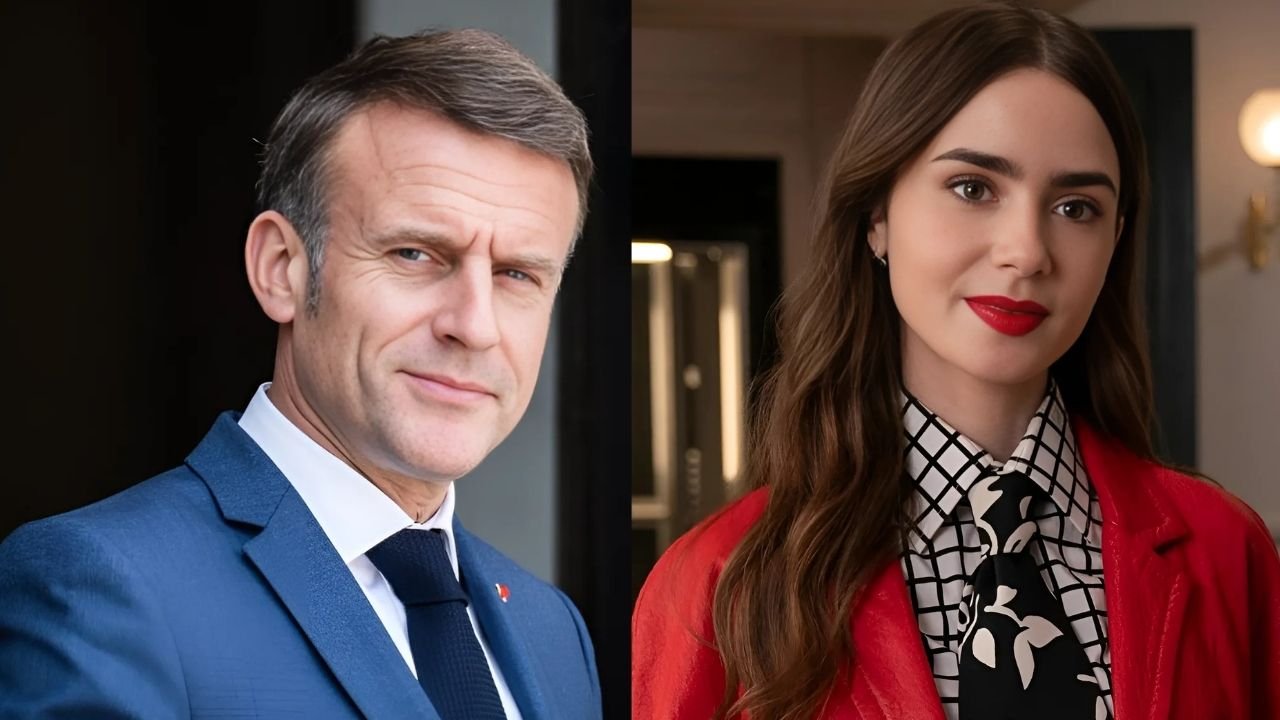
    French President Emmanuel Macron said in an interview published Wednesday he hoped that Netflix’s hit series “Emily in Paris” would remain centred on the French capital rather than move to Rome.

    The fourth season of “Emily in Paris”, currently streaming, takes events to the Italian capital where the show’s star, played by Lily Collins, seeks to break new ground both personally and professionally.

    When the show was renewed for a fifth season last month, the series’ creators said it would play out between Paris and Rome, with Emily having “a presence” in Italy.

    Darren Star, the creator and showrunner of “Emily in Paris”, was quoted as saying that the show’s heroine “was becoming very comfortable in Paris. I wanted to throw her into some unfamiliar waters”.

    Asked by US magazine Variety what he thought of the move, Macron said he would not take it lying down.

    “We will fight hard,” he said. “And we will ask them to remain in Paris.”

    Macron’s wife Brigitte has a cameo appearance in the show’s fourth season, in which, during a chance meeting in a restaurant, she says she follows Emily on Instagram.

    “I was super proud, and she was very happy to do it,” the president said about his wife’s effort. “‘Emily in Paris’ is super positive in terms of attractiveness for the country. For my own business, it’s a very good initiative.”

    Was he asked to appear on the show? “I’m less attractive than Brigitte,” Macron replied.

    “Emily in Paris” has been mostly lambasted by French critics for showing the French capital in what they say is an unrealistically glamorous light. Some of them have admitted, however, that it has its moments.

    “It’s a saccharine series filled with stereotypes,” judged culture magazine Telerama when the show first aired. “And yet we can’t get ourselves to totally hate it.”

    Britain’s The Guardian came to the show’s defence. “Yes, Emily in Paris is unrealistic”, the paper said. “But when it comes to escapist TV, reality is overrated.”
  • French President Emmanuel Macron loses  majority in parliament

    French President Emmanuel Macron loses majority in parliament

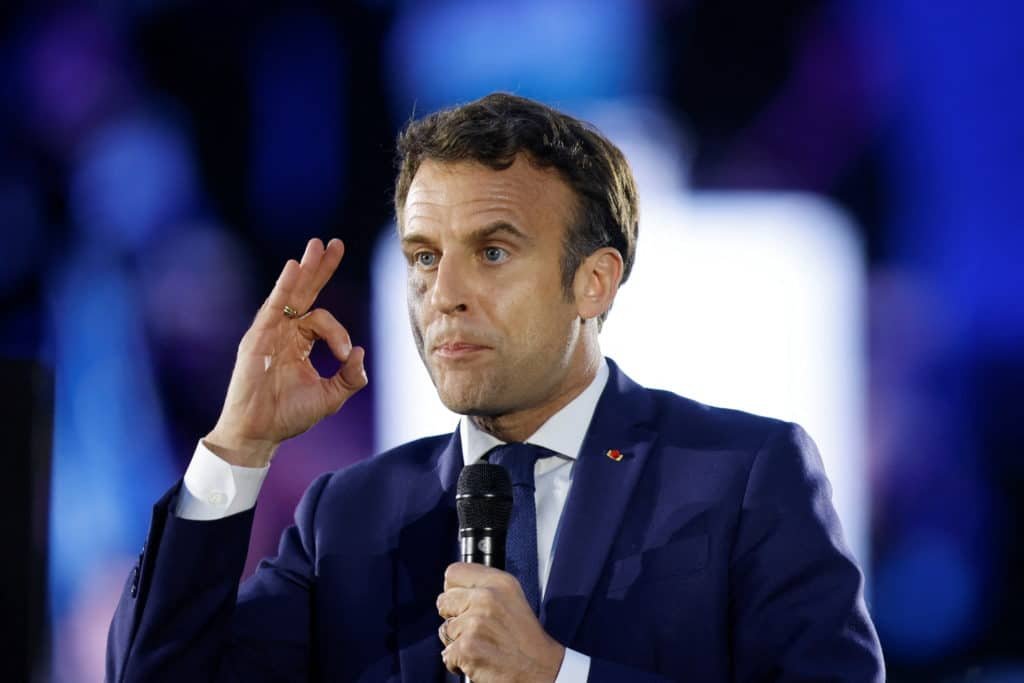
    In legislative parliamentary elections, French President Emmanuel Macron lost his legislative majority on Monday.

    Interim results show that Macron’s coalition (ENS) won 245 of the 577 seats in the National Assembly, the French Interior Ministry announced Monday morning after the vote count ended.

    He fell short of 289 seats to get an absolute majority.

    Prime Minister Elisabeth Borne said in a televised statement: “This situation constitutes a risk for our country, given the challenges that we have to confront.” She also stated, “We will work from tomorrow to build a working majority.”

    Macron, 44, is now at risk of domestic troubles as he seeks to end Russia’s invasion of Ukraine and play a key role as an important figure in the European Union.
    The last time a newly elected president failed to win a clear majority in France was in the 1988 parliamentary elections.

  • French President Macron gets elected again

    French President Macron gets elected again

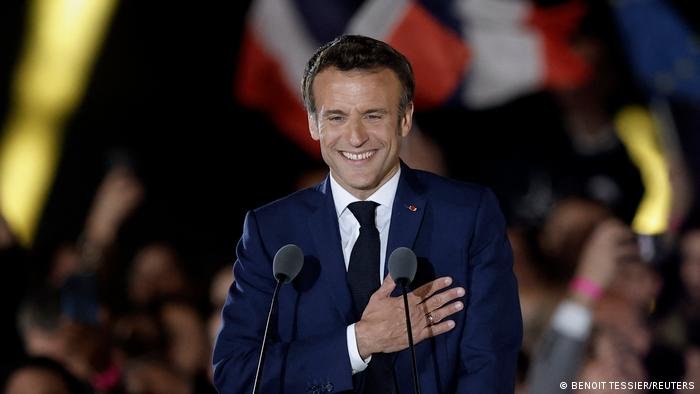
    French President Emmanuel Macron won the presidential race again and became the first French President to have won a second term in office in the two decades on Sunday.

    Macron defeated his far-right rival Marine Le Pen of National Rally party. This is her third defeat in a presidential poll.

    According to interior ministry, Macron managed to secure 58.6 per cent of votes while Le Pen received 41.1 per cent votes. The result marks the closest the far-right has ever come to taking power in France and has left the nation divided as Macron’s victory against his far-right rival was narrower than their last face-off in 2017, when the margin was 66.1 per cent to 33.9 per cent, reports Al Jazeera.

    However, while addressing the nation after his victory, Macron vowed to heal rifts in a deeply divided country.

    The 44-year-old president will now have to face the challenge of parliamentary elections in June, where keeping a majority will be critical to ensuring he can realise his ambitions.

    Le Pen hailed her result as a “brilliant victory” and vowed to keep up the fight with parliamentary elections in June.

    Final figures from Sunday’s vote are due today (Monday).

  • Shireen Mazari deletes tweet equating French president with Nazis after France strikes back

    Shireen Mazari deletes tweet equating French president with Nazis after France strikes back

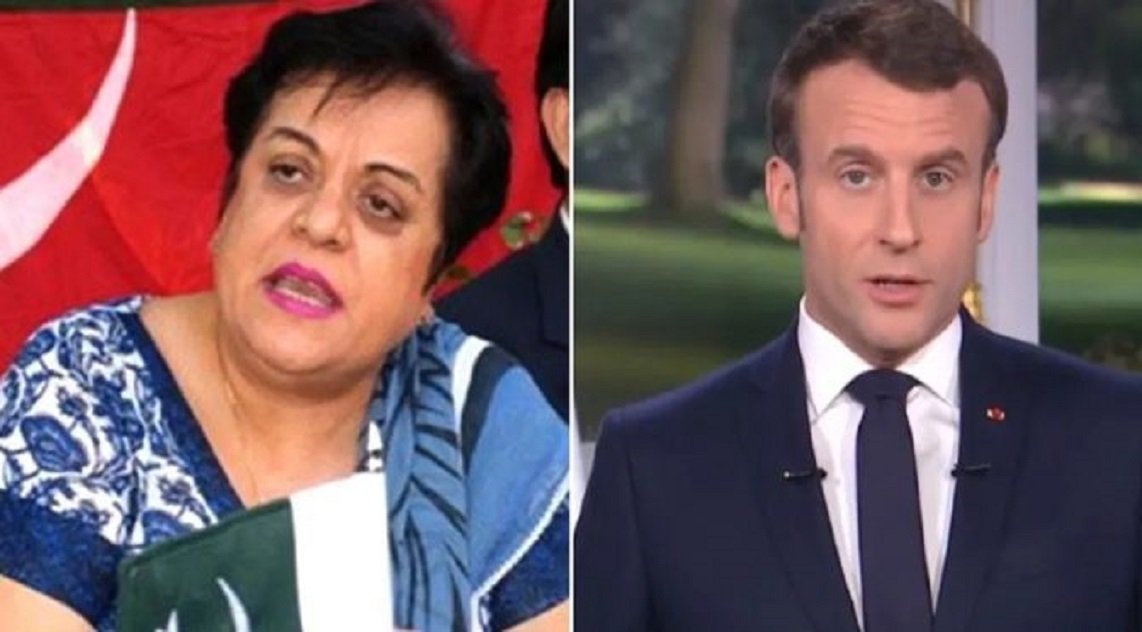
    France on Sunday objected to a statement by Minister for Human Rights Shireen Mazari equating President Emmanuel Macron’s new measures to counter “Islamist separatism” in France with the anti-semitic policies of Nazi Germany, however, the issue was later resolved when both sides held dialogue after a false claim in the cited news article came to light.

    Earlier this week, Macron issued a “charter of republican values”, detailing a series of steps aimed at purging France of what he declared as “radical Islam”. One of the measures made it necessary for school-going children to wear an identification number that would be used to ensure they are attending school.

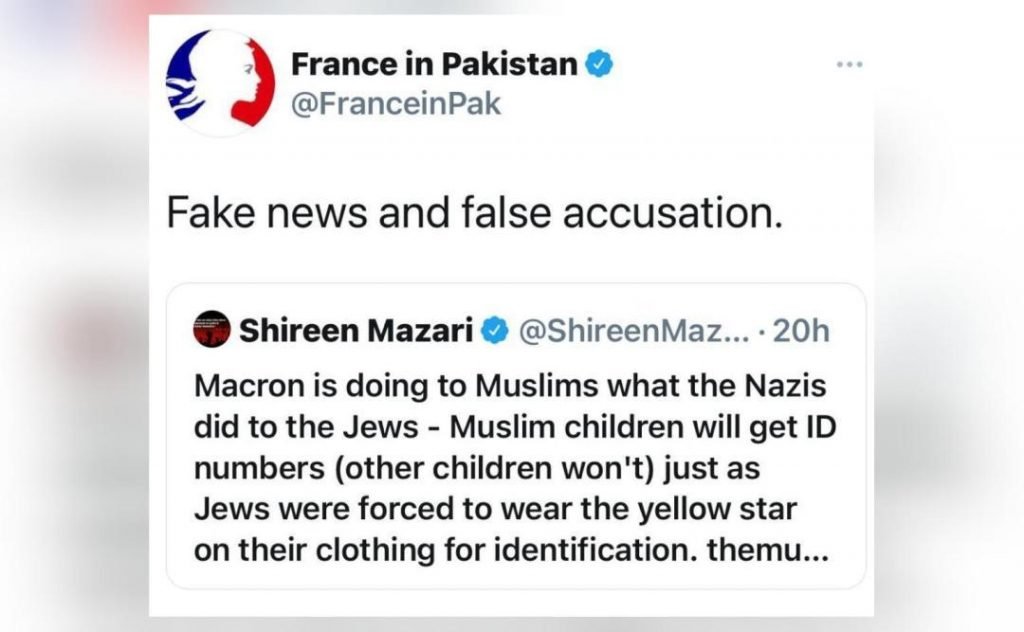
    Mazari, who apparently understood that the identification number would be issued exclusively to Muslim children, censured the move, saying through the new measures, “Macron is doing to Muslims what the Nazis did to the Jews” in Nazi Germany.

    “Muslim children will get ID numbers (other children won’t) just as Jews were forced to wear the yellow star on their clothing for identification,” she added linking to an online article.

    Responding to the tweet, the French Ministry of Europe and Foreign Affairs on Sunday issued a statement, calling the minister’s remark “insulting […] blatant lies, loaded with an ideology of hatred and violence.”

    The rather unceremonious statement asked Pakistan to “return to the path of dialogue based on respect.”

    The publication later amended the article and issued a clarification stating that the law mentioned in the article applies to all children in France, not specifically Muslim children.

    The embassy also sent a series of tweets to point out the mistakes in the article.

    In response to the French envoy’s message, Mazari deleted her tweet and issued a clarification on Twitter and admitted her mistake. “The French Envoy to Pak sent me the following message and as the article I had cited has been corrected by the relevant publication, I have also deleted my tweet on the same,” she tweeted.

    Responding to the minister’s tweet, the French Embassy thanked Mazari for the clarification and apology, and wrote that “freedom of expression and debates are essential in democracies, based on verified and accurate facts.”

    READ: ‘Stay out of our domestic affairs,’ French minister tells Pakistan and Turkey

    Macron on Wednesday unveiled the bill and asked Muslim leaders in France to agree to its instructions as part of a broad clampdown on so-called “Islamic extremism”. He gave the French Council of the Muslim Faith 15 days to work with the interior ministry.

    The bill includes measures which include: restrictions on home-schooling and harsher punishments for those who intimidate public officials on religious grounds; giving children an identification number under the law that would be used to ensure they are attending school and a ban on sharing the personal information of a person in a way that allows them to be located by people who want to harm them.

    Parents who break the law could face up to six months in jail as well as large fines, it said.

    The draft law — which Macron said will strengthen a 1905 law separating Church and state in France — will be discussed by the French cabinet on December 9.

    The new bill comes on the heels of three separate instances of terrorism following the publication of blasphemous caricatures by Charlie Hebdo, a French satirical weekly best known for vulgar irreverence, and Macron’s insistence on defending the act in the name of freedom of expression.

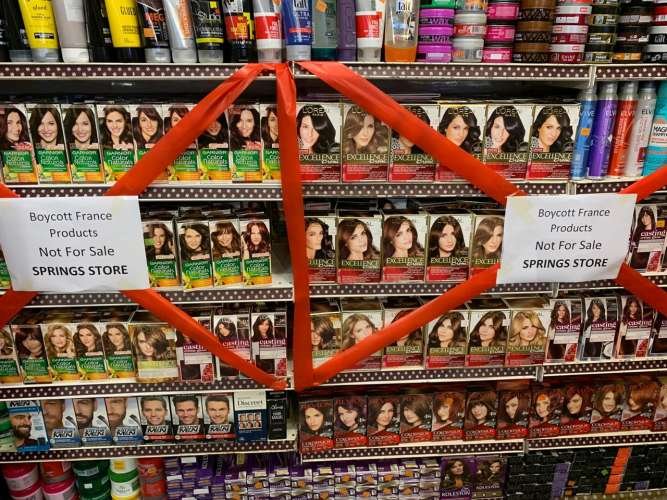
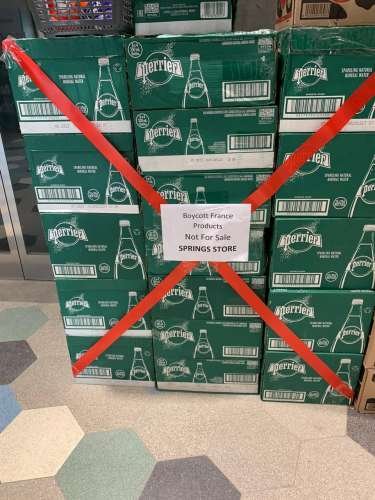
    Following the publication of these cartoons and Macron’s defense of it, relations between France and the Muslim world grew sour as tens of thousands of Muslims in several countries joined protests, burned effigies of Macron, chanted anti-French slogans and called for a boycott of French goods.

  • Will boycotting French products make a difference?

    Will boycotting French products make a difference?

    French President Emmanuel Macron’s recent controversial statements about Islam and his stance regarding the continued publication of blasphemous caricatures of The Holy Prophet’s (PBUH) served as a source of bitter disappointment for the Muslim community worldwide. Citizens of several Muslim countries publicly called for an official boycott of French products to demonstrate their opposition against Macron’s insensitive actions. Pakistanis are no different.

    While every Muslim country is contributing a unique weightage of resistance, here are five interesting facts about #BoycottFrenchProducts’ increased momentum which may motivate us to appreciate and self-assess ourselves as Pakistanis:

    1. Pakistani Market accounts for 0.08% of France’s exports only

    While the attempt to boycott a country’s products to get our disapproval across is plausible, unfortunately, this protest in the Pakistani context is merely symbolic. The power to ‘actually’ influence world politics cannot be achieved without economic stability. We do not want to sound like Donald Trump here but, for the sake of national integrity, the Ministry of Finance and our Industrial Sector needs to really “do more”.

    2. Sephora has been accused of racially discriminating against Asians

    Many Facebook groups are asking women in Pakistan to boycott the international giant makeup retailer, Sephora and not to order makeup from the popular chain. Sephora was founded by a French entrepreneur, Dominique Mandonnaud, and has its headquarters based in Paris, France. In 2014, customers filed a lawsuit against the retailer for engagement in racial discrimination against Asians.

    3. Divide and rule?

    Not long ago, to condemn Macron’s derogatory remarks about Islam, Prime Minister Imran Khan tweeted that President’s comments seem “to deliberately provoke Muslims, including own [France’s] citizens” to which a French minister responded by telling Khan to stay out of France’s domestic affairs. On 3rd November, renowned French news media outlets like France24 released a news piece titled, “Several French Muslim leaders on Monday condemned calls for boycotts of French goods in Muslim countries as unjustified and accused those leading the charge of using Islam for political gain”. The statement has been released on behalf of the leaders of the Great Mosques of Paris, Lyon and the French Mediterranean island of Reunion and three main Muslim groups of the country. The sole purpose of this boycott is to protect the sentiments of a ‘unified’ Muslim community throughout the world; however, French media says otherwise. Divide and rule?

    4. LU is not French

    Netizens, leave LU out of this! While social media posts calling out for the boycott of LU biscuits went viral, a BBC report verified that our very Pakistani Continental biscuits Limited (CBL) is in fact a joint venture with an American company called Mondelez. LU was initially registered under a French trademark but was bought by the American Company a while later. So, let bygones be bygones.

    4. Taking a stand

    Pakistanis have never shied away from risking anything to stand with their fellow Muslims worldwide. An interesting example of this can be our ever-favorite apparel brand. Back in 2011, Gul Ahmed received an award from the French Ambassador Daniel Jouanneau for being the largest exporter to France in Home Textile category. Despite reporting an annual loss of 625 million due to Covid-19 induced lockdown in the fiscal year of 2019-2020, Gul Ahmad did not condemn the boycott. The company seems to have risked its financial position in case France decides to reciprocate the ban due to the deteriorating relations between the two countries. Putting communal interests over business is a commendable gesture indeed.   

  • ‘Stay out of our domestic affairs,’ French minister tells Pakistan and Turkey

    Turkey and Pakistan should not meddle in France’s domestic affairs, Interior Minister Gerald Darmanin has said after Turkish President Tayyip Erdogan and Prime Minister (PM) Imran Khan denounced French President Emmanuel Macron’s “anti-Islam” agenda and called for a boycott of French goods.

    The comments from Erdogan and Imran were the latest expression of anger in the Muslim world over blasphemous images being displayed in France of the Holy Prophet (Peace Be Upon Him).

    Erdogan, in his statement, also questioned Macron’s mental health, prompting Paris to recall its ambassador in Ankara.

    Joining Erdogan, Imran also denounced Macron’s remarks on the publication of caricatures, calling them “encouragement of Islamophobia”.

    “By attacking Islam, clearly without having any understanding of it, President Macron has attacked and hurt the sentiments of millions of Muslims in Europe and across the world,” the premier had said.

    “It should shock each one of us that foreign powers are meddling with what is going on in France,” Darmanin told France Inter radio earlier this week, adding he was referring to Turkey and Pakistan, where parliament passed a resolution urging the government to recall its ambassador from Paris.

    The National Assembly (NA) on Monday unanimously passed a resolution condemning the caricatures and the “resurgence of Islamophobic acts” in some countries.

    “Turkey should not meddle with France’s domestic affairs,” Darmanin added.

    The row has its roots in a knife attack outside a French school on October 16 in which a man of Chechen origin beheaded Samuel Paty, a teacher who had shown pupils blasphemous caricatures of Holy Prophet (Peace Be Upon Him) in a civics lesson on freedom of speech.

    Macron, who met representatives of France’s Muslim community on Monday, has pledged to fight “Islamist separatism”, saying it was threatening to “take over” some Muslim communities in France.

  • VIDEO: Egg on French president’s face over Islam remarks?

    French President Emmanuel Macron has come under criticism over his remarks on Islam after a teacher was beheaded on the streets of Paris allegedly for showing blasphemous cartoons to students.

    Amid this, a video of Macron having an egg thrown at his face as he is in conversation with some people is circulating on social media.

    WATCH VIDEO:

    The claim along with the video says Macron was attacked for his remarks on Prophet Mohammad (PBUH) and Islam, which have led to calls for a boycott of French products across the Muslim world.

    The Current has found the claim along with the video to be misleading. The video was shot in March 2017 in Paris days before the presidential elections in France, when Macron was a candidate for the top post.

    Using related keywords, we found some media reports carrying a similar video of the event, shot from a different angle.

    A report by Express says Macron was attacked by a protester with an egg when he was attending an agriculture show in Paris in March 2017.

    This was not the first time when Macron was egged. In 2016 too, an angry mob pelted eggs on Macron in Paris.

    So, it has been established that the video is more than three years old and has nothing to with Macron’s recent remarks on Islam.

    ‘WON’T GIVE INTO ISLAMIC RADICALS’:

    On Sunday, Macron tweeted, “We will not give in, ever to Islamic radicals.”

    “We do not accept hate speech and defend reasonable debate,” the French leader added.

    Calls to boycott French goods are already growing in the Arab world and beyond after Macron criticised Islamists and vowed not to “give up cartoons” depicting the Holy Prophet (PBUH).

    Macron’s initial comments, on Wednesday, had come in response to the beheading of a teacher, Samuel Paty, outside his school in a suburb outside Paris earlier this month, after he had shown the blasphemous cartoons during a class he was leading on free speech.

    With the French president pledging to fight “Islamist separatism”, which he said was threatening to take control in some Muslim communities around France, hashtags such as the #BoycottFrenchProducts in English and the Arabic #ExceptGodsMessenger trended across countries, including Pakistan, Kuwait, Qatar, Palestine, Egypt, Algeria, Jordan, Saudi Arabia and Turkey.

  • France urges Muslims to stop boycott of French products over blasphemous cartoons

    France has urged Arab countries to stop calls for boycotts of French products, while President Emmanuel Macron vowed the country would never give in to “Islamic radicals”.

    The French Foreign Affairs Ministry said in a statement released on Sunday that in recent days there had been calls to boycott French products, notably food products, in several Middle Eastern countries as well as calls for demonstrations against France over the publication of satirical cartoons of Prophet Muhammad (PBUH).

    “These calls for boycott are baseless and should stop immediately, as well as all attacks against our country, which are being pushed by a radical minority,” the statement said.

    On Sunday, Macron tweeted, “We will not give in, ever to Islamic radicals.”

    “We do not accept hate speech and defend reasonable debate,” the French leader added.

    Calls to boycott French goods are already growing in the Arab world and beyond after Macron criticised Islamists and vowed not to “give up cartoons” depicting the Holy Prophet (PBUH).

    Macron’s initial comments, on Wednesday, had come in response to the beheading of a teacher, Samuel Paty, outside his school in a suburb outside Paris earlier this month, after he had shown the blasphemous cartoons during a class he was leading on free speech.

    With the French president pledging to fight “Islamist separatism”, which he said was threatening to take control in some Muslim communities around France, hashtags such as the #BoycottFrenchProducts in English and the Arabic #ExceptGodsMessenger trended across countries, including Pakistan, Kuwait, Qatar, Palestine, Egypt, Algeria, Jordan, Saudi Arabia and Turkey.

  • French president refuses to condemn blasphemous caricatures of Holy Prophet (PBUH)

    French President Emmanuel Macron has defended the decision by Charlie Hebdo magazine to re-publish blasphemous caricatures of Prophet Muhammad (PBUH), saying “we have freedom of expression and freedom of belief”.

    But Macron, speaking on a visit to Lebanon on Tuesday, said it was incumbent on French citizens to show civility and respect for each other, and avoid a “dialogue of hate”.

    “It’s never the place of a president to pass judgment on the editorial choice of a journalist or newsroom, never. Because we have freedom of the press,” Macron said.

    The infamous French magazine is republishing the offensive caricatures, which unleashed a wave of anger in the Muslim world, to mark the start of the trial of alleged accomplices in the militant attack against it in 2015.

    Most cartoons were first published by a Danish newspaper in 2005 and then by Charlie Hebdo a year later.

    “We will never lie down. We will never give up,” Editor Laurent Sourisseau wrote in a piece to accompany the front cover that will be published in print on Wednesday.

    Twelve people, including some of the magazine’s cartoonists, were killed when Said and Cherif Kouachi stormed the Paris offices of Charlie Hebdo and sprayed the building with automatic gunfire.

    The Kouachi brothers and a third gunman who killed five people in the 48 hours that followed the Charlie Hebdo massacre were shot dead by police in different stand-offs, but 14 of their alleged accomplices go on trial on Wednesday.

    The decision to republish the offensive cartoons will be seen by some as a defiant gesture in defence of free expression.

    But others may see it as a renewed provocation by a magazine that has long courted controversy with its satirical attacks on religion.

    After the 2006 publication of the cartoons, people online warned the weekly would pay for its mockery. For Muslims, any depiction of the Holy Prophet (PBUH) is blasphemous.