Tag: funds

  • PKR loses for 6th straight session due to declining reserves

    PKR loses for 6th straight session due to declining reserves

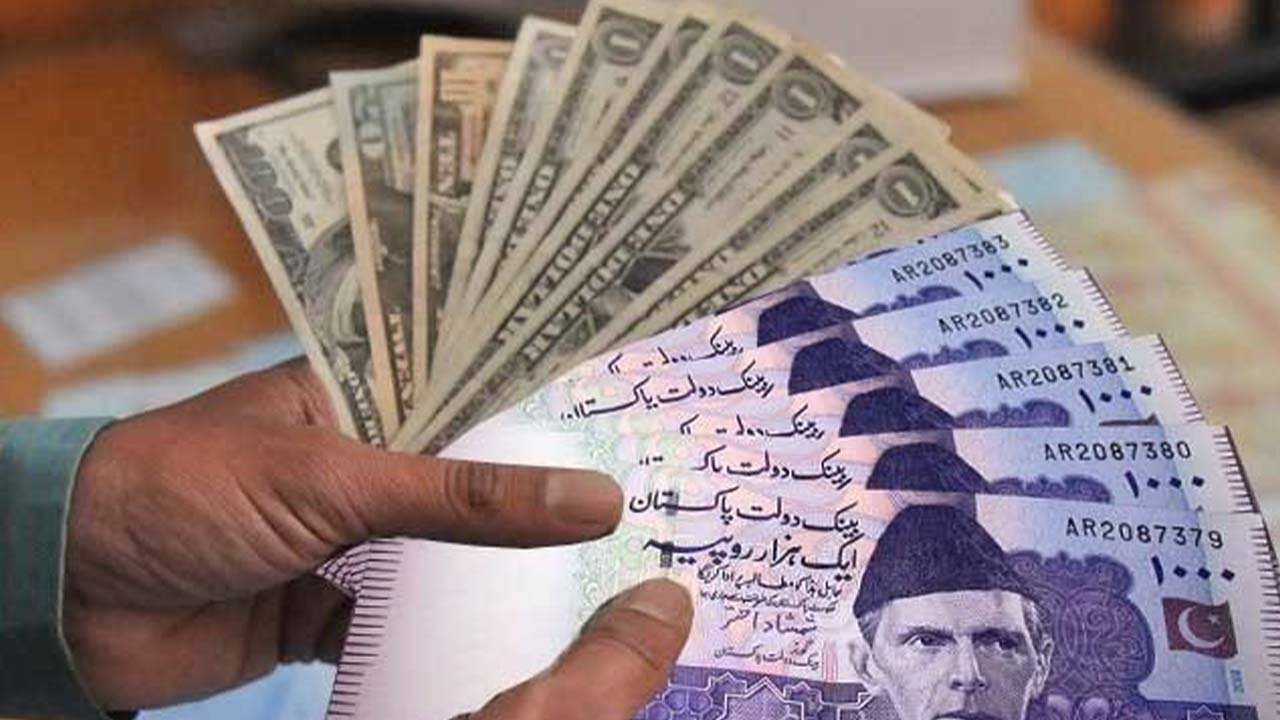
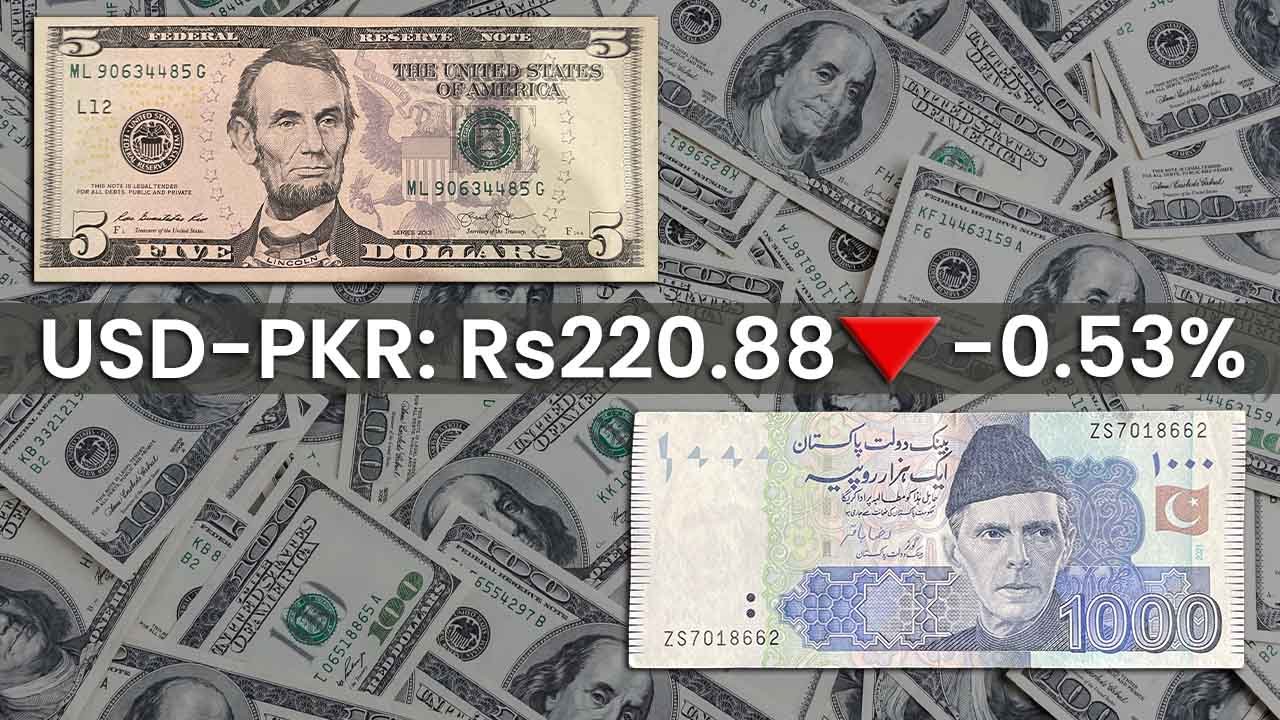
    The Pakistani rupee dropped against the US dollar for the sixth straight session on Wednesday, losing 0.53 per cent in the inter-bank market.

    According to the State Bank of Pakistan (SBP), the local currency dropped by Rs1.17, or 0.53 per cent, to close at Rs220.88. In the last six trading sessions, the rupee has lost Rs3.09, or 1.4 per cent, of its value overall.

    The rupee lost value against the US dollar on Tuesday for the fifth consecutive session, closing at Rs219.71 after losing Rs0.82 (0.37 per cent).

    According to market analysts, the local currency’s weakness is caused by declining reserves and a lack of evidence of foreign capital inflows.

    In an interview with Bloomberg, Finance Minister Ishaq Dar said that the rupee has been “heavily undervalued”.

    “It is due to speculation – and some players in the market have been responsible for that,” he added.

    Globally, the greenback hung close to a 32-year peak versus the yen on Wednesday while edging up from a two-week trough against a basket of major peers as traders weighed improved risk sentiment against the prospect of aggressive Federal Reserve rate hikes.

    The dollar index – which measures the currency against six peers including the yen, sterling and euro – edged up to Rs112.01, after dropping to the lowest since October 6 at Rs111.76 overnight.

    On Wednesday, oil prices increased marginally despite bearish factors like unclear Chinese demand growth and falling gas costs, which were offset by bullish factors like declining crude stocks and a generally undersupplied market.

  • FIA books Imran Khan and others in ‘prohibited funding’ case

    FIA books Imran Khan and others in ‘prohibited funding’ case

    The Federal Investigation Agency (FIA) has booked Pakistan Tehreek-e-Insaf (PTI) Chairman Imran Khan and other party leaders in a case pertaining to their party allegedly receiving prohibited funding.

    The case was filed by the state through FIA’s Corporate Banking Circle in Islamabad.

    In the First Information Report (FIR), the federal agency alleged that Abraaj Group transferred $2,100,000 to PTI account. In addition, the FIR states that the party received more financing from two bank accounts of Wotan Cricket Club.

    The complaint named Imran Khan, Sardar Azhar Tariq Khan, Saifullah Khan Nyazee, Syed Yunus Ali Raza, Aamer Mehmood Kiani, Tariq Rahim Sheikh, Tariq Shafi, Faisal Maqbool Shaikh, Hamid Zaman and Manzoor Ahmad Chaudhary as signatories/beneficiaries of the PTI account in question.

    The FIR alleged the branch’s operations manager had also failed to report these illegal transactions to the concerned authorities.

    In August, the ECP issued its verdict in the prohibited funding case — previously referred to as the foreign funding case — against the PTI, which stated that the party did indeed receive prohibited funding.

    The ECP said that the party, in violation of the Constitution, had received funds from 34 foreign entities. The party received funds from the United States, Australia, and the UAE. The ECP added that 13 unidentified accounts also surfaced during the probe in the PTI funding case.

  • IMF board approves disbursement of $1.17 billion in bailout funds

    IMF board approves disbursement of $1.17 billion in bailout funds

    The seventh and eighth reviews of Pakistan’s bailout programme were approved by the International Monetary Fund (IMF) board on Monday, releasing $1.17 billion to the cash-strapped nation.

    Pakistan is now set to get a $1.17 billion loan tranche from the international lender within the next six days.

    “Alhamdolillah, the IMF board has approved the revival of our EFF programme. We should now be getting the seventh and eighth tranche of $1.17 billion,” said Finance Minister Miftah Ismail in a tweet announcing the news.

    Additionally, the Finance Minister praised the Prime Minister, Shehbaz Sharif, “for taking so many tough decisions and saving Pakistan from default.”

    The previous payment was made to Pakistan in February, and the subsequent tranche was scheduled to be released following a review in March.

    However, the PTI government drastically reduced petroleum prices by providing substantial subsidies to the country, which caused the program’s fiscal objectives to be missed.

  • Another friendly country to confirm assurance this week: Miftah Ismail

    Another friendly country to confirm assurance this week: Miftah Ismail

    According to Pakistan’s Finance Minister Miftah Ismail, “one friendly country” has confirmed its commitment to assist Pakistan in filling the funding gap, while another nation would confirm its assurance in a day or two.

    An announcement will be made soon on this subject after confirmation.

    Earlier, the International Monetary Fund (IMF) said that Pakistan has completed the final prior action for the combined seventh and eighth reviews with the increase in the petroleum development levy (PDL).

    The IMF also stated that the board meeting is tentatively scheduled for late August once adequate financing assurances are confirmed.

    In order to prevent Pakistan from having a liquidity vacuum following the IMF loan, the international lender wants to make sure Pakistan will be able to get $4 billion in additional cash.

    The country has a $4 billion finance imbalance, according to Miftah, and the IMF wants our reserves to grow by $6 billion.

    Pakistan is in touch with friendly nations to cover the gap, and one of them has already reaffirmed its assurance. Within a day or two, the other nation will confirm as well.

    The assurances would be announced in advance of the IMF board meeting, which is slated to take place in the last week of August. According to reports, the IMF would announce the disbursement for Pakistan as soon as sufficient finance assurances are verified.

    The import bill has decreased to $4.92 billion, according to the minister. Due to this, there is now more cash coming in than going out. The market attitude has improved as a result of this.

    He believed that the Pakistani rupee had grown significantly versus the US dollar and would continue to do so.

    The Pakistani rupee made a significant recovery on Wednesday, recording its largest day-over-day gain in absolute terms against the US dollar to settle at Rs228.8, up Rs9.58 or 4.19 per cent in the inter-bank market. In the early hours of Thursday, trade, the rupee kept rising.

    On Thursday, stocks extended their gains, with analysts blaming the strong recovery of the rupee and soaring global equities for the optimistic trend.

    Read more: Dollar may drop near Rs180 after IMF tranche

    The benchmark KSE-100 index increased 356.50 points or 0.87 per cent to settle at 41,425.37 points, according to the Pakistan Stock Exchange (PSX).

    After being battered for weeks due to political and economic unrest, the local currency recovered by Rs9.59 on Wednesday, marking the highest one-day rise in decades.

  • Pakistan, IMF reach staff-level agreement to resume loan

    Pakistan, IMF reach staff-level agreement to resume loan

    The International Monetary Fund (IMF) extended the total loan size to $7 billion on Thursday and announced a staff-level agreement on the completion of two unfinished programme assessments, but cautioned Pakistan to be prepared to take any extra measures.

    “The IMF team has reached a staff-level agreement (SLA) with the Pakistan authorities for the conclusion of the combined seventh and eighth reviews of the EFF-supported program. The agreement is subject to approval by the IMF’s Executive Board. Subject to Board approval, about $1,177 million (SDR 894 million) will become available, bringing total disbursements under the program to about $4.2 billion,” IMF said in a statement.

    The statement added, “Additionally, in order to support program implementation and meet the higher financing needs in FY23, as well as catalyze additional financing, the IMF Board will consider an extension of the EFF until end-June 2023 and an augmentation of access by SDR 720 million that will bring the total access under the EFF to about $7 billion.”

    IMF team leader Nathan Porter noted in a statement “Pakistan is at a challenging economic juncture. A difficult external environment combined with procyclical domestic policies fueled domestic demand to unsustainable levels.”

    According to him, the ensuing economic overheating reduced reserve buffers, increased inflation, and resulted in significant fiscal and external deficits in FY22.

    The statement continued, “Policy priorities include the consistent implementation of the FY23 budget, which aims to reduce the government’s significant borrowing needs by targeting an underlying primary surplus of 0.4 per cent of GDP, underpinned by current spending restraint and extensive revenue mobilisation efforts targeted particularly at higher-income taxpayees.”

    According to Express Tribune, the international lender claimed that due to poor implementation of the previously agreed upon plan, the circular debt (CD) flow in the power sector is predicted to increase significantly to about Rs850 billion in FY22, exceeding programme targets, endangering the viability of the sector, and resulting in frequent power outages.

    To improve the situation in the electricity sector and reduce load shedding, the authorities are committed to resuming reforms, which crucially include the timely adjustment of the power tariff, including the delayed yearly rebasing and quarterly adjustments.

    According to the IMF, Pakistan’s headline inflation rate hit 20 per cent in June, impacting the most vulnerable people the most. The recent monetary policy boost was reasonable and necessary in this regard, and future monetary policy must be designed to ensure that inflation is slowly brought down to the medium-term goal of 5-7 per cent.

    “Importantly, to enhance monetary policy transmission, the rates of the two major refinancing schemes EFS and LTFF (which have over recent months been raised by 700 bps and 500 bps respectively) will continue to be linked to the policy rate. Greater exchange rate flexibility will help cushion activity and rebuild reserves to more prudent levels,” it added.

    The unconditional cash transfer (UCT) Kafalat scheme reached nearly 8 million households during FY22, with a permanent increase in the stipend to Rs14,000 per family, while a one-time cash transfer of Rs2,000 (Sasta Fuel Sasta Diesel, SFSD) was made to approximately 8.6 million families to lessen the effects of the inflationary crisis.

    The government has increased the BISP budget for FY23 from Rs250 billion to Rs364 billion in order to expand the SFSD programme to more non-BISP, lower-middle class beneficiaries and to accommodate 9 million extra families into the BISP safety net.

    The statement further stated that in order to maintain the effectiveness of the anti-corruption agencies (including the National Accountability Bureau) in investigating and prosecuting corruption cases, the authorities are putting in place a strong electronic asset declaration system.

    According to the SLA for the combined seventh and eighth reviews, consistent execution of the defined policies will support the development of growth that is more equitable and sustainable.

    “The authorities should nonetheless stand ready to take any additional measures necessary to meet program objectives, given the elevated uncertainty in the global economy and financial markets,” the statement concluded.
  • Punjab’s ePay system collects over Rs90 billion tax revenue through 17 million transactions

    Punjab’s ePay system collects over Rs90 billion tax revenue through 17 million transactions

    Since its launch in October 2019, e-Pay Punjab, an online payment solution developed by the Punjab Information Technology Board (PITB) and the Punjab Finance Department, has collected over Rs90 billion in tax revenue through 17 million transactions.

    As per details released by the PITB on Friday, e-Pay Punjab has collected a total of Rs57 billion in sales tax, Rs11.5 billion in token tax, Rs9 billion in property tax, Rs4 billion in traffic challans, and Rs440 million in vehicle transfers.

    It’s worth noting that e-Pay Punjab now accepts online payments for 23 taxes and levies from ten different departments. Its 1-Link network integration with the State Bank of Pakistan (SBP) and all scheduled banks makes it a secure and dependable payment channel.

    The e-Pay Punjab application, which has over 1 million downloads, generates a unique PSID number that is accepted by banks across Pakistan through their various channels, including Internet and Mobile Banking, ATMs, and physical branch visits.

    It is also a secure, smart, and fast online payment option for the annual Token Tax. Vehicle owners can use e-Pay Punjab to pay their Token Tax from the comfort of their own homes.

    The app’s primary objective is to make it convenient for the government to gather revenue in the form of taxes through a simple solution. With Pakistan’s first digital tax aggregator, the app demonstrates how Pakistan and its government are rapidly integrating financial technology (fintech) into their processes.

  • Pakistani rupee reaches a new all-time low of Rs190 against the US dollar

    Pakistani rupee reaches a new all-time low of Rs190 against the US dollar

    In the interbank market on May 11, the US dollar soared to an all-time high against the Pakistani rupee (PKR), reaching Rs190.10.

    In the morning. the local currency was trading at Rs189.89 to Rs190.04, with deals reported at Rs190.

    The dollar gained Rs1.44, surpassing the prior day’s finish of Rs188.66. The greenback touched an all-time high on May 11, when it surpassed the Rs189 level.

    It had gone down in the immediate aftermath of the April 11 change of government, but the adjustment soon ran out of steam, and the greenback is now flying again, hitting a new all-time high.

    Read more: CNG prices pushed to Rs140 per kg for sales tax collection

    Experts say the rupee is under pressure because of increased oil import bills and speculation about the Saudi package. Foreign reserves were also under strain due to delays in talks with the International Monetary Fund.

  • PKR continues losing streak against US dollar, sheds Rs1.48

    PKR continues losing streak against US dollar, sheds Rs1.48

    The Pakistani currency plummeted further against the US Dollar (USD) on April 20, with losses reported on the interbank exchange. At the completion of today’s session, the Pakistani rupee (PKR) lost Rs1.48 versus the US dollar.

    It declined by 0.80 per cent versus the greenback, closing at Rs185.92, after shedding Rs1.90 in the interbank market on Tuesday, April 19th, and concluding at Rs184.44. During today’s open market session, the Indian rupee (INR) fell to an intraday low of Rs185.95 over the US dollar.

    The local currency weakened against the dollar as businesses remained under pressure amid the ongoing dialogue between Pakistan and the International Monetary Fund (IMF). The Pakistani government is likely to undertake certain difficult and problematic steps in order to revive the local economy.

    Read more: PKR declines against US Dollar after winning for a week

    Oil prices rallied following steep losses the previous day as concerns about tighter supply from Russia and Libya arose, although industry data showed a decline in US crude inventories in the previous week.

  • Pakistan to import 32.7 million barrels of oil to cover petroleum needs

    Under a deferred payment agreement with the Saudi Fund for Development (SFD), Pakistan would acquire roughly 32.7 million barrels (MBL) of crude oil in 2022 to cover its petroleum product needs.

    The Pak-Arab Refinery Company Limited (PARCO) and National Refinery Limited (NRL) plan to import 16.89 and 15.81 million barrels of oil in the ongoing year, respectively.

    Crude oil worth $100 million per month may be imported under the terms of the arrangement, with payment deferred for a year. The price will be set in accordance with the existing long-term agreement between Saudi Aramco, PARCO, and NRL.

    The facility will be available for a 12-month period, which may be increased for one year. The withdrawn funds, plus the margin of 3.8 per cent, will be repaid in one annual installment in US dollars.

    Previously, In June 2021, the Saudi government agreed to pay $4.2 billion in providing economic aid to Pakistan, which was legally formalised in November. While the SFD programme has been in effect since March 7, 2022, and oil purchase has now already begun.

  • Pakistan’s exports grew 25% in the last nine months

    Pakistan’s exports increased by 17.3 per cent in March 2021 to $2.773 billion, up from $2.365 billion in March 2021 and 25 per cent in the last nine months.

    The Prime Minister’s Adviser on Commerce and Investment, Abdul Razak Dawood, said that exports increased by 25 per cent to $23.332 billion in the July-March fiscal year 2021-2022, compared to $18.688 billion in the same period last year, implying a $4.644 billion upsurge.

    On the other hand, according to preliminary data from the Pakistan Bureau of Statistics (PBS), exports fell 2 per cent on a month-on-month (MoM) basis to $2.77 billion in March 2022, down from $2.82 billion in February 2022.

    Dawood said in a tweet, “We are glad to share that Pakistan’s exports for Mar-2022 grew by 17.3 per cent to $2.773 billion as compared to $2.365 billion Mar-2021. For Jul-Mar 2022, our exports grew by 25 per cent to $23.332 billion as compared to $18.688 billion in Jul-Mar 2021. This is an increase $4.644 billion”.

    While talking about the target for exports he added that “We expect to achieve our yearly target. The import figures would be shared when finalised by the PBS. We would like to congratulate our exporters for maintaining the momentum of exports under these testing times in the global market”.

    Pakistan’s current account deficit (CAD) decreased by 78.46 per cent to $545 million in February from $2.531 billion in January, owing primarily to a steep drop in imports.

    Read more: FBR records 29.1% growth during July 2021 to March 2022, despite providing ‘massive tax relief’

    Surprisingly, the CAD crossed the $12 billion level in the first eight months of FY22, showing no signs of improvement in the external account. The CAD was only $34 million in February 2021.